
After the Fire
What happens to the forest after unprecedented wildfires rip through Cree territory?
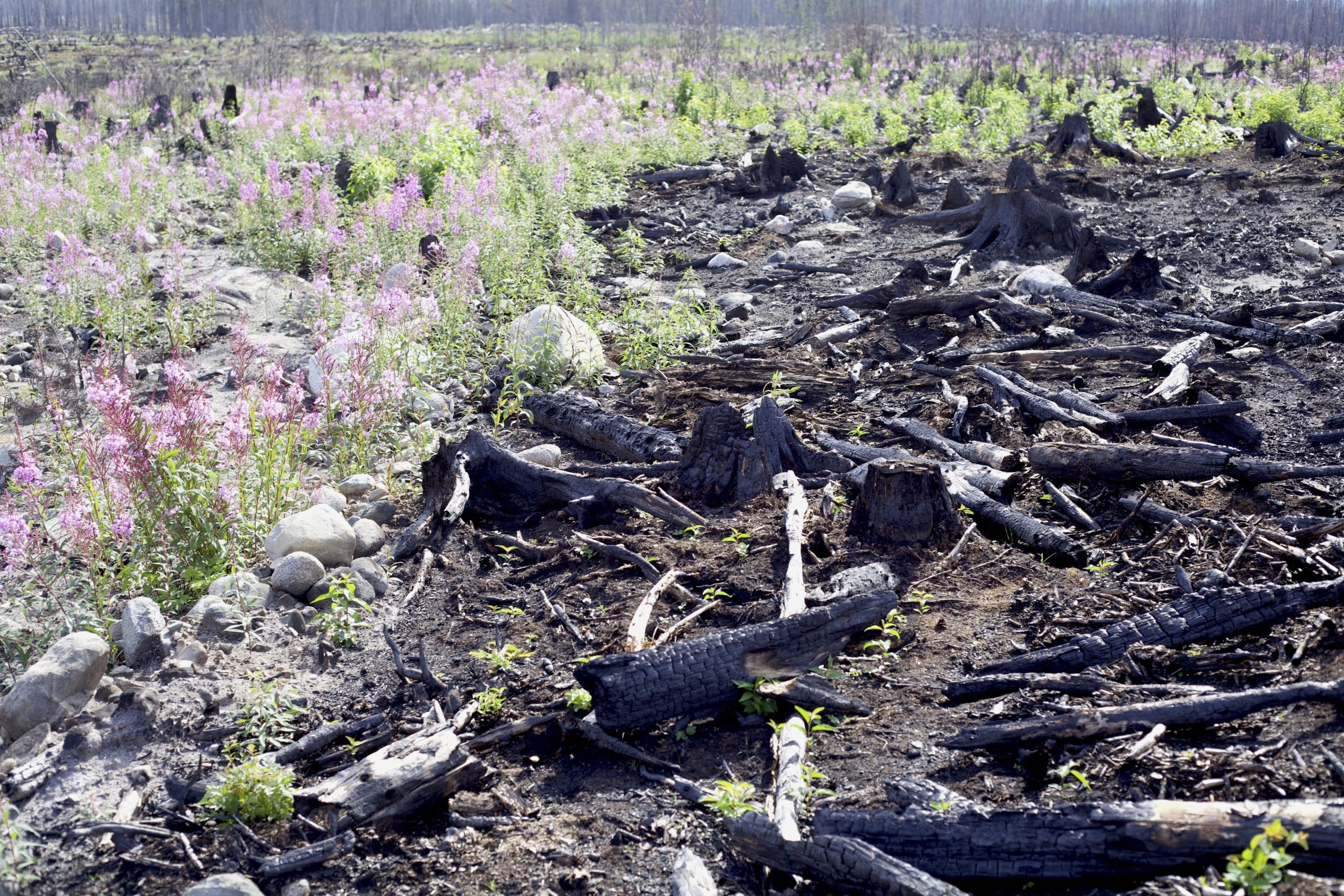
The first to arrive after a forest fire are the longhorn beetles.
Often referred to as pine beetles, these wood-boring insects travel dozens of kilometres to feast on burnt wood at the first scent of char. The longhorn’s larvae begin as eggs laid beneath the bark, then burrow long tunnels into the trunks and feed for two years before they emerge to find fresh conifer twigs. The infestations are quick, and the phantom sound of chomping wood is already starting to haunt forestry companies in Quebec.
“Many people are worried about this tiny bug and what it can do to harm the burnt trees. As for me, it’s the least of my concerns,” said Allan Saganash, a consultant on the forestry file for the Cree First Nation of Waswanipi. “I am a Cree hunter and trapper that is connected to the forest and wildlife. I am more concerned (with) what we have lost to these massive forest fires.”
Wildfires in northern Quebec began in the spring, the worst of which was burning out of control in June and July. Over 500 fires raged across Quebec this year, ripping through 1.5 million hectares of forest, a majority of which in Eeyou Istchee, Cree territory.
It made life untenable for many Cree Nation communities, forcing those in Waswanipi, Mistissini, Oujé-Bougoumou, Eastmain, Nemaska, Waskaganish and Wemindji to evacuate. Some communities evacuated several times, including Waswanipi, which had two evacuation orders.
With few resources and other provinces fighting their own forest fires, Quebec sought help from South Korea, France and the United States among others. By July, thousands of international firefighters arrived in provinces across Canada in an effort to contain the worst wildfire season in the last 40 years. The worst of the fire season appears to be behind Quebec, though on Wednesday, 11 active fires were reported by the Société de protection des forêts contre le feu (SOPFEU).
After firefighters have gone, forestry companies descend. They’re the next to arrive, in many cases even before the Cree. The loggers are in a race against nature. Beneath the burnt bark is viable wood for market, so long as they beat longhorn beetles and other insects before they permanently damage otherwise salvageable crops. In Waswanipi, consultations with loggers have already begun, and plans to salvage what’s left of the trees are well underway.
Pine trees, which are favoured by the construction industry, now line mass areas of the boreal forest. Saganash and other Indigenous experts say they’re making the forest more flammable than ever before, and fear that the unprecedented spread of fire in what was once a natural environmental occurrence will be the new normal.

In the aftermath of the devastation, there are new worries. While the ecological impacts of the fires are under assessment, experts brace for its effects on Eeyou Pimatseewin, or the Cree way of life.
“I’m worried about spring and what could possibly come,” said Chief Irene Neeposh of the Cree First Nation of Waswanipi. “We have no clue what we’re going to be left with, how long this cycle will be in terms of where the animals will flee to and when they are coming back.”
“I’m really paying attention to the wisdom of the elders to see what they’re sharing,” Neeposh said. “And they’re sharing with little confidence because they’ve never seen anything like it.”
—
Eliane Grant worries about the wildlife too.
“Now the big problem is a lot of forest (has been) burnt,” said Grant, a Cree biologist who worked for nearly five years for the Cree First Nation of Waswanipi. “The big game are able to travel far distances, so they could move away from the fire, or come back later, or find new habitats. But there isn’t a lot left, so they all have to go to the same space, to smaller habitats. So they’ll congregate in small areas, (which) will be more dangerous for predation and hunters.”
Since she was a child, Grant dreamed of becoming a scientist and bridging the field with Indigenous knowledge. The trips she’d taken onto her family’s trapline in the Waswanipi forest fostered her connection with nature at a young age. Grant was fishing on the lake with her father one day when she noticed large swaths of forest around the mountains in her trapline cut.
“At that point, I thought, we should do something,” said Grant, who’s finishing her masters degree at the University of Quebec in Abitibi-Témiscamingue. “I decided to (pursue) my masters degree in ecology, specializing in the wetlands and moose, and the cultural importance of the wetlands for the First Nations in Eeyou Istchee.”
Grant says that the fires have likely brought pressure onto the already threatened moose and caribou populations in Eeyou Istchee, which the Cree have relied on to feed their communities. She fears that the efforts made in recent years to protect big game could be thwarted. In 2021, a rapid decline in moose populations resulted in a moratorium against non-Indigenous moose hunters. And the federal government declared boreal caribou as a threatened species under the 2003 Species At Risk Act, citing forest degradation, loss, or fragmentation as the main threat.
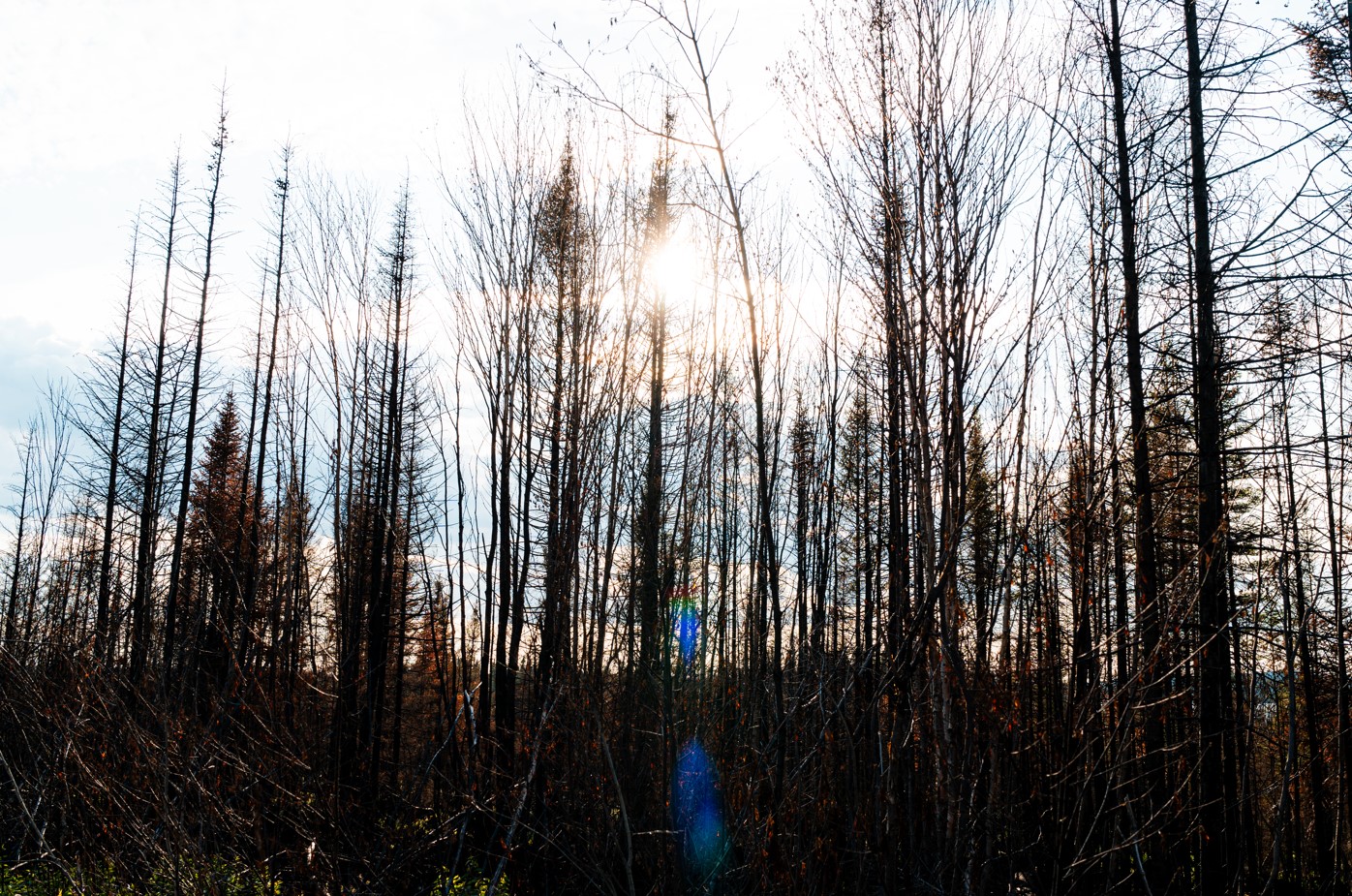
“A lot of the southern part of Eeyou Istchee is burnt,” Grant said, “so my guess is all the wildlife is moving more north towards the caribou areas. That could put more pressure (on) the caribou we are trying to protect.”
She says it’s the reason Crees from Waswanipi stopped hunting caribou more than a decade ago.
In addition to the forest and its wildlife, Grant has concerns about Eeyou Istchee’s waters. Given that the fires took place in late spring, which is the spawning season for fish, water temperatures were likely too hot for most to survive.
And mercury, which is a naturally present element, could also be washing into the waters. Trees and vegetation usually do the important job of keeping mercury and other elements out of the water by absorbing it. Soil scarification only exacerbates the problem, given that the process involves turning topsoil to expose mineral soil beneath. The forest floor is then raked, which creates small streams of water that direct mercury and other minerals into lakes and creeks.
“Mercury is not a problem when it’s dry or on the soil. It’s (a problem) when it gets into the water and it goes into the sediments of the lake, where the small fish eat the bacteria, and there’s bioamplification of mercury in the food chain,” Grant said. “Walleye and pike then end up with more concentration of mercury. But it’s also the fish that Crees like the most.”
The fears that led Grant to pursue ecological research in the first place are still present. Companies that were once mass clear-cutting in Cree forests without consent will now clear out swaths of burnt forest under guidelines set out by the 2002 La Paix des Braves. Clear-cut and scarification in forests also create bumpy landscapes which become more dangerous with snowfall. Over the years, hunters have reported seeing moose with broken legs because they’ve fallen on these areas.
Ultimately, Grant’s biggest concern is the climate crisis and the ways it will continue to threaten the Cree way of life. Global warming has shortened winters and effectively wiped out the early spring season, where snow and ice once took until mid or late May to melt. With faster thawing seasons, the boreal forest floor is dry for longer periods of time. It becomes particularly dangerous with even the smallest spark of fire, which now spreads faster than ever in hotter and drier climates.
“It’s a big disaster for everyone, and for ministry companies it’s a loss of money,” Grant said. “But for the Crees, it’s way worse, because many of them lost everything. They lost their camps, the wildlife, the forest, memories. It’s very difficult for a lot of families.”
A lifetime spent in Waswanipi’s forests and listening to Cree elders taught Grant to trust its lands. It’ll take at least 100 years before burnt forests can once again become hospitable for boreal caribou, but the forest has already begun to regenerate.
“The challenge now is that changes are happening faster, so we need to adapt faster than before,” Grant said. “So it’s not really a loss, but we need to adapt.”
—
Neeposh has seen her community adapt for generations. She says the desire to preserve culture is tied with the land, all of which has changed drastically within her lifetime.
“My grandmother would tell me, ‘I remember when the water used to be sweet.’ Like you would be able to scoop it out of the water and it would be sweet. But now we have to filter our water,” Neeposh said. “So there’s a sense of longing from what they were exposed to what we’re exposed to. It really has evolved and changed over time.”
Like Neeposh, Grant has witnessed striking changes in Eeyou Istchee and felt an urge to protect it. Her research has led her into direct conversations with various government ministries, a responsibility she takes seriously. But she says more importantly, she’s proud to bring Indigenous knowledge into her fieldwork.
“When I sit on committees with the ministry, I always bring Cree knowledge or questions about how and why they’re doing things a certain way,” Grant said. “Because for me, it’s always the tallymen and elders’ knowledge that would come first. So if science says something else — which is pretty rare, because science usually just validates Cree knowledge — but if that happens, I usually follow what the elders are telling us first.”
Neeposh has long echoed the importance of Indigenous science, and the impacts of overdevelopment in Eeyou Istchee.
“I invite the science community to think outside of the box. Give Indigenous knowledge a chance. Because like I said, we’re not making this up. It’s years of experience—direct experience,” Neeposh said. “We’re telling you that we’re killing the planet. We need to slow down. We need to allow the planet to restore itself and find its balance.”
Author

Related Articles

Quebec Workers Experienced a “Counter Revolution” Under Jean Boulet: Experts
The outgoing labour minister leaves behind a legacy of attacking the Constitutional right to strike.

« Combien de mères avez-vous fait pleurer? »
À Montréal-Nord, la communauté se soulève contre la brutalité policière et le profilage racial.
“How Many Mothers Have You Made Cry?”
In Montréal-Nord, a community rises up against police brutality and racial profiling.
Comments (0)
There are no comments on this article.