
Remembering Goose Village, a Neighbourhood Demolished, a Community Displaced
Marisa Portolese grew up hearing about Goose Village, but it was destroyed before she was born in the lead-up to Expo 67. Now, she’s working to preserve what she can.
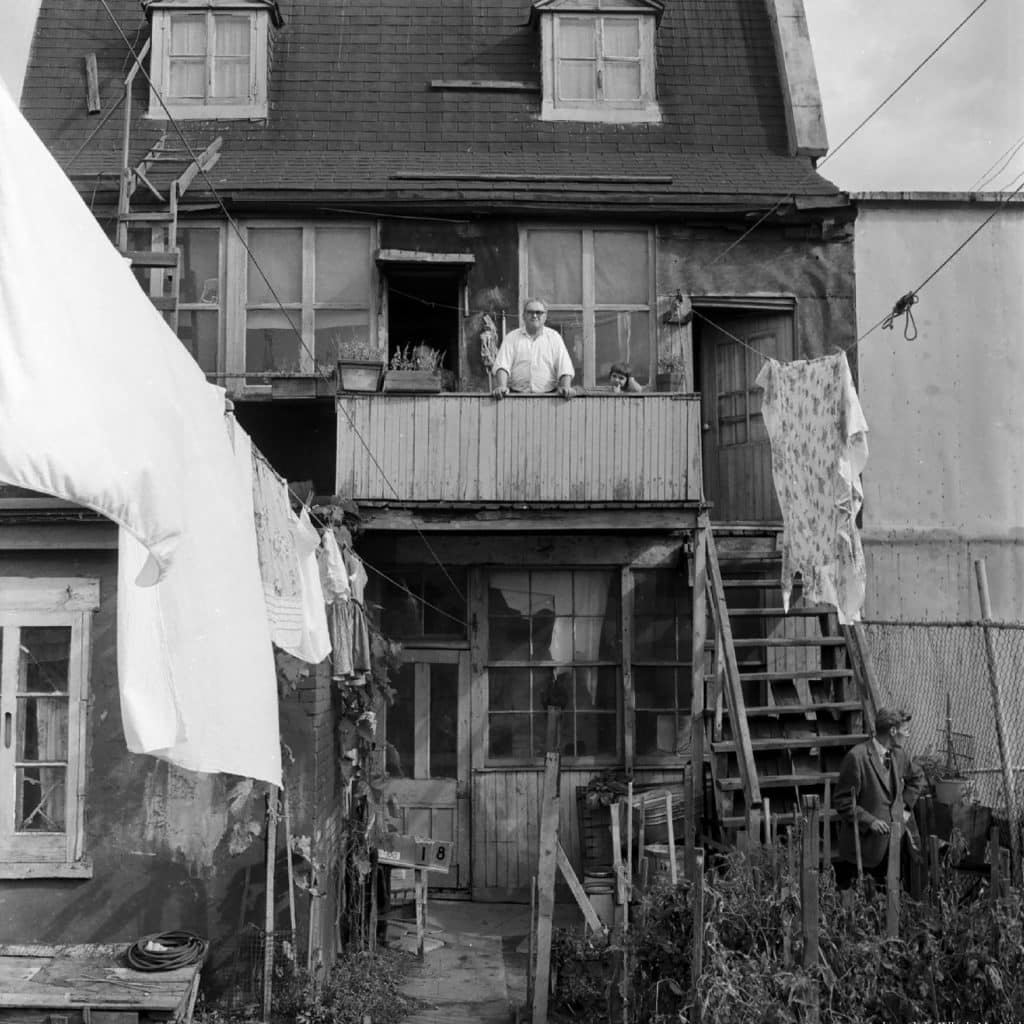
The backyard of a house in the Goose Village, taken by the City of Montreal in the lead-up to the neighbourhood’s demolition on Oct. 17, 1963. PHOTO: Courtesy, Ville de Montréal
Terre des Hommes.
Man and His World.
Many will recognize this motto as the theme of Expo 67, the massive event that put Montreal on the world map, that made it into the metropolis we know today. A celebration of Man’s evolutionary superiority, and his dominion over “His” world.
The marks of its existence decorate the city: Habitat 67, or Parc Jean-Drapeau and the metro tunnels from which it came. But Expo 67 leaves its mark in absence, too. Paradoxically, Expo 67, and the political decisions made in its lead-up, can reveal something about Man’s shortcomings, or the limits of his control.
For the working-class community of Goose Village, an enclave in Pointe-Saint-Charles, Expo 67 brought with it a death sentence.
On the orders of then-Montreal mayor Jean Drapeau, the village was expropriated, then demolished in 1964, to make room for the Autostade — a stadium built to host several events like the World Music Festival and a rodeo show.
A few years later, the Autostade itself was torn down. Now only a parking lot remains, covering any trace of the neighbourhood that once stood there.
But the people of Goose Village never forgot.
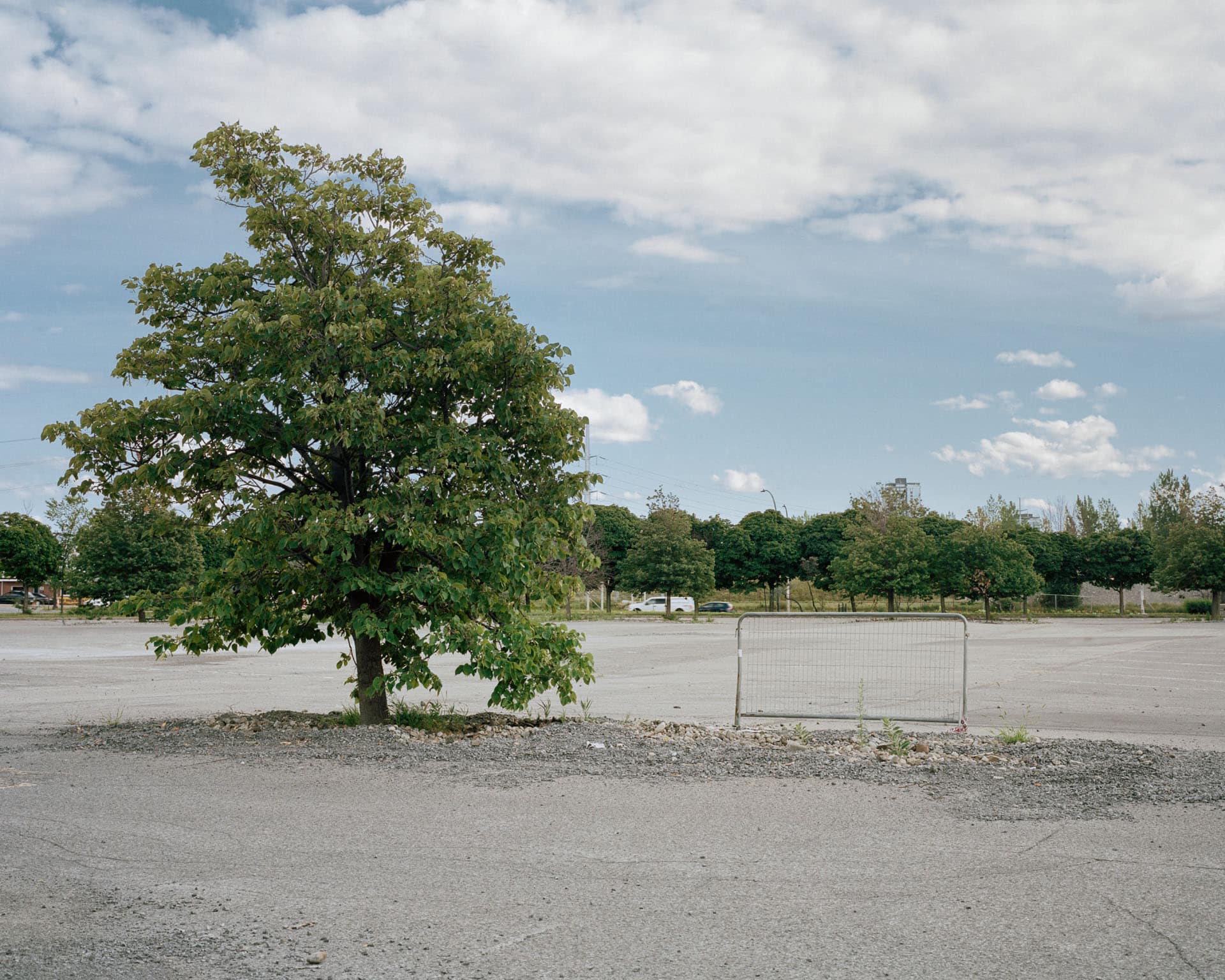
The parking lot where Goose Village once stood. PHOTO: Marisa Portolese
“When I was growing up, my parents and my aunts and uncles and family friends kept talking about this village,” said Marisa Portolese. “We (their children) were all mesmerized by their stories because we thought, ‘Where is this village?’ But it didn’t exist anymore.”
The Goose Village was demolished before Portolese was born. But though she never got to see it, the village is an integral part of her life story as a second-generation Canadian. The entire paternal side of her family settled in this small community after immigrating from Calabria, Italy.
Following their marriage in Italy, Portolese’s father brought her mother to the Goose Village, where they first lived as a married couple until they got the news that they would have to leave. That’s when about 350 buildings were expropriated and some 1,500 people were exiled from their homes.
“Even though it was a very tiny neighbourhood, it had an incredible impact on the people who lived there,” said Portolese. “And, I think what happened to them was complete disregard for who they were.”
Support Independent Journalism
For the past four years, Portolese has been working to document the Goose Village, its people, and what’s become of the land on which it once stood. It’s a multidisciplinary project made up of photography, archival images, interviews, video, and timelines — and now, as of this month, a book.
Goose Village, a self-published book made possible through funding by the Social Sciences and Humanities Research Council of Canada, is a collection of Portolese’s photography work, accompanied by essays from herself and Vincent Bonin, a writer and curator.
Portraits of the former villagers and images of the emptiness that now characterizes the space are juxtaposed with photos taken by the City of Montreal during the expropriations — images of houses half-packed up as people readied to move, dispossessed from their homes and their community to make space for what was supposed to be a celebration of the supremacy of man, of his dominance over his world.
***
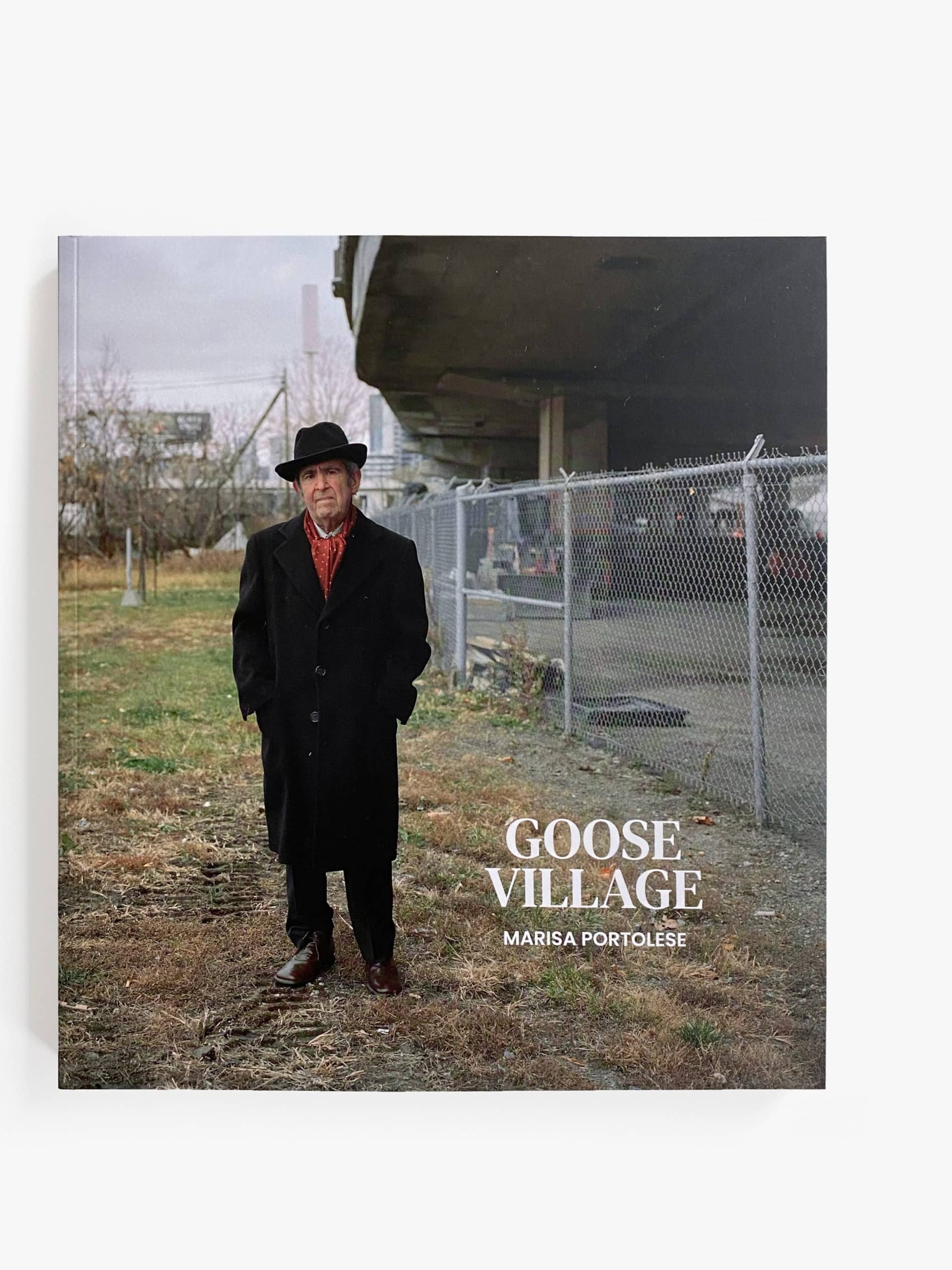
Marisa Portolese’s book, Goose Village, co-written by Vincent Bonin, is available in French and English. PHOTO: Marisa Portolese
Goose Village, like all of Montreal, was located on unceded Indigenous territory, a meeting ground for the Kanien’kehá:ka and other nations.
Its name reflects this history: it was a favoured spot for First Nations hunting geese. Though it was officially called Victoriatown (Victoriaville) for its proximity to the Victoria Bridge — and that it was a settling ground for the Irish immigrants who built it — it was the name Goose Village (Village-aux-Oies) that stuck.
“This is my father on the cover,” said Portolese. “He’s photographed on the site at the corner of Riverside, which is under the Bonaventure Expressway, and what used to be — guesstimating here — Forfar St. which is where he lived.”
The villagers she interviewed told her that when Italian immigrants began settling in the area, many married the Irish already living there, united by their Catholic faith. Then there were later waves of immigration from eastern Europe, but the area retained its strong presence of Irish and Italians.
Portolese had wanted to take on this project for years, but it wasn’t until the City of Montreal digitized its archival images of Goose Village and made them available online that it became possible.
In the lead-up to the demolition of the village, the city sent photographers to take pictures of every single building, on every street.
“The history of the Goose Village (up until the photos were made public) was oral, it took a while until this documentation became available,” said Bonin, who has experience working with archival images and wrote a two-part essay for the book, offering an outsider’s view on the story of the Goose Village and on Portolese’s work.
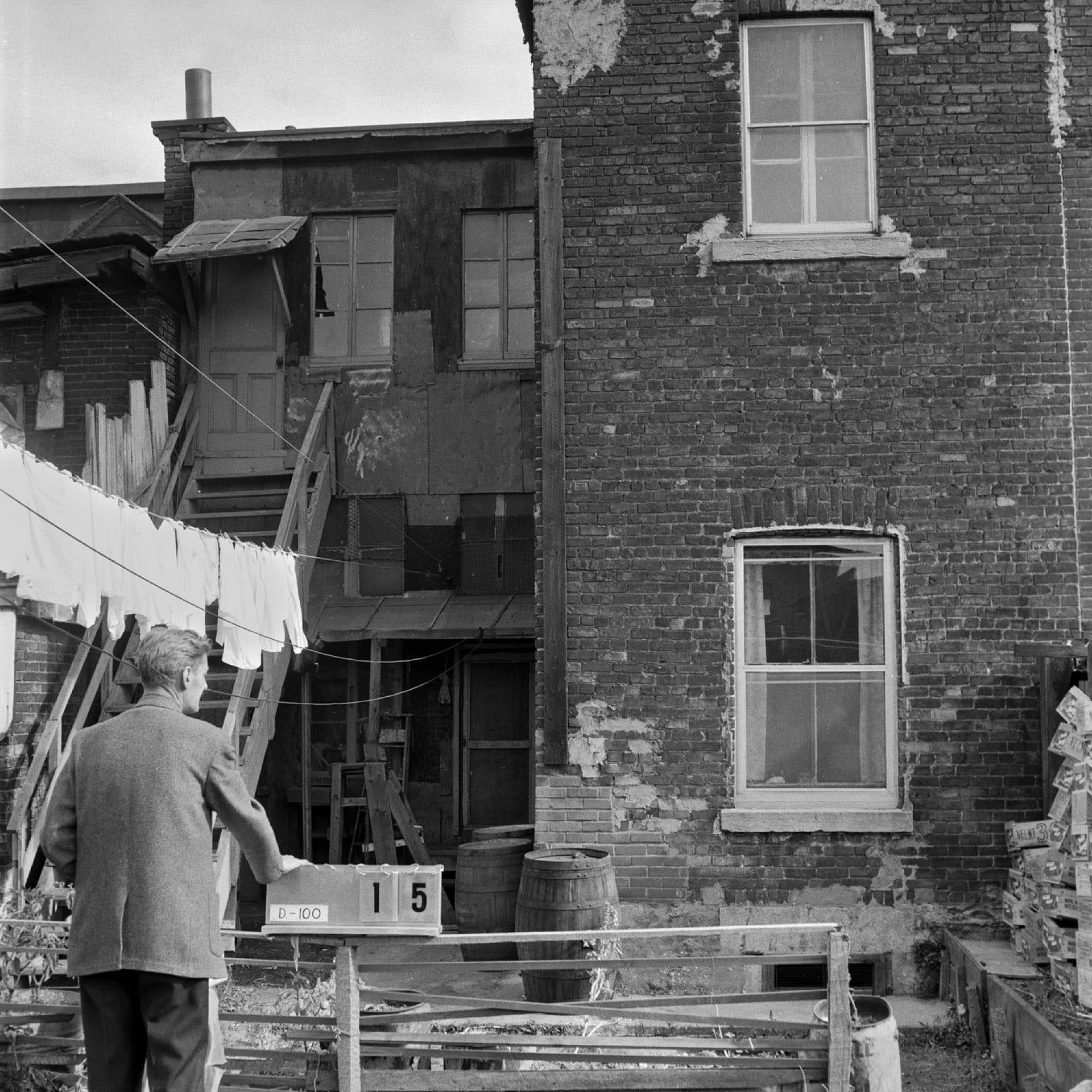
The backyard of a house in the Goose Village, taken by the City of Montreal in the lead-up to the neighbourhood’s demolition on Oct. 17, 1963. PHOTO: Courtesy, Ville de Montréal
“The first part is focused on these archives, and it’s a detailed analysis of their function, of the way that they were used by the city to justify the expropriation, and also the ethics that transpire when you look at these photographs. Then the second part is on Marisa’s own work,” he said.
“As a portraitist, she thinks a lot about the relationship that she has with her models.”
Portolese has developed strong relationships with the villagers, themselves still good friends despite the years that have passed. The portraits included in the book show them posing with what little greenery is left at the site of the village, connecting them to the place as it exists today.
“When I first brought my father on site, he was completely disoriented — and he’s very lucid. He couldn’t understand what he was looking at. He said, ‘I don’t understand, where am I?’” Portolese recounted. “It was heartbreaking, to see that.”
She had to explain to him that this parking lot in which they stood was the site of the village he always spoke of so fondly.
“Along this parking lot, offering some respite from this dour wasteland, were these overgrown trees, weeds and bushings.”
Her father, an avid gardener, was drawn to the greenery of the space.
“I can’t help but poetically muse that, you know, the former residents found a way to leave their mark, because were they from the former gardens?” Portolese said. “It’s a bit of magical thinking, and very romantic. But there are vines along Bridge St., and people did have vines in their gardens.”
***
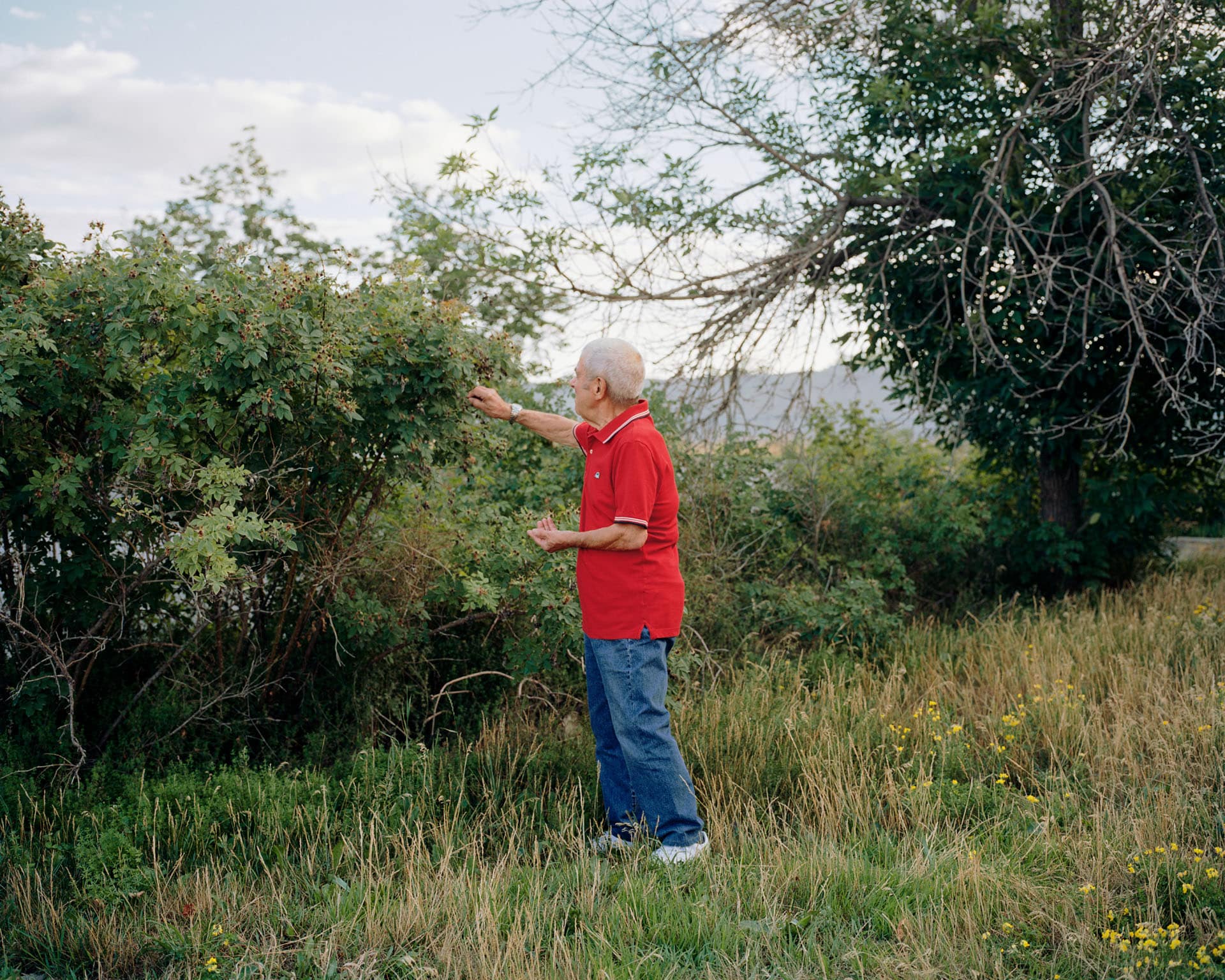
Domenico Portolese, Marisa Portolese’s father, picking berries from the bushes lining the parking lot at the Goose Village’s former location. PHOTO: Marisa Portolese
“One of the reasons why the village was bulldozed was to have a site for the Autostade that was built there,” said Bonin.
“But also, behind that, the reason was also to remove an ‘eyesore.’”
When tourists from across the continent drove into Montreal for Expo 67, thousands of cars took the Victoria Bridge. They would have seen that iconic view of Montreal’s skyline from the southwest, with the burgeoning city in front of Mount Royal. But had Goose Village not been demolished, it would have been the first neighbourhood they would have seen up close as they drove along the newly constructed Bonaventure Expressway.
It’s no secret that then-mayor Drapeau, the driving force behind Expo 67, wanted to use the event to present Montreal as a modern metropolis, as a world-class city. Reports from the time link demolition projects of the Goose Village and Montreal’s red light district to the upcoming World Fair.
Goose Village’s inhabitants had a reputation for being fiercely proud. Many were immigrants, who did not speak English or French as a first language. Many also did not have the opportunity to go to school, and worked long hours in the neighbouring factories — all factors that made inhibited mobilization against the expropriations.
“There’s a former villager, Johnny Ferguson, who I’ve met several times and I see often, he once exclaimed: ‘We were like one big happy family,’ and he said it in all seriousness,” Portolese recounted.
“A lot of the neighbourhood was made up of people that were helping one another. If your kid was (playing) on the street, you didn’t worry about it because there were so many people around. There were stores at every corner, all family-run businesses.”
She conceded that despite the rosy picture that the villagers often paint, the area dealt with many of the problems working-class communities in Montreal faced at the time: pollution from nearby factories hung in the air, and many of the houses lacked running water.
“There were slaughterhouses around the area. There was a stench, you know. I asked the villagers about it, they said ‘Oh yeah, we forgot about that. You smelled it on certain days and then it went away.’ There were certain days you couldn’t hang your clothes outside because of this smell.
“It wasn’t paradise, but it kind of was for a lot of people because they felt safe. There was no crime, but then it was deemed a ‘slum.’”
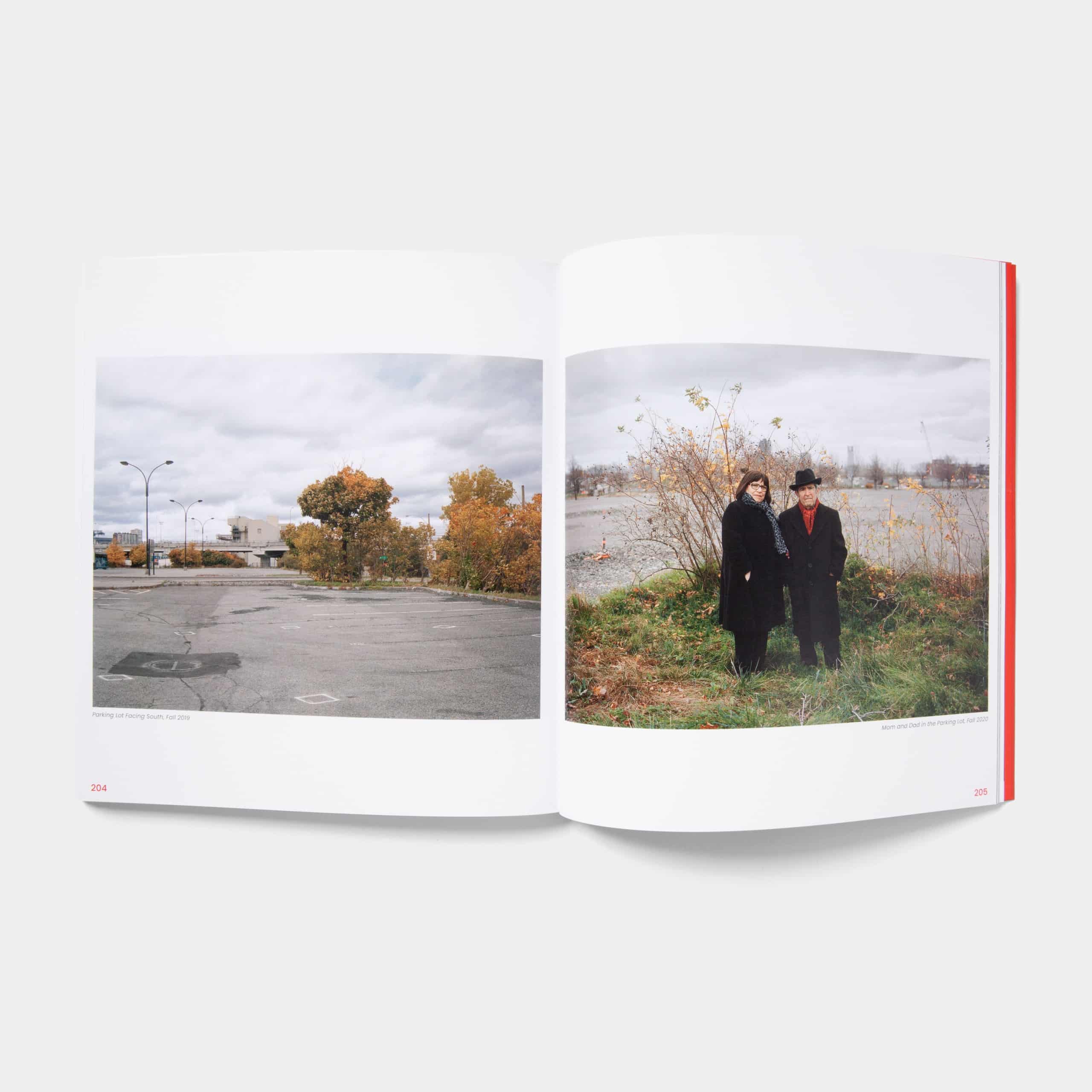
A look inside Marisa Portolese’s book, Goose Village. PHOTO: Marisa Portolese
Bonin’s essay explores how this notion of Goose Village as a “slum” wasn’t corroborated in the data, such as the low crime rate or high rate of homeownership among the residents. Yet the local media picked up the terminology from the political discourse at City Hall: “Démolition de taudis occupés par 1200 familles,” declared a headline in Le Nouveau Journal on June 12, 1962.
“It’s not based on sociological data. It’s constructed, in this case, from the photographs, from zooming in on details” said Bonin.
“Drapeau at the time, didn’t have a social approach to this. Basically, people were expropriated, they (got) a little bit of money, not much. And then they had to find ways to relocate themselves because he was against this idea of social housing.”
Portolese said former residents talked about how, though the exterior of the buildings resembled other working-class neighbourhoods like the Plateau-Mont-Royal or Pointe-Saint-Charles, the interiors were decorated with wallpaper, with family heirlooms displayed on a credenza in the dining room. She has spent many an afternoon poring over old family photo albums with the villagers, examining pictures of their parents and grandmothers posing in clean and orderly homes.
“That doesn’t sound like a slum to me,” Portolese pointed out. “This is how we treat people living in more modest neighbourhoods, lower-income families, whereas this would never happen in Westmount.”
Former villager Ed DiZazzo, upon finishing Portolese’s book, reported that it helped him connect what happened to the Goose Village to a larger injustice. He said that the book allowed him to revisit a place that was very important to him, “something I grieved I would never be able to do again.”
“I learned so much about ‘where I came from’ and now finally understand all the dynamics that were at play,” he said. “A civic crime in every sense of the word!”
“And then the Autostade was decimated 10 years later and it became a parking lot,” said Portolese. “All this for a stadium that isn’t even there anymore?”
***
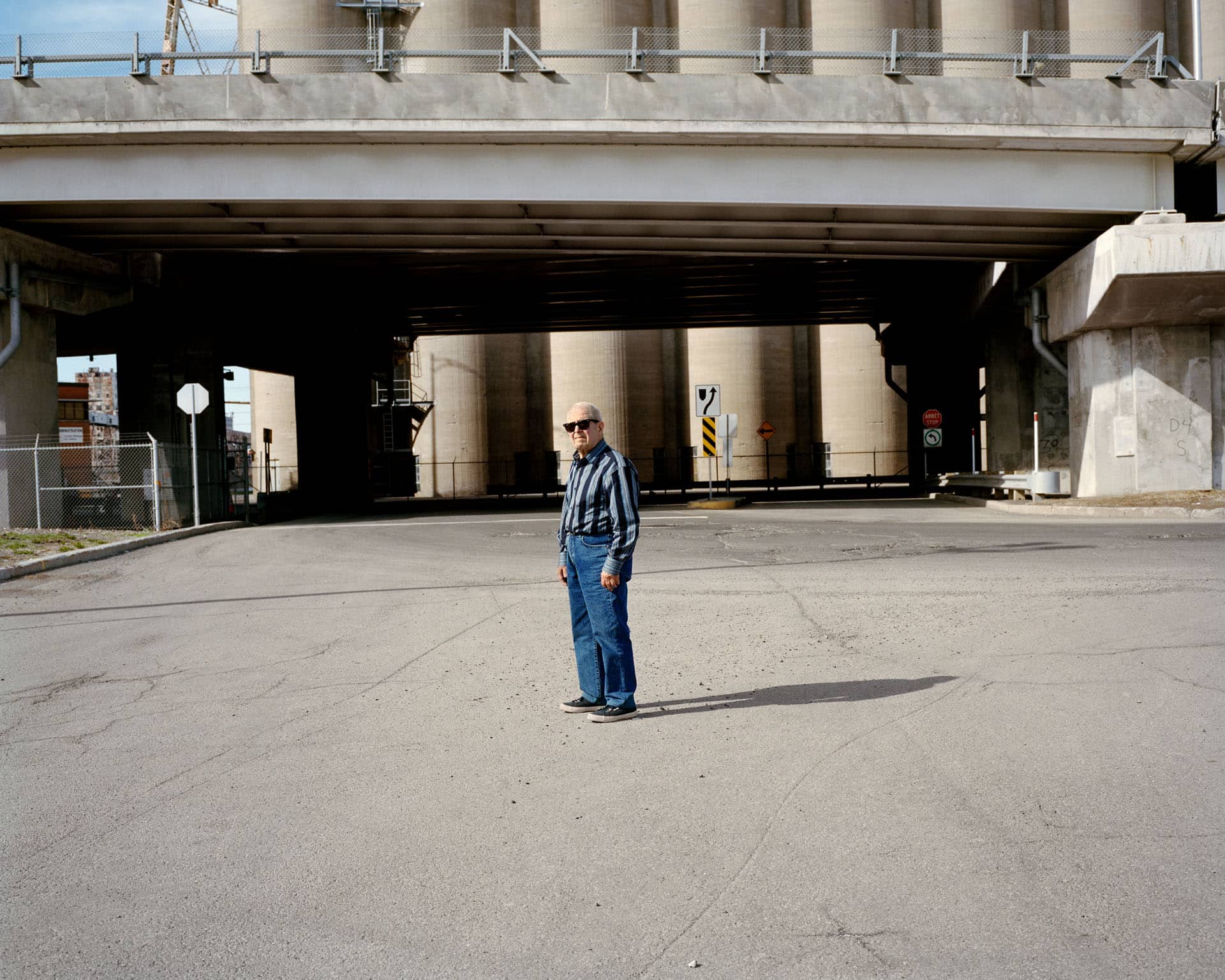
Domenico Portolese standing in the parking lot at the Goose Village location. PHOTO: Marisa Portolese
“We still, as of today, nourish the myth that Expo 67 was a high, in Montreal but also in Canada.
But it came also with the cost of removing people from their dwellings,” said Bonin.
“We took a stance to debunk this myth of Expo, ‘Terre des Hommes,’ as they were saying at the time. It happened just at a moment where there were many expropriations, not only in the Goose Village but elsewhere in Montreal.”
“The city that we’re living in right now, that was the city that Drapeau was dreaming about at the time,” he summarized.
The land that was once the Goose Village is part of Bridge-Bonaventure, a massive industrial sector set to be redeveloped.
In Montreal’s current housing crisis, the question of what type of housing will be built is drawing the most debate. Though the matter is far from settled, Portolese was reassured when she read that at least some of the sector will be developed with social housing.
“Goose Village wasn’t gentrified, it was erased. So that’s pretty extreme,” she said. “But a lot of neighbourhoods are gentrified, especially the Southwest.
“When we were growing up, people living in their first apartments, we were paying very little money for such incredible places. That’s no longer possible.”
She said she feels that the city is not as democratic as it once was.
“Montreal was the place to be for all these people that came from different walks of life and economic backgrounds, and it’s becoming virtually impossible for people that make more modest living wages to live in the city.”
As the area faces upcoming redevelopment, Portolese hopes that the Goose Village can be honoured in some way.
“There should be a sign,” she said. “It’s an important historical area. The Irish community, they built this city. They built the bridge. That neighbourhood was a neighbourhood that was built for the workers (…). How can we just erase this incredible history without acknowledging it in some poetic way?”
Above all, she wants the villagers and what they went through to be recognized.
“Always consider the people that are affected by what you’re doing. That’s not done enough. We talk about care and compassion, but we need to put it into practice.”
DiZazzo, the former villager, had a message for Portolese, that he accepted to have included in this article:
“As Isabel Allende once wrote: ‘People only truly die when they are forgotten.’ Your beautiful work has now ensured that Goose Village can never be erased or forgotten. Mission accomplished, my friend! Truly grateful for what you have done.”
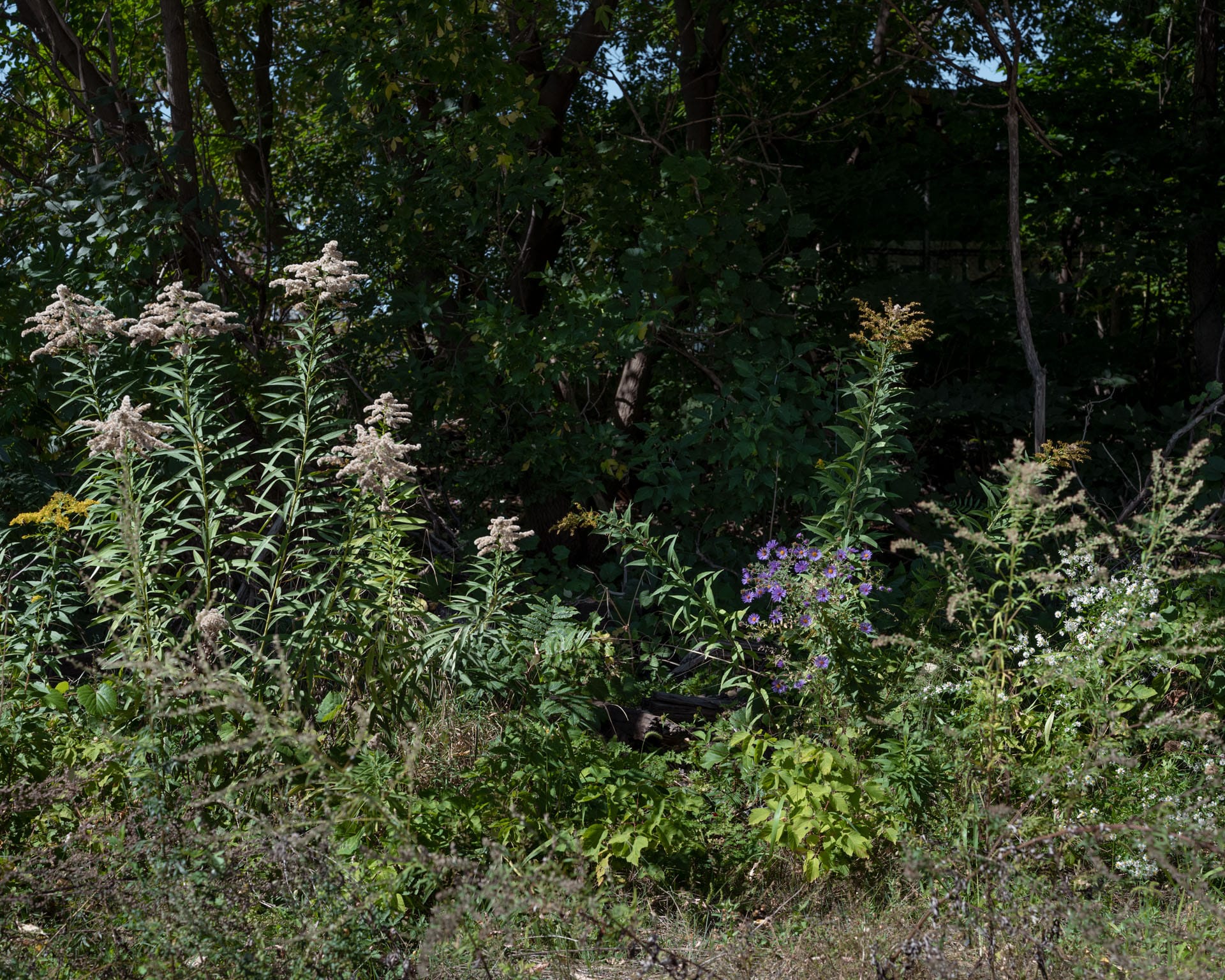
Greenery on the site of what was once Goose Village. PHOTO: Marisa Portolese
Author

Comments (1)
Leave a comment
Related Articles
Occupation and Defiance in Trump’s America
Three months out from the reduction of ICE agents in the Twin Cities, Minnesota, residents remain on alert.

La « mort sociale » des femmes musulmanes au Québec
Confrontées à des pertes d’emploi et à des atteintes à leurs droits garantis par la Charte, des musulmanes s’interrogent sur leur avenir dans une province où elles se sentent isolées et en danger.
The “Social Death” of Muslim Women in Quebec
Beset by job losses and attacks on their Charter rights, Muslims ponder their future in a province that’s left them feeling isolated and afraid.
My mother was born and raised in Goose Village. Would you know if there are any photos of the Village before it was torn down? I remember a fire station on the same street my grandparents live on.