
Students Fight a ‘Lonely Battle’ Against Quebec Government
Montreal’s anglophone universities face an unprecedented crisis at the hands of François Legault’s government.
Siva Kumar Darapu is the kind of engineer Quebec needs.
Over the next 10 years, the province has to train over 50,000 new engineers to meet demand in a field that covers everything from building light rail networks to writing the algorithms that make artificial intelligence possible.
Given Quebec’s history as a hub for engineering research and innovation, filling those jobs with local and international talent shouldn’t be a problem. It attracts people like Darapu, who left his home in India to pursue a master’s degree in engineering at Concordia University.
In less than three years since arriving, Darapu has been on a tear. He’s designed ventilation systems at one of the city’s most prestigious engineering firms, he was elected president of his student association last year and he just passed his Level 2 French exam.
But with the Coalition Avenir Quebec’s decision to double tuition for international students who attend anglophone universities next fall, Darapu says he’s looking for work in Ottawa. He may not be personally affected by the hikes but Darapu says they were the breaking point for him.
Support Independent Journalism.
“I’ve been here two years. I love Montreal. I love Quebec. I love learning French. But the decisions made by this government don’t make us feel welcome,” Darapu told The Rover. “It’s devastating to think I would move somewhere else, because I really love it here.”
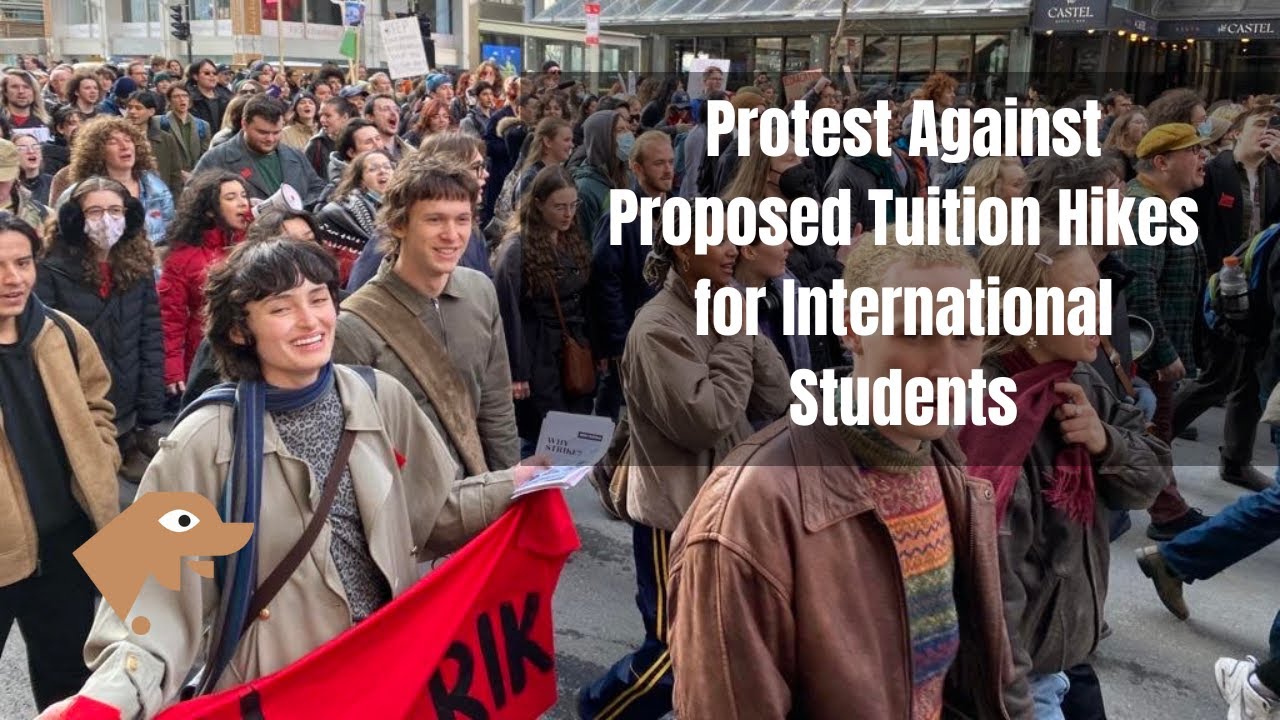
Last Wednesday, Darapu and hundreds of his colleagues met outside Concordia to protest the CAQ’s tuition hikes. They banged pots and pans, painted the asphalt on McKay Street red and blocked traffic as they marched deeper into the city. Far from annoyed, merchants and pedestrians along Sherbrooke St. cheered the crowd on.
The protesters were among the 21,600 students on strike at Concordia and McGill University for five days last week, organizing picket lines that shut down classes across the city. If the hikes come into effect, it will cost international students over $20,000 a year to attend an anglophone university in Montreal.
The CAQ will also be increasing tuition for out-of-province students from $9,000 to $12,000 annually, claiming these measures will take $110 million out of the anglophone system and give it to francophone universities. The government did this without consulting the universities and against the recommendation of its own experts at the Comité consultatif sur l’accessibilité financière aux études.
At $9,000 a year, Quebec’s current tuition for out-of-province students might seem like a bargain but it’s actually in line with the national average. Quebec students pay $3,000, affordability and access to a university education has been sacrosanct in this province since the Quiet Revolution. It may translate to higher taxes and deficits but the presence of six campuses and a quarter million university students on the island of Montreal drives the city and the province’s economy.
But those deficits have been adding up.
A series of studies published in the past year suggest that Quebec’s universities are underfunded by anywhere between $850 million to $1.2 billion when compared to the rest of Canada. Premier François Legault told reporters he believes the tuition hikes will help Quebec catch up to the rest of Canada but that’s only if university enrolment doesn’t plummet.
Since the CAQ announced the increase last fall, applications at Concordia are down 23 per cent for out-of-province students and 12 per cent for international students. The university expects enrollment will drop dramatically next year, leading to job losses, layoffs and fewer classes being offered by Concordia.
“Twenty-three per cent is what we’re losing at the top of the funnel,” said Vannina Maestracci, a spokesperson for Concordia. “We won’t know the exact impact until classes start next year. It’s hard to budget and plan for that.”

Siva Kumar Darapu participated in protests against the Quebec Government’s proposed tuition hikes for international students because he says they make him feel unwelcome in his chosen home. PHOTO: Christopher Curtis
Some 11,000 students at Concordia come from abroad and form a huge part of student life on campus. International students have been elected student union presidents, they’ve written award-winning articles in the school’s student newspapers and their expertise has helped attract millions in research funding for the university.
In the graduate engineering program, international students account for roughly half the student body. A drop in enrolment could affect the university’s ability to train skilled workers in the middle of an unparalleled labour shortage in Quebec, Maestracci said.
“The government claiming this will raise $110 million for francophone universities is based on current enrollment,” she continued. “If enrollment goes down, which it will, it’ll be much less than that. Looking at our own projections, it’s possible the government will collect less money from international and out-of-province students next year than it did before the tuition hike.”
The decision initially targeted McGill, Concordia and Bishop’s University, but the Quebec government decided to exempt the latter from out-of-province tuition hikes after being lobbied by francophone leaders in the Eastern Townships. Bishop’s has just 2,600 students with many of them coming from small towns in Ontario and contributing to the economy in the Estrie region — where the CAQ holds five of six electoral ridings.
The presidents of McGill and Concordia met with the Premier twice to offer a counterproposal that would see an unprecedented level of funding and curriculum to bolster the French language on their campuses. Their offer included creating compulsory French classes for out-of-province students, internships in Quebec’s faraway regions, events that highlight francophone culture and a partnership with local institutions to better integrate students into Quebec society. The offer was rejected outright.
Last month, the universities announced they’d be suing the Quebec government on the grounds that these new rules violate the Charter rights of Canadians to equality of education for anglophone and francophone linguistic groups.
“The government significantly increased tuition fees for out-of-province students attending anglophone universities only,” said Concordia president Graham Carr in a statement released last month. “(The CAQ) imposed a new fee structure for international students that will have disproportionately negative financial consequences for anglophone universities.
Want a deeper analysis of this developing story?
On episode 2 of The Rover‘s new podcast, The Midnight Choir, Christopher Curtis and host Isaac Wylde break down the details and dive right in to the reality of what’s facing anglophone universities in Quebec as the tuition hike looms around the corner.
Find the full episode on The Rover‘s new YouTube channel, and please subscribe to help our content reach more people!
You can also listen to the podcast on many streaming services. Find the links to those here.
“The changes could have a significant and harmful impact on Concordia’s student enrolment, financial well-being and international reputation. Members of the government publicly admitted as much on several occasions.”
Anna Sheftel is the Principal at Concordia’s School of Community and Public Affairs, where she teaches students from the rest of Canada about Quebec’s social welfare model.
“Some of my students who come from out of province find it very rich to learn about how we do things in Quebec,” said Sheftel, who marched alongside the students Thursday. “They want to see if they could apply Quebec’s social welfare model to Saskatchewan or Ontario or anywhere across Canada, really.
“The message is clear: they want to punish the English university sector. It’s two things. Politically cheap and easy to beat up on English universities. But I think the larger politics here is making austerity measures palatable by going after an easy target. You’re rebranding a funding cut as protecting the language. If fewer students attend Concordia, the whole system suffers.”
Already financially strapped, Concordia has had a hiring and salary freeze in place since it posted a $35 million deficit last year. The university was looking to cut its budget by 7.8 per cent, and that was before the CAQ’s surprise tuition announcement. The decision could cost Concordia $64 million over four years. McGill could face up to $94 million in lost revenue over that same period, according to university president Deep Sainai.
Though supporters of the CAQ’s new policy claim it’s a way of preventing international students from coming to Quebec for cheap education and leaving once they’re done, the evidence is not so cut and dry. At Concordia, for instance, some 54 per cent of international students stay in Quebec after graduating.
And while Premier François Legault and his allies in the conservative press argue international students are contributing to the anglicization of Montreal, some 70 per cent of them can carry a conversation in French, according to the Office québécoise de la langue française.
At McGill, drops in funding could jeopardize research partnerships with Université de Montréal, further isolating the anglophone institution from its francophone counterparts.
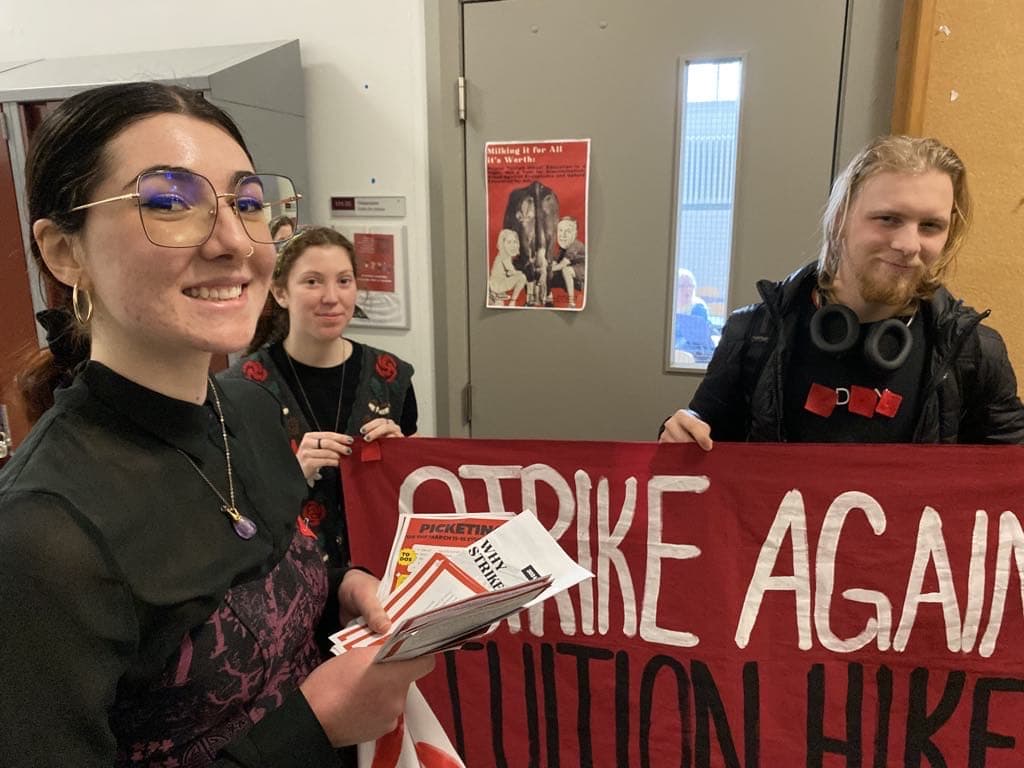
Valérie Brunelle and other students participating in the strike at Concordia University. PHOTO: Christopher Curtis
That isolation is also felt among students fighting the tuition hikes. Last week, about 20 of the strike organizers at Concordia gathered on the Loyola Campus to form “hard pickets” outside classes in the psychology department.
Alternating between a rendition of Sweet Caroline and chants of “Cancel class! Cancel class!”, the students didn’t manage to stop their colleagues from attending their courses but they made enough noise to be invited to speak to the class.
“This professor, he’s acting like we’re going to ruin everyone’s academic career,” said Valérie Brunelle, a psychology student, as she led the group of strikers through a hallway in the old Jesuit school that houses her department.
Like one-quarter of Concordia students, Brunelle is a francophone who won’t be directly impacted by the hikes. But she will be impacted nonetheless.
“We’re already feeling the crunch of underfunding,” said Brunelle, one of the strike’s organizers. “Next year is supposed to be my last but all the core classes I need to take are waitlisted. There might not be enough classes for me to graduate on time and I’m not the only person in this situation.”
Unlike the 2012 student strike — which brought together hundreds of thousands of university students against the Liberal government’s proposal to nearly double tuition for Quebecers — students at the anglophone university are resisting with little outside help.
The increases have been criticized by opposition parties at the National Assembly but aside from McGill and Concordia’s lawsuits, there isn’t much action being taken to resist the hikes. So far, the students’ most high-profile defender has been Montreal Mayor Valérie Plante, who said the move was “a hard hit” on the city’s international reputation.
“We share the government’s concerns about protecting the French language. We are proud to be the francophone metropolis of North America,” Plante said, during a press conference last fall. “But there is a way of accomplishing that without depriving ourselves of the talent we need to keep our economy rolling, like with artificial intelligence for instance.”
In response to the Mayor’s criticism, Legault accused Plante of not wanting to defend the French language.
There is another way the hikes could affect Quebec-born students. While the provincial government spends around $200 million a year to subsidize the education of 10,500 out-of-province students, there are around about 8,000 Quebecers enrolled in universities across Canada. There’s nothing preventing those provinces from raising Quebec students’ tuition to retaliate against the CAQ.
“What’s so frustrating about this is that it goes against the fundamental — almost sacred — principle of accessible education in Quebec,” said Professor Sheftel. “A long time ago, Quebec made the decision, as a society, to make higher education accessible because it aligns with our values as a society.
“We’re not going to cheapen the value of our degree because we have less money. As professors, we’ll do everything we can to fulfill our mission. But these cuts attack the core of what makes Concordia special. We have classes that are a fraction of the size of McGill’s. It’s a community, it’s a place to exchange ideas with the rest of Canada and the rest of the world. That’s what’s at stake here.”
Author

Related Articles
Guilty Until Proven Innocent: A Man’s 12-year Battle with Revenu Québec
Quebec’s tax agency freezes retirement savings, seizes assets and “ruins lives” with investigations based on mere assumptions.
School Board Votes to Support Candidate who Smeared Rival, Acted in ‘Undignified’ Manner
Julien Feldman gets off scot-free after falsely associating his rival candidate with antisemitism and referring to her as “Ms. Gaza.”

« Je veux juste qu’on me croie »
Victime d’une agression sexuelle alors qu’elle travaillait pour le gouvernement provincial, une femme lutte avec Québec depuis cinq ans.
Comments (0)
There are no comments on this article.