
McGill Encampment Withstands Second Legal Challenge
The student protest for Gaza holds firm despite mounting pressure.
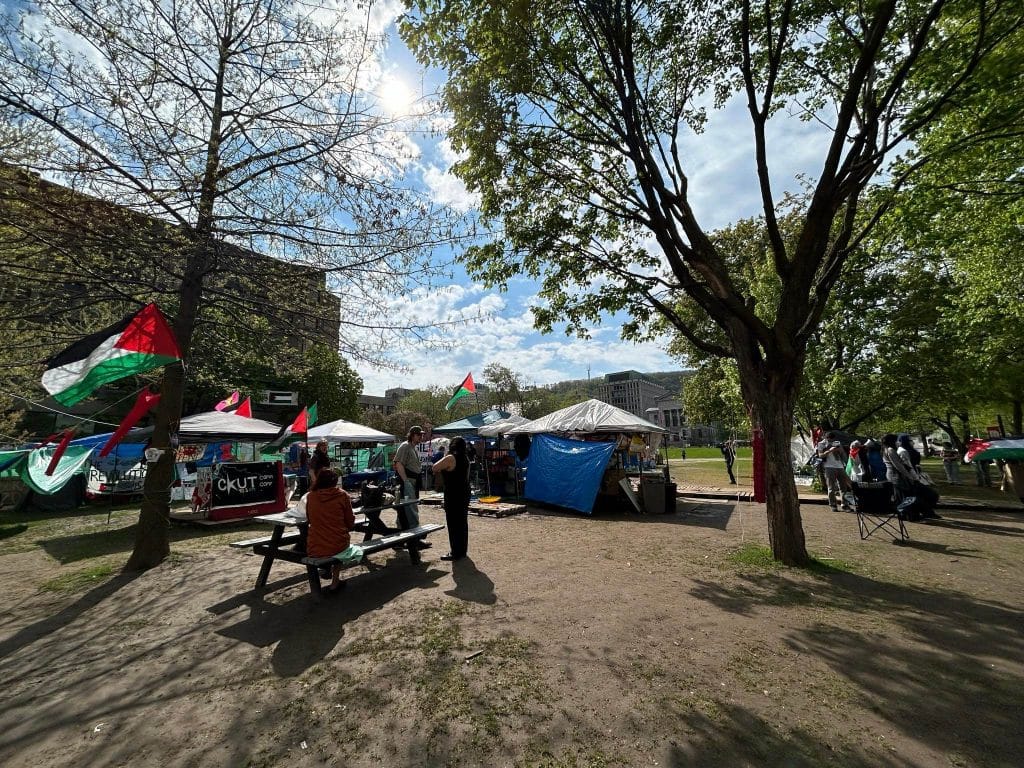
At the McGill University student encampment, May 14, 2024. PHOTO: Chris Curtis
“Students are prepared to sustain this camp until they are forcibly removed.”
The protester didn’t raise her voice but there was a firmness to that statement. She stood outside the encampment’s steel barriers Tuesday, her shoes caked in mud and her face weathered by the sun.
It would have been easy to dismiss those words as bluster two weeks ago. Back when rumours of an imminent police raid coursed through the McGill encampment. In those first days, it felt like a strong gust of wind could blow the whole thing onto Sherbrooke St.
But it became a lot harder to brush off the protesters after they secured another victory in court Wednesday. Superior Court Judge Marc St-Denis ruled that McGill University didn’t provide enough evidence to warrant an emergency injunction against the encampment. Yes, the protesters are boisterous and their occupation of the university’s front lawn will almost certainly disrupt convocation next week.
Even so, St-Denis ruled that the students’ right to protest McGill’s stake in the armaments industry — as Israeli missiles rain death and destruction on Gaza — supersedes the university’s property ownership rights. At least for now.
Support Independent Journalism.
“These tents, this encampment, is a form of expression and if you criminalize that — in an institution of learning — that sends a dangerous message,” said Julius Grey, the constitutional lawyer who argued against McGill in court Monday. “McGill’s position is ‘It’s our property and you can’t camp there.’ Most people are in agreement that actually, yes, you can demonstrate there.
“The question is: how long do you need to make a particular point? And in this case, with two sides not listening to each other, I think it’s important for each of them to make their point. The question is, how long do you have to make that point? Because it can’t be permanent.”
In the three weeks since the camp was erected, it has withstood a torrential downpour, a counterprotest and two eviction attempts. Meanwhile, students have held firm against threats of academic and criminal consequences for their actions.
And far from the flimsy mud pit sinking into McGill’s lawn last week, the encampment appears to have doubled in size. A row of steel fences wrapped in tarps makes it impossible to see inside but there are an estimated 100 tents on site with ample food, water and medical supplies.
The encampment has hosted teach-ins, film screenings and even a Seder dinner to mark the end of Passover. The Mohawk elder Ellen Gabriel has spoken at the encampment as has Sarah Jama, an Ontario MLA who was kicked out of the New Democratic caucus last fall after calling Israel an apartheid regime.
It has also inspired similar protests across Canada, with solidarity encampments at the University of Toronto, the University of Ottawa and the University of British Columbia among others. After Edmonton police cracked down on a Gaza encampment at the University of Alberta with batons and tear gas last week, associate dean Natalie Loveless resigned.
“With police marching on our students, on our campus, I can neither protect students nor facilitate the difficult conversations that are needed to advance equity and justice for our community,” Loveless wrote, in an open letter Tuesday.
These days, organizers at the encampment are in constant meetings and group chats, preparing for an eventual police raid, according to sources inside the camp. The protesters have been training first aid and acquiring medical supplies while drilling what might be done should police swoop in.
The sources insist there’s been no self-defence training and none of their preparations involve physically confronting police should they send in the riot squad.
Barring some incident around the encampment, the earliest that might happen is May 22, when the Superior Court meets to hear arguments over the next injunction request. By then, with convocation just days away, it’ll be nearly impossible for McGill to clear the site and erect a stage in time for the ceremony.
In fact, it was the university’s decision to secure an alternate location for convocation that may have cost it an emergency injunction. In his ruling, Judge St-Denis said the university’s own admission that it spent $700,000 to rent a space for the graduation showed McGill has already made arrangements to mitigate the encampment’s apparent harm on student life.
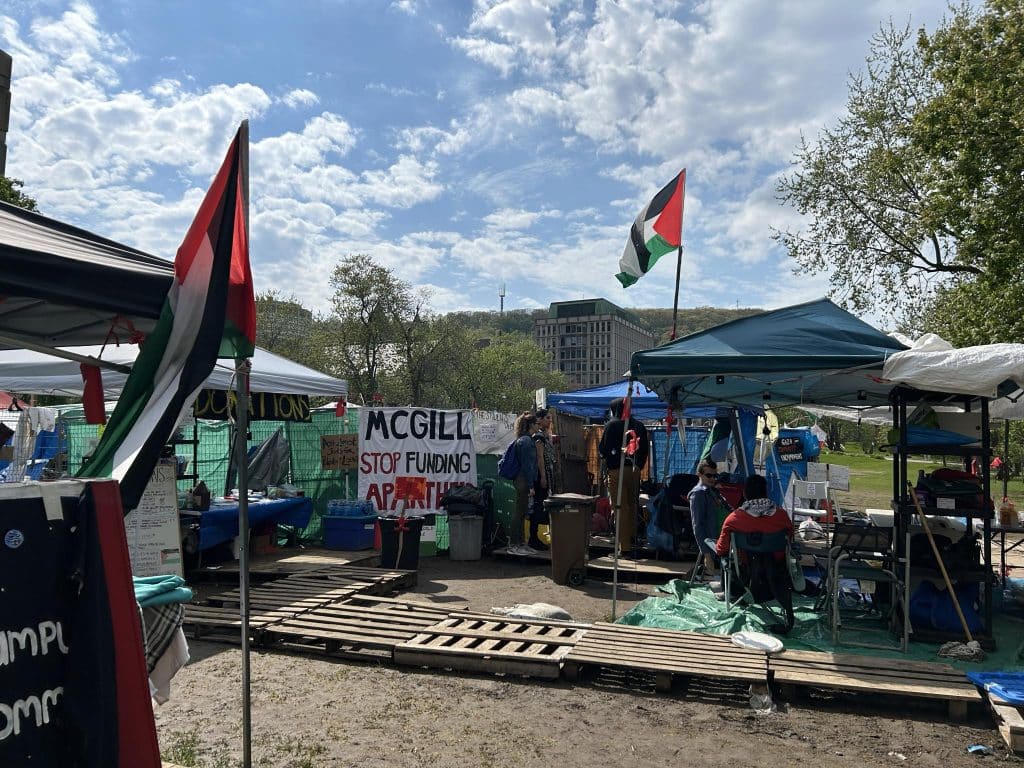
PHOTO: Chris Curtis
As a sign of just how badly the university’s lawyers have fared against the encampment, the Montreal police also spoke out against the injunction request in court, arguing police discretion in the matter is essential and that the cops aren’t McGill’s private security force.
McGill’s decision to seek the injunction also put an end to a series of meetings between administrators and protesters, further cementing the divide between both parties.
The university hadn’t initially sought confrontation. The first injunction request came from two students who claimed the encampment threatened their sense of safety and well-being on campus. Superior Court Judge Chantal Masse determined the plaintiffs weren’t able to demonstrate how a peaceful encampment that isn’t physically blocking students from going to class requires the use of police force.
Of course, pressure against the encampment is building.
Last week, Premier François Legault said it’s time for police to break up the camp and there are students on campus who say they don’t feel safe identifying as Jewish or displaying support for Israel at McGill. And sources inside the university say several major donors have threatened to pull funding if the protests go on much longer.
Given the enormous financial pressure McGill is under, these factors no doubt weigh in the balance. Last week, Moody’s downgraded McGill’s credit rating because of an expected drop in enrolment. Earlier this spring, the Quebec government announced it would double tuition fees for international students and significantly increase them for out-of-province students at McGill.
“No matter what you think of our leadership, it feels like we’re being attacked on all sides here,” a source inside the administration said. “No one wants to see the cops on campus but it feels like that’s where things might be headed.”
Back at the encampment, the strategy hasn’t changed. They will stay, they will chant and they will occupy the grounds until McGill divests its millions in investments from the armament industry and companies they say profit from the subjugation of Palestinians.
Or until they’re dragged away by force.
“The most important thing to remember is that we shouldn’t be rushing to criminalize expression on either side of this debate,” said Grey, a lawyer who has fought against antisemitism and Islamophobia throughout his storied career.
“I’m not saying that if a protester attacks somebody or starts a fire, that there shouldn’t be consequences. Screaming, yelling, refusing to leave or insults, these are not dangerous crimes. You don’t need to be arrested and have a criminal record for this. Especially at a time of records and constant state surveillance.
“The purpose of criminal records is to keep track of dangerous individuals. Not to punish people as some sort of accounting for ‘You did this! You did that!’ When you attack people for political speech, you’re attacking idealists. It’s not the selfish person who only thinks of No. 1 that gets criminalized. It’s the one who believes in a cause, who is shocked either by the hostages or by the children being killed in Gaza.
“Those people, ones with a strong sense of empathy and sympathy, are not criminals.”
Author

Comments (1)
Leave a comment
Related Articles
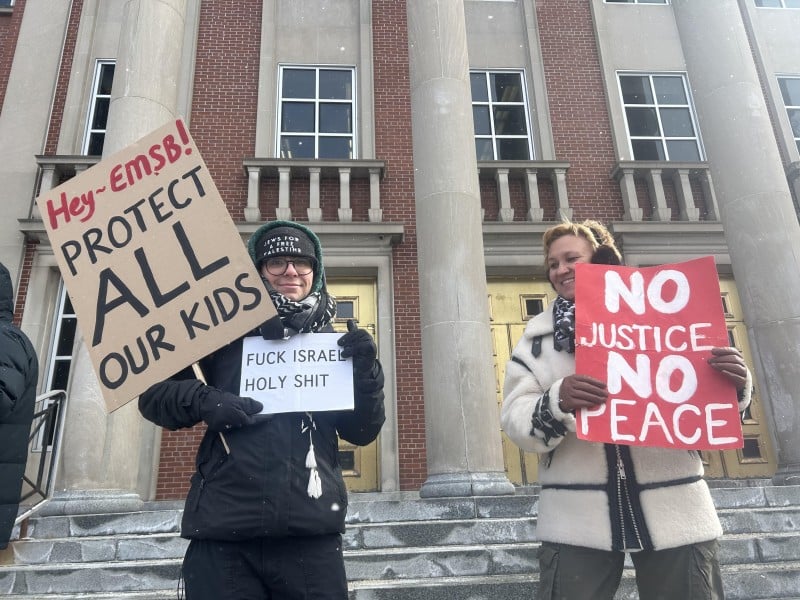
Ombudsman Rules in Favour of Student Suspended for “F*ck Israel” Post
The English Montreal School Board was ordered to retrain staff on its anti-bullying policy and students’ rights.

Will Bill 21 ‘Erase’ a Generation of Muslim Teachers from Quebec?
The legal battle over Quebec’s religious symbols ban has reached the Supreme Court in a case that will make Canadian history.
Nunavik Police Get a Pay Raise Amid Community Concerns
Inuit activists say the pay raise should match police efforts to rebuild trust with the communities.
This is worst than a rat infestation the police are gonna go take these garbages out of there ?? This aint a camp ground