
Excerpt: Nora Loreto’s “The Social Safety Net”
In her latest book, Nora Loreto asks us to consider that maybe the system was expressly built to hollow out the state and fatten the pockets of the elite, leaving the rest of us to claw at each other for crumbs.
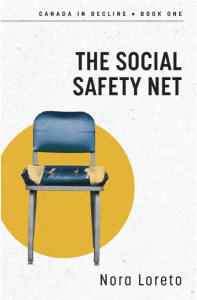
The cover of The Social Safety Net: Canada in Decline Book One by Nora Loreto. PHOTO: Dundurn Press
If you’re looking for a way to cope with the rise of fascism in the West, consider reading Nora Loreto’s The Social Safety Net: Canada in Decline Book One.
Buy it at a bookstore whose owner didn’t attend Donald Trump’s inauguration, check it out of the library while those still exist, borrow it from your communist daughter, do whatever you must but make sure you read it. At a time when pundits are looking for easy answers to explain the collapse of centrist parties in the West, Loreto makes the case that this crisis was generations in the making.
How else would someone as uniquely loathsome as Pierre Poilievre rise to power but through decades of declining trust in our institutions? Our healthcare system has been hollowed out, our public schools are falling apart, homelessness has nearly doubled since the beginning of Trudeau’s mandate and there’s an entire generation of Canadians being kept out of the housing market.
That same runaway real estate market has forced Canadians to take on a mountain of consumer debt. For each dollar of disposable income we spend, we borrow $1.85. That’s more than our neighbours to the south — who just elected an actual fascist — and much higher than the G7 average of $1.25. Living with that kind of debt is incredibly stressful. Radicalizing, even.
And yet, the value of the Toronto Stock Exchange has tripled since the 2008 market crash, banks are making record profits and the world’s richest man is closing in on a half trillion in hoarded wealth.
In The Social Safety Net, Nora Loreto asks you to consider that maybe the system was built this way, designed to hollow out the state and fatten the pockets of the elite, leaving the rest of us to claw at each other for crumbs. Like everything Nora does, it is incredibly well-researched, the writing is smooth (if somewhat cheeky at times) and it comes from the mind of someone who knows more about Canadian history than anyone I’ve ever met.
We’ve included this excerpt with Nora’s permission. If you like it, consider buying it or checking out Nora’s podcast.
Happy reading,
Chris
Neoliberalism didn’t come to Canada overnight.
It would have been impossible to take away people’s community supports and hope that they didn’t notice in 1985. It took years and years for the pieces to fit together. Sociologist William Carroll argues that neoliberalism doesn’t destroy as much as it transforms. Indeed, Canadians probably would have noticed destruction. But transformation is much more difficult to pin down. Carroll writes: “Neoliberalism, then, does not involve a hollowing-out or by-passing of the state so much as a shift in the state’s priorities and a reshaping of its modalities.”1 Terms and concepts like ‘deregulation’, ‘contracting out’, downloading responsibilities from one government to the next, ‘funding caps’, ‘wage freezes’, ‘free trade’, ‘globalization’, ‘privatization’, tuition fee increases, ‘user fees’ all are part of the packet of neoliberal reforms that have become so normal, so mundane, and yet so vague that most Canadians tune them out. In the forty years since the Shamrock Summit, neoliberalism went from being a fringe idea cooked up by a bunch of right-wing businessmen and political thinkers in the shadow of World War Two to become the dominant political theory underpinning Canada’s economy, political system and society.
The transformation of post-war society into market-centric neoliberalism isn’t just the result of changes in public policy. Fiddling with public policy alone would not cause a shock strong enough to force people to assume neoliberal logic. The public policies were accompanied by a social paradigm shift that impacted people directly. Bourdieu explains it like this (emphasis his):
“Without a doubt, the practical establishment of this world of struggle would not succeed so completely without the complicity of all of the precarious arrangements that produce insecurity and of the existence of a reserve army of employees rendered docile by these social processes that make their situations precarious, as well as by the permanent threat of unemployment… The ultimate foundation of this entire economic order placed under the sign of freedom is in effect the structural violence of unemployment, of the insecurity of job tenure and the menace of layoff that it implies. The condition of the “harmonious” functioning of the individualist micro-economic model is a mass phenomenon, the existence of a reserve army of the unemployed.”2
By targeting people in their workplaces, people’s livelihoods become less stable. This then gives rise to worsening social conditions. Carroll writes, “As neoliberal policies take effect, social divisions and inequalities tend to proliferate increasing the need for a well-armoured state.” People scrambling to make ends meet have less and less capacity to think about society as a whole. And so the state comes in to give us more “freedom.” A strong state can then effectively surveil the population, whether that’s poor and/or unemployed individuals, anyone fighting to unionize or through a union to improve their working conditions, or anything else that the state deems to be terrorism or public disorder – anything that is a threat to neoliberalism.3
The transformation of the population from community groups to individualized, isolated individuals underpins the neoliberal shift during the 1980s. Now, neoliberalism is about to hit middle age. The millennial generation grew up hearing about the myth of progress: that Canada was always progressing to become better; that our public services were always innovating and becoming stronger; that systemic oppressions were always being identified and stamped out; and that the long arc of history in Canada bends towards justice. From our brutal colonial origins to a sophisticated society that promises that no one will be left behind, the story of Canada is one of constant progress and improvement.
Or, rather, this is what generations of Canadians grew up believing. As neoliberalism matures, this story sounds more like a fairy tale, and impossible to believe in any more. Our condition has declined but our myths have yet to catch up with these changes, creating mass cognitive dissonance leading us to question: what in the hell happened?
Bourdieu was writing in 1996 but here’s what his “reserve army of employees rendered docile by these social processes that make their situations precarious” looks like in Canada today. Non-standard work in Canada grew from 28% of the workforce to 34% between 1989 and 1994 and then stayed about at 34% until the 2000s.4 Non-standard work is a catch-all phrase that includes everything from part-time work to gig and side employment. Between 1993 and 2016, part time employment grew slightly across all age groups for men and grew significantly for women aged 20 to 24 years of age.5 Disabled people, who already have less access to the job market than able-bodied people, are more likely to work in precarious employment.6 These figures don’t consider increasing precarity in full-time jobs, where managers have too much power, where bosses can install spyware on your computer to build an easier case to fire you, and where salaries have not kept up with inflation. Canadians are paying for their living expenses by taking on massive amounts of debt. Household debt hit 184.5% of household income in June 2023.7 That means that for every dollar a household has to spend, it’s borrowing $1.85. Together, Canadians collectively owe $2.32 trillion – a number that is higher than Canada’s total Gross Domestic Product (GDP).8 If the labour market is a battlefield, the bosses have turned precarious work into weapons of mass destruction and our government’s refusal to intervene in the market has turned Canadians into servants of their household debts.
These are the forces that have killed community and allowed neoliberalism free reign to transform Canada. These are the forces that have caused the decline. People’s lives become oriented to servicing their debts and paying for a standard of living they’re told they should have but that has become impossible to attain with their current income. Debt frightens individuals away from taking financial risks. Debt chains workers to jobs they hate, jobs that are dangerous, or multiple jobs. Debt creates mental health and physical health crises. And for what? So that some individuals can get stinking rich while the vast majority loses sleep over the next interest rate hike?
1 William K. Carroll, “Social Democracy in Neoliberal Times” in Challenges and Perils, Social Democracy in Neoliberal Times eds. William K. Carrol and R.S. Ratner (Black Point, NS: Fernwood, 2005) 13
2 Bourdieu, “The essence”
3 Carroll, “Social,” 12
4 Cynthia J. Cranford, Leah F. Vosko and Nancy Zukewich. “Precarious employment in the Canadian labour market: A statistical portrait.” Just Labour Vol. 3 (Fall 2003), 8.
5 Francis Fong, “Navigating Precarious employment in Canada: Who is really at Risk. . CPA Canada, 2018, 11.
6 “Canadians with disabilities twice as likely to report low quality employment than those without disabilities.” At Work, Issue 112, Spring 2023, https://www.iwh.on.ca/newsletters/at-work/112/canadians-with-disabilities-twice-as-likely-to-report-low-quality-employment-than-those-without-disabilities
7 “Household debt level rises as interest rates bite into cash flow,” CTV News, June 14, 2023, https://www.ctvnews.ca/canada/household-debt-level-rises-as-interest-rates-bite-into-cash-flow-1.6440924
8 Ibid.
Did you appreciate this article? Share it with a friend!
Author

Comments (1)
Leave a comment
Related Articles

Live from the Fall Classic: Game 7 with The Rover
Cheering for Canada’s Team in the World Series was a balm for my soul. But no matter what, my heart will always belong to the Expos.
Gaza: Rubble Invades the City and Its Memory
Can memories survive destruction and guarantee a future for Gaza City?

Opinion: Montreal Cycling Race a Win for Genocide Supporters
Montreal is being used as a prop to clean up Israel’s image on the international stage
I appreciated this article very much.
As the former president of the NDP EDA of Lasalle-Émard-Verdun, I can truly say that we need more such articles that help educate the public. The trickle down promise of Brian Bologna and his friends Ronald and Margaret were all a hoax. And let us not forget the ever present political tactic of distraction and division, as practiced so efficiently by our present Premier. The dual threats of language and religion will get my father’s family up in arms regardless of the veracity of the claims.
We are pawns in the game. And we will remain so until we realize that we, the labourer class, must rise up and and take ownership and control of the means of production.
You may use my comment and name if you wish.