
Kanesatake Chief’s Dismissal Casts Shadow Over Council Election
The removal of Kanesatake Grand Chief Victor Bonspille comes amid a criminal investigation into council finances and just months before the next election.
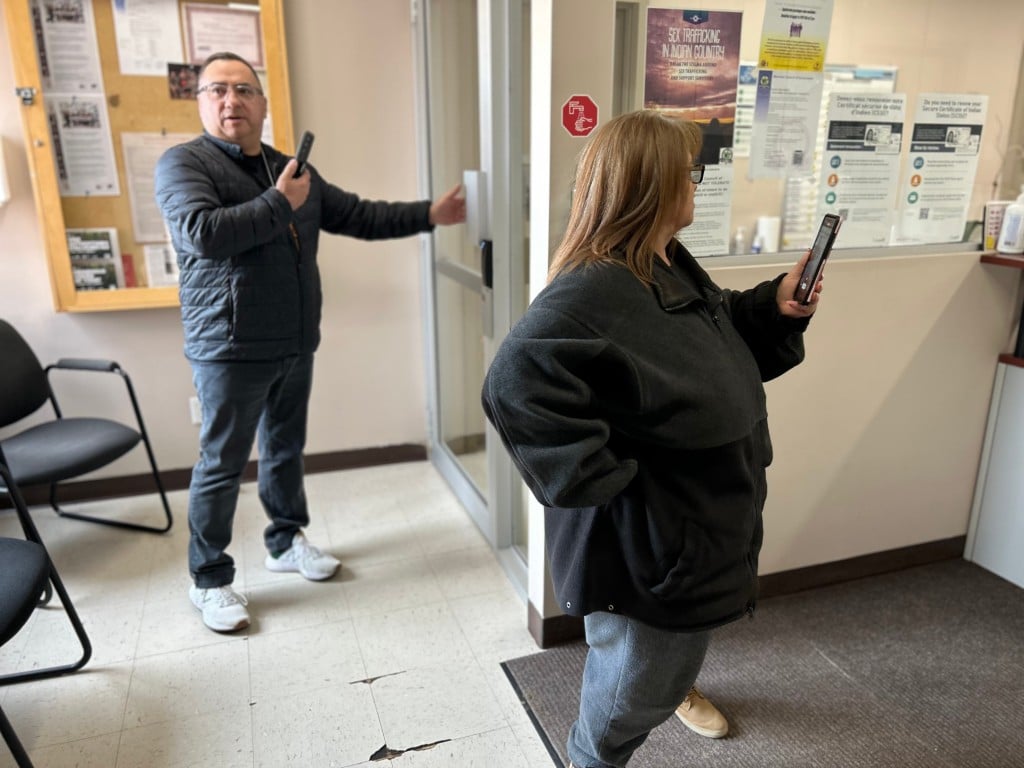
Grand Chief Victor Bonspille was locked out of his own office Friday. PHOTO: Chris Curtis
Victor Bonspille knew the door was locked but he pulled on it anyway, repeatedly slamming the latch into its metal frame.
“Otsi, can you let me in so I can get my stuff?” said Bonspille, while trying to barge into the Mohawk Council of Kanesatake’s (MCK) office last Friday.
“If anybody goes in my office and removes my items, you’ll face charges of breaking and entering. My office contains personal sacred items.”
Bonspille says he was illegally removed as grand chief of the MCK on March 26 in retaliation for his years-long crusade against corruption on council. His opponents claim that, since his mandate began, Bonspille has insisted on governing without their input.
Four years ago, Bonspille was elected on a promise to investigate allegations that high-ranking council members used federal funds to enrich themselves and their allies at the expense of the community.
Those allegations came from Kanehsatà:ke Mohawks who noticed unusual patterns in how federal aid money was distributed during the COVID-19 pandemic. Bonspille took on their cause, unseating longtime grand chief Serge “Otsi” Simon in 2021. After his election, the new grand chief ordered a forensic audit of the previous council’s finances and the findings led to a criminal investigation, which is still ongoing.
On Friday, Bonspille was locked out of the band office.
The grand chief and his sister Valerie, also an elected chief, “vacated” their positions over violations of Kanesatake’s electoral code, according to a March 26 ruling by the band’s Ethics Commission. Under Section 9.1.5 of the Code, a chief is not allowed to miss three meetings without a valid reason. Bonspille missed over 50.
After the MCK suspended Bonspille and Valerie in February 2024, the siblings asked for an appeals process to be put in place. That led to the Ethics Commission being created.
The confrontation inside the office last week was the culmination of over two years of political brinkmanship between Bonspille, his twin sister and the other five elected chiefs on council.
On one hand, Bonspille and his sister say they stopped attending council meetings two years ago after they became “too toxic.” During one meeting, in October 2022, an argument between Bonspille and the other chiefs degraded to the point where someone called the police.
After that incident, Bonspille says he offered to hold their weekly meetings online instead but this version of events has been challenged by the other chiefs. In the end, his continued absence from council was grounds for dismissal, according to the commission’s ruling.
For his part, Bonspille claims he continued his duties by meeting with political counterparts in Ottawa, holding community meetings he says the other chiefs would not attend and advancing whatever files he could with Valerie. Last week’s ruling means Bonspille can no longer run for grand chief in this year’s elections, according to the MCK.
He said he plans on running anyway.
“Call an election, let the people decide,” he shouted last Friday in a scene witnessed by The Rover. “Call an election!”
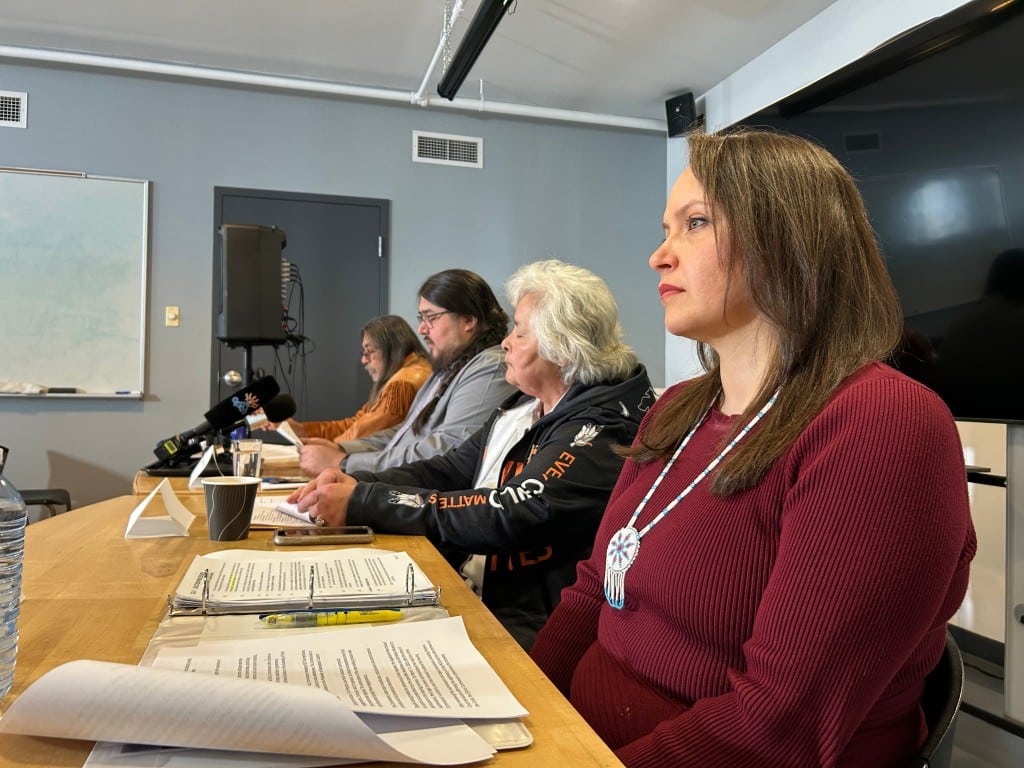
Left to right: Chiefs Serge Simon, Brant Etienne, Denise David and Amy Beauvais address Bonspille’s dismissal on Wednesday. PHOTO: Chris Curtis
When the news broke of the Ethics Commission decision on March 26, The Rover immediately contacted and met with Bonspille, who was attending a Assembly of First Nations Quebec-Labrador (AFNQL) meeting, still representing his community and casting his vote despite being dismissed. Bonspille said that the AFNQL was aware of the situation and still paying his accommodation to allow him to fulfill his duties. His salary now halted, Bonspille says he does not have money to pay legal fees to fight any longer.
On the other side of the political conflict, the remaining five chiefs on council — “Otsi” Simon, Brant Etienne, Amy Beauvais, Denise David and John Canatonquin — continued showing up to the office and caucusing among themselves in Bonspille’s absence. Whether or not the chiefs are bickering, over 2,000 Mohawks in the community rely on the council for access to healthcare, education, housing grants and a slough of other essential services.
Beyond those responsibilities, council has to make decisions about land claims while advocating for their community in Ottawa. A dysfunctional council bleeds out into nearly every aspect of life in Kanesatake, which sits next to the village of Oka some 45 minutes west of Montreal.
The past four years of political maneuvering have coincided with a series of calamities in Kanesatake. There was an illegal dumping scheme that saw truckers from off-reserve dump thousands of loads of contaminated soil on Mohawk land. Meanwhile, the cannabis shacks that started off as small family-owned businesses in 2018 have mutated into 24-hour bar, casino and entertainment complexes that have attracted a criminal element into town.
During a press conference explaining its decision to dismiss the Bonspilles, four MCK chiefs said his absence made handling these crises nearly impossible.
While Bonspille claims he’s itching to get on the campaign trail, the chiefs opposed to Bonspille are poised to delay the elections until July 31. They say it’s to match the date of the 2021 election, which had been delayed by two months because of COVID-19 restrictions.
Even so, this delay could be interpreted as a violation of the same electoral code used to justify Bonspille’s dismissal, according to Amanda Simon, the MCK’s former estates and lands manager. Amanda Simon posted this on Kanesatake’s private Facebook page Saturday.
According to the custom electoral code, adopted in 2015, elections are mandated to be held on the second Saturday of June. Council is also legally bound to appoint a chief electoral officer 120 days before the vote. That deadline expired on March 22 without anyone being appointed.
“No matter what happens from this point forward, the results of the election will probably be thrown out in court,” said one Kanesatake resident, who helped draft the code in 2015. The resident did not want their name published for fear of reprisals.
“Neither side of this fight is right. They’re both wrong.”
***
Bonspille says the origin of this political conflict is his insistence on investigating corruption.
He says things fell into dysfunction early during his mandate, when he signed a resolution ordering a forensic audit of the previous council’s alleged misuse of $3.98 million in emergency COVID-19 funds.
If, as Bonspille claims, his political opponents are opposed to his corruption investigation, that wasn’t always the case. Chiefs Brant Etienne, Denise David and John Canontonquin, all of whom now find themselves at odds with Bonspille, co-signed the resolution. They contracted the forensic accounting firm Williams, Meaden and Moore to conduct the audit.
Auditors found that former vice-chief Patricia Meilleur had collected over $469,000 in pay over 16 months. The annual salary for a council chief is just over $50,000. They also found that the Kanesatake’s health director received $279,000 to serve on the community’s COVID response team while collecting her full salary.
Another shocking detail: a limited liability corporation created by senior band council employees to handle aid money was registered at someone’s personal address instead of through the band office.
By the time the auditor’s conclusions became public in July 2022, vice-chief Meilleur had already lost her bid for re-election. She has repeatedly refused to comment on the audit. Meilleur has not been charged with any crime and none of the allegations against her have been tested in court.

An SQ investigator raids the Kanesatake band office in May, 2023. PHOTO: Chris Curtis
Chief Etienne told The Rover over the phone on March 27 that he considers nothing abnormal happened with the COVID funds given the nature of the emergency, and that emergencies require special measures that involve staff getting extra pay.
There were, in total, $1.2 million in emergency funds not distributed through the band’s standard payroll system, according to the audit. Some of the aid was set aside to compensate business owners for lost revenue during the COVID-19 lockdown. The fund helped family-owned construction companies, consulting firms and catering services stave off bankruptcy.
Bonspille and two sources close to the investigation say they believe there was also a “fraudulent” system put in place to “embezzle” the relief money through fake businesses.
In an email obtained by The Rover, Bonspille refers to a series of payments from the emergency fund to businesses that “do not exist.” The chiefs had asked Bonspille to sign off on $247,836 worth of funds that were distributed to local businesses during the pandemic. These payments, which generally range from $4,000 to $9,000, went to dozens of community members and businesses.
But Bonspille claims some of that cash ended up in the wrong hands.
“As I said to all of you, I do not agree with these disbursements and will not sign to this,” Bonspille wrote in the email, dated March 24, 2022. “It is not right or fair to pick and choose who is eligible. A number of these businesses do not exist and proper follow up was not done. If this is truly to help those affected by COVID, then everyone (in Kanesatake) should receive a payment.
“To pay large amounts to false businesses is a fraudulent act, and I will not be a part of this. I ran on transparency and honesty. If this is done, I will make this fraudulent act public.”
At Wednesday’s press conference, Etienne said it was Bonspille who attempted to enrich his family through the emergency fund. Etienne claims the former grand chief only raised the issue of fraudulent payments after he learned that his brother’s business wasn’t eligible for Covid relief. He did not provide documentation to support this claim.
Some cheques issued earlier in the Covid pandemic, in the meantime, did not follow community policy that requires transactions exceeding $5,000 to be approved by council. The Rover was given access to some of these documents, which show current Chief “Otsi” Simon — who was grand chief at the time — signed several cheques in excess of that amount without council approval.
“The fact is there was no process for the financial transfers during Covid,” Simon said, on Wednesday. “It wasn’t part of our regular funding agreement. So our finance team was scrambling to find a way to cover the costs and protect our community from this deadly virus. … It all went through the federal government. It was directed by Indian Affairs themselves and since this stupid thing began, they’ve been silent.”
In the context of the emergency, both MCK and Bonspille agree that it’s possible that the transactions that violated this policy are not necessarily nefarious. No one has been formally accused of any wrongdoing by the authorities. Simon told The Rover that he has not been interviewed by detectives or subpoenaed by the Crown.
“They sent my lawyer something but he said I didn’t even have to respond to it, so I didn’t,” Simon said.
And while vice-chief Meilleur was Simon’s closest ally on council, the audit shows his salary and any extra compensation he received during COVID was well within the norm.
A handful of community members and Bonspille took the audit’s findings and demanded an investigation by the Sûreté du Québec’s financial crimes division. Now, over two years into the probe, Quebec’s Crown prosecutor has until the end of May to file charges.
During Wednesday’s press conference, Otsi Simon said he had contacted the AFNQL and that he intends on asking the body to throw out all the votes Bonspille cast after his 2024 suspension. Simon and Brant also criticized the federal and provincial governments for continuing to address Bonspille as grand chief and meet with him despite the suspension.
“They need to respect our sovereignty,” said Simon.
Bonspille maintains that the band operates on unwritten rules passed down through Mohawk custom, which dictates that only the grand chief can call council meetings. He considers his absence from the council chiefs’ meetings irrelevant to the legal arguments since it is his and only his right, under custom, to call meetings.
He did not present any evidence to back this claim up to the Ethics Commission, which refused to grant him an extension. Bonspille did not show up to the hearing. “Otsi” Simon contends that council must abide by the 2015 Custom Electoral Code, which states nothing about grand chiefs having an exclusive right to call meetings.
However, one of the people who helped draft the Electoral Code told The Rover it is being selectively applied by both Simon and Bonspille. He added that work on the legal document was still underway as recently as 2022, but council stopped paying for lawyers to consult on the legal process, so the work just stopped.
“It’s still swiss cheese, this Code, it’s still full of holes,” they said. “I’m telling you it wouldn’t survive a court challenge.”
***
On Saturday, the remaining council chiefs held an online meeting to discuss the dismissal of Bonspille and Valerie.
It did not go well.
On the community’s private Facebook page, some Kanesatake residents complained they weren’t allowed to ask questions during the meeting. Others described the process as “shady” and “illegal.”
“Let’s be honest, the Ethics Commission was not created to strengthen governance or uphold ethics for future generations,” wrote Amanda Simon. “It was created unilaterally and in haste, with a single goal — to remove sitting officials. This wasn’t institution building. It was a political maneuver.”
Though there are about 2,000 band members in Kanesatake, council elections rarely draw more than a few hundred voters. MCK chiefs who spoke to The Rover conceded that politics in the community can be toxic and the climate of fear and infighting on council drives down voter participation.
One former chief said it goes deeper than that.
“This colonial system is, first and foremost, founded on the principle of economic growth, financial gain, competition and gaining power over everything else,” said the former chief, who did not want his name published. “There is so much collective trauma and paranoia from (the 1990 Oka Crisis), it spills over into our politics. Our land was taken from us, our language, our ways of life.
“Now we have these toxic politics. It won’t go anywhere until we fundamentally change the way our governance is structured.”
On Wednesday, Simon said he spoke with Quebec Indigenous Affairs Minister Ian Lafrenière, who told the chief he’s optimistic this summer’s elections will break the political gridlock.
But governance problems have plagued the MCK since it adopted the elected band council system in 1991. Almost all of the six grand chiefs elected since then — including Simon — have faced court challenges from their political rivals and presided over divided councils.
“First Nations across the country are facing issues that stem from colonization, disenfranchisement and so on,” said Etienne. “But that cannot be used to excuse every misdeed by an individual.”
Authors


Related Articles

Quebec Workers Experienced a “Counter Revolution” Under Jean Boulet: Experts
The outgoing labour minister leaves behind a legacy of attacking the Constitutional right to strike.
« Combien de mères avez-vous fait pleurer? »
À Montréal-Nord, la communauté se soulève contre la brutalité policière et le profilage racial.
“How Many Mothers Have You Made Cry?”
In Montréal-Nord, a community rises up against police brutality and racial profiling.
Comments (0)
There are no comments on this article.