
Organized Crime Could “Take Advantage” Of Political Turmoil on Mohawk Territory
Quebec’s Indigenous Affairs Minister warns Kanesatake council that criminals are entrenching themselves on the territory.
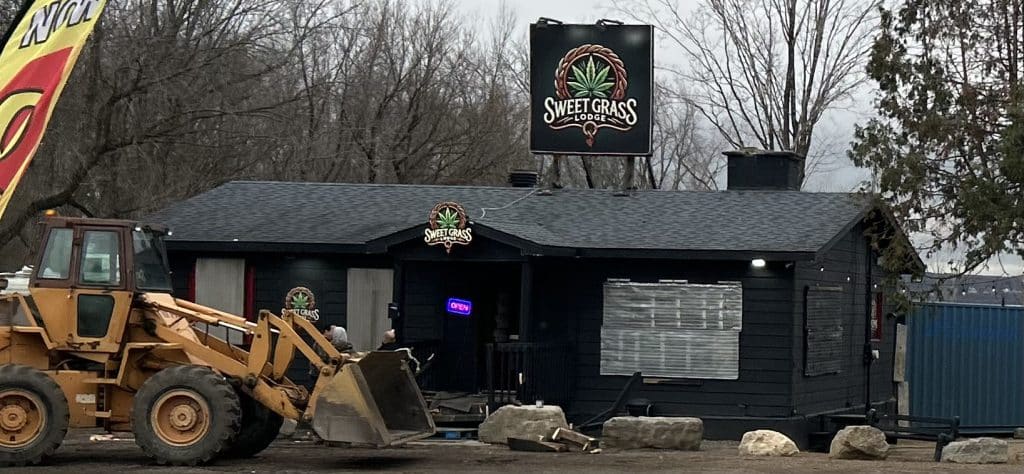
The Sweet Grass Lodge was the site of an early morning gunfight last November. PHOTO: Chris Curtis
Kanesatake’s band council is careening towards disaster.
Two chiefs have been sacked, a criminal investigation into the Kanien’kehá:ka (Mohawk) territory’s finances is ongoing and, depending on who you ask, the next band election is either on June 14 or Aug. 2.
Meanwhile, Council Chief Brant Etienne had his car’s windshield smashed shortly after introducing legislation that would regulate Kanehsatà:ke’s lucrative cannabis trade.
“The situation that persists is far from ideal,” wrote Quebec’s Indigenous Affairs Minister Ian Lafrenière, in an email to council. “I’m also concerned about the presence of organized crime, which can take advantage of this moment of vulnerability to pursue their operations.
“I’ve never hidden the fact that I have always been in contact with the two groups that have formed within the Council. You have both told me you’d like to see elections as soon as possible, and I believe that this is the right solution.”
Lafrenière sent the email as five of the six elected council chiefs were set to announce the firing of Grand Chief Victor Bonspille and his twin sister Valerie(also a chief) at a press conference on April 2. During a confrontation after he was locked out of his office that week, Bonspille vowed to win his job back at the ballot.
But if Minister Lafrenière was hoping an election will cool tensions in the community, he may be in for a rude awakening. Kanesatake’s former lands manager, Amanda Simon, told The Rover last week she thinks the election results will wind up being decided in federal court — no matter who wins.
“Unfortunately the council members have been taught the colonial way,” Simon said, during a community meeting. “We’ve been well taught. We act just like them. So it’s unfortunate but it’s the truth.”
Simon is running for council in this year’s election, which was scheduled for June. But the remaining five chiefs want the vote delayed six weeks — a violation of the band’s Custom Electoral Code. The five chiefs claim that to hold it on any other day but in August would also be a violation of the Code.
Both sides acknowledge the Code, ratified by council in 2015, is full of holes and appears to be contradicting itself on this matter.

Clifton Nicholas and Amanda Simon stand outside a community meeting on April 15, 2025. PHOTO: Chris Curtis
Section 12.22 of the Code stipulates that elections must be held every four years, on the second Saturday of June. But to run for grand chief, someone has to have served a full four-year term, according to Section 5.1.5.
“It’s unconstitutional,” said Tracy Cross, Kanesatake’s former chief of police, at the meeting last week. “It would never hold up in court. This isn’t how democracy works, you can’t just pick and choose your opposition by forcing them to serve a full term before they can run for grand chief.”
Here’s where things get even more confusing.
The last election, in 2021, was delayed by six weeks because of safety concerns over COVID-19. That means that if the election is held in June, each chief will be six weeks short of a full term and therefore ineligible to run for Grand Chief.
In an attempt to clear up the confusion, the five chiefs’ lawyer wrote a letter to Simon last month, stating that the election can be delayed because the rule about a full term supersedes the rule about June elections.
Simon says this is political maneuvering disguised as legal advice.
“It’s not the role of the legal counsel to act as judge and jury, to reinterpret the code or to decide that one clause takes precedence over another,” Simon said at last week’s meeting. “These clauses are not in conflict, they hold equal weight and must be read in harmony. Not twisted for political convenience.
“It’s about rules, nothing more. This is about turning around and calling the election when the election is supposed to be called. And that is June 14. There’s no other way around it.”
If you’re still confused, so is everyone else.

Victor and Valerie Bonspille confront their colleagues after being locked out of the band office. PHOTO: Chris Curtis
When did things on council fall apart?
Victor Bonspille claims the origin of the conflict between himself, his sister and the other five chiefs is ultimately about corruption.
Four years ago, Bonspille was elected Grand Chief on a promise to investigate allegations that band council employees — and possibly the vice chief — were using federal funds to enrich themselves and their allies.
This information came from Mohawk whistleblowers who noticed unusual patterns in how COVID-19 relief funds were being dispersed throughout the community.
Bonspille won the day, in 2021, and unseated longtime Grand Chief Serge “Otsi” Simon in the process. One of his first resolutions, on council, was to order a forensic audit of the emergency funds by an outside firm. The firm’s findings were alarming.
Most notably, it found that former vice chief Patricia Meilleur collected $469,000 in pay over a 16-month period. A council chief’s salary is normally around $50,000. The audit also found payments to businesses that don’t exist and business relief payments to people receiving social assistance. It also forced the director of Kanesatake’s health centre to resign after it was found she collected $279,000 in emergency COVID funds in addition to her salary over a 16-month period.
None of this has been proven in court and no one has been charged with a crime. An investigation by the Sûreté du Québec’s financial crimes division is ongoing.
Three of the five chiefs currently opposing Bonspille signed on to the audit. But Bonspille claims things went sour in the Spring of 2022, when he wanted to take a closer look at emergency payments made out to local businesses.
“I do not agree with these disbursements and I will not sign on to this,” Bonspille wrote, in a March 24, 2022 email to council. “A number of these businesses do not exist and a proper follow up was not done. … To pay large amounts to a false business is a fraudulent act, and I will not be part of this.”
Soon afterwards, Bonspille and Valerie stopped attending council meetings, claiming things had become too toxic to continue. In the interim, the rest of the council continued to meet weekly. Bonspille’s continued absence from council was a violation of the 2015 Electoral Code, which stipulates that a chief who misses three meetings without a valid reason will be removed from office.
The Bonspilles missed about 50. They were removed from their positions last month after a disciplinary committee — created by the five chiefs and their lawyers — ruled that they were in violation of the Code.
Most of Bonspille’s mandate was eaten up by legal battles and infighting. As Minister Lafrenière alluded to in his email, this coincided with a rise in the presence of organized crime on the Mohawk territory.
Sources inside the community told The Rover they blame both sides of this conflict for their unwillingness to mediate a better solution.
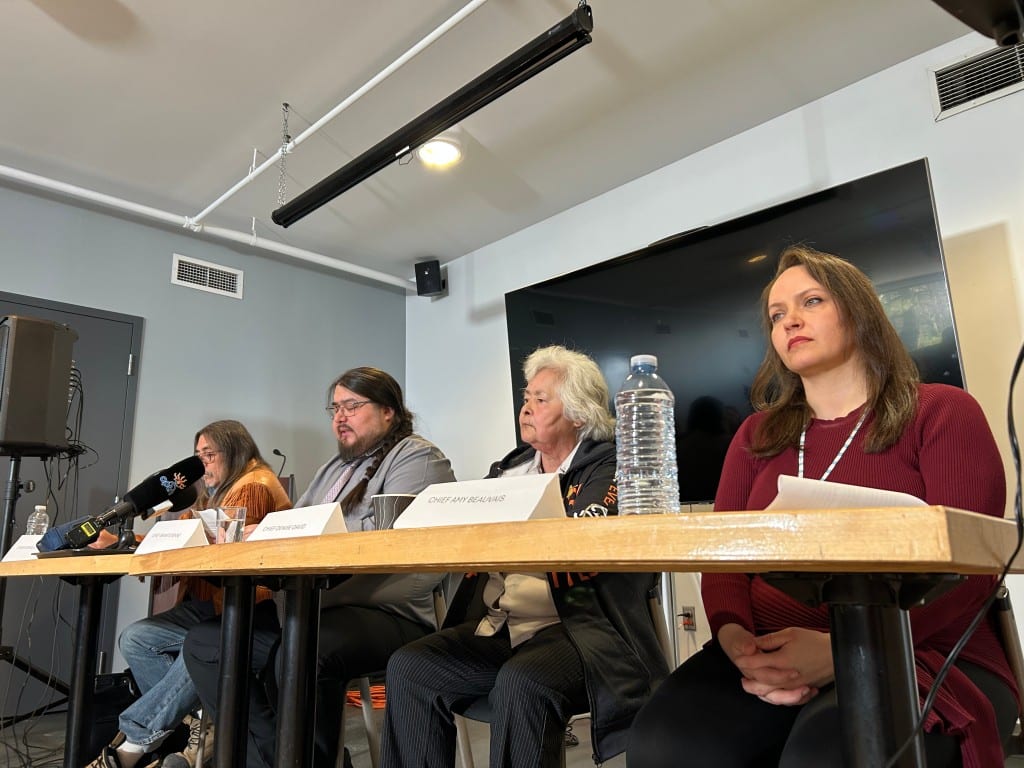
Left to right: Chiefs Serge Simon, Brant Etienne, Denise David and Amy Beauvais. PHOTO: Chris Curtis
Organized crime, illegal dumping and the cannabis industry
The political crisis coincides with two separate but related crises in Kanesatake.
The first: many of the family-owned cannabis shacks that once dotted the road that passes through Mohawk territory were replaced by enormous plazas with links to Montreal gangsters, bikers and other criminals. No longer content to just sell weed, the plazas started selling alcohol, running slot machines and holding events that draw thousands of outsiders onto the reserve. There have been two high-profile instances of drivers coming from outside the reserve, getting drunk at one of the plazas and crashing on their way home.
The second: to build these complexes along the Lake of Two Mountains, the developers began working with outside trucking companies to dump contaminated soil directly into the lake so they could expand their waterfront property. This scheme, uncovered by The Rover, triggered a criminal investigation into violations of the Fisheries Act — a federal law that includes steep fines and prison time.
One of those lakeside properties, Sweet Grass Lodge, was the site of a shootout on Nov. 21 of last year. Sources told The Rover that a man in a stolen car rammed the dispensary and opened fire with an automatic small-calibre pistol. He managed to escape, but not before someone emerged from behind the property and returned fire.
Clifton Nicholas, who opened the first Mohawk cannabis dispensary in 2018, told The Rover the industry has been taken over by bandits. When Nicholas founded Kanesatake’s cannabis industry, he wanted to help people use cannabis for medicinal purposes just as he had used it to treat his PTSD.
“I dreamed of an industry where it was run by the community and for the community,” Nicholas said. “You know, we put all the money in a pot and then all of our community gets a dividend cheque each financial quarter.”
Knowing the potential for outsiders to infiltrate the cannabis trade, he approached “Otsi” Simon in 2018 and offered to help regulate the industry. He says Otsi, who was the grand chief at the time, laughed in his face.
“Two years before all this stuff started happening, I approached council. I said, ‘We need a plan. Let’s do something,’” Nicholas said. “Nothing happened.”
In a conversation with The Rover, Otsi said Nicholas’ plan amounted to self-regulation and simply wouldn’t work.
“If that’s how Otsi feels, we could have sat down and hashed it out, but he refused to,” said Nicholas. “People are sick and tired of this. We need a change.”
In an attempt to get the industry under control, Brant and three other council chiefs passed a lawmaking process last winter that could impose restrictions on cannabis shop owners. His car window was smashed days later.
“This stuff always seems to happen after dealing with something contentious in the community,” Brant told The Eastern Door. “I’m not particularly afraid of this stuff.”
What comes next?
If the election is going to be held in June, it is already in violation of the Electoral Code.
Section 12.2 of the Code states that council must appoint a chief electoral officer (CEO) to oversee the vote no later than 120 days before the election. That deadline expired in March.
Last week, the five remaining chiefs announced the election would be in August and that they’re taking applications for the position of CEO. Local elders and one other expert who worked on the Code say it’s being selectively applied by both sides of this political conflict.
“I hope whoever gets elected, they will make it their priority to reform the Electoral Code,” said Amanda Simon. “Because it needs reform. Because it was written for a certain council. Because it was written for that council instead of opening it up to have new voices, to have new blood in council they choose to run their councils like a pack of wolves.”
Though Simon and Otsi find themselves at odds over a number of issues, on this they agree.
“Absolutely that should be a top priority of the next council,” Otsi told The Rover. “We can’t go on like this. We do need new blood, we do need an Electoral Code that’s more inclusive.”
Author

Related Articles

Will Bill 21 ‘Erase’ a Generation of Muslim Teachers from Quebec?
The legal battle over Quebec’s religious symbols ban has reached the Supreme Court in a case that will make Canadian history.
Nunavik Police Get a Pay Raise Amid Community Concerns
Inuit activists say the pay raise should match police efforts to rebuild trust with the communities.

Montreal Police Pressured Community Leaders not to Attend Vigil for Abisay Cruz
Sources say that while police spoke of listening to community after the killing of Cruz, they took a much harsher line behind the scenes.
Comments (0)
There are no comments on this article.