
A Dirty Business, in Kanesatake and Across Quebec
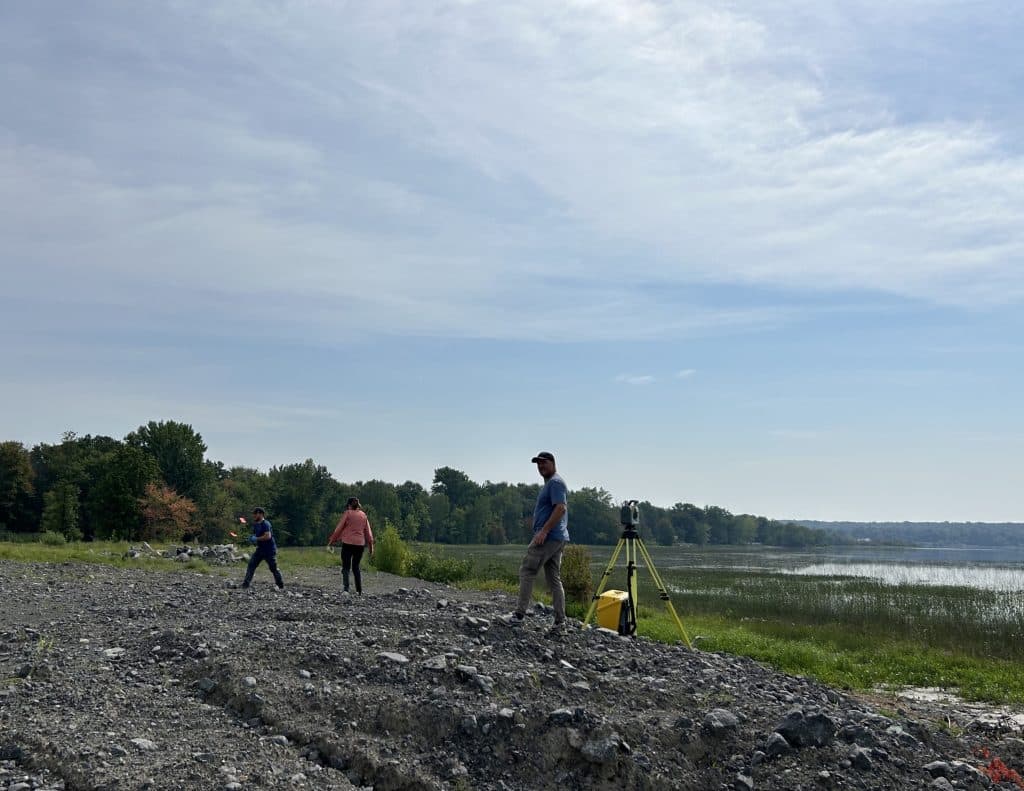
One million tonnes of contaminated soil disappear from Quebec each year. After the province collected soil samples from Mohawk territory last week, experts say Kanesatake is just the tip of the iceberg.

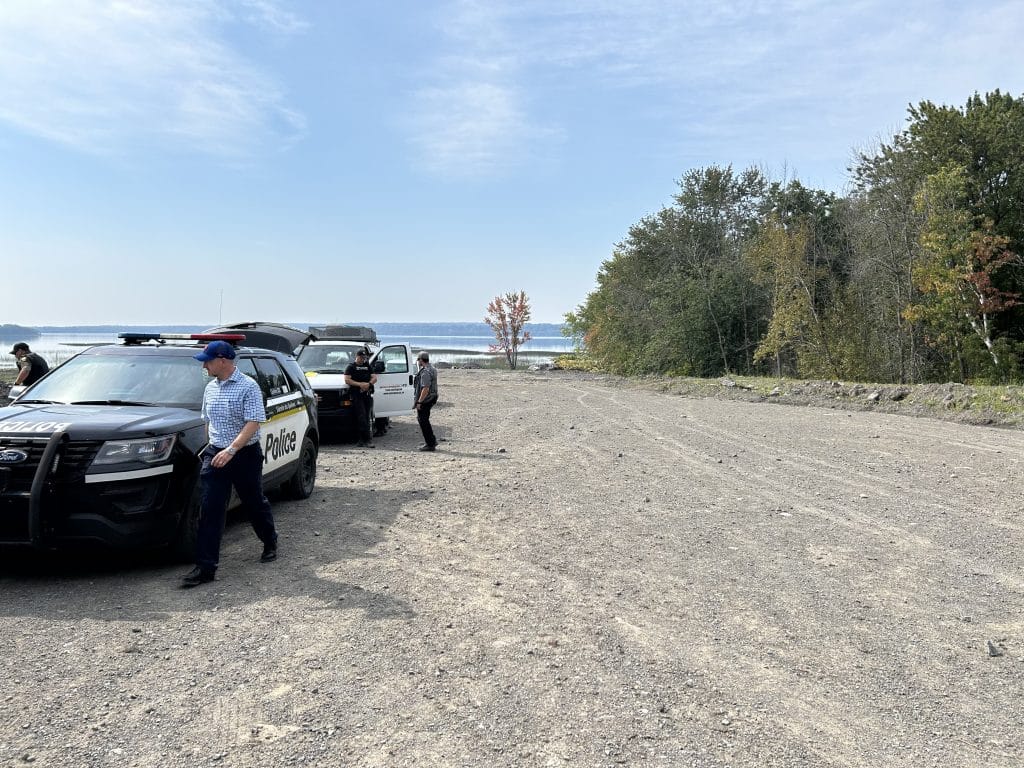
Sûreté du Québec officers escorted provincial conservation officer to collect soil samples in Kanesatake on the morning of Aug. 27. PHOTO: Chris Curtis
It was almost easy, in the end.
There was no show of force by police, no parade of lights and sirens to wake up half the rez on the first day of school. Instead, the Sûreté du Québec quietly rolled into Kanesatake on the morning of Aug. 27, escorting biologists and conservation officers onto the old bingo grounds.
Privately, some of the cops worried news of their presence would trigger a massive response: masked warriors blockading the road and folks using bulldozers to keep the convoy out as they hardened their defenses.
But their fears were ill-founded.
As the team gathered soil and water samples from the illegal dump site that morning, a stray dog wandered into their midst, moving on after one of the officers gave his ears a scratch. That was about as much action as they saw. The cops and conservation officers were allowed to do their work in peace because people on the reserve have been asking them to for years.
Last week’s operation was aimed at six dump sites along the Ottawa River, where experts are beginning to assess the extent of the environmental devastation.
SUPPORT YOUR LOCAL TROUBLEMAKERS!
In an Aug. 27 statement released to the press, Quebec’s Environment Minister said there could be upwards of $1 million in fines to each person involved in the scheme and $6 million from companies that sought to profit off the destruction of Indigenous land. This destruction is upending what little is left of the once sprawling Kanien’kehá:ka (Mohawk) territory.
Since 2015, excavation companies digging the foundations of new condo towers and housing developments in Montreal have taken contaminated soil from those job sites and dumped it on landfills in Kanesatake. Under Quebec law, they’re supposed to test the soil and — if it contains hydrocarbons or other contaminants — dispose of it in a provincially-mandated landfill. This costs upwards of $3,000 per truckload.
Instead, these firms make secret deals with a handful of landowners on the territory, forking over a few hundred bucks per load to use the land as their private dumping ground. Three experts interviewed by The Rover say that, on a big enough job site, illegal dumping can save a contractor millions in disposal fees.
The real cost of these savings are borne by Mohawk families who’ve seen their shoreline go from a wetland bursting with life to a hare grey slab lined with chunks of asphalt. It’s these families, the ones who worry their water supply is slowly being poisoned, that fought for years to see last week’s inspection of the dump sites happen.
This network of Mohawk whistleblowers has been operating behind the scenes for years, gathering videos, photos, secret recordings and putting their safety at risk to pass that evidence along to journalists. One source says he won’t go exploring the sites without a shotgun under the dashboard.
“These guys, the ones involved in the dumping, I’ve seen them put a pretty bad beating on someone,” said George*, who took The Rover on a tour of over a dozen illegal sites in June. “I ain’t scared of them but I ain’t calling the cops on them either. They’re just not going to catch me with my guard down. They depend on you to back down, to be scared because these guys know where you live and they know who your family is.”
It was these members of the community — not Ottawa or Quebec City — who collected enough evidence to present it at Parliamentary subcommittee meetings, champion new federal legislation with Green Party Leader Elizabeth May and ultimately push Quebec to enforce its own laws.
Officials from both governments have admitted as much in private conversation and off-the-record interviews.
“I don’t think we’d be here if it weren’t for all the news reports,” said one Quebec government source, who was involved in last week’s operation. “We’ve known about this for years and many of us pushed for a forceful response much earlier. But our bosses — or I should say our bosses’ bosses — only started listening when the news reports surfaced last spring.
“None of that would have been possible without people in the community advancing the investigation.”
***
Sûreté du Québec officers escorted provincial conservation officer to collect soil samples in Kanesatake on the morning of Aug. 27. PHOTO: Chris Curtis
Quebec has struggled to contain illegal dumping in Kanesatake since the problem began spiralling out of control in 2015.
Back then, the market was dominated by two Mohawk brothers who owned a recycling centre on the west side of the territory. Gary and Robert Gabriel operated a centre that was licensed, by the Quebec government, to house just under 30,000 cubic meters of waste.
By the time Quebec shut them down in 2020, the Gabriel brothers had allowed roughly 400,000 cubic meters on site, producing so much methane gas that the mound of trash would spontaneously catch fire, according to provincial inspection reports.
Successive provincial governments have blamed jurisdictional overlap with Ottawa and alluded to historic tensions between Quebec and the Mohawks to justify inaction. In emails obtained by The Rover, two Mohawk whistleblowers are told, by provincial officials, to take their health and safety complaints to Ottawa since Indigenous land is a Crown jurisdiction.
When they followed up, the whistleblowers were told by the federal government to refer the matter to Quebec or their band council since environmental issues are a provincial jurisdiction. But because the pollution in Kanesatake is seeping into the Lake of Two Mountains, it also falls under the purview of Oceans and Fisheries Canada.
Making matters even more complicated, both levels of government deal with an elected band council that was imposed on Kanesatake by the Indian Act — whose authority isn’t recognized by many of the 2,000 people living on the territory and in neighbouring Oka.
Trying to untangle the politics of it can be a mess, but one band council chief says much of this distracts from a larger problem in the Quebec construction industry.
Chief Brant Etienne says the prevalence of influence peddling, bid rigging and mafia connections in construction are as relevant now as they were during the public inquiry into the industry back in 2012. Etienne says Quebec still hasn’t done enough to combat the kind of dirty tactics outlined during the Charbonneau Commission.
“The behaviour of these (construction companies) is exactly the behaviour of companies laid out in the Charbonneau Report,” he said. “So when you’re looking at the question of what’s motivating this: it’s organized crime, it’s greed, it’s disregard for not just the sovereignty of Kanesatake but also in non-Native communities as well.
“It’s a known fact that this type of dumping happens on farmland and all over the province. We’re the squeaky wheel, we’ll get the grease, but it’s a systemic issue. As long as governments aren’t prepared to stamp out organized crime, this is going to continue happening. It’s a pan-Canadian, pan-North American problem.”

Mohawk Council of Kanesatake Chief Brant Etienne standing in front of the band council’s offices in Kanesatake. PHOTO: Chris Curtis
Indeed, one of the main companies involved in the Kanesatake scheme, Nexus Construction, is owned by two brothers who were partners in one of the businesses taken down by Quebec’s UPAC anti corruption taskforce.
Nexus owners Romeo and Tony Sacchetti were 50 per cent owners of Groupe Triforce between 2010 and 2013 — a period that saw the company secure over a dozen government contracts through illicit means. Neither of Nexus’ owners were charged or convicted in the scheme, and the company did not respond to repeated interview requests.
But their former partner Giuseppe Nuccio pleaded guilty in 2020 to bribing a Hydro-Québec official with hockey tickets, weekend getaways and a job for the official’s daughter. In exchange, Nuccio secured snow removal contracts spanning 40 sites owned by the public utility. Nuccio and the Sacchettis parted ways in 2013 during a bitter legal dispute that devolved into accusations of theft and fraud between the parties.
In sworn testimony, Nuccio claims to have involved six other companies in the scheme, collecting “hundreds of thousands of dollars” in payment from the firms to give them access to his Hydro-Québec contracts. This happened while he ran Triforce with the Sacchettis and their wives, whose names had to be on all official documents since the brothers previously declared bankruptcy.
At least one other firm that secured a snow removal contract through Nuccio is believed to be involved in the Kanesatake dumping, according to two police sources.
Reporting by The Rover and La Presse throughout this summer found Nexus trucks taking contaminated soil from condo development sites in Montreal and Laval and dumping them on Mohawk land. At its peak, earlier this summer, the scheme involved hundreds of truckloads of contaminated soil per day.
Three excavation industry insiders told The Rover they aren’t surprised that there are ties between the Kanesatake scheme and contractors who used to be in business with a convicted criminal.
“A lot of these companies are linked — either closely or a few steps removed — to organized crime,” said Yves, one of the foremost experts on contaminated soil in Quebec.
Yves did not want his real name published for fear of reprisals, but he’s been in the industry for over 30 years and worked closely with Liberal, Parti Québécois and Coalition Avenir Québec governments.
“It’s not like there are hundreds of companies doing this, it’s almost always the same guys,” he continued. “There are maybe 10 or 15 major players — and sometimes it’s the same companies with a different name — but it’s always basically the same guys. The inspectors know them, the investigators know them, but it’s hard to pin anything on them.”
It doesn’t help that Kanesatake has no local police force and depends entirely on an SQ detachment to patrol the territory from its headquarters seven kilometres east. Two sources in Kanesatake told The Rover they called 911 on a neighbour firing rounds of his AK-47 assault rifle into air last year only to have police show up an hour later.
They said they stopped calling the cops after that.
Sûreté du Québec officers escorted provincial conservation officer to collect soil samples in Kanesatake on the morning of Aug. 27. PHOTO: Chris Curtis
Another construction industry insider, who we’ll call Stéphane, says Quebec has the means and the system in place to track every single shipment of contaminated soil in the province but does little to enforce the rules.
Developed in response to tightening provincial regulations around the disposal of contaminated soil, Traces Québec is a system that can track shipments in real-time. One of the engineers who built the software told The Rover it’s on par with the best comparable software in any other North American jurisdiction.
Of course, that’s only true if the system is actually being used.
“It’s a system that’s entirely dependent on the goodwill and voluntary participation of contractors,” said Stéphane, who did not want his real name published for fear of professional reprisals. “If you want to get rid of your soil in a sand pit, nothing’s forcing you to have a soil test done. You just tell them it’s clean soil. That’s how it works. It’s not like the cops are going to pull you over and do a lab test on the side of the road.
“What we have, in Quebec, are environmental inspectors who are often right out of college. So you might have a 19-year-old kid who is about four feet tall and a hundred pounds soaking wet, pulling over a 300-pound trucker with tattoos up to his face. When someone like that tells you, ‘Fuck off, kid! I’ll rip your head off!’ you’re not going to push back.”
Companies that register their shipments with Traces Quebec have to pay $2.13 for every tonne entered into the database. This alone adds an extra $40 to each truckload of soil in addition to disposal costs.
It’s also known within the industry that there’s a major shortage of conservation officers to enforce environmental laws in Quebec. There are about 315 conservation officers tasked with overseeing a territory three times the size of France. In 2018, there were 378 officers working for the province, but a slew of retirements and a stoppage in officer training during the COVID-19 pandemic mean staffing levels are unusually low.
What this lack of enforcement means, in practice, is that there are up to 900,000 tonnes of contaminated soil going untraced every year in Quebec, according to the government’s own estimates. But that may be a conservative figure.
One insider was among the consultants who helped Quebec grasp the scale of illegal dumping in the province. He said it’s far more likely there’s over 1 million untraced tonnes, representing anywhere between 10 and 25 per cent of the contaminated soil dumped every year in Quebec.
“This is pollution on a scale that’s difficult to imagine,” said Grégoire, a government consultant who is not authorized to speak on the record. “What’s more, it’s all happening in the private sector. With big government contracts — like building a highway or a bridge — it’s too risky to try dumping illegally. It’s all those big commercial projects: condos, mini-malls, housing developments, that’s where it’s a huge problem.”
***

A map showing the location of dump sites in and around Kanesatake visited by The Rover in June 2024.
Given how flagrant the dumping has been, Chief Etienne and others wonder how Quebec’s UPAC task force hasn’t gotten involved.
One former UPAC official, who spoke to The Rover on condition of anonymity, says the scam may have been designed to circumvent the task force’s mandate.
“There was a scam involving the disposal of contaminated soil some years ago,” the official said. “Back then, there was a government subsidy to transport and dispose of contaminated soil. People would forge truck manifests to make it seem like they’d gotten rid of 100 loads when, in reality, they’d only get rid of, say, 20.
“You’d also have to — for each foot of contaminated soil you dug from the earth — you had to replace it with three feet of clean soil. But no one checked so they’d charge the government for moving a six-foot hole’s worth of contaminated soil when most of that soil never left the site. So unless the scam in Kanesatake involves this government fund, it’s probably not within UPAC’s mandate.
“UPAC’s job is to make sure the government isn’t being defrauded by contractors. They don’t do work in the private sector, where this kind of practice is far more widespread. It’s a lot harder to pull this kind of scam on a job site where your client is the Transport Ministry. They’re going to ask you for documentation.”
The former UPAC official said the extent of criminal involvement in illegal dumping is obscured by the fact that so many corrupt firms have become experts at hiding in plain sight.
“A lot of these construction companies, the name on the documents is just a straw man,” they said. “The real owners can’t be seen to be involved in the business because of their criminal connections. We’ve seen it, in the excavation industry, with trucking companies that had links to the Hells Angels, some companies will declare bankruptcy, change names but it’s all the same players.
“I can’t tell you for certain who’s involved in the (Kanesatake) dumping. I can say that, in the past, this is exactly the kind of scam that would attract a criminal element.”
When Marc Miller was Indigenous Services minister, from 2019 to 2021, he worked closely on the Kanesatake file and found that it’s impossible to speak about illegal dumping without first addressing the question of who really controls Mohawk land.
“People talk about governance issues on the band council but you have to realize that these are all a product of Canada imposing the council system through the Indian Act,” Miller said, in an interview with The Rover. “There’s the issue of land theft that’s occurred historically with Oka. And when you talk about it and people say ‘what does that have to do with illegal dumping?’ Well, I think, it’s created a void where people can exploit vulnerabilities.
“It’s the same issue with drugs, it’s the same issue with anything ‘bad’ you see going on in Kanesatake. The source is usually external. And then you add all the trauma onto a community that’s been particularly badly served by our governments, there’s a real vulnerability there.
“It should be no surprise to anyone that, quite outside of this being identified as an Indigenous issue, there’s a lot of non-Indigenous people that exploited those vulnerabilities. It can’t be that hard to crack down on people going into the community to do something illegal. Whether that’s illicit drugs or illicit dumping.”
During his time on the file, Miller worked on a $100 million plan to begin remediating the Gabriel brothers’ dump site. The plan was announced publicly for the first time last spring but it immediately created a rift on band council.
Though a majority of councillors approve of a plan to hire the Indigenous-owned consulting firm W8banaki, Grand Chief Victor Bonspille has expressed doubts about the company’s capacity to undertake such a massive project. The only other work W8banaki did on the territory — an asbestos removal job at the local high school in 2022 — was mired in safety code violations and other difficulties, according to band council emails obtained by The Rover.
Those concerns are shared by Jean-Denis Garon, the Bloc Québécois MP whose riding is in Mohawk territory. Garon told La Presse he doesn’t believe W8banaki has the track record to pull the job off.
Regardless, the firm will move forward with remedial work. The only problem is, none of that $100 million contract deals with the more than 12 dumps that have spread across the territory since the Gabriels’ site closed four years ago.
“We’re about to have a much clearer picture of the damage and it’s not going to be an easy fix,” said Chief Etienne. “I don’t doubt our people’s ability to bring back the land. We’ll get it done. I know that, above all other concerns, we are a people who care for this land and we’ll care for it as long as we exist in this place.
“What kills me, what kills us, is the divisions and the violence that have been stoked. Excuse my language but we need to move past this bullshit, we need to have true sovereignty over our own land and we need it now.”
Like what we do? Support The Rover. Help us tell stories you won’t find anywhere else.
Author

Comments (1)
Leave a comment
Related Articles

Le refus de l’asile à Ranjit Singh
Militant pour le mouvement indépendantiste sikh de l’État du Pendjab, au nord de l’Inde, Ranjit Singh fuit les persécutions policières pour trouver refuge au Canada en 2019. Il y a deux semaines, sa demande d’asile est rejetée et sa déportation prévue le vendredi 6 mars 2026.

The Refusal of Asylum to Ranjit Singh
An activist for the Sikh independence movement in the state of Punjab, Ranjit Singh fled police persecution to seek refuge in Canada in 2019. Two weeks ago, his asylum application was rejected, his deportation scheduled for March 6.

Faced with a ‘Time Bomb Budget,’ the STM Turns to Real Estate for Revenue
Montreal’s transit body wants more money for crumbling infrastructure, continues negotiations with maintenance workers.
“Instead, these firms make secret deals with a handful of landowners on the territory, forking over a few hundred bucks per load to use the land as their private dumping ground.”Sounds to me that whoever is responsible for making these deals should be delt with. Whether this happens or not, depends on the Band Council and the Peace Keepers