
A Funeral March for Dead Venues
Montreal’s indie cultural scene is in trouble. A funeral march honoured once-vibrant show venues that have been swallowed up by rising rents and gentrification.

The booming sound of the Van Hornies’ brass band carried through Jeanne-Mance Park on Sunday, attracting curious park-goers and dog walkers. But beneath the melody of George Michael’s Careless Whisper was mourning.
This was no summer celebration; it was a funeral.
The collective Réverbérations d’une crise organized the Marche Funèbre pour les Lieux Disparus (funeral march for disappeared venues). Made up of artists and tenants, this collective uses sound-based actions to explore and protest the impacts of the housing crisis on cultural spaces in Montreal.
The event mourned the closure of independent arts venues in the Plateau-Mile-End area. The idea of a funeral march aligns with the collective’s approach: blending activism and performance to make these losses heard, not just seen.
Hubert Gendron-Blais, a member of the collective, expected the attendees to be “people directly touched by these dead venues, people who love art, people who love music, but also people who think that the city isn’t going in a good direction.”
Support Independent Journalism.
Over the last decade, at least a dozen small or underground venues have closed their doors, from Le Divan Orange in 2018 to La Tulipe in 2024.
These closures reflect a larger problem: a systemic unravelling of Montreal’s independent arts scene and a growing threat to the city’s creative communities.
These smaller venues earned Montreal its reputation as a cultural hub, and they are what made Montreal’s nightlife so vibrant and unique. They provided spaces for less mainstream, more experimental artists to develop as musicians, gain exposure, and even build a fan base. And despite the city of Montreal continuing to boast its nightlife to tourists, these spaces are closing at an alarming rate.
Gendron-Blais explained that there are three dimensions to consider in the loss of these venues: the rise in rent, noise complaints, and gentrification. At each stop on the march, the stories of the venues’ struggle demonstrate at least one of these dimensions.
STOP #1 – Le Divan Orange
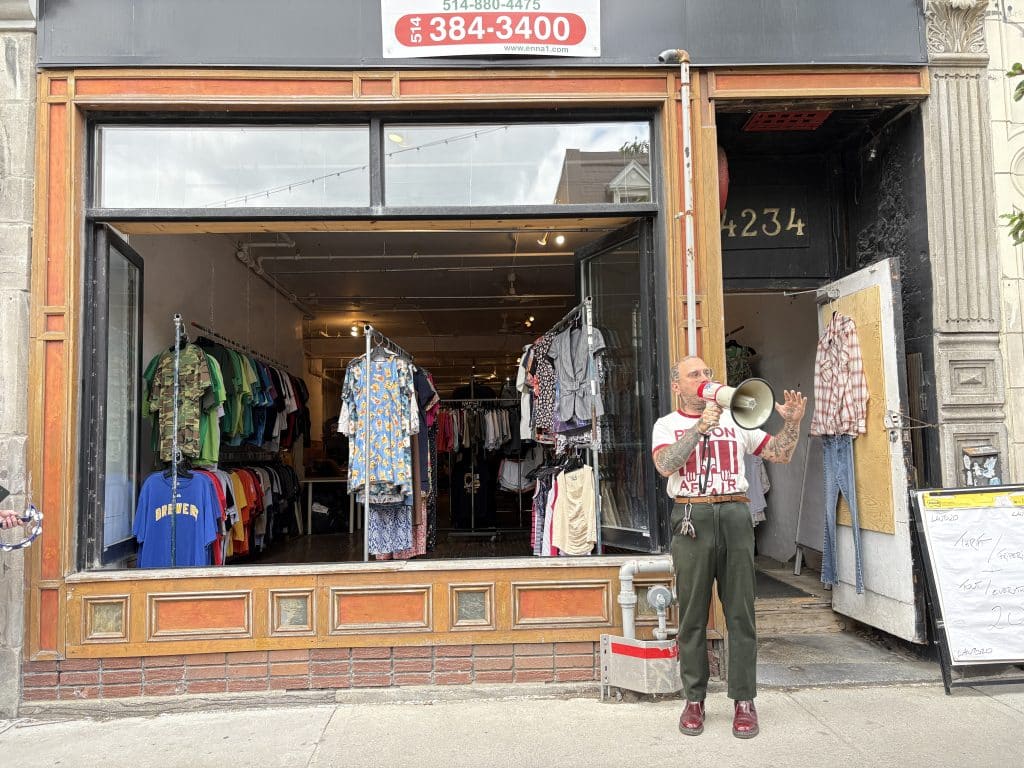
“When Divan Orange closed, I knew it was the beginning of something, and unfortunately, I was right,” said Gendron-Blais.
Michel Tremblay worked at Le Divan Orange for 12 years and witnessed firsthand the energy it brought to the Plateau-Mile-End. It hosted over 10,000 shows, but it was also a place that blurred musical and linguistic boundaries.
“Divan Orange brought a sort of energy into this area, where Francophones and Anglophones could mix,” he said. “It was kind of special because it was catering to both communities in a sense.”
The venue attracted local and international talent, as well as musicians passing through from the Festival de musique émergente (FME) in Abitibi, including guitarist Marc Ribot.
Despite this, Le Divan Orange became the target of relentless noise complaints, mostly from a single tenant in the building.
After racking up nearly $20,000 in fines, with tickets averaging about $1,000 each, Divan Orange hired lawyers to contest the fines, adding yet another expense. Unfortunately, the venue still had to pay about half of what was owed.
Le Divan Orange even paid the complaining tenant to move.
“We had to pay her a lump sum to move somewhere else,” Tremblay said. “According to the city and the borough, that was the only way out.”
Notably, the tenant renewed her lease in this building despite previously living above Le Divan Orange, but this wasn’t taken into consideration by the police addressing her repeated noise complaints.
While the venue was battling these noise complaints, artists became hesitant to perform at Le Divan Orange because there was a chance that the police would show up before they could finish their set.
Montreal’s new Nightlife Policy, which came into effect on May 1, offers soundproofing grants for small venues (with under 3,000 seats) and encourages boroughs to adopt more flexible noise regulations, like using spectral emergence to better measure noise impact. Support like this might have saved Le Divan Orange and any other venues forced to close over noise complaints.
As the funeral marchers made their first stop in front of what was once Le Divan Orange – now a friperie – Sergio Da Silva, co-founder of TurboHaüs, took to the megaphone: “These are places that are not just bars where you go to have drinks, these are places where you create community, these are places where you create culture, these are… places where you fall in love, with the city, with the people around you.”
STOP #2 – Le Cagibi
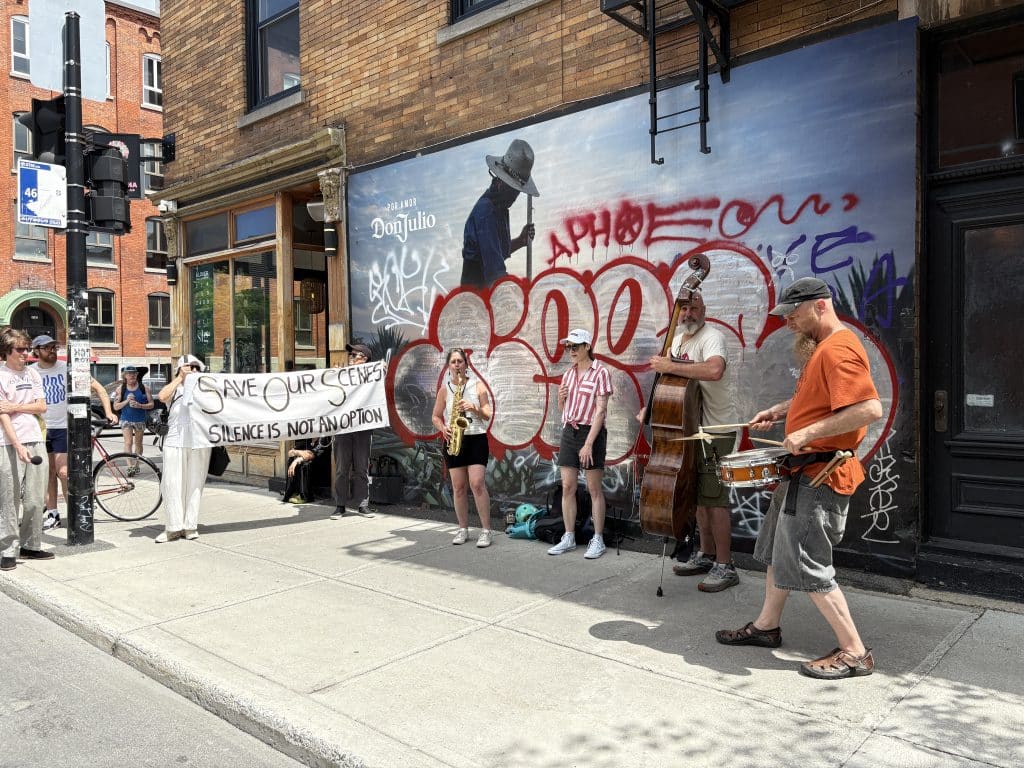
Le Cagibi was known for its experimental and punk music shows, and oddly enough, for its homemade desserts.
“The food there was really great. There was the woman that made the cakes, I called her the ‘cake woman,’ she lived upstairs… Everything was good about that place,” said Kevin Segal, who performed once at Le Cagibi and attended the march.
In 2017, both the music and the baking stopped. SLG Realty, the venue’s landlord, carried out a renoviction which forced Le Cagibi to close.
Gendron-Blais credited this renoviction to Ubisoft opening its office nearby a few years earlier: “the landlord wanted to double the rent to open a restaurant… It was like, ‘Oh wow, I could just double the rent and have a fancy restaurant where they could have their lunch.’”
SLG also targeted the nearby Welsh bookstore, Llety, attempting to push them out under similar renoviction pretenses.
Renovictions in Montreal increased by 229 per cent from 2022 to 2023, rising from 288 to 949 cases, according to a December 2023 report by the Regroupement des comités logement et associations de locataires du Québec (RCLALQ). This tends to impact businesses more severely than residential tenants, since commercial rents are less regulated, and landlords can raise them more freely after renovations.
“All these spaces, it’s because they’re marginal. They’re not McDonald’s, they’re not Place des Arts. They’re run by these weird people doing their own thing, and yet that place was so community,” said Segal. He described Le Cagibi’s original space as “super raw, for me, in the best way possible.”
STOP #3 – Kabane 77
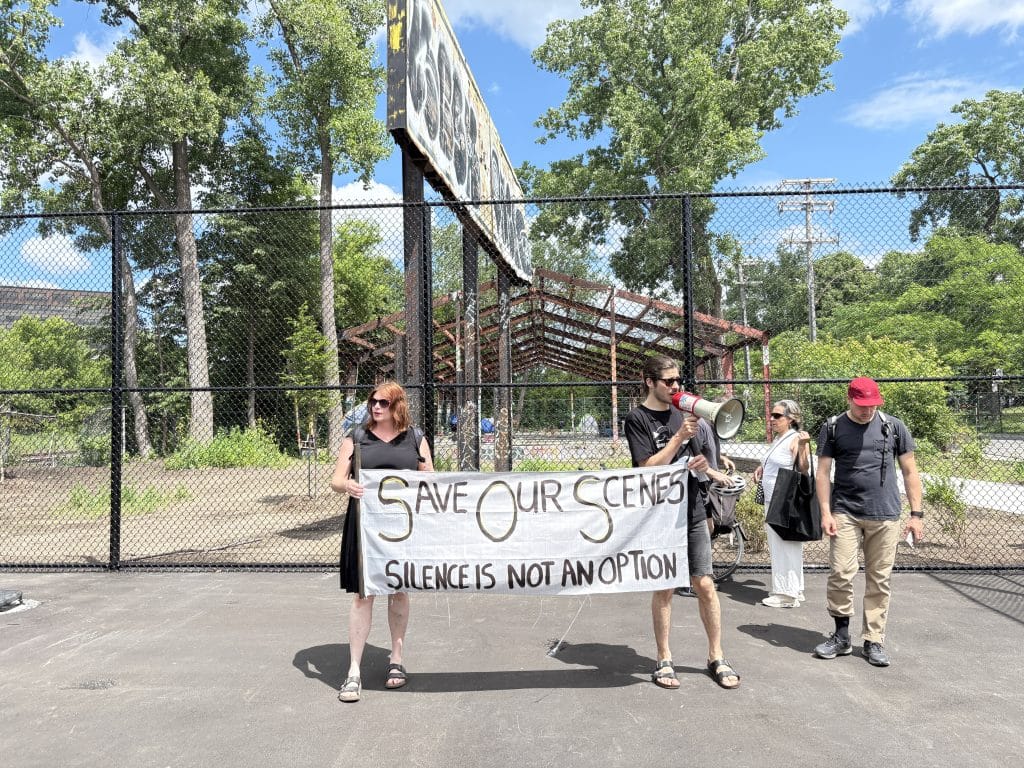
Kabane 77 was a punk venue so raw that it operated out of a warehouse.
The space was used by a collective of artists, mostly from the experimental film scene, who hosted concerts and screenings in a kind of DIY, grassroots environment.
The group’s vision was to turn the space into a permanent, artist-run centre. Gendron-Blais explained it as “the type of initiative you could imagine as la lumière collective today.” However, the city, led by Projet Montréal at the time, declined to fund the project or give them the lot.
“Kabane 77 is really symbolic because the artists were mobilized around the issue of disappearing places, not only to present their art, but to work,” said Gendron-Blais. “They did many mobilizations, meaning shows and various types of events on the site, and the city refused [to support them] until what was remaining of the warehouse was set on fire.”
Ultimately, Kabane 77 occupied a warehouse in a neighbourhood facing gentrification. Without support from the city, the space was left vulnerable to redevelopment. Once again, affordable spaces disappeared, and independent artists were pushed out.
To Gendron-Blais, it was a missed opportunity. He sees Kabane 77 as a clear example of how Montreal’s cultural policy keeps failing its independent artists – the very kind of culture the city still boasts about in tourist brochures.
“I understand that it could be annoying, to have a punk band playing just a few houses from your house, but like, you’re living in Montreal,” said Gendron-Blais. “If you want a really calm and silent city, go to Blainville, you know?”
STOP #4 – L’Envers

Similar to Kabane 77, L’Envers was an autonomous, artist-run space with no institutional backing.
The space showcased all things improvisation, and the founders believed that smaller audiences allowed artists to reflect on their performances and evolve.
L’Envers opened in June 2008, and by 2011, the venue had to downsize due to financial pressure. But even then, they struggled to pay rent. At one point, L’Envers offered memberships that came with t-shirts, buttons, concert tickets, and CDs.
Montreal’s Diverse Metropolis bylaw, which came into effect in April 2021, was created to “preserve the diverse character of our neighbourhoods and promote access to adequate housing for everyone,” but it doesn’t extend to the types of venues that the march featured.
Grassroots, informal venues are often left out of the city’s preservation efforts and L’Envers demonstrates why these efforts need to recognize less conventional spaces.
“Non-official culture needs to be acknowledged and supported, because this is Montreal,” said Gendron-Blais.
The Marche Funèbre pour les Lieux Disparus was part of the Suoni per il Popolo Festival, a meeting ground of experimental music, art and activism presented by the non-profit organization Société des Arts Libres et Actuels (SALA). The festival runs until June 30 and features numerous free and paid shows, workshops and panels.
Related Articles

Becoming Ballers: How Nunavik’s Youth Built a Community Around Basketball
In villages across the North, Inuit teens are creating a safe space for each other and the next generation of athletes.
By and For: Exhibit Traces History of Sex Worker Resistance
Sex worker support organization Stella wants to change the public’s perception of sex work with an exhibit at the Centre des mémoires montréalaises.

Live from the Fall Classic: Game 7 with The Rover
Cheering for Canada’s Team in the World Series was a balm for my soul. But no matter what, my heart will always belong to the Expos.
Comments (0)
There are no comments on this article.