
A Summer of Resistance in Nehirowisiw Territory
How Indigenous land defenders and allies mobilized against the CAQ’s Bill 97 — and won.
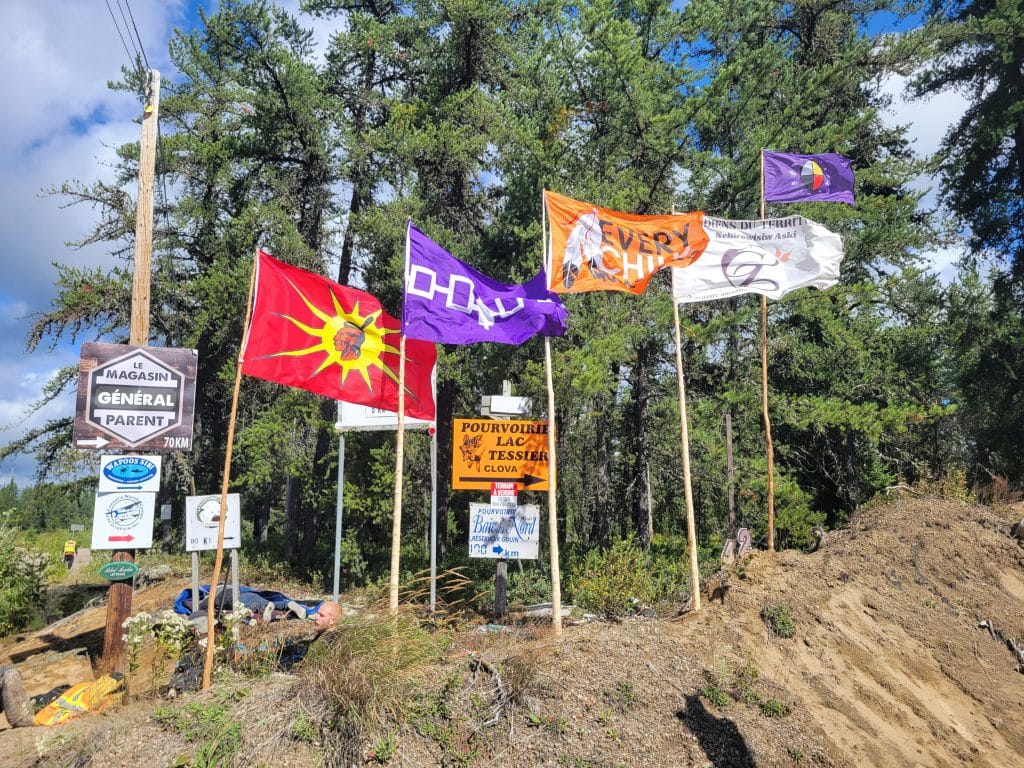
It’s 3:30 a.m. on a late August morning when my alarm wakes me from my sleep on a mossy forest bed at kilometre 106 of Chemin de Parent, a logging road about a five-hour drive north of Montreal.
The night before, I drove 28 kilometres from a camp at kilometre 134 of the same road, accompanying Nehirowisiw (Atikamekw) land defenders and allies as they prepared to block logging trucks arriving at 4 a.m. I had set up my tent for a few hours of sleep, while others took turns sleeping in their pickup trucks. We were about 15 people in total, with a mix of Nehirowisiw land defenders alongside both Indigenous and non-Indigenous allies.
Upon arrival at kilometre 106 around 11 p.m., we set up camp by lighting a fire and mounting banners asserting Indigenous sovereignty, including the Mohawk warrior flag and the Hiawatha wampum flag of the Haudenosaunee Confederacy. These symbols make clear the intentions of the land defenders: to remind logging companies and the Quebec government that their land is not for sale.
“We’re here because we decided not to accept Bill 97,” said hereditary chief Robert Echaquan when challenged by an employee of Groupe Crête, whose trucks were being blocked.
Although the land defenders and the allies accompanying them have an unwavering belief in their cause, everyone is on edge as the trucks accumulate on the road. Earlier that month, on August 11, a similar action ignited tensions between the Indigenous land defenders and the forestry workers following acts of blatant racism, including threats to run them over, trucks driving slowly towards them, and even a suggestion that settlers should treat Indigenous people and their allies the way Israel is treating Palestinians in Gaza. The people participating are well aware of the risks they face, but believe that this is the only way they can have leverage to prevent the rapid loss of these forests.
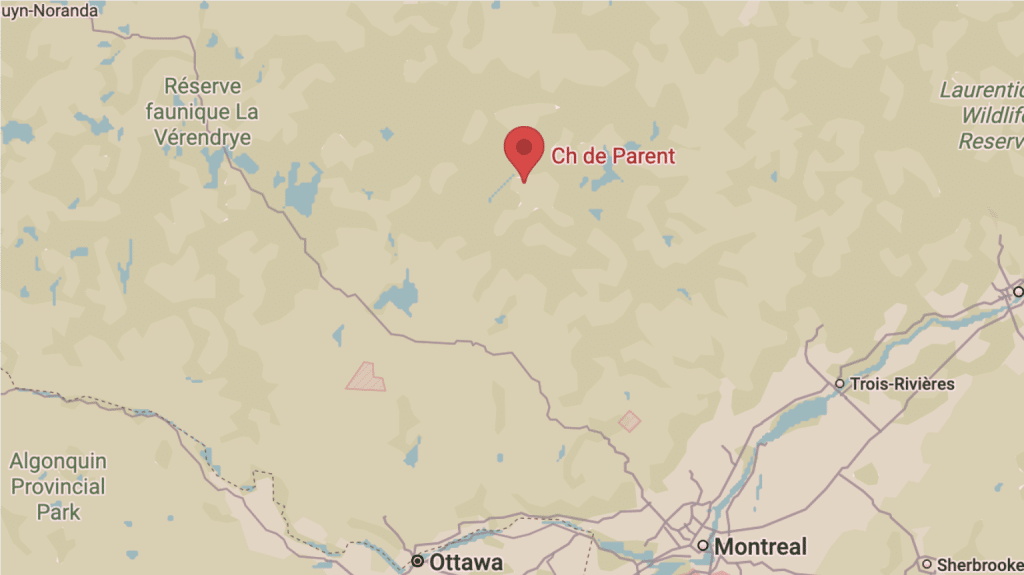
Since 2021, Nehirowisiw land defenders from Manawan and Wemotaci have been confronting the logging industry. Lisanne Petiquay, President of Associations des Gardiens du Territoire Nehirowisiw Aski, describes the groups as hereditary chiefs and elders passing down traditional knowledge, as well as younger people supported by these elders, chiefs, and matriarchs.
They’ve seen how clear-cut logging on their territory, which they call Nitaskinan, is leading to mass deforestation, and they worry that future generations won’t have a forest if this continues at the current pace. With the recently proposed Bill 97, the struggle to protect their forests has only become more urgent.
“Before Bill 97, Indigenous folks already recognized that the situation of the forest in Quebec was already at an emergency level,” said Franklin López, a filmmaker documenting land defence in Nehirowisiw and Innu territory, referred to as Nitaskinan and Nitassinan, respectively.
“Bill 97 essentially hands the forest over to the logging industry.”
In June, Nehirowisiw land defenders, mainly from Manawan, set up a long-term base on Chemin de Parent at kilometre 134, where they are often joined by allies coming up from Montreal, Quebec City, Lanaudière, or other Indigenous communities. At this point, a sophisticated camp has been established, complete with a kitchen, an outdoor toilet, a generator, and even a Starlink providing Wi-Fi. The atmosphere at the camp is generally peaceful and collaborative, and most people driving by are supportive of the Nehirowisiw struggle.

Nevertheless, the land defenders have faced pushback from forestry workers. Tipis set up on Chemin de Parent are often found knocked over or damaged, generally surrounded by beer cans. There has also been more organized resistance, with some settlers attempting to organize convoys to confront the land defenders, although they often fail to materialize.
With the threat of Bill 97 passing, the Echaquan family had called for allies to be present at their camp to watch the road, educate passers-by about the Bill, and deter potential attacks from angry settlers.
Bill 97: A “Green Light” for Deforestation
Bill 97, An Act mainly to modernize the forest regime, was introduced in April by Maïté Blanchette Vézina, Quebec’s then Minister of Natural Resources. It was withdrawn last week, six months later, after facing massive backlash from Indigenous leadership and environmental advocates. Notably, the bill proposed dividing Quebec’s forests into three zones: priority forest development zones, conservation zones and multi-purpose zones.
The text of the bill further explains that “in priority forest development zones, the carrying out of certain activities that restrict the carrying out of forest development activities, as well as the implementation of conservation measures for an area, are prohibited.”
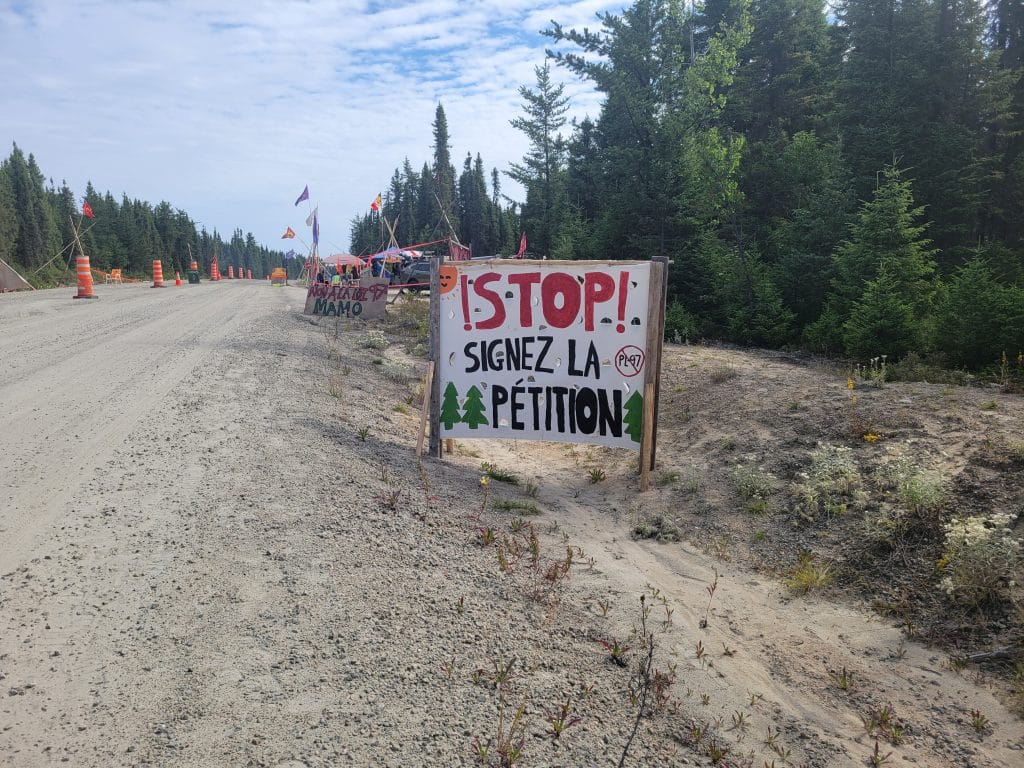
According to López, Bill 97 came at a time when land defenders had already been confronting the logging industry for years, and were well-prepared to oppose the bill, which would accelerate the already intense logging of their forests.
“I saw the devastation of logging in several areas,” he said. “I also witnessed how (the guardians) surveilled their territory and how they demanded that the logging companies show them some maps so they can determine whose territory they were logging on [and] if there was any consultation from the folks who are the guardians of that land.”
Drone videos already show the immense scale of deforestation in these territories. Echaquan emphasizes every morning at camp that this fight is not just for his nation, but rather for the whole planet, as the preservation of these forests is vital for planetary health.
Emily Fleming-Dubuc, an Inuk who spent over a month on the frontlines, also described the “shocking” extent of deforestation which she witnessed when accompanying land defenders surveying the territory. If 30 per cent of Quebec’s forests are handed over to the logging industry with a “green light” for clear-cutting, she warned, everyone in the province will feel the consequences.
“These companies are profit-driven,” said López. “When they look at the forest, they don’t see the beauty and the biodiversity and the traditions and all the different things that hold value to Indigenous folks and to folks who love the environment. What they see is dollar signs.”
Bill 97 is one instance in a string of legislation being introduced across Canada that undermines environmental protections and Indigenous consultations for projects or industries seen to boost the economy. This includes Bill C-5 at the federal level, Bill 5 in Ontario, and Bills 14 and 15 in British Columbia.
Support boots-on-the-ground journalism.
8th Fire Rising, a coalition founded to fight these bills, describes this trend as “flooding the zone,” a fascist strategy coined by Stephen K. Bannon. Their website defines this as “where you change so many laws and policies at once that you overwhelm people and make them feel like they can’t fight the onslaught of oppression.”
“I find this discouraging because we’re prioritizing the economy to the detriment of future generations,” said Fleming-Dubuc. “Of course, again, Indigenous people are never taken into consideration.”
Resistance across the province
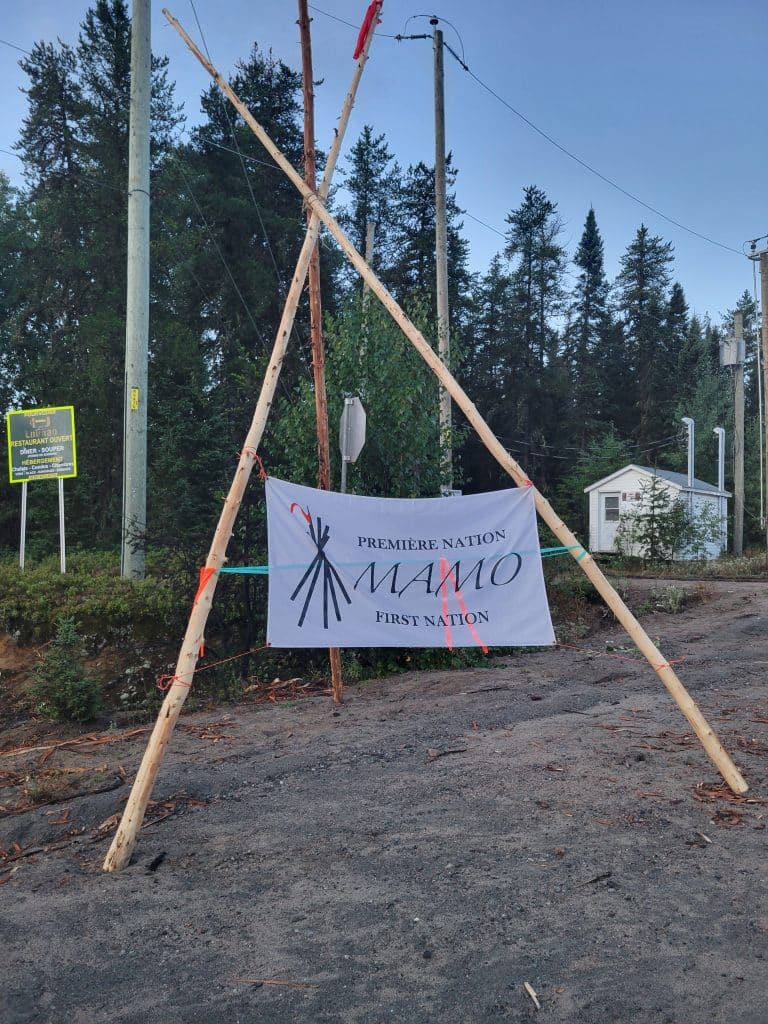
When Bill 97 was introduced, Indigenous communities across Quebec came together in opposition. On April 11, the MAMO/MAMU alliance formed to unite Indigenous land defenders from Nehirowisiw (Atikamekw), Innu, and Abenaki communities against the Bill that could accelerate exploitative logging on their lands.
Shortly after, MAMO delivered eviction notices to companies that are allegedly acting illegally on their lands. In the past few months, several communities have set up checkpoints to block the logging trucks, including Nehirowisiw families on Chemin de Parent and Chemin Wemotaci, and Innu chiefs in Mashteuiatsh.
The Assembly of First Nations Quebec-Labrador (AFNQL) engaged in negotiations with the Quebec government to amend Bill 97. Yet on Sept. 9, the organization called for a complete withdrawal of the Bill, stating that “it has become impossible to continue the work without a genuine assurance that the essential elements put forward by the First Nations would be fully incorporated into the legislation.”
Fleming-Dubuc organized five protests against Bill 97 in Montreal and Quebec City since May. Before visiting the Nitaskinan, she had already seen firsthand what the Quebec government’s treatment of Indigenous communities looks like through poor living conditions in her mother’s village of Kuujjuarapik in Nunavik. As she was initially unable to travel to the territory, organizing these protests was her way of supporting the land defenders.
“I can’t believe that our governments exploit our territories and leave our communities to suffer like this. That’s why I’m speaking out,” she said prior to the announcement that the bill will be scrapped. “(Bill 97) will have serious repercussions on the environment and future generations, and again, it’s Indigenous people, First Nations who will suffer.”
After organizing a first protest, Fleming-Dubuc received overwhelming support from many different movements, including climate justice, Palestine solidarity, Indigenous rights, and LGBTQ+ liberation. She and her co-organizers eventually formed a collective known as the Front de resistance autochtone populaire (FRAP) to oppose Bill 97 and support anti-colonial struggles.
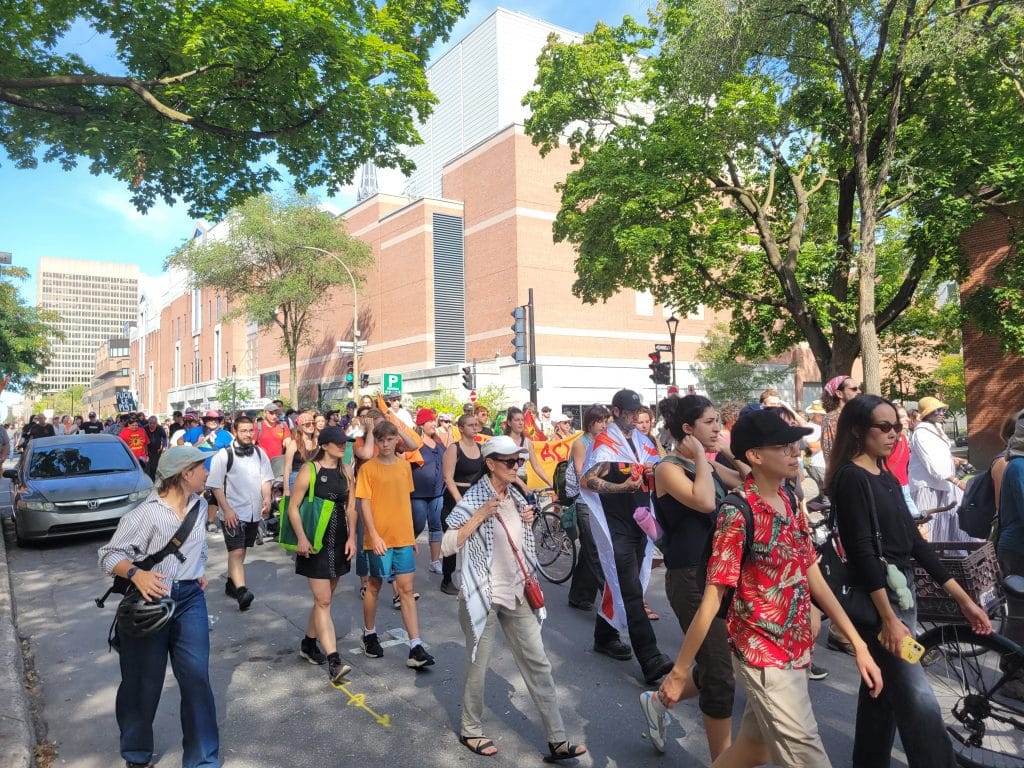
In addition to organizing protests, Fleming-Dubuc made videos on Instagram and TikTok discussing the fight against Bill 97, often conveying updates from the frontlines. When we were at Checkpoint Parent, many people who stopped by had learned of the resistance against Bill 97 through her videos.
“A large majority of the population are very ignorant about the reality of our people here in Canada,” she said, adding that social media videos are “a way for them to get to know us and learn about our realities.”
The reality on the ground
When she was finally able to visit the camp, Fleming-Dubuc recalled being shocked at the racism that Indigenous land defenders experience from forestry workers, who often claim that protests against logging threaten their livelihood. Quebec has one of the biggest forestry sectors in Canada, employing over 61,000 people. López, who has captured many instances of this racism, wants workers to understand that the fight isn’t against them.
“I haven’t heard anybody say that they’re against logging,” he said. “All they want is to be consulted. They want the logging to be done responsibly and for them to be respected.”
Following the first action on August 11, Blanchette Vézina and Ian Lafrenière, the Minister Responsible for Relations with First Nations and the Inuit, met with Atikamekw band council leaders in La Tuque. Notably, this meeting did not include territorial chiefs or representatives from MAMO, many of whom do not view the band councils as a legitimate authority. MAMO spokesperson André Pikutelekan also argued in an interview with APTN that band councils are limited in their ability to address illegal logging and Bill 97, because their power is confined to the reserves.
The areas logged are generally not located within reserves, but rather on land owned by individual families, such as the Echaquans. When speaking with representatives from the forestry companies, Echaquan emphasized that they must negotiate with territory chiefs such as himself, not band councils.
In a similar vein, the Innu guardians of Nitassinan argue that “customary law and our millennial presence on the Nitassinan give us legitimacy to protect and decide the territory’s future.” They argued that any agreement made without the consent of the guardians is void, and that the guardians reserve the right to use any peaceful means necessary to protect their land.
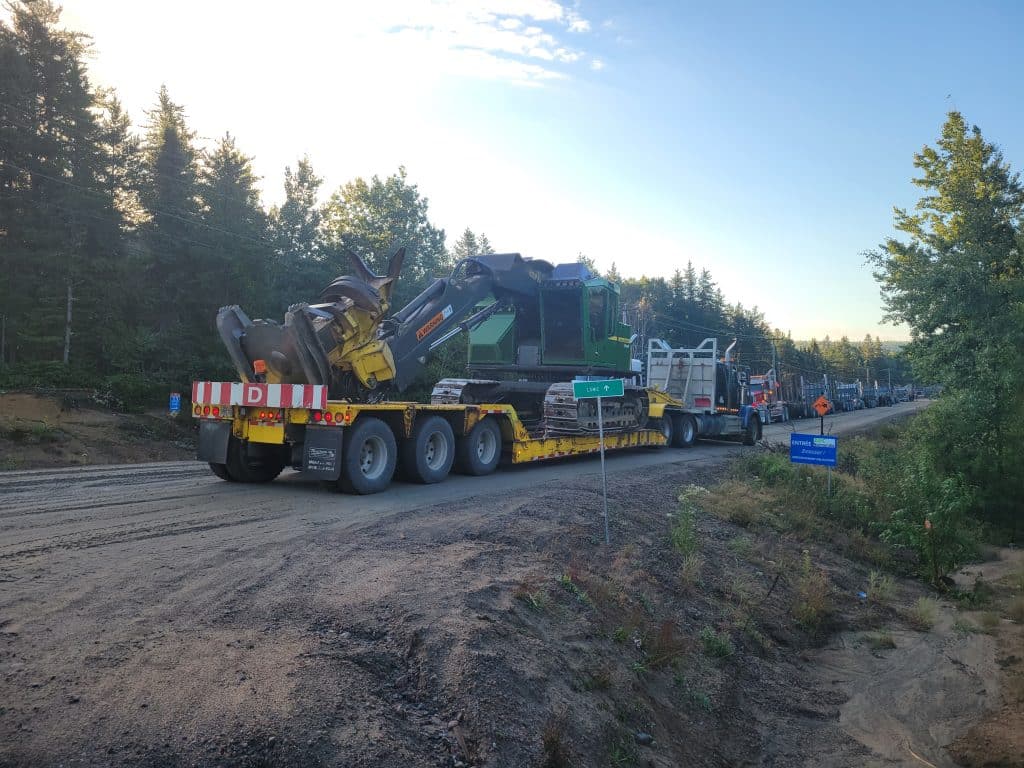
When I arrived at Checkpoint Parent in late August, land defenders were preparing for a second blockade at kilometre 106. Although forestry companies had claimed they were no longer felling trees, two harvesters remained in the forest. By blocking logging trucks, Echaquan was able to negotiate the removal of both harvesters as a condition for allowing the trucks to enter and collect wood that had already been chopped.
Despite this small victory, the Echaquan family and their supporters plan to stay at the checkpoint well into the winter months to continue monitoring logging activities.
What happens now?
On September 25, the Legault government announced that Bill 97 would be scrapped, with a new forestry reform bill drafted from scratch. Blanchette Vézina has left the governing Coalition Avenir Québec (CAQ) after being removed from her ministerial position during a cabinet shuffle, when she was replaced by Jean-François Simard.
The move was welcomed by the AFNQL and the Council of the Atikamekw Nation, who both emphasized that the government must meaningfully collaborate with Indigenous communities when designing future forestry management legislation.
“The government has the opportunity to co-construct, with all stakeholders, a truly sustainable forestry regime,” the AFNQL wrote in a press release.
Following the announcement, Fleming-Dubuc wrote that “just because (Quebec Premier François Legault) is abandoning a bill doesn’t mean he’s abandoning his ambitions.”
She argued that Legault’s actions, not his words, will determine whether the bill will truly be repealed, or brought back in a different form. The Quebec premier has not yet specified how Indigenous communities will be involved in the process of drafting a new bill.
Regardless of what the government decides, the land defenders are not going anywhere. The MAMO alliance released a statement asserting that they would continue to maintain a presence on the land and monitor forestry operations.
“Our rights and responsibilities don’t depend on any law or government decision,” they wrote. “The hereditary chiefs and guardians of the territory continue their exercise of ancestral sovereignty to ensure the defense of our fundamental rights, the preservation of our environment, and the respect of our responsibility towards Mother Earth.”
Did you like this article? Share it with a friend!
Author
Comments (2)
Leave a comment
Related Articles
Le refus de l’asile à Ranjit Singh
Militant pour le mouvement indépendantiste sikh de l’État du Pendjab, au nord de l’Inde, Ranjit Singh fuit les persécutions policières pour trouver refuge au Canada en 2019. Il y a deux semaines, sa demande d’asile est rejetée et sa déportation prévue le vendredi 6 mars 2026.
The Refusal of Asylum to Ranjit Singh
An activist for the Sikh independence movement in the state of Punjab, Ranjit Singh fled police persecution to seek refuge in Canada in 2019. Two weeks ago, his asylum application was rejected, his deportation scheduled for March 6.

Faced with a ‘Time Bomb Budget,’ the STM Turns to Real Estate for Revenue
Montreal’s transit body wants more money for crumbling infrastructure, continues negotiations with maintenance workers.
Nakurmiik!
Superbe reportage!
Thank you for this reporting.