
Arena Kings: Senegalese Wrestling Blends Sport, Spirituality and Tradition
VIDEO: The Rover heads to Dakar to take in a sport that fills stadiums with screaming fans, percussion bands and the occasional witch doctor.
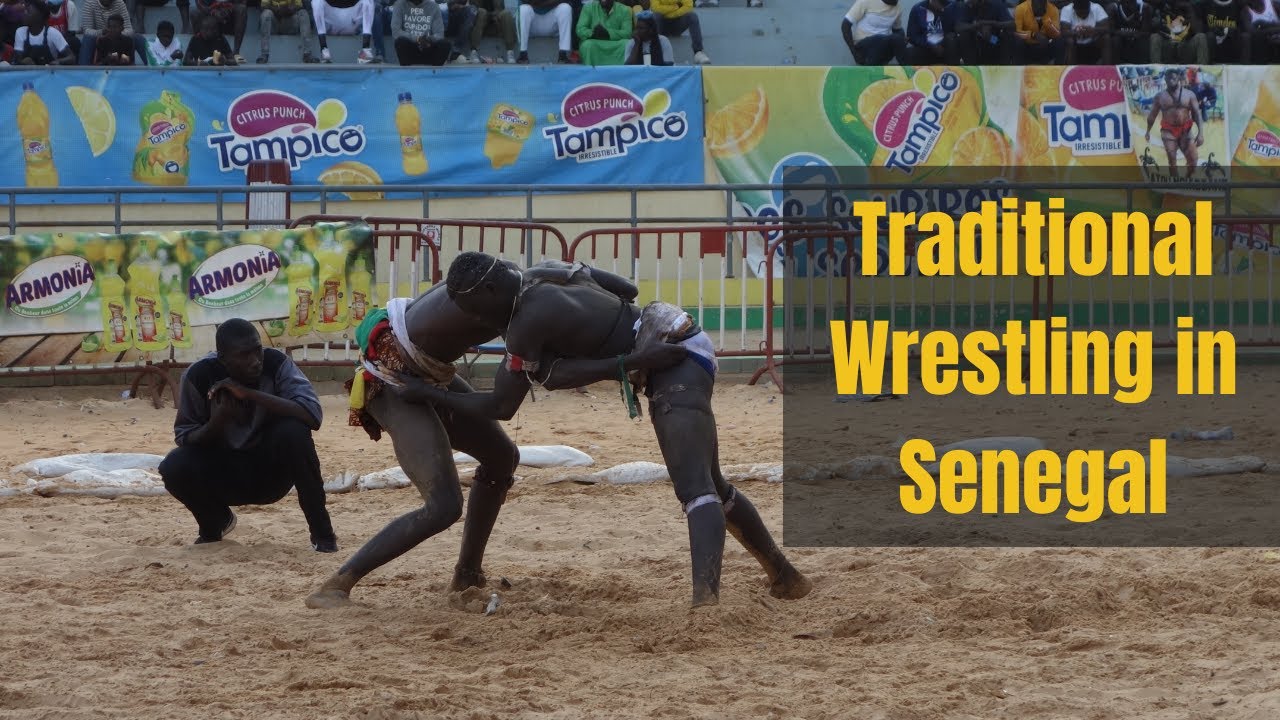
The Olympics have wrestling, Mexico has its Lucha Libre wrestlers, and Japan has Sumo.
Senegal, for its part, has its own unique wrestling tradition, yet for some reason, you won’t hear about it much outside of this Sub-Saharan country.
The unique, particular way of practicing wrestling in Senegal impacts every sphere of society. It’s even a social and economical lifeline for a lot of youngsters.
Known as “laamb” in Wolof, traditional wrestling is much more than just a sport in Senegal. It’s an important part of the country’s cultural identity and a practice that unites generations, reflects values and traditions.
We wanted to check it out for ourselves.
***
It’s late afternoon in February.
We’ve been in the islands of Sine Saloum, three hours south of Senegal’s capital, Dakar, for a few days. We came here because it’s home to the Serere nation, one of the first to practice traditional wrestling and who still do today. We traveled in a packed bus with no air conditioning, hustling through the big Dakar highways. We soon enter another Senegal, with endlessly open sandy fields, a savanna-like landscape and the biggest baobab trees you’ll ever see.
There’s no Facebook page or other form of advertisement to check to know where or when tournaments are happening, especially in villages. Where we are, there are no cars. You travel by boat or with a horse cart.
We’ve been staying in a cabin by the sea, resting a little bit from our first hectic week in Dakar and from our disturbed stomachs. It’s nice to breathe in sea air, far away from the heavy traffic of Dakar.
Our host has made some calls to people he knows around the islands to see if we can go to a wrestling training and a tournament. A cart comes to pick us up at around 4:00 p.m. to bring us about half an hour from where we are. We set up the camera while we wait for the Mar Fafako youngsters to show up for training. Most houses are half built, garbage is all over the place (they have other priorities). We hear the distant call to prayers from the small village mosque, an essential part of life in this Muslim-majority country.

Mar Fafako wrestlers after their training. PHOTO: Gabrielle Brassard-Lecours
The young men show up slowly. We ask if we can film, take pictures, and interview a few of them after their training. They come to the village sand field every day to train. They all want to go to Dakar to become professional wrestlers: that’s where the money is.
Traditionally, wrestling was a way of celebrating the end of harvest season between villages and determining which had the strongest men. The champion would win a cup of coffee, a cow or a bag of rice.
In the 1990s, one wrestler, Tyson (not the American one), “Arena King” for several years, decided to make wrestling a real job. He brought sponsors and introduced striking in the Dakar tournaments, which is usually forbidden in the traditional wrestling form.
“Promoters who organized tournaments were making the big bucks, and wrestlers had nothing. I changed that. Before, wrestling wasn’t considered a real job. Now it is. Wrestlers have a social status and can make a lot of money,” Tyson says.
Indeed, today wrestling is perceived as one of the most high paying jobs in West Africa, according to Aboubacry Sam, sociology professor at Cégep de Lanaudière, Senegalese himself.
Back to Mar Fafako: we watch, impressed, those young boys with incredible bodies train.
They run, do jumping jacks and have friendly fights. The only accepted uniform is a loincloth, which is the only material competitors are allowed to grab during a match. Senegalese wrestling takes place in a circle delimited by sandbags. When it starts, the two fighters size each other up for a few minutes, trying to evaluate their adversary’s strength and mental state, turning around in a kind of mystical dance. They then grab each other’s loincloth, arms or legs, trying to get their opponent to the ground.
The first to put all four extremities on the ground, lie on his back or be thrown out of the circle is declared the loser.
“I want to go to Dakar to do a tournament in the national arena, but I need money,” says Internet, a promising, soon-to-be famous wrestler (according to his friends).
One of them says “Don’t worry, the whole village will help. That’s why when a wrestler wins, it’s not only an individual victory, but also a collective one,” he explains to us.
He’s not the only one to say that.
“It’s a sport that’s both individual in preparation, but very communal when it comes to fighting and winning,” adds Tyson.

Tyson, a retired Senegalese wrestler. PHOTO: Gabrielle Brassard-Lecours
Back in Dakar a few days later, we attend a tournament on Malibu beach north of Dakar in the Pikine neighbourhood, famous for its wrestling schools, or “sables,” as they call them. It’s a tournament to showcase the next generation of wrestlers.
We meet Clandestin, Adapikine and Building.
“I’d like to be Arena King to help my family and give them money,” says Building, as the others also reiterate. Celebrity, social status and individual wealth is certainly appealing to these young men, but helping their community and their family is their first motivation.
Senegal is one of the only African countries that never had a coup d’état, and the Senegalese are strong on defending their democracy — we witnessed it when we were there. The president tried to postpone the upcoming election and people burned down the streets in protest, making him reverse course. But it’s still a country of the Global South with difficult social and economic conditions.
More than half of its 15.4 million inhabitants live under the poverty line. This is explained partially by government corruption, lack of agriculture modernisation, and climate change. Senegal, like many African countries, has been colonized, lastly by France, and even though it’s been independent since 1960, economical and political ties to the French country are still very strong.
Many educated young minds leave the country to go work in Europe, but wrestling is one way of staying — although for Tyson, wrestlers should also go to school.
“You usually retire around 40, and then what? You have a lot of money, and you need to know what to do with it, in a smart way,” he says Tyson, who invested his fortune by building his real estate company which owns buildings all around Dakar.
Physical and spiritual preparation
“Wrestling is in fact a reflection of Senegalese society,” says Aboubacry Sam. Indeed, if the Muslim religion is practiced by the vast majority, animism is also very present and intertwined with health and wellbeing, the economy, and, of course, wrestling.
Beyond the competition, traditional wrestling is awash with symbolism. It’s often accompanied by live song, dance and percussion, creating a festive and solemn atmosphere. When wrestlers enter the arena, dancing with their entourage to the sound of percussions and women signing, you can feel spectators staring at them with a lot of respect and admiration.
The griots, guardians of oral tradition, play a crucial role, singing the praises of the wrestlers and recounting past exploits, accompanied by women in their finest garments who also sing of the athletes’ exploits.
The wrestlers, accompanied by their teams, perform a choreographed dance representing the place they come from, often a far away village that has its own cultural traditions that they want to a tribute to in the arena. We see this with our own eyes when we go to another Serere village, Fadjal, where we witness the full power of a wrestling tournament.
It starts late at night. The whole village, kids and elders alike, gather around the sand-made arena to watch some 30 wrestlers prepare and fight. It lasts around 3 hours and every minute of it is intense, between the mystic preparation, the live singing, the cheering and the fighting. It’s incredible to see it in action and to see proof of how much the sport rallies people together.
This cultural dimension makes each fight a unique spectacle, where athletic performance goes hand in hand with artistic and spiritual expression. The fight itself may only last a few minutes, but the dances and incantations that precede it often last for hours and are an integral part of the show.

A fight taking place at the Dakar arena. PHOTO: Gabrielle Brassard-Lecours
Wrestlers therefore prepare themselves with protective rituals and prayers, surrounding themselves with marabouts — witch doctors of sorts with mystical and secret powers and rites — in the belief that these practices can influence the outcome of the fight.
“Wrestlers invest in maraboutage to protect themselves, but also to spiritually harm their opponent,” says Aboubacry Sam. That’s why wrestlers have artist names: to protect their souls from marabouts and to prevent the evil spells they might cast on them if they knew their real name.
Marabouts in the wrestlers’ entourage are controversial, even though they are essential to the show and the athletes’ preparation. Indeed, there are several types of marabout in Senegal, including those who are religious and present in the highest spheres of society.
“They are inspired by the sacred texts of the Quran and act as advisors to politicians. Their opinions are highly respected, and they are called up by the media and when important decisions are made”, explains the sociologist.
Then, he says, there are the healers, who have an average command of the Koran and confuse Islam with animism.
“Finally, there are the charlatans, who predict wrestling victories and defeats, and decorate wrestlers with grigris and magic potions as part of their mystical preparation,” says Aboubacry Sam. If a wrestler loses, his marabouts will tell him it’s because he didn’t follow their instructions to the letter. It’s a lucrative industry, since all wrestlers must have marabouts to be ready to fight.
Where it starts
With the modernisation of wrestling and its migration from villages to the urban neighbourhoods of Dakar, a massive stadium solely dedicated to the sport was inaugurated in 2018, filling its 20,000 seats every weekend when tournaments take place.
We head there on the last days of our trip.
It’s like the culmination of all the village and beach matches we saw, the place where all the young wrestlers want to be to win the title of Arena King, awarded by the press on the basis of the performances of the strongest wrestlers. Dozens of wrestlers attend tournaments at the same time, waiting for their turn, split into weight categories, and working their way up to the finale.
Fans from everywhere in Dakar and further come together to cheer for their favourites, rolling out banners with their star’s face, screaming their name while they fight. The atmosphere in the stadium can be heated, as fans from enemy wrestlers can sometimes engage in their own fight in the tier.
Some will have physical fights of their own while watching the tournament, especially towards the end. The exit from the stadium can even become dangerous because fans are mad or get carried away in celebration of their wrestler’s fights.
Some are outraged at the referee.
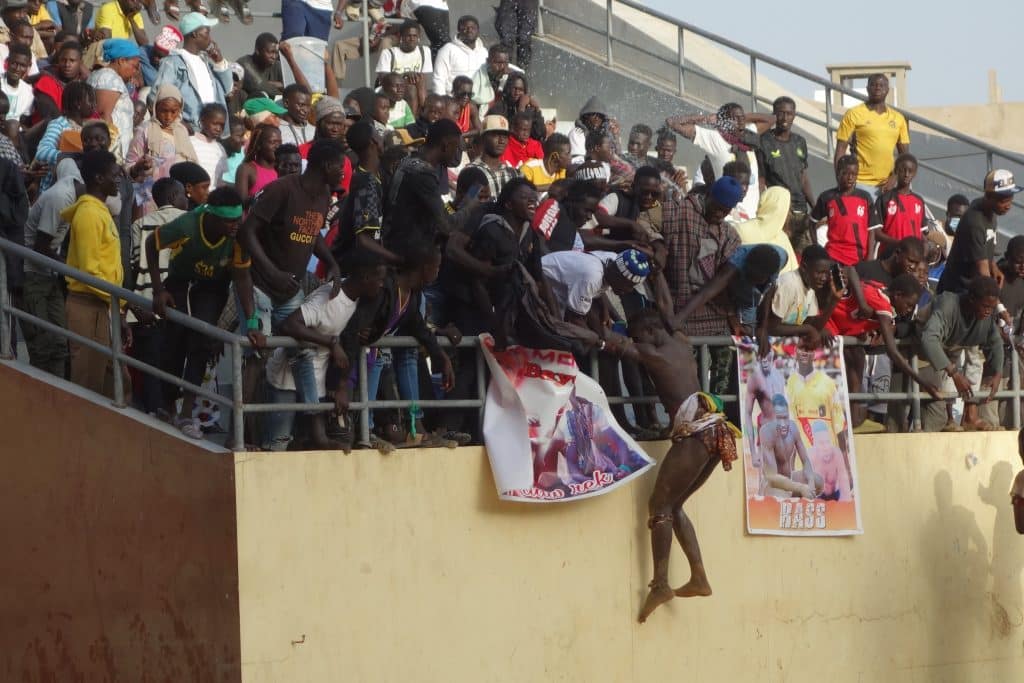
Excitement at the Dakar arena. PHOTO: Gabrielle Brassard-Lecours
“Wrestling has always been a meeting point for villagers, and now it’s the same in Dakar. It always brings people together,” confides wrestling fan Doudou Dione, Serere and manager of the Espace Thialy hostel in Dakar’s Patte d’Oie district.
Over time, Senegalese wrestling has evolved, integrating modern elements while retaining its traditional essence. But some do claim the loss of this essence from transforming the sport into an industry, lucrative for some (wrestlers, marabouts, promoters), while others believe it’s a good thing, finally making wrestling a professional sport from which to make a living.
Fights are now televised, attracting millions of viewers, and professional wrestlers benefit from lucrative sponsors and contracts. Wrestling tournaments, such as the Dakar ones, have become major events, attracting visitors and fans from all over the world.
“Nio Far,” Doudou says with a smile when he talks about wrestling, and his people. “We are together.”
Thanks to all our fixers and the Senegalese who made this report possible, including Xavier Datta, Mamadou Gueye and Amadou Samba.
This report was made possible by a grant from the Fonds québécois en journalisme international.
Related Articles
Prison Recipes By and For Incarcerated People
La Cantine is a cookbook that helps inmates discuss risk prevention and reflect on food in prison.
Becoming Ballers: How Nunavik’s Youth Built a Community Around Basketball
In villages across the North, Inuit teens are creating a safe space for each other and the next generation of athletes.
By and For: Exhibit Traces History of Sex Worker Resistance
Sex worker support organization Stella wants to change the public’s perception of sex work with an exhibit at the Centre des mémoires montréalaises.
Comments (0)
There are no comments on this article.