
Battle Over Pro-Palestine Encampment Spills Onto Streets
Montreal police cracked down on protesters outside UQAM’s student encampment in support of Gaza on Monday.
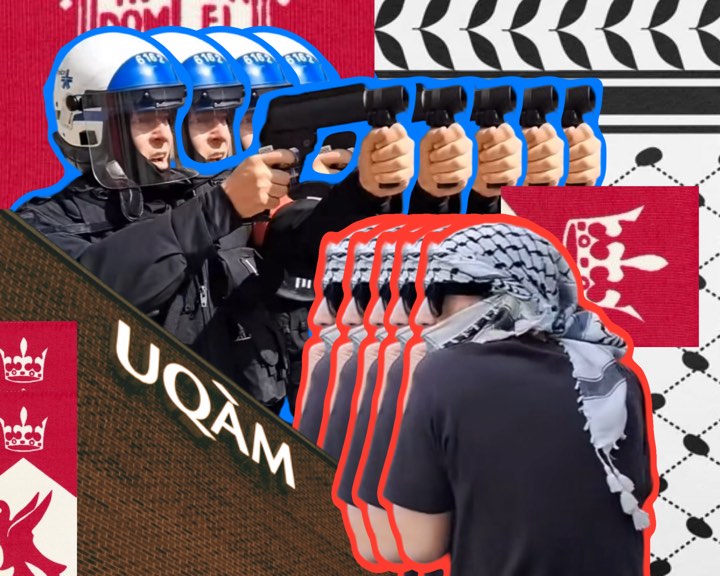
Robert was backing away from police when they unloaded a can of CS Gas into his eyes.
The “pepper spray” used by Montreal police is actually a powder that attacks pain receptors in the eyes, nose, throat, lungs and skin. At close range, it is excruciating, causing some to double over in pain and vomit.
In Robert’s case, it wasn’t the pain so much as the fact that he was temporarily blind, trying not to get trampled by the riot squad as they closed in on him.
“To be so disoriented and completely at the mercy of police, that terrified me,” said Robert, who was blocking President Kennedy Ave. during a protest Monday when police intervened.
“They were swinging their batons wildly, I know of at least two comrades who were concussed and others who had to be treated at the encampment. We weren’t warned, weren’t told to leave and even though we were backing away from the cops, they attacked us with blistering violence.”
Support Independent Journalism.
Robert is part of the encampment at Université de Québec à Montréal (UQAM), where protesters blocked the streets to raise awareness of Israel’s war on Gaza. His group stood at four intersections near the downtown campus for about 20 minutes, playing music and chanting slogans until columns of riot police broke up the direct action.
Witnesses described the incident to The Rover, providing video footage to bolster their claims.
“You better believe it’s going to hurt real bad once we run into you,” one officer is heard saying, in a video filmed shortly before the clash.
Another video shows some officers approaching the protesters while slapping their shields and batons in unison, offering them a chance to leave. But it also captures officers charging into the pack at a full clip and repeatedly striking protesters who show no signs of active resistance.
In one video, an officer aims a 40 mm launcher and appears to fire a tear gas canister at protesters instead of above their heads. During the short skirmish, a protester was hit by an aluminum projectile that exploded near his eye, lacerating it and leaving chemical burns on the eyelid.
A handful of protesters sustained truncheon blows to the head, stomach and legs as police sought to disperse the group during the intervention on President Kennedy Ave. No one was arrested on site but police say one suspect will be charged with assaulting an officer.
Though it isn’t the first clash between pro-Palestinian protesters and the riot squad, Monday’s crackdown offers a closer look at how Montreal police have chosen to contain the antiwar movement.
In the four weeks since McGill and Concordia students set up a protest camp on McGill’s front lawn, police have resisted calls for a raid. Police brass actually argued against the university’s request for an injunction to clear the encampment last week, insisting it’s not the department’s job to act as McGill’s personal security service.
But the cops have also stamped out any attempt at direct action protests off campus.
This predates the start of McGill’s Gaza encampment to two major interventions on April 15. That morning, riot police shut down an attempt to block the Port of Montreal using batons and tear gas.
A few hours later, they arrested 45 people — including journalist Savanna Craig — during a sit-in at Scotiabank Tower. This is despite Craig clearly and repeatedly identifying herself as a member of the press covering the sit-in for CUTV.
Even so, the police are asking Crown prosecutors to charge Craig with criminal mischief — a decision that’s been criticized by the Canadian Association of Journalists (CAJ), the Committee to Protect Journalists and other human rights groups. The charges will almost certainly be dropped but CAJ president Brent Jolly called Craig’s arrest an act of intimidation by Montreal police.
“The police are basically saying, ‘You can have your little encampment but if you try to move it off campus we will respond with force,’” said Ted Rutland, a Concordia professor who researches policing in Montreal. “It’s not good PR to be beating up a bunch of students on a university campus. Globally, police since the 1960s have sought to adopt a sort of counterinsurgency strategy where they’re, at once, cracking down severely on certain kinds of resistance while being more light on other forms of protest.
“The hope is that they can break apart the movement, create distinctions between people within the movement and also encourage the least disruptive forms of protest. It’s a weird thing to say because the McGill encampment is disruptive to McGill. It’s effective.
“But it isn’t bothering anyone except the university administration and some big donors. Whereas the UQAM encampment tried to take their direct action to the streets and got shut down immediately.”
The Ligue des droits et libertés called the police’s UQAM intervention a clear instance of brutality and a violation of the protesters’ Charter rights. They also called on Mayor Valérie Plante to condemn Monday’s “police violence.”
***
Having failed to evict the protesters from its lower field, McGill had to spend $700,000 to move this week’s spring convocation ceremony off campus.
In its decision to reject McGill’s injunction request against the encampment last week, Quebec’s Superior Court ruled that the protest has largely been peaceful and within the bounds of constitutionally protected free speech.
A spokesperson for Mayor Valérie Plante says the police’s “professionalism and capacity to preserve a peaceful climate” have kept things from getting out of control.
“The peaceful climate seen in Montreal since the beginning of the conflict won’t be able to persist on campuses if reprehensible acts are committed,” wrote Simon Charron, Plante’s spokesperson. “We expect that good faith dialogue will allow a peaceful resolution to the situation.”
At McGill, discussions between administration and the Gaza encampment fell apart two weeks ago when the university sought an injunction against the protesters.
In response to the injunction request, students at UQAM — many of whom were living in the McGill encampment — decided to branch off and form their own camp in case police raided the McGill site.
While their comrades across town are calling on McGill to divest from arms manufacturers that supply military technology to Israel, the UQAM protesters want the Quebec government to reverse its decision to open a trade office in Tel Aviv this summer.
The provincial government has come under fire for its insistence on expanding a trade relationship with Israel at a time when the country is waging a brutal war against the people of Gaza. On Friday, the United Nations highest court ordered Israel’s military to stop its offensive on Rafa, ruling that further violence against the Gazan city could violate the Convention on the Prevention and Punishment of the Crime of Genocide.
Robert said that, regardless of each encampment’s specific demands, the ultimate goal is to “end genocide.”
“We want to add another pressure point to Montreal’s university sector and show solidarity with our comrades who resist,” said Robert, who retreated back to the barricaded UQAM camp after he was pepper sprayed Monday.
“We’re in communication with our comrades at McGill but also in universities across Canada. We share resources, tactics, ways to stay dry in the rain. We’ve learned a lot from how American protesters chose to negotiate, how they de-escalate conflicts with counter-protesters and how they deal with police.”
***
Police presence around McGill increased after a small group of counter-protesters confronted members of the Gaza encampment on May 17. Sources inside the camp say they now scout the campus and surrounding streets several times a day, keeping track of how many officers and police vehicles they see.
The police department, meanwhile, has been using its surveillance drone and plainclothes officers to gather intelligence on both encampments, according to sources in both encampments.
Montreal police do not comment on ongoing operations and matters before the court. But in statements about Monday’s direct action, the department said protesters reinforced their road blockade with wooden pallets and needed to be dispersed.
As a sign of how far apart the administration and protesters are at this juncture, McGill University president Deep Saini wrote a column referring to the encampment as an “illegal occupation” in Wednesday’s edition of The Gazette.
But while Sinai had previously levelled accusations of antisemitism against members of the encampment, he took a softer tone in Wednesday’s column. He referred instead to slogans that “regardless of their intent or origin” have harmful impacts on students who feel unwelcome and threatened.
The administration at McGill has shown a willingness to address some of the Gaza encampment’s demands. Sinai wrote that the university is ready to “examine divestment” from “companies whose revenues largely come from weapons.”
The McGill president added that the university wants to do more to support scholars in the West Bank and Gaza but that the encampment “continues to eschew meaningful conversation.”
A similar offer from Queen’s University to protesters brought an end to their student encampment in Kingston, Ont. Thursday. Protesters packed up the site and left after Queen’s administration agreed to create the Review Committee for Responsible Investment, charged with reviewing investments in companies that support Israel’s military. The university also vowed not to take any retaliatory measures against protesters.
While administrators at UQAM seek their own injunction against the encampment, the scope of their request is far more limited than McGill’s. The university wants a court order to take down the steel fences that reinforce the camp and prevent it from blocking classes. But the request doesn’t call on police to remove the encampment or protesters from UQAM.
Lawyers representing UQAM presented their case in Superior Court Friday.
Even if the universities manage to obtain an injunction, protesters at both encampments say they won’t leave until they’re forced out. And if that happens, there are plans for more acts of disruptive but nonviolent resistance.
McGill, meanwhile, is no longer seeking an emergency injunction but rather an interlocutory one, which requires a lower burden of proof from the university but takes longer to enact. The courts have shown flexibility on the student’s free speech rights but even the encampment’s defenders agree it can’t remain on campus indefinitely.
“Sooner or later, the encampment will have to go,” said Julius Grey, a lawyer who argued against McGill’s emergency injunction last week. “I think it’s clear the encampment, the tents, the whole site is an exercise in free expression. But it can’t be permanent. At some point the parties will have to sit down, talk to each other and resolve this.”
Author
Comments (3)
Leave a comment
Related Articles
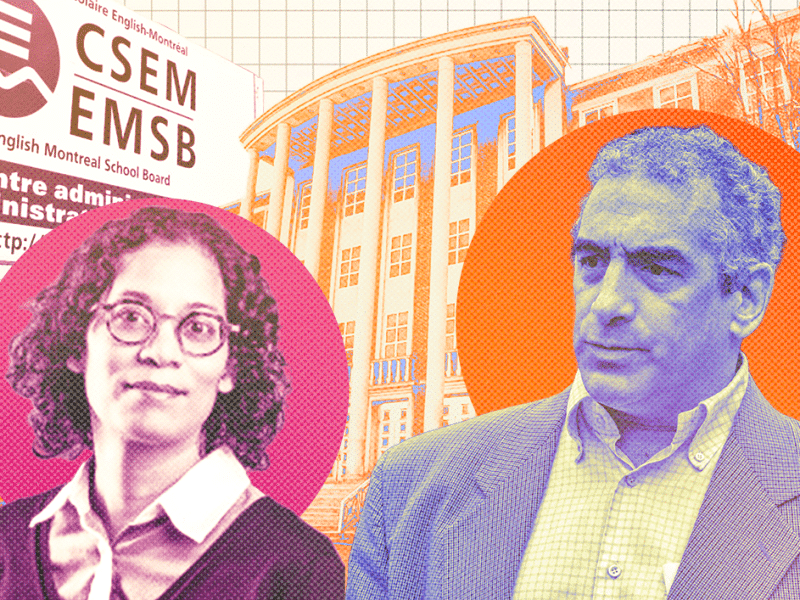
School Board Votes to Support Candidate who Smeared Rival, Acted in ‘Undignified’ Manner
Julien Feldman gets off scot-free after falsely associating his rival candidate with antisemitism and referring to her as “Ms. Gaza.”
« Je veux juste qu’on me croie »
Victime d’une agression sexuelle alors qu’elle travaillait pour le gouvernement provincial, une femme lutte avec Québec depuis cinq ans.
Hundreds of Migrant Workers Compensated After Fraudulent Recruitment Scheme
The multinational Newrest and the Montreal agency Trésor must pay $2.1 million to migrants tricked into working without authorization under the false promise of obtaining a valid work permit in Canada.
Chris, you’ve been incredibly disappointing in your framing of this war. Incredibly. Phrases like “Israel’s war on Gaza”, or “waging a war against the people of Gaza”. You realize that Hamas is also an active participant in this war, right? That they continue, to this day, to fight the IDF and to launch rockets towards civilian population centres in Israel? Why do you insist on portraying this war as the big, evil military hell-bent on genocide, versus the poor, innocent, blameless, passive, oppressed victims?
The IDF is fighting Hamas. Hamas is fighting the IDF, and actively targeting Israeli civilians. Please, for the love of god, stop your virtue signaling activism and actually start reporting on this in a fair manner. And hey, maybe interviewing some Jewish students and community leaders would be a good idea too? I’m not a journalist, but I’m just throwing that out there. Might be that you, and your readers, will learn something if you actually listened to them.
TED RUTLAND LOOOL WHAT WAS THAT A DISCUSSION BETWEEN TWO HAMAS SUPPORTERS , WHY DONT YOU TRY TO DO SOME REAL JOURNALISM ONCE IN A WHILE MAYBE THE ROVER WOULD BE MORE SERIOUS SOURCE OF INFORMATION
these bums should be provided with a one way tickets to yemen , idiots antifa leftists