
Can We Talk About Quebec Colonialism?
The mere mention of Quebec as a French colony triggered the province’s conservative columnists into a frenzy.
The mere mention of Quebec as a French colony triggered the province’s conservative columnists. Why is that?

How much are Quebecers willing to contend with our history on this land we call home?
With the circumstances surrounding how we got here, and the death and displacement those circumstances required?
When a Montreal theatre organized public discussions with academics from a research group on Quebec colonialism, the reactions online and among Quebec’s conservative columnists showed that for some, doing so proved difficult.
The events were mere, as Journal de Montréal columnist Richard Martineau put it, “indoctrination session(s) wrapped in the tinsel of ‘scientific thought’.”
Théatre Prospero often puts together events that address the themes tackled in their shows, a way to contextualize those themes for a local audience. So ahead of their production of Koulounisation, a play by Salim Djaferi exploring colonization through language, the theatre collaborated with Groupe d’étude sur le colonialisme québécois to offer two panel discussions: “Traduire la violence coloniale” and “Figures de l’imaginaire colonial québécois.”
But when Université de Montréal’s History department reposted the event on X/Twitter, it kickstarted a wave of retaliation particularly focused on the concept of Quebec colonialism. Journal de Montréal columnists Mathieu Bock-Côté and Richard Martineau seized on the news of the event, each disputing the existence of colonialism perpetuated by the nation of Quebec and calling the legitimacy of the academics’ expertise into question.
According to Bock-Côté, they are nothing more than “activists who pose as experts, most of them subsidized by public funds, because it is an originality of our times that the taxpayer pays taxes to finance the salaries or subsidies of those who spit in his face.”
The two also expanded on their criticisms of the subject on their joint QUB Radio show, La rencontre Bock-Côté – Martineau. It’s worth noting that both mistakenly attributed the organizing of these events to the History department at Université de Montréal, which was not involved.
Quebec’s popular history has long described the economic and cultural repression experienced at the hands of the British after France lost the Seven Years’ War. How then could Quebec be a colonial entity?
Support Independent Journalism
“The fact is that in Quebec, for Quebecers who are ‘de souche,’ ‘purlaine,’ these conversations are difficult,” said Philippe Néméh-Nombré, a postdoctoral fellow at Concordia University whose research focuses on Black political thoughts, cultures, poetics and ecologies, as well as Black and Indigenous solidarity.
“It’s hard to imagine being able even to be a vector of colonial violence when all your life you’ve been told that the colonization was British and it went the other way — it’s a whole other process to imagine yourself doing what you think others have done to you.”
Néméh-Nombré was one of three researchers who spoke at the second public talk, “Figures de l’imaginaire colonial québécois,” held on September 21 at Théatre Prospero. Despite the animosity sparked by the talks, no one stood out in front of the theatre on Ontario Street East in protest that evening, and some 50 attendees made their way inside.
For Néméh-Nombré’s part, he discussed how the prevailing notion of purlaine Quebecers being the victims of colonization at the hands of the British obscures the colonial violence committed by the French against the Indigenous Peoples of what is now known as Quebec — colonial violence that enabled a white, francophone society to develop prior to British rule.
There is a reason this idea has stood for so long, he said: it served the francophone elite in the former French colony, which could maintain its power by cooperating with the British while still appearing to have suffered from British rule, just as the working class did.
“To defend the idea of a Quebec, not necessarily independent, but stronger, with a strong elite, with a Quebec bourgeoisie, it is impossible to defend this idea without convincing everyone that we are all together. It is a narrative that ultimately cancels out the differences among the people, but it is a narrative that is held by the elite,” Néméh-Nombré explained to The Rover the day after the discussion.
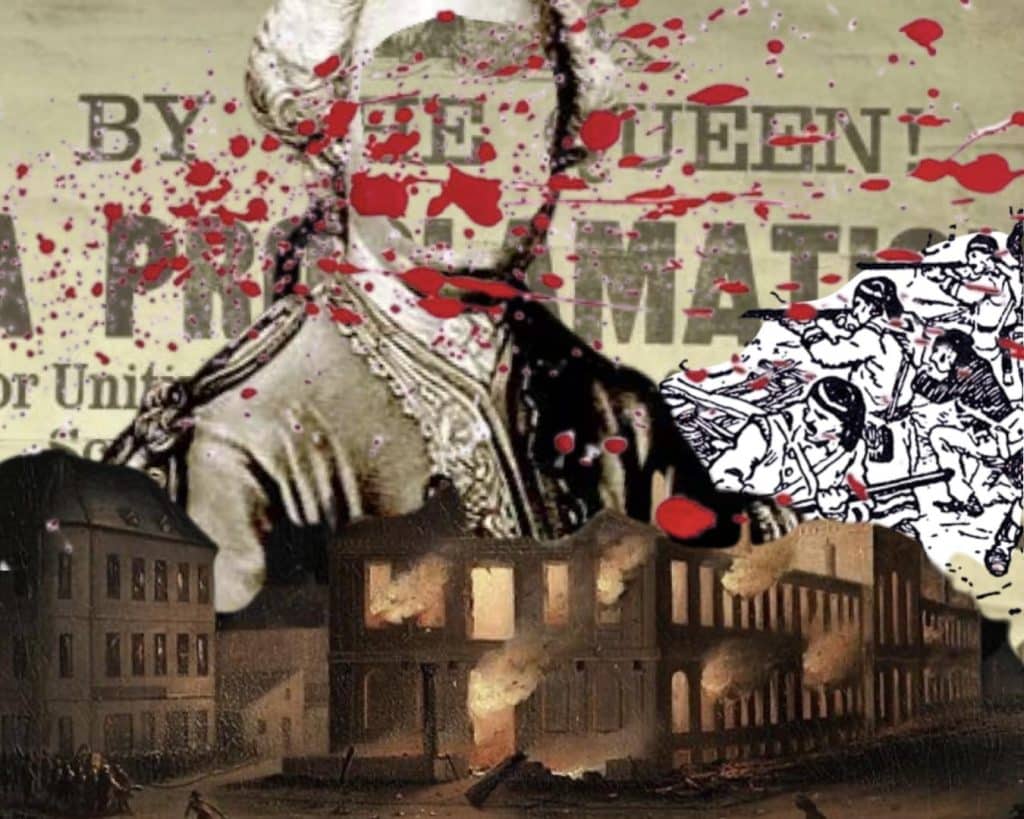
Many of the popular narratives strengthen and proliferate this colonialism, Néméh-Nombré said. For some Quebecers, 400 years of history on this land could be seen as long enough to be considered Indigenous to it, usurping the identity of those whose ancestors have lived here since time immemorial. Ongoing violence against Indigenous people, particularly women, can therefore be brushed off as it reinforces Quebec’s legitimacy in “owning” this territory and Indigeneity.
There is also the reluctance to deal with the historic presence of enslaved people in New France and in the British colony borne out of the war, both Indigenous people and African captives in the trans-Atlantic slave trade. In obscuring the reality that Quebec too has a history of enslavement within its borders, the idea of the working-class québécois as slaves to British rule can proliferate unchallenged.
The first talk on September 19, “Traduire la violence coloniale,” expanded on the central theme of Koulounisation in which Djaferi meditates on the importance of the words used to describe colonial history. Djaferi, a French national born to Algerian parents, was inspired to write the one-man show after visiting Algeria and learning that there, the Algerian War, as it’s known in France, has a different name: the revolution.
Webster, a hip hop artist and public speaker, discussed his recent French translation of Charles W. Mills’ The Racial Contract: Le contrat racial, published this year by Mémoire d’Encrier.
“I talked about a concept that I find very interesting, which was developed by [Mills] in his book,” Webster said after the discussion.
“He talks about the epistemology of ignorance: how ignorance is constructed to facilitate colonization and slavery, and how it erases many things for people constructed as white, and also for people constructed as non-white. Mills speaks of an agreement to misinterpret the world and world events. And we’re right in the thick of it when we talk about the way people react to Quebec’s colonialism.”
He pointed out the tendency in this province to construct a notion of “benevolent” colonization, which he likens to the Manifest Destiny concept which gave Americans a sense of moral rightness in colonizing the American West.
“I have the impression that our way of seeing colonization is similar to that dynamic: we imagine that this place was made for us, the Indigenous people were practically waiting for us, and that we colonized hand in hand with them and there was no negative impact for them,” he explained.
“We saw this in the columns that came out (by Bock-Côté and Martineau): for many people, colonization began in 1760 with the fall of Montreal into the hands of British soldiers. So colonization is only English colonization, the French speakers do not see their presence here as a colonial presence, at least not in the full sense of the term — we believe that it is a beautiful thing, in fact.”
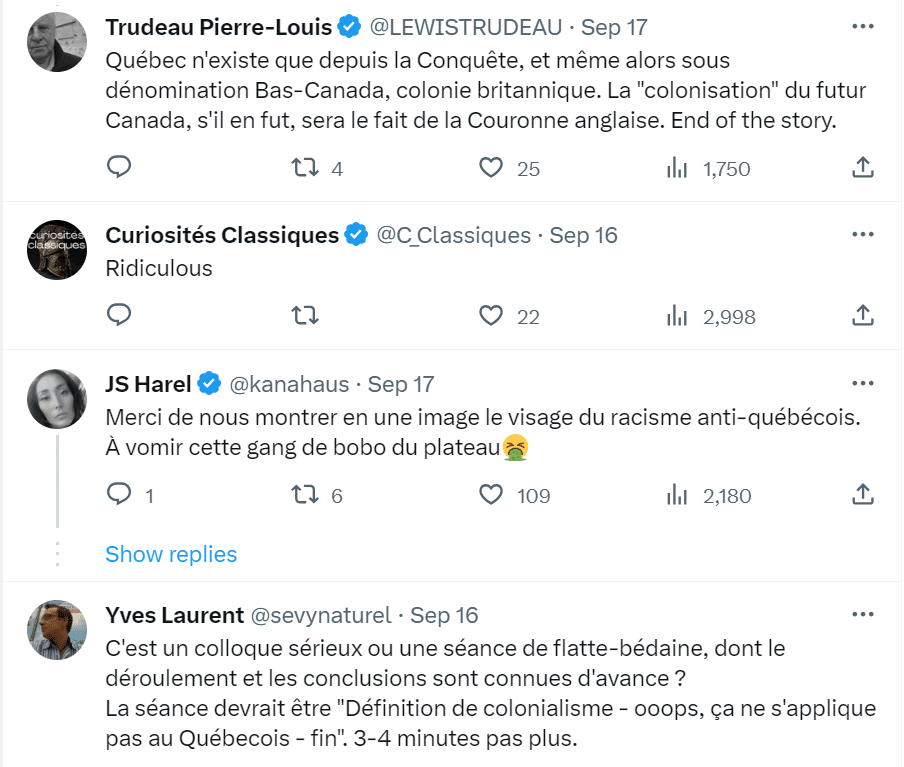
Reactions to the event information being reposted by Université de Montréal’s History department on X/Twitter.
Webster and Néméh-Nombré have faced backlash in the past for speaking publicly about these issues. And though neither of them was surprised by the outrage these two public discussions caused, they both highlighted that such protestation over merely discussing Quebec colonialism shows how some will never even consider the notion.
“In the rest of Canada and the United States, I get the impression that the discussion is more present in the public space — it receives as much backlash, but at least it’s a discussion that takes place. Whereas here, we’re not even able to have the discussion because we see it as something completely incongruous,” said Webster.
The backlash still has its use, Néméh-Nombré says: “It brings to light the violence of what we are denouncing. Without a backlash like what we saw, it is much more difficult to measure what a system is prepared to do to maintain itself.”
But even in the face of this public retaliation, the two agree that the only way forward is to keep speaking up about Quebec’s colonial history and how it continues into the present.
After all, there’s a reason the events were organized as discussions and not presentations: it invites people to consider what is being talked about, bring questions, and try to come to the answers together.
The talk on September 21, which The Rover attended, ended with questions from the audience, some of which began with a preamble expressing difficulty coming to terms with the notion of Quebec as a colonial entity, but a willingness to try to engage with it.
“There is no change in comfort,” Webster said. “Changes create discomfort and whatever the struggle, there are privileges that are shaken and that never pleases the people who have the privilege.”
It’s not an issue that only concerns researchers, or only those who are descendants of the colonized: it is an issue we all have to reconcile with, Néméh-Nombré said.
“It’s not a good argument, but I’m sensitive to the argument raised when people say ‘But it’s not me who colonized.’ It’s normal for them to say that to themselves if they don’t have the opportunity to understand to what extent colonialism exists today and to what extent it affects their own lives,” said Néméh-Nombré.
But these conversations are often led by academic circles, which can struggle to make their findings accessible to the general public. Perhaps a place to start, to get out of the theoretical, is with a play exploring these themes.
After all, the play that started this whole conversation to begin with, Koulounisation, is on at Théatre Prospero until October 7.
Author

Comments (1)
Leave a comment
Related Articles
Will Bill 21 ‘Erase’ a Generation of Muslim Teachers from Quebec?
The legal battle over Quebec’s religious symbols ban has reached the Supreme Court in a case that will make Canadian history.

Nunavik Police Get a Pay Raise Amid Community Concerns
Inuit activists say the pay raise should match police efforts to rebuild trust with the communities.
Montreal Police Pressured Community Leaders not to Attend Vigil for Abisay Cruz
Sources say that while police spoke of listening to community after the killing of Cruz, they took a much harsher line behind the scenes.
Most of the people talking about the past of Quebec simply do not know what they are talking about. Just a few points:
“Canada” was written first by French Explorer Jacques Cartier in 1535, in his travalling journal. He wrote it not less than 22 times!
So during the French Colony, this land (St.Lawrence River) was called “Canada”, not Quebec.
Around 1670 the French colons and their children started to identify as “canadiens” since they became distinct from France’s French.
From 1815, Louis Joseph Papineau became head of a political Party called “parti canadien”. Even the patriotes of 1837 were called “patriotes canadiens” and the song written in 1842 celebrating them is titled “Un Canadien errant”.
In 1880 Calixa Lavallée composed O Canada specifically for the French speakings!
What about Je Me souviens?