
Canadians Cash In While America Burns
It’s easy to sit in judgement of the U.S., but Canada has enabled, and even profited from, the rise of American fascism.
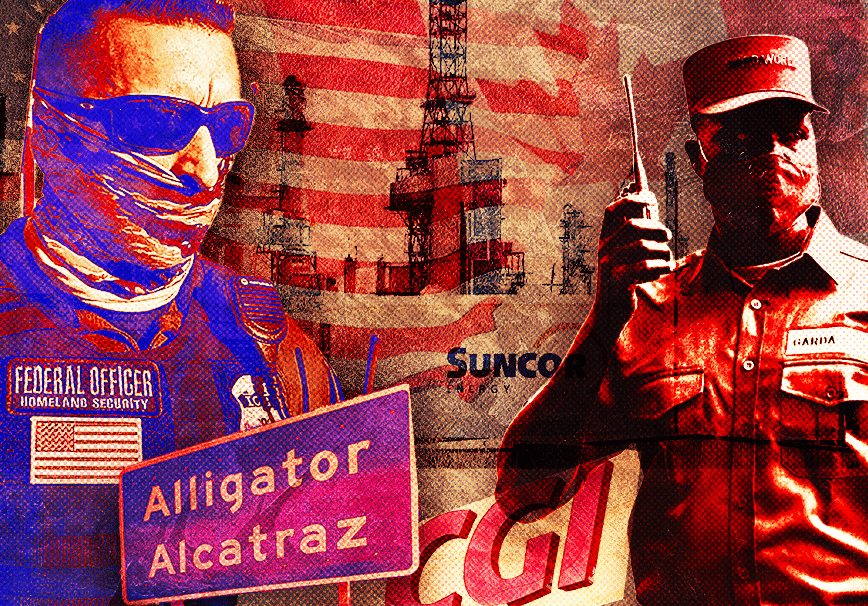
What role is Canada playing in the United States’ fascist turn?
The Department of Homeland Security rounds up hundreds of migrants a day, throwing them in cages operated by the Canadian security firm GardaWorld.
As ICE agents sow terror in cities across the U.S., the Ontario manufacturer Roshel supplies them with armoured vehicles to facilitate their work.
While ICE saw its budget balloon to $75 billion last year, the Montreal-based CGI Inc. helped the agency manage its sprawling technology needs from offices in Washington, D.C. and Philadelphia.
And just days after the U.S. military abducted a sovereign head of state, Canadian politicians boasted about the coup creating opportunities for Alberta oil in Asian markets.
Support your local indie journalists
Everywhere you see American imperialism ruining lives, you’ll find unscrupulous Canadians cashing in. Our political class would rather we not acknowledge this reality, that we continue to fall for slogans like “elbows up” without actually considering the degree to which our economy has been absorbed by U.S. interests.
It wasn’t always this way. When Brian Mulroney began the process of signing a free trade pact with the Americans in 1988, only 38 per cent of Canadians were in favour of the deal. And with good reason. Between 1988 and 2002, some 6,437 Canadian companies were bought out by American investors, over 300,000 manufacturing jobs were cut, and the federal government slashed billions from social programs to compete with American labour standards.
Despite free trade being unpopular at the time, Mulroney’s ‘88 election win made it a reality of life in Canada, and we are still dealing with the fallout from getting in bed with the world’s economic superpower.
Consider Prime Minister Mark Carney’s biggest political coup so far: the Canada-Alberta Memorandum of Understanding. By scrapping the carbon tax and exempting Alberta’s energy industry from certain environmental legislation, Carney turned a thorn in the Liberal government’s side into a partner. Together, Carney and Premier Danielle Smith hope to build a pipeline linking the oil sands to Asian markets, reducing our reliance on American exports.
The project is part of Canada Strong, a pitch by Carney’s Liberals to fast-track nation-building projects that will strengthen our country against American imperialism. But here’s the problem: the four largest Canadian companies operating in the oil sands — Suncor Energy, Imperial Oil, Canadian Natural Resources and Cenovus Energy — are mostly American-owned.
On average, about 60 per cent of each company’s shares are owned by American investors. What’s worse, according to an Oct. 21 report by the Alberta Federation of Labour, a shrinking percentage of the companies’ profits is going to Canadian workers. During the 2011 to 2014 energy boom, Alberta’s oil industry made $64.2 billion in profit, with workers getting a 52 per cent share of the revenue. But during the 2021-2023 oil boom, when profits reached a jaw-dropping $135.2 billion, workers only saw a 27 per cent of the earnings.
Why are they seeing their share of the pie shrink? Because profits from the energy sector are almost entirely swallowed by shareholder dividends. Unless Mark Carney decides to radically change his politics, taxpayers will pay for a pipeline that mostly benefits American investors at the expense of Canadian workers. We will continue to see our standard of living dwindle, our workers will get more desperate, angrier and seek out more extreme solutions to their problems. That, in turn, will make them more prone to MAGA-style populism seeking to blame these problems on immigrants and other marginalized groups.
But a small group of rich Canadians will get far richer by collaborating with the Americans. Consider all of the Canadian companies doing business with the Department of Homeland Security, taking advantage of free trade to set up shop in a country that puts children in cages.
But these companies and their CEOs aren’t pariahs derided for collaborating with an authoritarian government. Rather, they are considered pillars of the business community, lauded for their charitable works, written about glowingly in our mainstream media and connected to our most powerful politicians.
GardaWorld founder Stephan Crétier, whose firm provides agents for Alligator Alcatraz, has a wing named after him at the Montreal Museum of Fine Arts. His company has spent a fortune lobbying the federal and provincial governments and he has donated thousands to both the Liberal and Conservative parties.
In exchange, Garda was awarded a $2.7-billion federal contract to provide screening at airports across Canada and hundreds of smaller deals with Ottawa. The best part? Crétier doesn’t even live in Canada anymore, having moved to Dubai so he can pay lower taxes and run his mercenary force closer to war-torn countries like Iraq and Ukraine.
CGI co-founder Serge Godin, for his part, is both a member of the National Order of Quebec and an officer in the Order of Canada. His company’s work for the Department of Homeland Security won’t even be a footnote in his biography. Roman Shimanov, whose firm Roshel provides ICE with armoured vehicles, benefits from deferential coverage in The Globe and Mail, which posits that writing his firm a blank cheque is the “best offence” against economic stagnation in Canada.
These men aren’t patriots, they’re profiteers. And in Mark Carney’s Canada, they set the agenda.
Author
Comments (4)
Leave a comment
Related Articles
OPINION: Why is McGill Fighting to be on the Wrong Side of History?
The university insists on silencing its students as they push McGill to take a stand on genocide.
A Road Trip Through Trump’s America
What a week in West Virginia reveals about the direction of the United States.
Editor’s Note: When the Comments Section Gets Out of Hand
As our Instagram follower count grows, so too does the number of problematic comments. What are we supposed to do about it?
Tito “hamas” curtis would never dare write an article on the killings going on in IRAN …. for this useful idiot it would be islamophobic to say something lol…
Hello Mr. Curtis,
Your video criticising Elias Makos for his interview with the US ambassador was a peculiar watch.
I watched the same interview and totally disagree with your opinion.
Your use of the terms “bootlicker” and “cringe” were totally inappropriate.
You’re free to publically air your personal grievances. The public is also free to criticize you.
I for one find you lack credibility and are very hostile. I also find you very condescending for someone who lives rent free in someone else’s house and begs for money to survive.
To each their own I guess.
Best of luck.
Elias Makos: Canadians might not want to celebrate US independence because of tariffs :O
This guy right here ^: Don’t call my favourite US bootlicker a bootlicker 🙁
Also, pointing out that independent media relies on public donations to maintain editorial independence is not the own you seem to think it is…
Fuck off.