
Editor’s Note: A New Column From The Rover
Managing Editor Savannah Stewart takes you behind the scenes of The Rover in a monthly column.
You might have heard that journalism is at a crisis point.
Actually, several crisis points. There’s the problem of funding, but that’s nothing new. The news might have been a money-making business at one point, but it hasn’t been for a long time. The work of keeping the powerful accountable is not compatible with the logic of the free market, it never has been, and for the past 20-ish years we’ve seen the results of running the industry like it is.
There’s also the crisis of trust — people don’t trust journalism and those who do it.
Quebec is the province that trusts news media the most, where 21 per cent of people report a high degree of confidence in the media. Obviously, a healthy dose of skepticism is never a bad thing, but it’s hard to look at a number that low and not conclude that somewhere along the way, media makers screwed up.
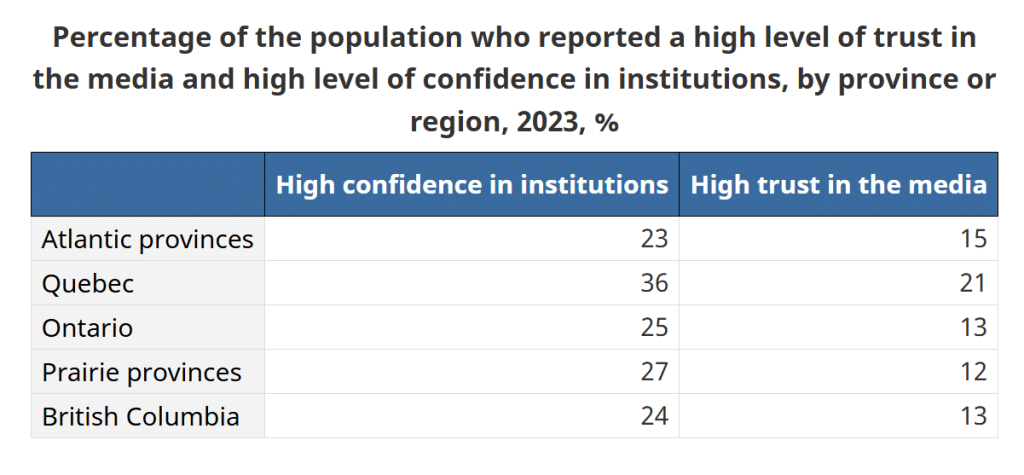
INFOGRAPHIC: Statistics Canada
These two things are related: subjecting journalism to the whims of a capitalist market has meant a dwindling number of journalists are tasked with reporting an ever greater amount of content. Always more, always faster, no matter how many rounds of layoffs the newsrooms go through. The first thing that’s lost is quality. How can we expect people to have confidence in a product with ever-diminishing value?
The Business of News
The Rover was born from this context. Christopher Curtis, my editor and friend, worked at The Montreal Gazette for about a decade. He was a print reporter who gained popularity among readers for his unique writing style, becoming particularly adept at reporting on issues that get at the heart of humanity and its messy, contradictory nature.
The Montreal Gazette was owned by CanWest, which was bought out by Postmedia in 2010. Big companies that benefit from big business policy, both pushed political endorsements of the federal Conservatives onto the editorial board at The Gazette and all other publications they own.
The result was The Gazette running endorsements of Stephen Harper in 2006, 2008, 2011, and 2015, in a city that hasn’t seen a conservative elected since Brian Mulroney’s sweep in 1984. It was, as readers weren’t shy to point out at the time, tone-deaf. Those endorsements would certainly not have inspired confidence in the paper’s readership, which is overwhelmingly Liberal.

The Montreal Gazette ran an editorial endorsing Stephen Harper days before Justin Trudeau won a majority government in the 2015 election. SCREENSHOT: The Montreal Gazette
While he was there, Chris saw the progressive asset stripping of the paper and the whittling away of staff until whole departments were shut down. At some point, it gets to you, to see decisions being made not to serve the public but to maximize profits. No one goes into this industry with their intentions turned towards profitability.
So he left and started The Rover, which is funded by the people and is a long way from making anyone money, because money’s not the point. The point is to take the time necessary to produce quality journalism, to invite our readers and funders behind the scenes of the reporting process, and cover the stories mainstream journalism has left by the wayside.
Four years later, I think we’re doing pretty good at the first and third points. We publish when the story is ready, not on some fixed schedule to churn out as much content as possible to feed the machine. We also take in pieces that can’t find a home anywhere else, as independent publications close and freelance budgets at the big organizations shrivel up.
But since joining this project as managing editor, and particularly in the past year, I’ve been thinking about the second point.
A Front-Row Seat to the Reporting Process
In the past few years, the erosion of public trust in journalism has gone from a vague concern of mine to an almost daily preoccupation.
I’m not going to pretend that the media doesn’t have real problems — I’m painfully aware of them — but in a time of disinformation, foreign interference, AI-generated images, deepfakes, and all the other weird shit going on in the year 2025, we are in desperate need of trusted sources of news with which to form a shared baseline notion of reality. We’re losing that common perspective. The centre is not holding.
It’s said by the people researching this kind of stuff that the best way to address the public’s loss of trust in journalistic institutions is to increase transparency, to explain how journalism is made. It’s one of our founding principles, and if you signed up for our newsletter from our website, you were promised a “front-row seat to the reporting process” in doing so.
But it’s a practice that has taken a backseat for us, as we focus in on the nine million other things involved in running and trying to grow The Rover. We’re keeping the lights on, to borrow one of Chris’ expressions, but we’re constantly in survival mode, putting out fires and managing crises every week.
Support Your Local Troublemakers
Because there are a few mini-crises I haven’t even gotten to yet. Meta banning Canadian journalism has had resounding effects in the industry, particularly for smaller, local, and alternative publications. Before we were forced off the platforms, our Instagram account had been growing steadily with almost 3,000 followers, and we were making inroads in the 24-35 age group, a demographic I’ve been eager to try and break into seeing as it’s my cohort (our readership is made up predominantly of 36-45 year-olds).
We lost all that momentum, having to restart with a new, “community-oriented” Instagram where we’re afraid to post anything too newsy lest we get kicked off again and have to start all over.
And don’t even get me started on what Meta’s decision means for the fight against disinformation in this country. In a nutshell: it’s not good.
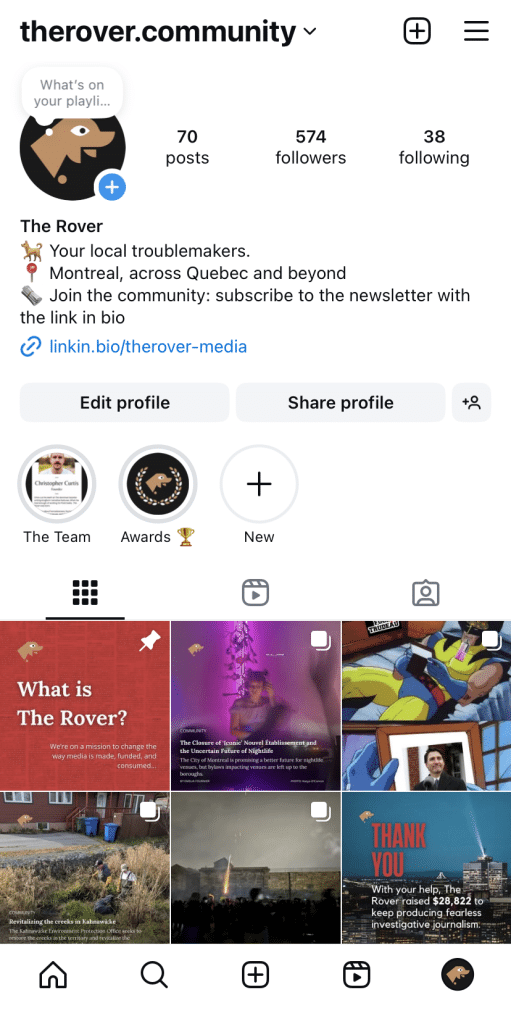
The Rover’s Instagram account, where we play the game of talking about our work without using the words “journalist,” “article,” or “news.” SCREENSHOT: @therover.community
What I’m Offering
There are times when we’re at work on a story that I wish I could explain the decisions we make directly to our readers, that I could look into a camera and tell you in my own words about the ethical, professional and logistical considerations that I’m thinking through in all aspects of my role. You don’t see my byline very often, because these days I’m in the background: I talk through the stories with the journalists we work with, I edit every piece, I manage the website, newsletter and social media, I plan our yearly in-person events and I’m slowly diversifying our revenue streams by applying for grants and trying to sell ad space.
A bit of my work is in everything we do, and those considerations I juggle shape the finished product that you get in your inbox every week.
So I’m a pretty good person to be demystifying what it is we do and why we do it this way, at a time when we need to be thinking about how best to serve our audience, how to offer you something you won’t find anywhere else, and give you a reason to join this community — whether it’s by becoming a paid member, making a one-time donation, or sharing our work in your circle.
At a time when, again, trust is hard to come by in our profession, we need to be giving you reasons to trust us.
I’ve also had to move away from reporting — lack of time and energy — and I made the questionable decision to do a Master’s in communication, specializing in journalism, so I spend most of my waking life engaging critically with the subject matter and I’m very eager to write something other than research papers.
So let us put our money where our mouth is with a monthly column giving you a front-row seat to the reporting process. Editor’s Note will bring you behind the scenes, detailing how we develop our stories, from the idea to the finished article, what gets in our way, and why we make the choices we make. But I aim to look beyond the work at The Rover to talk about our industry as a whole, what’s going wrong and how people are trying to make it right.
It’ll inevitably be informed by studies, but I promise not to cite too much Dewey, McLuhan or Foucault. Mostly, it’ll be informed by my work as a journalist and editor with various publications in Montreal and across Canada, and it’ll be informed by my role at The Rover, working alongside Chris, who has a thing or two to teach about this business.
It’ll also be informed by you. Get in touch if you have any requests for topics, or a question you want answering. In the meantime, please do something that would piss off a Postmedia exec, like supporting independent news.
Until next time,
Savannah
Author

Related Articles
Is Israel Preparing a Legal Framework to Execute Palestinian Prisoners?
Since October 7, 2023, prison conditions for Palestinian detainees have seriously deteriorated.
SAAQclic : quand l’État ne sait plus « faire » ni « faire faire »
SAAQclic dépasse le simple scandale administratif. Il révèle quelque chose de plus profond, soit l’érosion graduelle de la capacité de l’État à agir par lui-même et à encadrer efficacement les actions qu’il délègue.
Editor’s Note: Talking Feelings
We love what we do, but it comes with a lot of pressure.
Comments (0)
There are no comments on this article.