
Fight or Flight
At 37, I’m finally starting to heal from a lifetime of self destruction. Unfortunately, that means getting beat up a lot.
Learning to love yourself in the brutal world of combat sports

I’m quitting drinking.
The thought came to me as I hunched over a toilet bowl and evacuated the contents of my stomach. In truth, my newfound interest in sobriety began a few minutes earlier, when Chris Shawbell snapped my head sideways with his fist.
I’d fought my coach enough times to know what came next but was too hungover to stop it. Chris’ shin crashed into the doughy spot between my ribs and basin, dropping me to my knees. A well-timed liver shot sends a blast of pain through your body — your legs go limp and every breath is pure agony.
I got back to my feet and peeked at the clock: two minutes left in the round. And another half dozen rounds to go at least.
You’ll never have more honest accounting of yourself than when you’re hungover and getting beat up. I’m out of shape and indulgent, paying a 53-year-old man to thrash me as booze comes steaming from my pores. This is the definition of self-sabotage, taking your most destructive impulses and allowing them to ruin something beautiful.
There is no educational value here, it’s just suffering for suffering’s sake.
I was in crisis when I started kickboxing four months ago, working six days a week to pay down my debts and cycling through manic episodes that seemed to last longer each time.
I’ve been on a cocktail of antidepressants and antipsychotic drugs for so many years that, if I miss just one dose, my whole body shakes. Another side effect of the pills: at a certain hour of the night, I am overcome by a raccoon-like desire to forage for junk food and gorge myself until it hurts. Lacking any semblance of self-control, I ballooned from 165 pounds to 220 since I started taking them in my twenties.
On balance, the pills keep me from going over the edge and I’m grateful for that. But I still slip up, I still spiral into fight or flight mode for days on end, going without sleep and replaying the most violent memories until I’m consumed with rage.
And that worries the people who love me.
So when the new year came, I made a promise to my partner and my baby girl that I’d work on myself. New therapist, less drinking and, on the advice of the good doctors at the Douglas Mental Health Institute, constant exercise.
“Interrupt me,” Chris mumbled, through his mouthpiece.
Chris likens fighting to music. All the good stuff, he says, happens on the half-beat. Even the best fighters have patterns. If you can keep your composure as they hurl their fists at you, a pattern begins to emerge. Once you know their rhythm, you can interrupt it.
I tried to kick Chris in the ribs but he put his knee up and smashed my leg. It felt like a glass bottle exploding inside my calf.
“You’re telegraphing!” he said, pretending to write a letter with his glove.
Chris wanted me to use more feints so I could create an opening and attack. But I was too tired to think so I just waited for him to come at me again and threw a looping left punch in desperation. It caught Chris and backed him off.
Suddenly, he was the one on his heels with me in close pursuit but my reprieve was short lived.
As I closed the distance between Chris and I, he fired another straight kick into my guts — the ninth or tenth by my count — causing me to groan cartoonishly and get to one knee. Round over. I rushed to the bathroom and puked.
I’m quitting drinking.
The night before, I’d stayed out until 1:30 a.m., drank a case of Labatt 50 and devoured a gyro pita before passing out on the couch. I had been disciplined for months but pissed it away. If you’re serious about fighting, you don’t show up to the gym hungover. Because if you’re serious about fighting, you know that somewhere out there, there’s another person preparing to destroy you.
We’re hoping to find that person by the end of summer.
Chris and I have been vagabonds for the past few months, riding metros and bicycles to whatever fight club will lend us a small corner of their gym. We initially thought we’d be doing this for a month or two while Chris saved up to open his own place. But it’s hard to find somewhere that’s affordable and not too close to rival gyms.
A few weeks ago, I finally summoned the courage to ask Chris if I could join another club.
“You need to keep training if you want to fight, that’s priority one,” he said. “I think I know someone.”
***
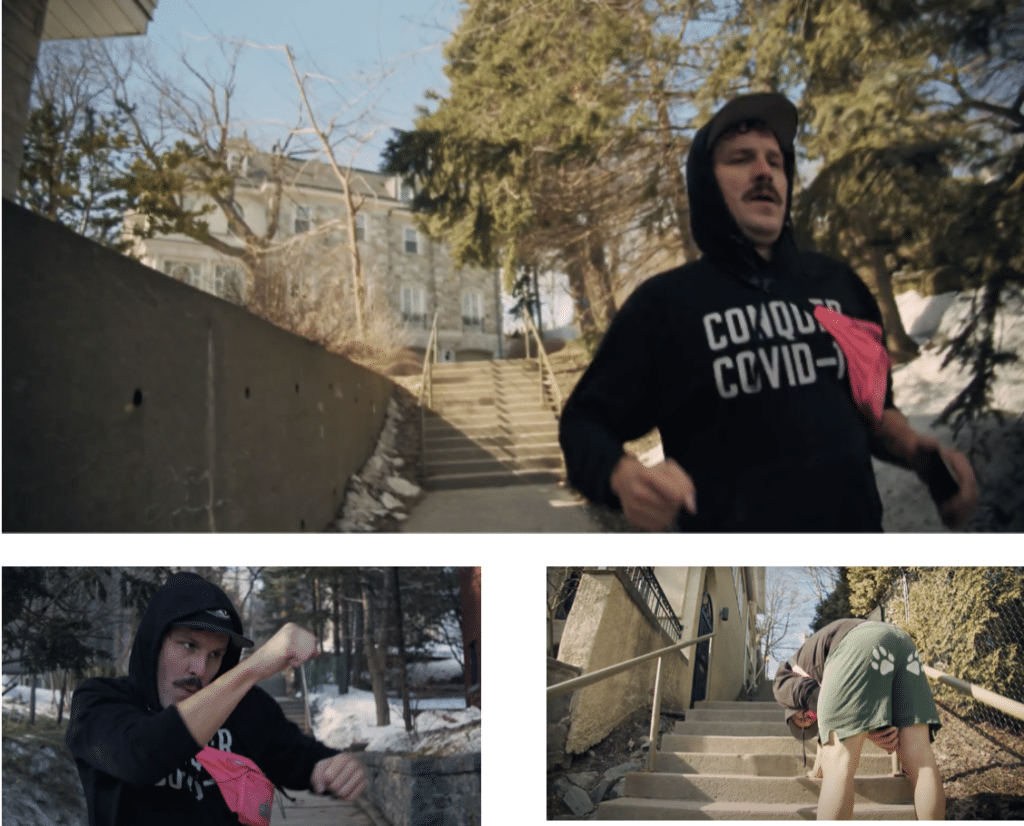
Running stairs is brutal. PHOTOS: Jay Walker
“You can romanticize this all you want but, deep down, fighting is fighting. It’s two people, in a ring, trying to wail on each other.”
Francis Duguay preaches the combat Gospel from a church basement on Jarry Street.
“When you learn to respect the danger of it, that’s when you start to put the work in,” he continued. “And fighting is hard work, it’s pushing your heart, your lungs and your body past where you think they could go. That’s why we do it. We do it because it’s hard.”
Under the Paroise St-Vincent-Ferrier — named after the patron saint of fishermen and plumbers — Duguay leads a group of fighters who may as well be in a cult. They show up early, stay late and answer every question with a roaring “Yes, coach.”
Chris recommended Duguay based solely on that devotion.
“I’ve never seen him coach a class but he has the most loyal students in Montreal,” Chris said. “That tells you a lot about a person. Plus he’s a cool fucken guy.”
The Paroise above Duguay’s gym is a 104-year-old building that still towers over the neighbourhood. It has all the trappings of a Montreal-style church:haut-relief carvings chiseled into the columns, copper spires turned green from a century of oxidation and, of course, stained glass depictions of Christ in agony.
Dug into the cavernous hall beneath St-Vincent Ferrier, Duguay’s gym has none of this opulence. The action takes place between steel beams and stucco walls that hold the building together.
Everything else has an improvised quality to it; a makeshift ring kept alive by duct tape, two-by-fours and canvas ropes. Boxing gloves and kick shields spill out of a repurposed filing cabinet and the most advanced piece of fitness equipment is an exercise bike that looks like it was fished from the bottom of a canal.
There are no clocks or windows to mark the passage of time. Everything is measured by the buzz of a ring timer that goes off in three-minute intervals. In between buzzers, the slapping of gloves and shins against flesh echoes throughout the church basement.
This gym, Barbu Kickboxing, will be my second home for the foreseeable future. Its biggest selling point, to me, is that it’s the rare gym actively working to root out the toxic elements from combat sports.
During the mixed martial arts boom of the mid aughts, it seemed every “alpha male” in the world owned an MMA gym. Picture the biggest piece of shit you went to high school with but now he’s ‘roided to the gills and somehow managed to get a small business loan.
If you’re unfamiliar with this archetype, just imagine beach muscles, a spray tan, tattoos of their estranged children and a wardrobe that consists entirely of bedazzled t-shirts.There goes Sensei Zane Higgins, fighting a bouncer outside a strip club in Laval.
I trained about a year of MMA back then and it wasn’t uncommon to hear words like “f*ggot” carelessly thrown around and witness other aggressively homophobic behaviour.
Duguay is not that kind of guy.
For starters, he’s a former merchant marine, someone who honed his sense of self on long, lonely voyages up and down the St-Lawrence River. You don’t get the sense that he’s trying to compensate for anything by being “alpha.”
He’s about five-foot-nine, rail thin and wears equipment held in place by medical tape. A self-described nerd, he wears Dragonball Z t-shirts and plays opera music while his students train. The only hint of flash on him is a thick moustache that curls at the tips, giving him the appearance of a Slavic duke.
By and large, the fight scene is full of people like Duguay but it has a nasty habit of enabling deeply problematic behaviour.
Floyd Mayweather has repeatedly been convicted of battering women but were he to fight this weekend, the boxing champ could command a $30 million purse without batting an eye. Last winter, after footage of UFC president Dana White slapping his wife surfaced online, the fight promoter faced no consequences for his actions. He remains one of the most influential and wealthiest figures in combat sports.
In almost every corner of the fight world — from former UFC champion Conor McGregor’s criminal convictions to former kickboxer Andrew Tate’s arrest on human trafficking charges — there’s a tacit acceptance of violence against women and sexual minorities.
Inevitably, this culture trickles down to the gyms.
“We’re trying to distance ourselves from that toxic shit,” Duguay said, when I first met him. “We’re trying to build an inclusive community where everyone — regardless of gender identity, sexual orientation, race, religion — can feel safe.
“Yet we remain a serious and very competitive actor in the local fight scene.”
There are symbolic ways Duguay achieves this — the two Pride flags that hang above the ring are impossible not to notice — but the coach puts his beliefs into practice as well. Women, trans women and non binary people get a 10 per cent discount on membership and many compete in the amateur scene.
“It might come as a surprise to some people because they think of women as these soft demure things but I really like hitting shit,” said Katia Briand, a university student who trains at Barbu. “I grew up watching Buffy the Vampire Slayer and listening to metal. All the boys I dated would go, ‘I tried kickboxing and it’s not for me, I don’t want to get hit.’ But I love it, I’m covered in bruises and I love it.
“The options you have for women, at a lot of gyms, are cardio kickboxing classes. I did it because it was a good workout but there’s no attention to technique. A lot of people are there because they want to lose weight but I just want to learn how to fight.”
Briand said she took a free class at Barbu last summer but waited a month before going back.
“I have a lot of social anxiety so it’s overwhelming to be in this new space doing something that makes you feel so vulnerable,” she said. “And Francis (Duguay) was giving me these mad camp counsellor vibes. He’d say, ‘I like to pick on introverts, I like to get them out of their shell’ and that kinda freaked me out.
“But I went back and what it came down to is Francis cares a lot. He treats everyone like they’re going to fight, he takes you seriously even if you’re not the best student there. Even if it’s just for fun, he wants you to know how to take the time to get it right. I’d talk to one of the other girls there and that’s exactly what she said, ‘Francis gives a fuck.’ She’d been to another gym and she felt like the women were shunted off to the side. That’s not how it is here.”
Briand says she also enjoys the monastic aspect of fighting.
Because, while we train as a group, we fight alone. You can show up to class four times a week and put in a good 90 minutes of work but fighting is something you practice by yourself.
It’s shadowboxing in the laundry room while your baby sleeps. It’s running flight after flight of stairs until the lactic acid melts your calves. It’s lying in a bathtub full of corner store ice, praying your swollen bones will recover in time for the next practice.
Like ballet, the sport of kickboxing is merciless on your feet. Just about everyone at the gym, myself included, has fractured toes, blisters under the balls of their feet and hips that crackle like cement mixers.
If you miss a kick shield and hit the point of someone’s elbow with your foot, you’ll limp around for days. At first, it’s impossible to jump rope without whipping your toes at least three or four times a class. Your feet and legs are constantly bruised and held in place with medical tape.
A few nights ago I dreamt someone kicked my front teeth in and woke up with the taste of blood in my mouth. The night before, I awoke in the push up position. Sometimes, before I fall asleep, I stare at the ceiling and pantomime combinations: jab, cross, left knee… fake jab, front kick and a left hook that drops Chris Shawbell (a kid can dream).

Chris Shawbell barely breaks a sweat as I struggle not to dry heave. PHOTO: Peter McCabe
This all sounds pathetic and it is.
But a mild case of embarrassment is a cheap price to pay for the high you feel from training. I’ve heard Christians describe the Holy Spirit coursing through their bodies. I can only imagine it’s similar to the wave of endorphins that hits you on the metro ride back from the gym.
“There’s nothing like it,” Chris says. “It breaks you down to your foundation, it tests you always. I’m 53, my knees are fucked, I have permanent turf toe, my back is wrenched I’ve been hit thousands of times but there’s nothing like it.”
***
I was always afraid of fighting.
Not so much because of the pain. I’d grown up with an older brother and a half dozen older cousins, each more sadistic than the next. It was something deeper than pain that scared me.
There was this time cousin Jay forced me to stand on the edge of a seesaw so he could try to catapult me into the air. “Stand still or I’ll punch you in the fucken mouth!” he screamed.
Three of the other cousins watched giddily. My brother Vincent could barely stand to look but, when our eyes met, I swear I saw gratitude in his face. It was my turn to suffer.
Jason stomped down on the seesaw with both feet, launching me into the night sky. I remember this moment of euphoria, thinking maybe I’d do a flip and land perfectly on my feet, dazzling the four older boys.
I came down face first onto the seesaw, fracturing my front tooth and cutting my gums on the rusty handlebar. To this day, the tooth is still loose. I was 10 years old when it happened. Jay was 16.
He’s a dentist now.
I didn’t cry because it hurt — which it did, immensely. I cried because it was humiliating. There is nothing so degrading as someone else imposing their will on you. What’s far worse than physical pain is knowing that, on some primitive level, you don’t measure up. Even today, 27 years later, no accomplishment will ever mask the fact that I could not prevent another boy from torturing me for sport.
The shame goes even farther back.
When I was six, an older boy pinned me down and sexually assaulted me. I remember freezing, not even trying to fight back because I was so afraid. We saw each other a few more times that summer and, when he wasn’t assaulting me, I desperately wanted him to like me. That fact caused me to hate myself for a long time.
For most of my life, I assumed that other boys could smell the stench of what he did to me. I started to think of myself as a victim, as someone who needed to hide behind humour and surround himself with protectors instead of standing up for myself.
Though my brother would smack me around, on occasion, he was also merciless with anyone who tried to hurt me. Vince was the star athlete, the leader, the alpha dog in our group and I gladly fell into the role of the weird little brother.
In second grade, this older kid stomped on my head until his buddy pulled him off. Minutes later, Vince stalked the schoolyard until he found my bully and mauled him in front of everyone. It filled me with a weird mix of pride and resentment.
I carried that resentment into adulthood, weaponizing it against myself so that — no matter how bad someone wants to hurt me — they can never punish me as much as I punish myself.
I used to think that burning hatred made me a good journalist and kept me safe. In reality, it nearly killed me. I’ve now spent most of my life on mind-altering medication that I cannot stop taking at the risk of ending up on suicide watch.
At 37, with a baby girl at home and a partner I’ve dedicated my life to, I worry that I’ll never get better. I can live with the meds making we overweight but the self-destruction is all-consuming.
Fighting hasn’t fixed that. Fighting won’t fix me. It’s just a small part of the daily struggle to take back control of my life.
When I first sparred, years ago, I remember being so scared I forgot to breathe. By the time my opponent planted the softest knee to my belly, I collapsed and briefly considered quitting.
But I quit after eight months because I couldn’t get my self-destruction under control. One morning, after popping Ritalin and getting hammered all night, I showed up half-drunk to a sparring session and nearly got myself knocked out.
When I got back to training this year, I very nearly fell back into that pattern. But I’m interrupting it this time.
Last Friday, a few weeks after puking during my session with Chris, I fought 11 rounds in a church basement — sparring against opponents of every size and description.
I don’t care about wins and losses or how others might perceive my skill level.
What drives me is knowing that I can build discipline into a life ruled by chaos. What drives me is that I’ve found something that can make me feel good without giving me a hangover or causing me to black out and do terrible things.
What drives me is the knowledge that I can be afraid of someone and still fight back.
Author

Related Articles
Prison Recipes By and For Incarcerated People
La Cantine is a cookbook that helps inmates discuss risk prevention and reflect on food in prison.
Becoming Ballers: How Nunavik’s Youth Built a Community Around Basketball
In villages across the North, Inuit teens are creating a safe space for each other and the next generation of athletes.
By and For: Exhibit Traces History of Sex Worker Resistance
Sex worker support organization Stella wants to change the public’s perception of sex work with an exhibit at the Centre des mémoires montréalaises.
Comments (0)
There are no comments on this article.