
Here’s How Montreal’s Mayoral Candidates Would Fight Homelessness
The municipal parties are pitching plans to increase shelter spaces, address encampments, and improve public security leading up to the Nov. 2 election.
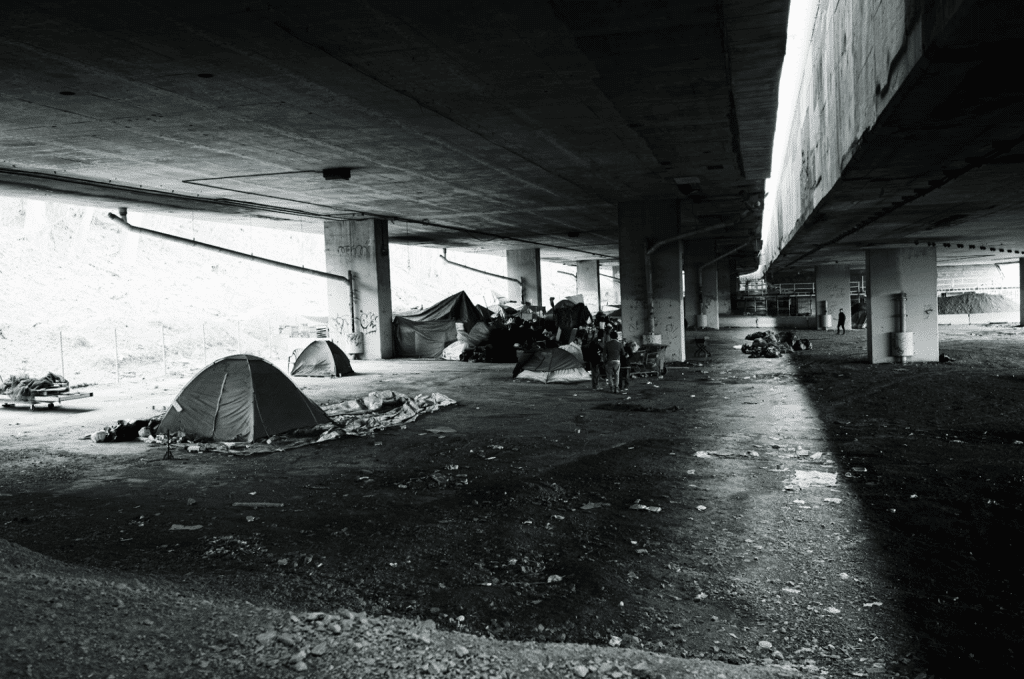
When a Léger poll asked Montrealers what their biggest concerns were going into the election, homelessness came a close second behind housing. More than taxes, road infrastructure, transit and crime.
Montreal’s leading municipal parties have responded in kind, making homelessness a central pillar in their platforms. Mayoral hopefuls have promised to address the overall lack of shelter spaces and resources for unhoused people and want to increase funding for organizations working with the city’s vulnerable and unhoused population.
Projet Montréal and Ensemble Montréal have both pledged to “end homelessness.”
Projet’s mayoral candidate Luc Rabouin is promising to end it by 2030. His party plans to build 500 modular housing units and 500 transitional housing units, and to protect and expand off-market rooming houses. While Rabouin proposes to double funding to community organizations working with homeless people over the next few years, the party’s focus is on longer-term housing rather than short-term shelters. For context, Projet Montréal announced $22.5 million in funding for homelessness organizations this past August over a three-year period.
Ensemble Montréal said it would take them four years to eradicate homelessness. Mayoral candidate Soraya Martinez Ferrada is proposing to spend $100 million to buy up buildings to convert to emergency shelters, and $120 million to homelessness support organizations and intervention workers over three years. Her party would also do away with the “seasonal” logic of only offering expanded shelter spaces during extreme weather. The party also promises to build 2,000 transitional and permanent housing units with psychosocial support.
Support your local independent journalists.
One of Transition Montréal‘s first orders of business would be to declare homelessness a state of emergency, permitting the city to use hotels and vacant buildings for temporary shelter during the cold season. Craig Sauvé’s party would triple funding for community organizations addressing homelessness. The party also proposes to transform the city’s unused real estate to meet short-term shelter needs. Transition Montréal would pay for its “fight against homelessness and unaffordable housing” with a new property tax on luxury single-family properties over $3.5 million.
Action Montréal wants to create a roundtable of community organizations to “harmonize their services (shelters, care, reintegration) and avoid duplication.” The party would like to convert some of the 80 vacant buildings owned by Montreal’s housing office (OMHM) into homeless shelters, where people in camps could be redirected. Within two years, the party promises to have transitional centres equipped with tents, sanitation, medical services, and security, as well as permanent rooms tailored for three profiles: “people facing economic hardship, those with addictions, or those with mental health challenges.” In the meantime, they propose places of worship, like mosques and churches, open their doors as temporary shelters.
Futur Montréal proposes that the municipal housing office partner with the city’s hotel industry to offer monthly packages for citizens experiencing temporary involuntary homelessness.
Under Mayor Valérie Plante, Projet Montréal has received criticism for dismantling homeless encampments over the past few years. A recent report from Montreal’s public consultation office on homelessness advised against dismantling homeless encampments. Rabouin said that unhoused folks in encampments should be placed in modular housing units, but did not say whether the party would continue the practice of dismantling.
Martinez Ferrada and Sauvé both said that dismantling camps was not a viable solution, with Martinez Ferrada saying transitional housing was needed. Ensemble Montréal plans to create a Tactical Intervention Group on Homelessness (GITI) and draft a protocol for encampments within its first 100 days. Transition Montréal has a “zero dismantling” policy. Sauvé’s party would ensure community workers and basic services in homeless encampments and restrict police access.
This is in line with Transition Montréal’s broader goal for fewer interactions between unhoused people and police. Central to the party’s plan: the creation of a civilian crisis response service with trained intervention workers to respond to 911 calls linked to mental health and unhoused people in crisis. Transition would crack down on police overtime hours and redirect funding from what it calls a “wasteful” police budget to this new civilian response team. The party would also put a stop to random street checks, which disproportionately affect Black and Indigenous people in Montreal.
Futur Montréal also proposes a separate hotline for social intervention cases, but this would still be under police purview. The party’s mayoral candidate, Jean-François Kacou, promises to crack down on crime, advocating for a “zero tolerance” policy on violence and drugs.
Ensemble Montréal, Futur Montréal and Action Montréal all want to increase police in “high-risk” zones and install more security cameras in vulnerable public spaces. Martinez Ferrada wants to increase the number of STM special constables from 160 to 230 patrolling metro stations to address public safety — despite reports of violent interactions between unhoused people and these officers. Kacou wants STM officers to get trained in frontline intervention.
Projet Montréal, Futur Montréal, Action Montréal and Ensemble Montréal want to equip police officers with body cameras to address concerns of police abuse. While the recent shooting of Longueil teen Nooran Rezayi has reignited calls for police bodycams, the effectiveness of this technology is mixed at best. In Montreal in 2019, after a bodycam pilot project, the SPVM concluded body cameras were costly and ineffective. Public reception was also mixed, especially since officers were permitted to turn off their body cameras “in exceptional cases.”
Projet Montréal and Ensemble Montréal also tout the “mixed police teams,” where social workers accompany police in their interventions, as a solution for better intervention practices among unhoused people. Rabouin said he’d like to “improve the efficiency” of these teams, and Martinez Ferrada wants to increase the amount of mixed teams patrolling the streets.
Ensemble Montréal, Projet Montréal and Transition Montréal all want to increase funding for rent assistance programs for households at risk of eviction. Ensemble Montréal and Transition Montréal both propose creating a municipal rent bank. Transition’s would cover up to three months’ rent for individuals at risk of eviction, and for tenants who have been evicted, OMHM would ensure they do not end up on the streets.
Ensemble Montréal would also give an additional $1 million to existing community organizations that work to stop evictions via microloans and other resources. Projet Montréal promises more funding for Maison du Père’s microloan program, and an additional $1.5 million to housing committees across the city. These housing committees — or “comités logement” — help tenants access their rights, including how to deal with the threat of eviction.
Related Articles
‘Everybody Who’s on the Stage Is Part of Your Community’: Ctrl+Alt Festival Returns for a Third Edition
Free festival stacked with queer, local performers to take over the Place du Village July 24-26.
Moving Day: A “Desperate” Struggle for a Growing Number of Montrealers
July 1 is now a race against time for families facing homelessness once their lease expires.

Quebec Workers Experienced a “Counter Revolution” Under Jean Boulet: Experts
The outgoing labour minister leaves behind a legacy of attacking the Constitutional right to strike.
Comments (0)
There are no comments on this article.