
Homelessness: surviving a freezing night in downtown Montreal
On a frigid night in Montreal, La Converse’s young journalists were in the field with The Rover’s Christopher Curtis to talk to people experiencing homelessness about the nightly struggle to keep warm.

Unhoused people in front of the Old Brewery Mission. PHOTO: Amélie Rock
Note from the editor: Last Tuesday night, Chris was out in the field with the young journalists from La Converse’s latest cohort of École Converse, a 12-week training for young BIPOC Montrealers interested in working in journalism. The initiative is part of La Converse’s broader mandate to serve communities harmed by traditional Western journalism practices, namely racialized communities, by promoting the practice of dialogue journalism.
Chris shared some tips on fieldwork and on engaging with vulnerable communities such as unhoused people. This article is the result of that evening, co-written by him, the École Converse youth (Cindy Lufuluabo, Aude Simon, Sènan Guèdègbé, Firas Kefi, Aya Boucenna) and Loubna Chlaikhy, a journalist at La Converse.
We’re happy to share that we’ll be teaming up with the fine people at La Converse more often over the coming months, co-producing content to jointly serve our respective communities and put the notion of dialogue journalism into practice. In the meantime, I encourage you to check out La Converse, and if you can, make a donation to help them continue their vital work and train the journalists of tomorrow.
-Savannah
This article was originally published in French on January 24 at La Converse.
Translated to English by Savannah Stewart.
As a new cold wave hits Montreal, the risk of an unhoused person losing their life while spending the night outside is serious. On Tuesday evening, a public consultation was held on homelessness and the question of social cohabitation. But outside, the only question was how to survive. A report from École Converse.
7:00 p.m. The session “Homelessness and Social Cohabitation,” organized by the Office de consultation publique de Montréal (OCPM), began at the Saint-Pierre Centre. The goal of the consultation is to gather the public’s opinion on an issue that is getting a lot of attention: homelessness.
Forty-seven per cent of the homeless people identified in 2022 in Quebec, or 4,690 people, are in Montreal. Although, the current homelessness statistics are an underestimate, according to several community organizations, and do not account for hidden homelessness — people hosted by friends or who sleep in their car.
On the stage, six people were presenting this information session, the first in a public consultation process that will last until February 28. They were three commissioners of the OCPM, two representatives of the Department of Diversity and Social Inclusion (SDIS) of the City of Montreal and an advisor from the Service de police de la Ville de Montréal (SPVM).
At the back of the room, the latecomers served themselves a cup of coffee kindly offered to the public. While homeless people accumulated layers of clothing to ward off the cold outside, people in the Saint-Pierre Centre took off their coats as soon as they entered because it was so hot.
Questions from citizens that remained unanswered
“Resources dedicated to people experiencing homelessness are really critical to reducing homelessness, but also to meeting the basic needs of vulnerable people and promoting their inclusion. Perhaps most people agree that the services are necessary, but it is often the location of these services that is difficult to agree on,” says Nicolas Pagot, division manager of the Department of Diversity and Social Inclusion (SDIS) at the City of Montreal.
Cases of neighbourhood mobilization when housing projects for people experiencing homelessness are announced, for example, are in fact commonplace. But the City assures that it wants to “implement resources in the 19 boroughs” so that they are no longer concentrated in the city centre.
The benches reserved for the public were sparsely filled: 15 citizens responded to the invitation, while 50 people were following the consultation through the online livestream. Some spoke to the representatives. “You said you wanted resources in all boroughs, but also that it was difficult to reach consensus, so can you give us an idea of when you hope to reach this goal? ” a citizen asked at the microphone.
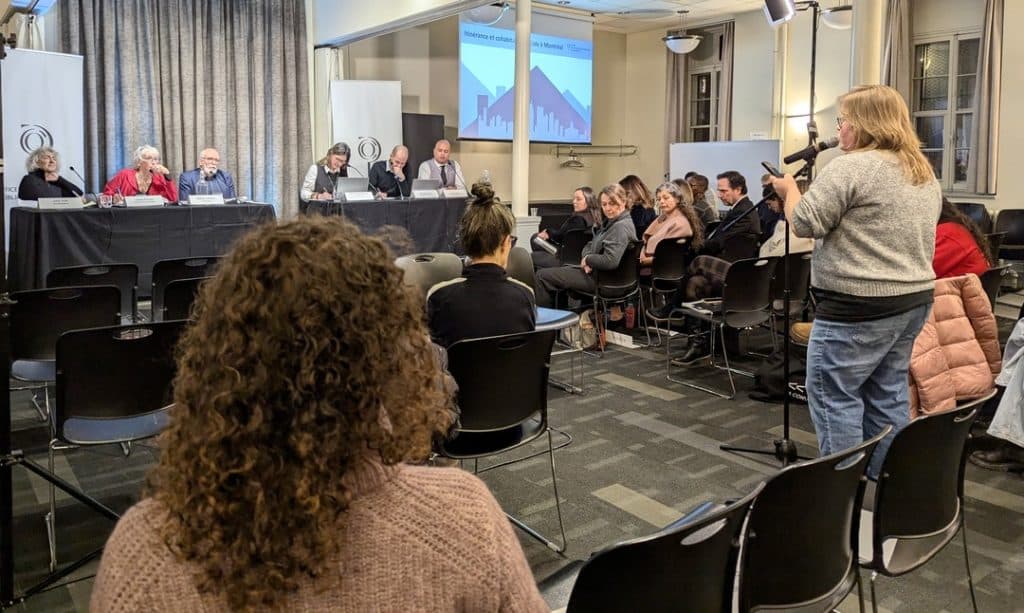
Some citizens asked questions during the public consultation “Homelessness and Social Cohabitation” which took place at the Saint-Pierre Centre on Tuesday evening. PHOTO: Loubna Chlaikhy
But there were few answers to the questions being asked… In this case, as on several occasions, the representatives of the City avoided giving a concrete answer. “And that’s all? You have no answer to give?” was the reaction of the president of the consultation, Ariane Émond. While laughter ran through the meeting, the city representatives promised a written response would be sent out later.
Among the audience was Héloïse Koltuk, an employee at Entremise, a Montreal company that creates living spaces in vacant buildings. “Every day I see people sleeping at my door, outside in the cold, while I manage an enormous heated and empty building,” explained the young professional. Koltuk takes care of a building near Berri-UQAM station, very close to the Montreal Bus Station and the BAnQ, which she describes as “the showcase of homelessness in Montreal.”
She questioned the validity of regulations and safety standards that prevent vacant buildings — numerous in Montreal — from being used to accommodate people experiencing homelessness, especially during extreme cold. She came to the consultation looking for answers to her questions: “I understand that there are standards in general, but in this specific case, I don’t understand how it would be more dangerous for homeless people to sleep in heated buildings, even if they are not up to standards, than to sleep outside and risk freezing to death.”
Again, Nicolas Pagot sidestepped the question: he simply responded that “identifying a space for a resource includes a lot of criteria,” particularly “in terms of fire safety.”
Outside, very close to this warm room where people discussed the fact that the presence of unhoused people should be socially acceptable, those first concerned did not have the luxury of escaping the cold. Their only concern that evening, which they knew would be particularly freezing, was to survive.
9:00 p.m. — A warm night, a daily mission
Only a few meters from the splendour of the Montreal Courthouse, a completely different world unfolds in the shadows. Here, no marble or gilding, but camp bags and difficult existences. One’s dignity worn over the shoulder under the frost.
It was 9 p.m. and in the darkness of a building door, under the clouds of smoke from their cigarettes, John and Denis were getting ready to spend a long night outside — maybe the coldest night of the year.
The minutes went by slowly as they considered the roofs that could shelter them. An ATM lobby, the entrance to a closed business, anywhere where the cold would be a little less severe… “You are lucky, you have a bed for tonight,” Denis told his companion. John was able to find a bed at the shelter that night.
Denis, in his 60s and with a gray beard, confides: “At some point, you’re so exhausted that you fell asleep, even with the lights on.” Another, younger, adds: “Outside, it’s impossible to sleep for more than 10 minutes in a row. It’s so cold that you wake up all the time.” When asked if they receive any help or support outside their community, Denis said, “Not really. But between us, yes.”
A little further on, in front of the Clark Street shelter, a strange normality set in. Some greeted each other, exchanged smiles, know each other. It was almost like being on a summer terrasse, but words echoed in the freezing air and hands gripped at blankets. What little they have, they share: a cigarette, a coffee, a moment of humanity.
But behind the window of the Café Mission, there is heat. The evening audience, numerous at the visitor centre, witnessed the victory of the Canadiens against the Tampa Bay Lightning at the end of the game on TV. A small joy on many faces marked by weariness and a feeling of abandonment.
Behind the Mission Café, in a dark alley, we met George Hadland. Originally from New Brunswick, he has been living in Montreal for 20 years. With a sincere smile and a natural sociability, this local resident opened the trunk of his car to reveal blankets, shoes, and hot and cold drinks.

Behind Café Mission, George Hadland brings supplies for people experiencing homelessness. PHOTO: Amélie Rock
George, ready to lend a hand, invited us to warm up. “Do you want anything? A beer? A blanket? ” We turned down the beer, but his kindness warmed our hearts.
“It’s hard to see them in this cold,” he said. “But if you can do something, no matter how small, that counts. I buy blankets, coats, stuff like that. I like doing that and going to my neighbourhood. It’s important to show that you care about others.”
“I’ve been doing this for four or five years,” he said. “Before, it was less serious, but now there are a lot more people. Everyone deserves a roof over their heads, and that’s what motivates me. I said to myself: ‘Today, it’s particularly cold, I have to go.’ Yesterday I was busy with my wife and the kids, but today we’re here. We’re collecting stuff, blankets, hats, anything we can to help.”
While the Chinatown Arch celebrates the memory of its pioneers, many homeless people struggle at its feet to survive. Some will spend the night outside for lack of space in a shelter. They too hope for a gesture, an open door. Yet year after year, their distress grows.
9:56 p.m. — Streets deserted by -15°C weather under the Jacques-Cartier Bridge
At the intersection of De Lorimier and Viger Est, under the imposing metal structure of the Jacques-Cartier Bridge, calm reigned. In the faint light of the lamp posts, the shadows stretched out over a frozen background.
A makeshift shelter was erected there, on the snow, made of plastic sheeting held in place by clumsily-arranged pieces of wood. Next to it, an image of an impossible journey, an abandoned bike, its front wheel missing, rested sadly. Around the tent, pieces of a life were scattered around. A powdery pink scarf hung out in the dirty snow, in the company of worn mittens, a reminder of a recent visit.
On the ground, remains of charred wood indicated an attempt to repel the cold. A small flame, probably ignited with rudimentary means, must have offered a short respite to one or more people. But that night, there was no one. No breath, no voice, just the distant murmur of traffic on the bridge.
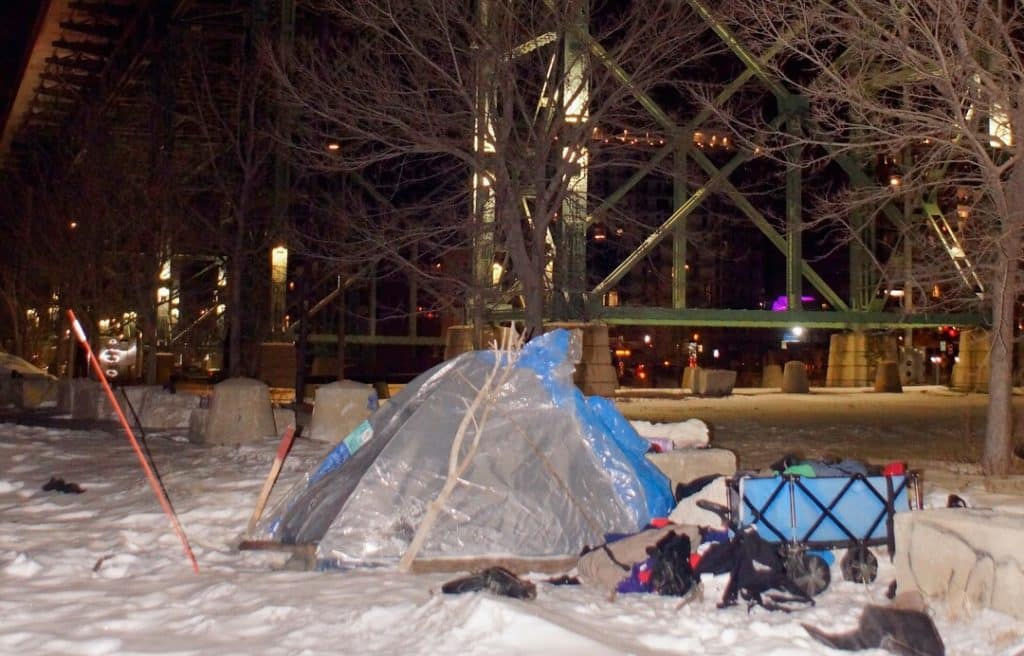
An abandoned tent under the Jacques-Cartier bridge. PHOTO: Amélie Rock
When we called to see if anyone was in the tent, no one answered. The contrast is striking. Here, under this bridge in a bustling city, the abandonment is palpable.
Where did they go? Have they found refuge elsewhere, or are they still wandering around looking for a less inhospitable place? These questions remained unanswered, suspended like the cold that creeps in from everywhere.
10:38 p.m. — The joy of finding a coat
As we walked towards Atwater, at the intersection of Saint-Hubert Street and Viger Avenue, the silhouette of a single man standing at the red light caught our attention. He called out to us. His eyes were soft, but tired. We offered him something to eat and his face lit up immediately. With gratitude, he spoke to us for a moment, briefly telling us about his daily life.
“If you want, go to Concordia, next to the A&W,” he said. “My friends are there. They will be very happy, because yesterday they were really hungry and could not find anything to eat.” There is an unwavering sense of kindness and solidarity.
Most of the time he’s trying to find a place to sleep, but it’s not always easy. Sometimes, when he falls asleep in the street, people steal from his pockets, taking with them what is most precious: often, a few coins or small objects…
But this Tuesday evening, he was relieved. “I am sleeping at someone’s house, on the floor, but warm,” he said, with a shy smile. Then, as if to share a bit of joy, he proudly showed us his coat. “Look! I found it on the street. See? It’s nice, isn’t it? ” His eyes sparkled as he caressed the fabric, happy with his find.
11:01 p.m. — McDonald’s at the corner of Atwater and Sainte-Catherine: 30 minutes, then leave
A stone’s throw from Cabot Square, between the smell of French fries and cleaning products, we passed under the golden arches to enter the famous fast food chain, one of the places where homeless people take refuge to find some heat. Many try to bargain for a few hours of respite inside McDonald’s, but are driven out. Outside, the cold is biting. It’s -15°C.
A few minutes later, an employee — who we’ll name Paul to preserve his anonymity — started his shift. His first task of the evening? Expelling the two homeless people sleeping in the dining room. He put on latex gloves and got ready to wake up the first one.
She was sitting on the bench and curled up, head in her arms on the table. She wore a coat and sunglasses and only raised her head for a few seconds when knocks sounded on the table. Right after, she was stopped by Ethan, a homeless man who seems to know the sleeping woman. He talked to her and in turn tried to wake her up. He tugged her arm, took her pulse to make sure she was okay, and shook her to get her up to leave.
“It’s very difficult. Of course, if I had the choice, I would do another job,” said Paul. Having recently arrived in Canada, he knew when he accepted this position that he would have to interact frequently with people experiencing homelessness. “But I did not expect to see that in Canada at all, it is very shocking to see so many people who use drugs in public spaces and so many people sleeping outside in this cold,” he says.
We had been there for 20 minutes when a woman entered the building. She let out a sigh of despair when she learned that the toilet was now inaccessible, locked with a key. “It’s closed at night because there was too much used injection equipment in the toilet. We reopen in the morning, but with someone who checks often,” confirms an employee.
“I don’t mind if they eat or if they sit down. Management gives them 30 minutes to warm up, but the agreement is that they leave afterwards to make room for the customers. Sometimes I even give them free food, but the problem is the people who arrive high and vandalize and steal,” Paul explains, pointing to a television that was damaged six months ago. Indeed, on the walls and pillars of the restaurant, we see posters signed by the management with a clear message: the dining room is only accessible to customers to eat for 30 minutes maximum.

People experiencing homelessness can warm up at Alexis Nihon’s McDonald’s for 30 minutes. PHOTO: Amélie Rock
More worryingly, Paul has already been attacked several times. “Last week, a man pulled out a knife; that sometimes happens. I’m not afraid, I know how to take them, but it’s not easy,” he whispered before heading over to another person lying on the ground.
Hidden under her coat, she slumbered. After a few tries, she still couldn’t stand up. Three police officers entered the branch and went to the counter, but they were stopped by the employee, who asked for their help. They were also unable to get this person to stand up, and she eventually left the restaurant in an ambulance.
SPVM agents are used to this type of scene in the city centre. “Sometimes, some people sleep in alleys or buses, and we wake them up because we wonder if they are still alive,” says one of them.
“In winter, that’s pretty much our job: looking for homeless people to make sure they’re not in danger and trying to find them a place to go. When you find someone, you call the shelters to find out if there is space. If yes, we accompany them, but sometimes the shelters are full, and there is nothing else we can do,” the police officer said. Those situations do not leave him indifferent, and he said he has learned to develop a certain form of “resilience” in order to continue his mission of “protecting the most vulnerable”.
11:34 p.m. — Left to their own devices, they wandered in the cold in search of a new refuge
Across Atwater Avenue, the rules are the same at A&W. The reception is not much warmer: homeless people cannot stay there for more than a few minutes. The atmosphere was getting heavier as time was running out: those who couldn’t make it into a shelter had to find a place to rest.
“I feel like I haven’t slept in years,” the woman who found the bathroom closed at McDonald’s told us over and over again. She was worried that winters would become more and more freezing.
When she has no choice, she takes refuge in the hospital. However, she strives to avoid it because it is impossible to smoke, among other things.
While she confided her concerns to us, Ethan, a man with an exhausted look, ended up leaving the restaurant, expelled by police officers and an employee. A cigarette between his lips, he left with a friend in search of the next place of respite. Several locations and shelters are full, they told us, listing how few choices they have left.
As they finished their cigarettes, they were told about a warm-up centre on Stanley Street, about a 20-minute walk away. Ethan and his friend admited to us, with a touch of surprise, that they did not know of its existence. The police never tell them where these shelters are, forcing them to walk randomly in the cold.
However, this heating centre has a major drawback: they cannot sleep there. The place only offers a temporary break. Ethan and his friend left towards the warming centre, their figures gradually blending into the darkness.
Sophia, with two hats on her head and her eyes full of gentleness, listened to the whole conversation. Silent until then, she spoke… She has been in Montreal for almost a year. She is originally from Kangiqsujuaq, a small village in Nunavik. Located near Hudson Strait and Baffin Island, just 840 people share their daily lives there.
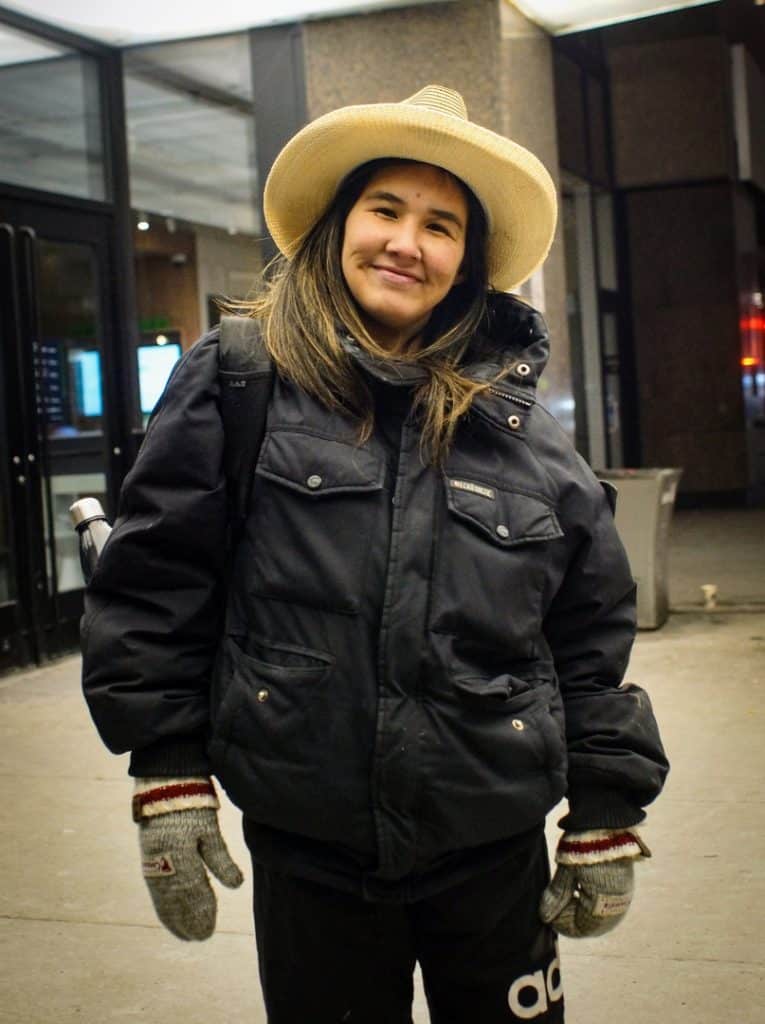
Sophia. PHOTO: Amélie Rock
Due to the housing crisis, her family had to move to Nova Scotia. She does have a few cousins in the city, but a void persists. The absence of her loved ones and her former life is felt.
“It’s really cold,” she exclaimed, her teeth clenched and her lips twitching. She glances at her phone, waiting to hear from her cousin.
“God gave me this life,” she whispered. Despite her difficulties, she does everything she can to help others, especially young Inuit women living on the streets of Montreal. “It’s easy to end up in bad circles,” said Sophia. She often reads the judgment in the eyes of passers-by, a look that weighs on her, so she tries as much as possible to create a space where these young women are supported and valued.
Before continuing on her way, she reassured us that she has a place to sleep.
One street away is Cabot Square. A tent named in honour of Raphaël Napa André was once erected there. The Innu man died in January 2021 on the streets of Montreal. On a freezing night, he was forced to leave a shelter due to COVID-19 restrictions.
The homeless population of Cabot Square and the surrounding area often visited the tent, where several services were offered to them. Hot drinks, seats, blankets and coats to stay warm, and food and feminine hygiene products were provided to anyone who needed them.
But two years ago, the city stopped putting up the tent. Instead, a skating rink was installed. Luxury condos and apartments replaced the gas station, and the old Montreal Children’s Hospital was relocated. The Atwater station exit adds to this weight, as its doors are now closed and barred, impossible to escape the cold in.
No death that evening… but tomorrow?
No one died and no one was brought to the emergency room for frostbite.
In this way, success on the streets of Montreal is less a question of what was achieved than what was avoided. And as Tuesday disappeared into Wednesday, as an arctic chill settled over the city’s 5,000+ homeless people, death stalked every street corner.
Given enough time, the cold will coil itself around a person’s vital organs. It will slow the heart down, fill the lungs with fluid and switch off the part of the brain that regulates body temperature.
By sunrise, outside Resilience Montreal, avoiding that fate felt less like a victory than a stay of execution. That’s what David Chapman, who manages the west downtown shelter, told La Converse early Wednesday.
“Sometimes, it feels like we’re gambling with their lives and not losing,” Chapman said. “But there are many more cold nights ahead of us and it’s almost a guarantee that we’ll lose more people by the time spring rolls around.”
If luck played a role in the survival of so many unhoused people, there was also a fair bit of preparation on the part of Montreal’s emergency services. Beat cops “double and triple checked” every haunt and corner their patrol, according to police spokesperson Jean-Pierre Brabant.
“There are check-ins at encampments, in alleys and laneways, it’s all hands on deck,” Brabant said. “On a night like that, if someone needs a ride somewhere or if they’re in distress, it’s our job to get them help.”
Similarly, paramedics across the city were on the lookout for anyone at risk of frostbite.
“Every one of our first responders are aware just how dangerous it is out there,” a spokesperson for Urgences Santé said.
Chapman has been on these street corners for about a decade. When he started, there were roughly 100 to 150 people who frequented the west downtown shelter. That number is closer to 300, now.
Before the pandemic, there was a handful of memorials every year to commemorate those who died on the streets. The shelter used to put up their picture on the wall and have a service for each victim.
But given how bad things have gotten these past five years, the dead are now grouped together in mass memorial services. Last summer, the shelter commemorated 37 people one afternoon at Cabot Square. They died over an 18-month period.
“It used to be we’d lose three or four people in a year,” Chapman said. “It was hard but we had no idea, back then, how hard it was about to get. Now we might see three people die in a month.”
With the cost of housing in Montreal ballooning since 2020, the streets and day shelters have swelled well over capacity. And with Tuesday’s recommendation, from Quebec’s housing tribunal, that the cost of rent should increase by 6 per cent this year, it looks like the streets will get even more crowded.
“People don’t want to walk halfway across the city only to be turned aside because a shelter is full,” Chapman said. “Right now, in some of these places, there’s a fifty-fifty chance you’ll be turned aside. You can’t keep gambling with that and not losing.”
Authors



Related Articles

Guilty Until Proven Innocent: A Man’s 12-year Battle with Revenu Québec
Quebec’s tax agency freezes retirement savings, seizes assets and “ruins lives” with investigations based on mere assumptions.

School Board Votes to Support Candidate who Smeared Rival, Acted in ‘Undignified’ Manner
Julien Feldman gets off scot-free after falsely associating his rival candidate with antisemitism and referring to her as “Ms. Gaza.”
« Je veux juste qu’on me croie »
Victime d’une agression sexuelle alors qu’elle travaillait pour le gouvernement provincial, une femme lutte avec Québec depuis cinq ans.
Comments (0)
There are no comments on this article.