
Hundreds of Migrant Workers Compensated After Fraudulent Recruitment Scheme
The multinational Newrest and the Montreal agency Trésor must pay $2.1 million to migrants tricked into working without authorization under the false promise of obtaining a valid work permit in Canada.
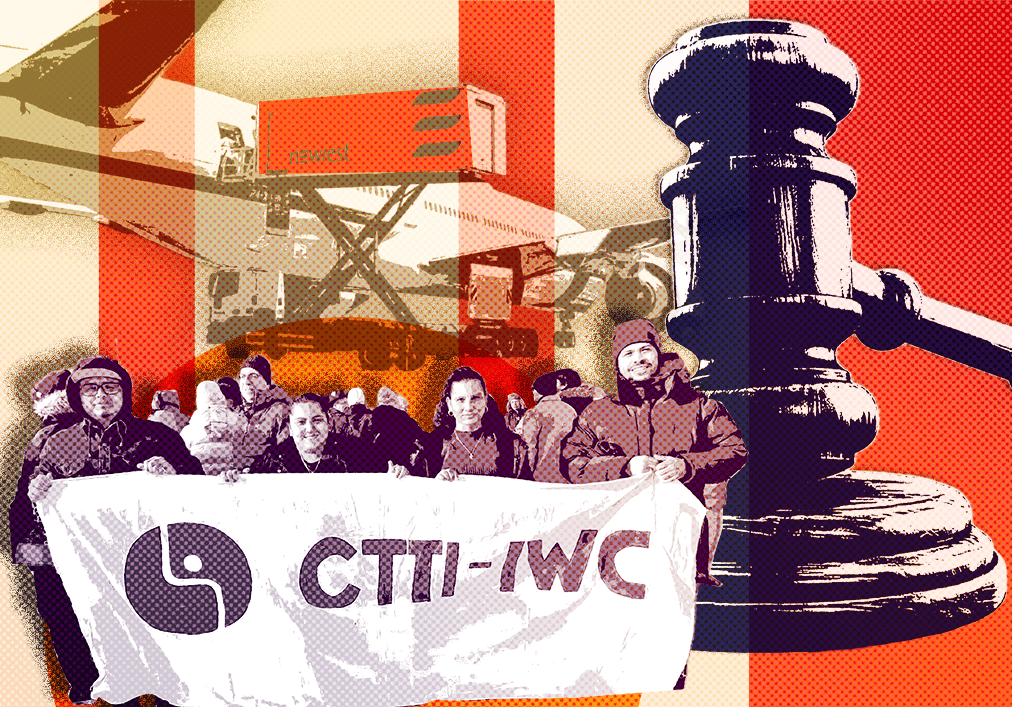
More than 300 migrant workers can now file a claim for monetary compensation after the Superior Court approved a one-of-a-kind settlement agreement for a class action lawsuit late last year.
In what Judge Catherine Piché is calling an “unprecedented” settlement for the rights of migrant workers, it allows for both monetary damages and a campaign to regularize their status in Canada.
In the lawsuit, the Immigrant Workers Centre (IWC) represented the hundreds of migrant workers who fell into a deceptive scheme in which Trésor — a Montreal-based recruitment, placement, and immigration agency — encouraged people from Latin American and North African countries to come to Canada on visitor visas with the promise of securing a job.
When the migrants arrived in Montreal, they were told they would have to earn their work permits after a three-month probationary period while working at Newrest, a French-based corporation that supplies some of the world’s biggest airlines with in-flight meals.
Support your local indie journalists
Helena*, a 39-year-old woman from Mexico who cares for five children and her elderly mother, fell into the scheme.
“I was manipulated into working for eight months without a permit, and I was fired after trying to stand up for my rights,” Helena told the IWC.
As reported by The Rover, at least two Newrest employees — including the man in charge of its Dorval factory — were aware of the fraudulent scheme and participated in it. Many workers faced psychological harassment, others were sexually harassed on the job, and many still have accumulated unpaid wages.
A remedial measure
In the weeks following the class action filing in 2023, the group of attorneys representing the IWC negotiated with Newrest to mobilize financial and logistical resources for a regularization campaign.
The IWC also negotiated with Immigration, Refugees and Citizenship Canada (IRCC) to establish an exceptional procedure to expedite applications for temporary residence permits and open work permits for migrants identified during the campaign, conducted in the fall of 2023 and winter of 2024.
Newrest paid $500,000 to support this campaign. As Judge Piché wrote in her 26-page ruling, it was “a remedial measure that is unprecedented in class action cases.”
Since most of the migrants were Spanish speakers, the IWC set up a temporary trilingual legal clinic. There, the workers also had free access to immigration lawyers and translators to obtain legal information about their status, as well as assistance in filing applications for Temporary Residence Permits (TRP).
“Through a really kind of extraordinary collaboration with IRCC and our client (IWC), we managed to regularize about 170 individuals who were victims of the alleged misconduct,” says Lex Gill, one of the lawyers who represented the IWC in the process.
The free legal assistance they received through the regularization campaign would have otherwise been inaccessible to many of them, since most didn’t speak English or French and had limited financial means.
“The campaign led by the (IWC) and its lawyers is unprecedented and has undoubtedly contributed significantly to the advancement of the rights of migrant workers in Canada,” said Judge Piché.
After the settlement agreement, Newrest, which operates out of 54 countries and has a massive presence in Montreal, is also required to ensure that any migrant worker it refers directly or indirectly to a workplace in Quebec has a valid work permit, and that all migrant workers employed in its Montreal production units enjoy the same working conditions as non-immigrant workers performing the same duties.
This provision stems from allegations in the class action lawsuit that undocumented workers were part of a three-tiered system at Newrest in the two industrial kitchens on the island of Montreal.
At the top, Canadian employees were unionized and enjoyed all of the legal protections outlined in their collective bargaining agreement. In the middle, migrant workers were paid $15 an hour through the Temporary Foreign Worker Program, and at the bottom, undocumented workers earned less than minimum wage, faced harassment, and were threatened with deportation for speaking out.
“These provisions of the Agreement are intended not only to ensure fairness in working conditions, but also to prevent a situation similar to the present one from recurring in the future,” Judge Piché wrote.
A change in policy
Multiple actors, like Trésor, took advantage of a change in immigration policy in 2020 to fraudulently recruit migrant workers.
During the COVID-19 pandemic, a temporary policy was implemented to allow foreign nationals stuck in Canada after border closures to apply for a work permit.
Manuel Salamanca, a community organizer at the IWC, said Newrest and Trésor’s case wasn’t the only one where the policy was at issue. The organization identified multiple smaller cases with the same modus operandi, but was unable to secure temporary resident permits for the migrants involved in those situations, even though in some cases there were signs of human trafficking.
At the end of January, the IWC called out the federal government for not applying existing regulations to protect foreign workers who have endured abuse from their employers or recruiting agencies.
“The problem with the government is that they don’t realize what people are suffering. They are very far from these situations,” says Salamanca.
In his eyes, Newrest and Trésor’s case resulted in policy change because it became a public issue.
Smaller cases had fewer victims compared to Newrest and Trésor’s case, and there was — and still is — no streamlined legal framework to process such cases that emerged under the COVID-19 policy.
The regularization campaign carried out by the IWC caught the attention of IRCC. In August 2024, the department announced the end of the temporary policy that was put in place in 2020. Although it was set to expire in February 2025, IRCC said it ended earlier as part of its overall efforts to recalibrate the number of temporary residents in Canada and preserve the integrity of the immigration system.
“IRCC is also aware that some bad actors were using the policy to mislead foreign nationals into working in Canada without authorization,” said the department.
Agencies without a license
In August 2023, the IWC filed a complaint against Trésor with the Commission des normes, de l’équité, de la santé et de la sécurité du travail (CNESST) after receiving the testimonies of the migrants who were caught up in the scheme.
A month later, the CNESST began investigating the five companies that make up Trésor. Guillermo Montiel Villalvazo is the president of four of them — Agence de placement Trésor Inc., Emploi Trésor International Inc., Emploi Trésor Inc., and Gestion Trésor Inc. The fifth company, 9475-0635 Québec Inc., is presided over by Erika Zapata López.
In reaction to the IWC class action, Montiel Villalvazo told the Canadian Press that his agency has operated completely legally since 2013. But documents obtained by The Rover show that Emploi Trésor Inc. and Gestion Trésor Inc. had never held a staffing agency license or a permit to recruit Temporary Foreign Workers. Quebec’s labour tribunal, the CNESST, found that Agence de placement Trésor Inc. doesn’t declare its entire wage bill.
The CNESST also found invoices for staff placement issued to Newrest in 2022 and 2023 by two different companies: 9371-8914 Québec Inc. and 9278-9627 Québec Inc. According to the Commission, neither of them had ever held a staffing agency license or a permit to recruit temporary foreign workers, nor declared their wage bills.
To this day, 121 workers are still owed wages by Trésor and Newrest. The migrants reported to the CNESST that they didn’t receive a written employment contract, pay stubs, or timesheets during the time they worked for Newrest. They had to collect their pay every Friday outside an office on St. Hubert Street, where they received their wages in cash-filled envelopes with the employee’s name inscribed on them next to a tally of the hours they worked.
Based on these testimonies, the CNESST issued a claim in 2024 for $600,000 in unpaid wages against Trésor and Newrest. However, since the companies refused or neglected to pay the amounts owed, the Commission brought the case before the Superior Court, which has yet to render a decision.
Neither Trésor nor Newrest responded to multiple interview requests from The Rover.
Author

Colombian journalist in Montréal. I love podcasts. Raccoon enthusiast 
Related Articles

Ombudsman Rules in Favour of Student Suspended for “F*ck Israel” Post
The English Montreal School Board was ordered to retrain staff on its anti-bullying policy and students’ rights.

Will Bill 21 ‘Erase’ a Generation of Muslim Teachers from Quebec?
The legal battle over Quebec’s religious symbols ban has reached the Supreme Court in a case that will make Canadian history.

Nunavik Police Get a Pay Raise Amid Community Concerns
Inuit activists say the pay raise should match police efforts to rebuild trust with the communities.
Comments (0)
There are no comments on this article.