
Is Chinatown Trying to Fight Homelessness, or Conceal It?
As intolerance for homelessness rises among residents in Chinatown, community organizers worry that increased policing and pressure on shelters will thin out more social services in the neighbourhood.
Wawa Li moved to Chinatown this year to be closer to her family.
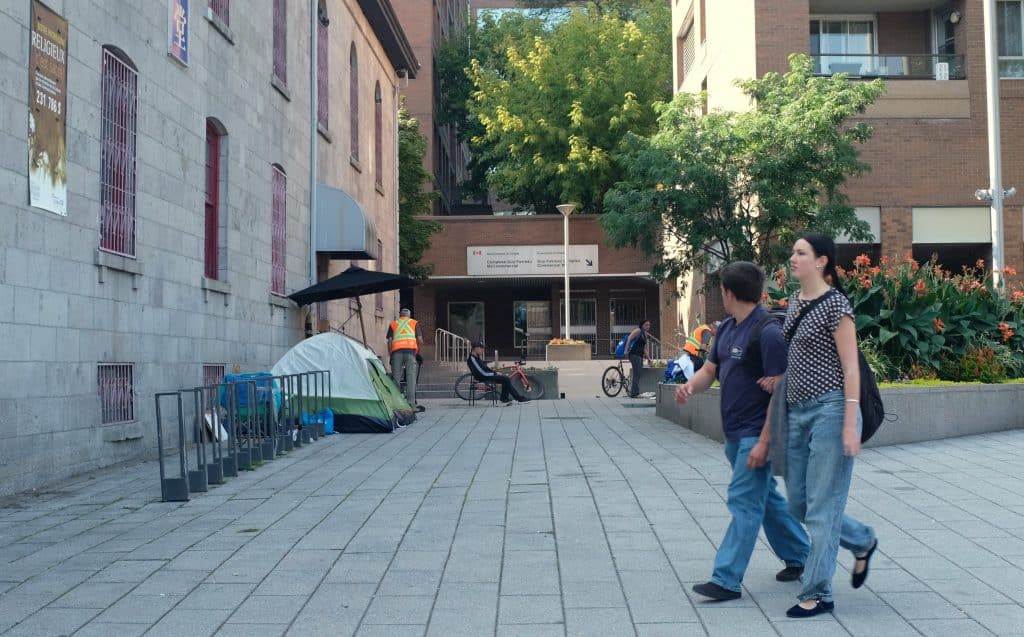
Her balcony in a subsidized housing complex overlooks a parking lot beside where clothes hang on fences and tents. And if you look further beyond the highway, you can see high-rises and the stone buildings leading to the old port.
When Li told her friend’s older Cantonese parents that she moved to Chinatown this year, they were surprised. They saw the move as a step backwards. They saw Chinatown, like many others, as a place you’re supposed to grow out of. Yet many people do not have the privilege to grow out of it.
As someone working in community organizations in the neighbourhood — including the Chinese Family Services, Chinatown Housing Rights Committee, and Stella, l’amie de Maimie (a sex workers’ rights organization) — Li sees the many facets of issues in Chinatown which crash into each other every day.
Homelessness has been under a particularly bright spotlight in Chinatown in recent years, especially since COVID, when the neighbourhood (like many others) saw a stark rise in homelessness rates. In fact, a new group called the Association of Residents of Chinatown came together in 2024 to voice the concerns they have for the neighbourhood. Much of their complaints have been about homelessness and public safety.
Indeed, the concern is echoed throughout the city — in an Aug. 29 poll about what issues Montrealers would like to hear about most in the municipal election, housing and fighting homelessness were by far the highest priorities.
Li sees the problems Chinatown faces, but she also sees a vibrant community where Cantonese, her mother tongue, is part of her landscape. She hears it on the way to the bus, in stores, she listens to people talk about what to eat, complain and gossip. The background chatter on the streets or in restaurants breathes around her. Since she moved to Montreal from Quebec City eight years ago, Li doesn’t get to speak Cantonese like she used to with her immediate family, and her Cantonese was eroding. Settling into Chinatown wasn’t just a way to be close to her aunties and community, but also to bring her language back into her life.
The sense of familiarity and home makes her feel safe; so does knowing her family is close by. When she bought an air conditioner for her apartment this year, her family member knew about it almost immediately, seeing it outside Li’s window on her daily walk. She knows that if something were to happen to her or if she needed help, people around her could catch her.

For Li, it’s this kind of self-organized mutual care that forms a community.
It’s something she wants to be a part of on a regular basis — something she wants to protect for everyone in Chinatown.
A growing intolerance in Chinatown
There is a palpable divide between the housed and unhoused residents of Chinatown.
It is like a wall that has been getting thicker and taller since COVID-19. It is a wall that separates as well as invisibilizes a whole group of people. Many housed residents complain about vandalism, about public urination, drug use, and the mere sight of tents. They complain about the visibility of struggle — which has always been a feature of the neighbourhood.
When Shi Tao Zhang tried to buy a meal for an unhoused man at a restaurant in Montreal’s Chinatown, the owner refused to sell to her. He said the meal, which included lobster, was too good for someone like him. Still determined, she tried to buy another item on the menu instead, but the owner began to belittle her as a spoiled little girl for trying to spend her money on him.
Some residents from Milton Parc and the adjacent Devonshire are similarly upset about the state of homelessness in their own neighbourhoods and have taken to filing a class action lawsuit against the City of Montreal, local health authorities and local homeless shelters.
With the help of The Center for Research-Action on Race Relations (CRARR), they are suing for up to $25,000 per resident impacted by the lack of safety and security in the neighbourhood because of the unhoused population. The lawsuit states that the presence of unhoused people has infringed on the Charter rights of housed residents living in the neighbourhood by undermining their right to life and security.
Alongside their demand for financial compensation, they are also asking for the court to order a permanent injunction for unhoused people in the area to be separated into “occasional homeless people who are sane” and “chronically homeless people who are physically and/or mentally ill and/or exhibit antisocial behaviour and/or are seriously intoxicated.” They ask for the latter group to be examined by a doctor and potentially “placed” in a specialized facility for their mental health or substance use, according to court documents reviewed by The Rover.
Support your local indie journalists.
In a press conference held this summer, CRARR and the Association of Residents of Chinatown said they are considering a similar lawsuit in Chinatown.
The possibility of this is deeply concerning to people like Zhang and Li, who work in the community with marginalized people.
“I am personally afraid that if there is a class action lawsuit that is filed in Chinatown, that the city will preemptively react by giving into the demands,” says Zhang, a member of the Chinatown housing rights committee. “I fear (that) would only make the marginalization of already marginalized people even worse and just increasingly erode the social safety nets of the people who are housed but very, very precarious.
“I think this is really something that testifies to the fact that there is a slow discourse that’s emerging that calls for the eradication of unhoused people and poverty from all public spaces.”
Of course, this isn’t an issue unique to Chinatown.
The criminalization of homelessness around Montreal is a regular feature of the city, like many Canadian cities. The Notre-Dame encampment in Hochelaga has been dismantled over and over again. La Maison Benoît Labre, a homeless shelter and safe consumption site, has been forced to relocate due to its proximity to an elementary school. Many shelters across the city, including shelters in Ahuntsic-Cartierville, Verdun, and Chinatown, were forced to relocate or shut down.
Li understands why many people complain about the safety of the neighbourhood. She encounters people struggling daily as someone living there and working with vulnerable people at community organizations. She calls a friend while walking alone at night and doesn’t dress the way she did when she lived in the Plateau.
“We all agree on the issues in the neighbourhood. Unfortunately, that’s a reality. So we all agree on that, but can we move forward? Can we see beyond this?” she says.
This predominant narrative on unhoused people creating a dangerous neighbourhood, according to Li, is invisibilizing bigger issues like housing insecurity and lack of community services. “What we should actually look at are the things we’re not talking about, like those that are really in danger I see every day are unhoused populations overdosing in our streets, and not being able to have their basic needs met.”
The push to fund cohabitation over policing
The Milton Parc and Devonshire lawsuits repeatedly state that cohabitation is not possible. They argue that residents have tried to live side by side with the unhoused population in the neighbourhood, but it simply cannot work because they feel in danger and disrespected.
Many residents in Chinatown have similar sentiments.
“We understand the frustrations that are being expressed, but at the same time, once you’ve expressed your frustration, well, what are the solutions?” says May Chiu, coordinator of the Chinatown Roundtable, an organization advocating for the needs of Chinatown residents and protecting the cultural landscape of the neighbourhood.
For the past year, local groups, including the Roundtable and Chinese Family Services, have been focusing on cohabitation efforts in the neighbourhood. Instead of advocating for more policing, more security, more surveillance in Chinatown to protect residents, they are pushing for more affordable housing, but also creating a more welcoming neighbourhood.
There is an apartment on Clark St. in Chinatown that people referred to as the crack house. The landlord of the building, according to Chiu, was trying to renovict the tenants to transform the place into housing for international students to make more money.
She says that he was doing his best to aggravate the already horrible living conditions so that the tenants would leave on their own accord. The front door was broken, as were the stoves, bathroom doors, and letter boxes. The building was infested with cockroaches and vermin. Drug dealers often frequented the building, and there were even overdose deaths inside.
On the other side of the street stood shops, but they usually remained closed. It was a quiet, desolate part of the neighbourhood, and Chiu says there was a climate of fear.
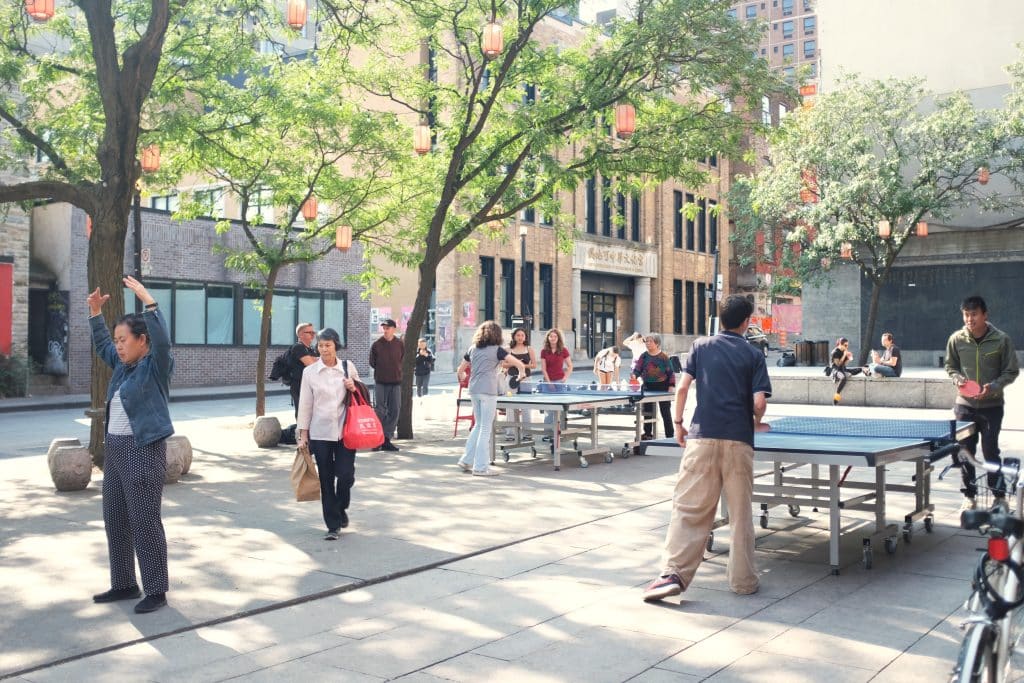
Then in 2023, the City of Montreal granted funding to Chinese Family Services to animate the public space adjacent to the street at Place Sun-Yat-Sen throughout the summer. Every day, five days a week, there were activities at the square like ping pong games, a Chinese calligrapher, Chinese painting, line dancing. Locals and tourists, housed and unhoused residents came together in the square, took up public space, and the street became a welcoming space for everyone.
“There’s this tenant from a nearby rooming house who always comes to play with us now,” said Li. “People who see him on the street, they’re less scared. So it’s like these very small actions to humanize and educate ourselves is one of the ways to create more community-led actions.”
Li’s aunty goes to the square to play ping pong and tells her about the unhoused residents in the neighbourhood she plays with. She tells Li that one of the men she plays with often is really good, too. Yes, there is a wall between housed and unhoused residents in Chinatown. But there are effective ways to make that wall more porous. It isn’t a long-term solution like more affordable housing units and robust funding for social services, but it does help.
“Most people just think policing, policing, policing is a solution,” Chiu says. But even the pro-police residents she has spoken with often agree that calling the SVPM doesn’t really help. They often arrive too late and fail to prevent crime from happening.
Last October, the City of Montreal even hired SIRCO, the same private security firm that dismantled the pro-Palestinian encampment at McGill University, to patrol Chinatown after residents were complaining about unhoused residents. The $120,000 project got guards to monitor and record any criminal activities happening in the neighbourhood.
In 2025, the city invested $824 million in Montreal’s police force, compared to $10 million on fighting homelessness and $6.5 million for social housing projects. It also invests an average of $25 million annually in community organizations.
“I’m worried that they will invisibilize the unhoused population even more. I’m worried that things are not going to change, and that I’m going to see more people from my community suffer,” says Li.
If more funding is being funnelled into policing and initiatives like private security firms patrolling Chinatown, and attention is focused on lawsuits to sue local homeless shelters, who will pour resources into affordable housing and essential community services?
Homeless shelters and initiatives that distribute free food to residents are ostracized for attracting more unhoused people to the area. Essential services for the most marginalized people in the city are under scrutiny for carrying out their mandates. This logic at work is a slippery slope for other community organizations, as well, like Chinese Family Services, which serves many intersecting populations.
“If the Chinese Family Services did not exist and the Chinese hospital was to dissolve eventually, where would my parents go?” asks Li.
She wonders what the state of the neighbourhood will be when it is fully stripped of its pillars and replaced with state-funded surveillance and policing. She wonders what will be left to support her as she grows old herself.
Did you like this article? Share it with a friend!
Author

Related Articles
McGill Spent Over $1 Million Fighting Unionization
Union organizers at the university say this is part of a broader trend towards corporatization of the public institution.
Rent Increases Set to Worsen the Housing Crisis
Experts warn that homelessness continues to grow as Quebec’s housing tribunal proposes a new way to calculate rental increases.
Montreal Leans on Condo Developers to Fix the Housing Crisis
As the number of unhoused deaths rises every year, experts say corporate interest in the housing crisis excuses the city and province from serving the public.
Comments (0)
There are no comments on this article.