
It Was Never Funny: Gavin McInnes and the Dangers of Dark Play
Urbania Média’s new documentary delves into author and commentator Gavin McInnes, a man whose relentless use of dark humour has sparked controversy for years.
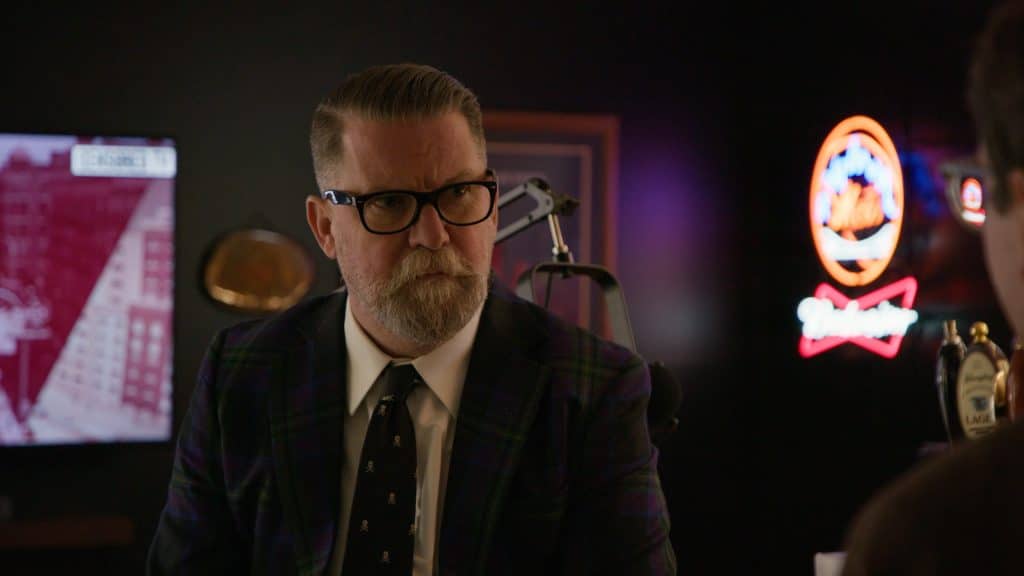
What do Gavin McInnes and soon-to-be 47th US President Donald Trump have in common?
Beyond a similar take on far-right politics, both frequently use shock-based humour to propagate harmful ideologies, and have happily done so for years. Dark play — flippantly adopting extremist stances for shock and entertainment value — is a phenomenon more than familiar to Republicans. But it is not funny, and is far from harmless.
Is shock comedy the key to understanding writer, podcaster, far-right commentator and founder of the Proud Boys Gavin McInnes?
Once the heart of alternative punk Montreal magazine Vice, now an influential mouthpiece for racist fearmongering and ‘indirect’ provocateur of extreme violent attacks, McInnes has been an enigma to his ex-colleagues and friends for years. So, in the newly released It’s Not Funny Anymore: from Vice to Proud Boys, documentarist Sébastien Trahan and journalist Thomas Morton set out to find some thread that weaves a sensical narrative through McInnes’s life and career, at least as coherently as possible.
Urbania Média’s It’s Not Funny Anymore: from Vice to Proud Boys is a 2024 documentary written and directed by Sébastien Trahan and co-written by Laurel Baker. The film follows writer and commentator Gavin McInnes’ trajectory as the former heart of Vice magazine-turned-founder of far-right militant organization Proud Boys through a series of interviews with McInnes’ colleagues, family and friends. Just like its subject, the documentary doesn’t shy away from the unfiltered and candid as it dissects Gavin’s career.
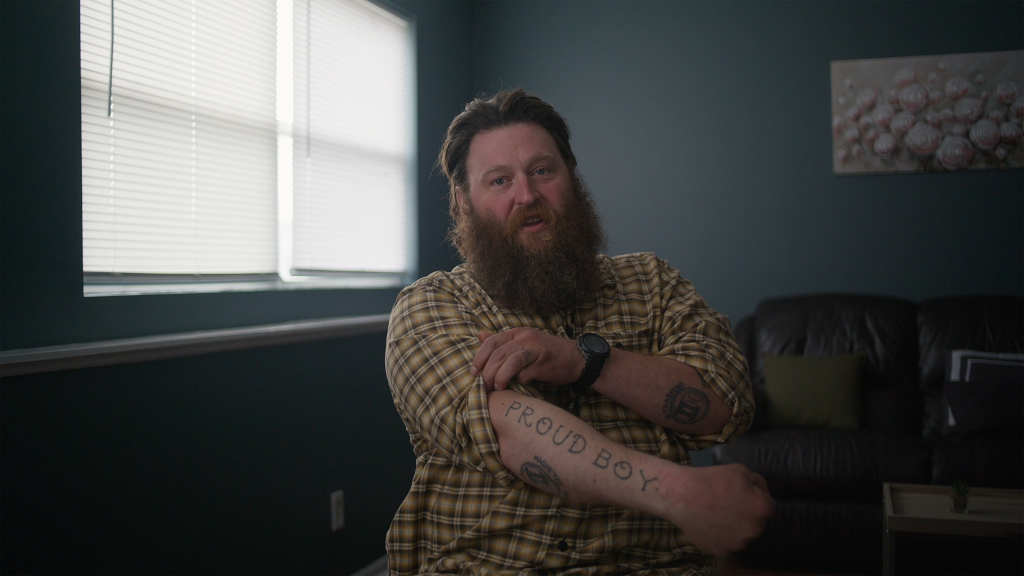
He ended up quitting Proud Boys, but Gavin played a major part in the organization: the documentary highlights the initiations McInnes had group members undergo, such as being arrested for provoking violence, while maintaining that any violence “has always been measured and necessary” despite the group facing intense backlash for the United States Capitol attack of 2021. Although Gavin had quit at this point, distancing himself by labelling them “not the brightest bulbs”, his ties with the right remain undeniable, especially as a podcaster and commentator.
Did McInnes truly change politics and ideology?
Although in his interview with Morton at the end of the documentary, McInnes claims he never did, Trahan takes the opposite view, noting that “society did change, and you change a certain way.” McInnes is no exception. But McInnes is not completely inconsistent. Though it has taken a variety of forms — from frequently coming in to the Vice offices naked, coked up, and making incredibly crass jokes in the 90s, to later claiming that “gay marriage is a scam” and “straight white American men are the least racist people in the world” — what has remained consistent in McInnes’ character is the gleeful, almost childlike joy he takes in the horrified reactions his humour can evoke.
Support your local troublemakers: become a Rover member today!
In conversation with Trahan, the director says McInnes always has a sense of where the “strongest wind is blowing.” That is to say, he plays off the current political climate to create as much shock as possible. McInnes could “address the 20-28… 18-27 (year old) demographic. When he was young at Vice, it was my demographic,” Trahan said. And now that McInnes is older, he “is pinpointing on a big demographic in the USA that listen to Joe Rogan.”
Therefore, when asked whether McInnes would hypothetically have aligned himself with far-right discourse — to the extent he did with the Proud Boys — had it been so prominent earlier on, Trahan responded that it is hard to say for sure, but if this discourse were as “strong as now, yes.”
McInnes’ “main, main, main mentality” can be encapsulated as such: when the “reaction is so big, he likes the reaction, not the content.” Trahan “was pretty sure that Gavin will not back off from any question… he’s a master of it.” No matter how extreme their viewpoints, interviewees like McInnes and Roger Stone will respond that they “are not ashamed of their views, because shocking people is what they do.”
If McInnes ever went into mainstream comedy, however, it would not necessarily have worked, according to Trahan. He did give stand-up comedy a go, but, to put it simply, he was not really good. Does this highlight that McInnes’ comedy depends on shock value and politics? That he is not actually funny, just outrageous?
This is subjective, but it’s certainly an argument that’s been made regarding Trump. Anyone could make the dark ‘jokes’ the newly-elected US President so frequently does, and a lot of his ‘humour’ is uncomfortably true. Last December, Trump claimed he would act as a “dictator,” but “only on Day One” of his presidency, if he won. He has made several other jokes of a similar nature, leading to severe criticism, yet he denies he really means it. This is without speaking of his countless misogynistic gags, welcomed by roars of laughter and cheers of agreement from his adoring fans, and horror from everyone else.
Dark play is frequently meant to target the ‘fake news media’ and ‘snowflakes,’ and of course, the more shocking they are, the more headlines these jokes garner. Extremist dark play is also dangerous because it can easily be blurred with reality: it is not completely out of the question that Trump would become a dictator. These words are rarely empty. Would Kamala Harris (the “antichrist” according to Trump) ever joke about leading a dictatorship? It wouldn’t work as a joke, partly because it’s just not funny, and crucially because it’s not believable that she’d say that.
It is also a matter of Trump having nothing meaningful nor productive to say at his rallies, so he just pokes fun at the other side, galvanizing his followers through empty promises and catchy taglines. Anything he does claim is often a lie, as Bernie Sanders tweeted, “Donald Trump has lied more than 3,000 times since taking office” the first time, a reality from which excessive use of humour and hyperbole also seem to distract. Political content online is also twice as likely to go viral if they are negative about politicians they oppose rather than positive about those they support, according to a Cambridge University study. Political polarisation is already rampant.
Modern politics run on division and hatred. And so, playing on this, exacerbating the problem with vile jokes, is so effective that it has allowed figures like Gavin McInnes to see great success. An even better example? A racist, misogynist, xenophobic and convicted felon has just been re-elected US President.
Author

Related Articles
Editor’s Note: Talking Feelings
We love what we do, but it comes with a lot of pressure.

Will Gaza Remain a Land of Camps?
When the temporary becomes a lasting policy.

“Don’t Come Here to Live”
Race, memory, and conditional belonging in Quebec.
Comments (0)
There are no comments on this article.