
Like a Girl
In Montreal, women and gender-diverse fighters battle for inclusion in combat sports.
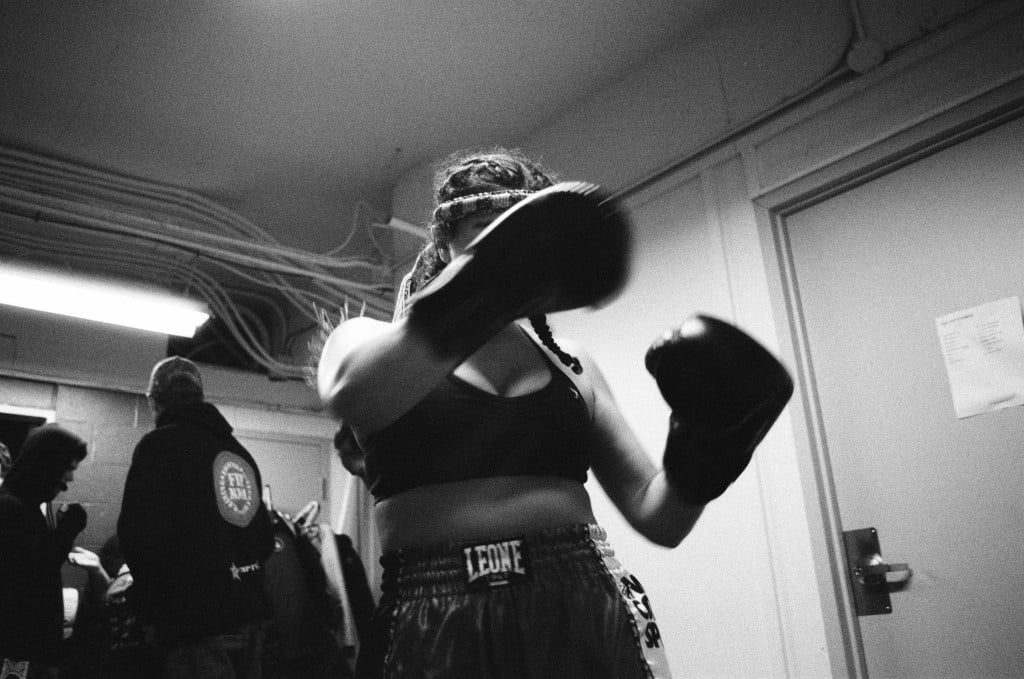
I meet the Apex Martial Arts team for some pho in a Vietnamese restaurant in Ottawa.
It’s Cory’s first meal of the day. In a few hours, she will be entering the ring to compete in her first Muay Thai exhibition fight.
Cory’s fight is the only female match-up scheduled for the evening: a rather regular occurrence at these events. What is unusual however is the presence of two women in the young fighter’s corner: her coaches Morgane Mary-Pouliot and Priscilla Paré.
Cory is buzzing with excitement. She fidgets with her braids, bombarding Morgane with questions: when she should drink her last bottle of Gatorade, what snacks she should buy.
The fights are over in a flash, lasting eight minutes at most. The preparation leading up to the event, however, lasts several hours once the fighters are weighed. Sitting in such meditative anticipation is a rarity, nowadays.
At the restaurant, we chat about random topics over empty soup bowls, killing time before Cory’s warm-up: Tinder, Thailand, and twisted ankles. The fighters sitting across from me are wearing different versions of their gym’s merch. Morgane cut the sleeves off her t-shirt to proudly highlight the arms she sculpted over months of fight camp training.
“I told Ryan: we need better t-shirts for women. The men’s t-shirts are too loose around my arms. He said, ‘OK, I’ll order some V-necks.’”
They burst out laughing in unison: complicity is forged in the most trivial aspects of living in a world designed for men.
Since Muay Thai is currently illegal in Quebec, the Apex team has developed a close partnership with the Ontario gym Westside Muay Thai.
As spectators fill the basement gym, pizza slices and beers are happily shared between the different teams competing in the ring. Over the course of the evening, I spot several of West Side’s members proudly wearing shirts with “Tiny Tank” emblazoned across their chests.
Tiny Tank is Morgane Mary-Pouliot’s fighter name. She has been training for six years, is already a rising star and has accumulated more fights than all the other coaches in her gym.
When she steps onto the ring, Morgane is a force of nature. Fierce, steady, relentless. I’ve seen her crush her opponent’s nose with her fist, drawing blood. In person, Morgane is disarmingly approachable.
Growing up in Quebec City, Morgane loved team sports. She played hockey and basketball but, when she reached high school, there was no female team she could join and the boys refused to play with a girl. She tried her hand at boxing, then gravitated towards kickboxing four years later when she moved to Montreal.
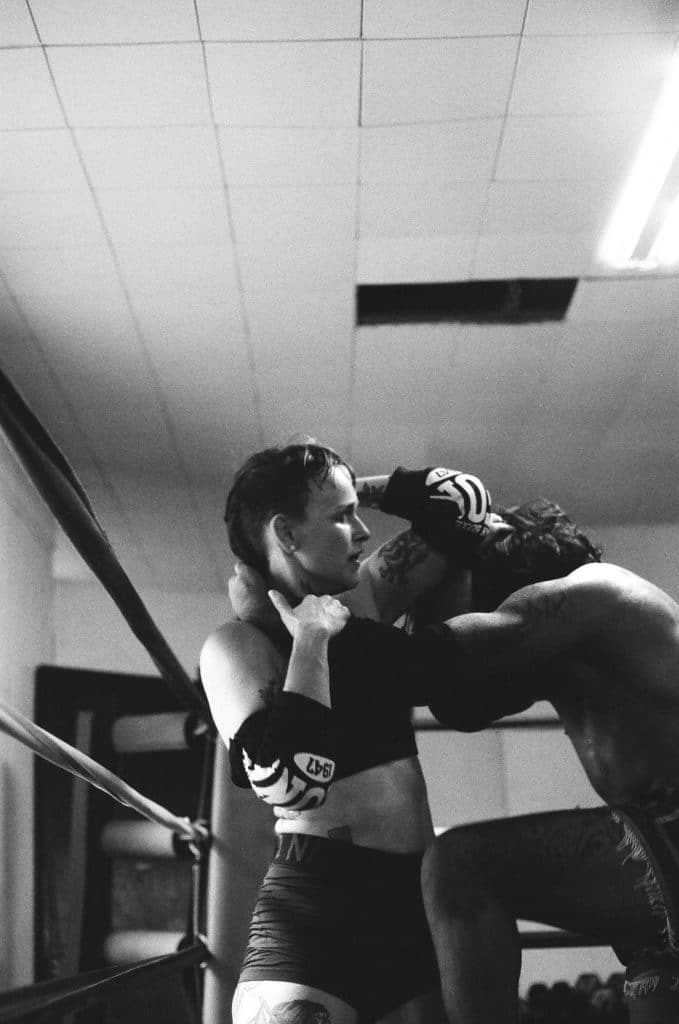
Morgane “Tiny Tank” Pouliot training at Apex Martial Arts in Montreal. PHOTO: Katia M. Briand
At first, kickboxing was simply a way to stay in shape. She chose a gym catering only to women, to make the experience less intimidating.
Morgane quickly took a liking to the sport. Just a few months after starting training, she participated in her first Muay Thai exhibition fight. “I got the shit kicked out of me, but I really liked it,” she said.
The first year after she joined Apex, she competed in five more smokers and planned her first trip to Thailand to train with seasoned champions of the martial art.
The body of a fighter
To my astonishment, Morgane does not consider herself athletic.
In my opinion, her stunning rise to the top is evidence to the contrary. Yet, she attributes her success mostly to her determination, as well as her understanding of the sport and her mental flexibility, what we call “fight IQ”. She believes that this lack of natural athleticism — that is, strength, explosiveness, and speed — led to her exclusion from men’s teams as a teenager, at a time when mental acuity was simply not valued by her peers.
A lifelong athlete, Nathalie Forget practiced different sports since childhood: running, skating, diving. She hung up her boxing gloves ten years ago, at the end of a career that took her around the world. Today, she channels her love for the sport through her work as a trainer and kinesiologist. Training professional boxers and athletes was never part of her post-retirement plan. She would much rather share her passion with everyday people who are discovering the benefits of physical activity. Through her work, she is able to introduce women to boxing, knowing they rarely gravitate towards combat sports.
Nathalie discovered karate at the age of 19, then kickboxing, which remains the sport she would have liked to practice professionally. Unfortunately, even fewer women competed at the time she began her career, which limited her opportunities to book fights and climb the ranks of the sport. She chose boxing to fulfill her ambitions.
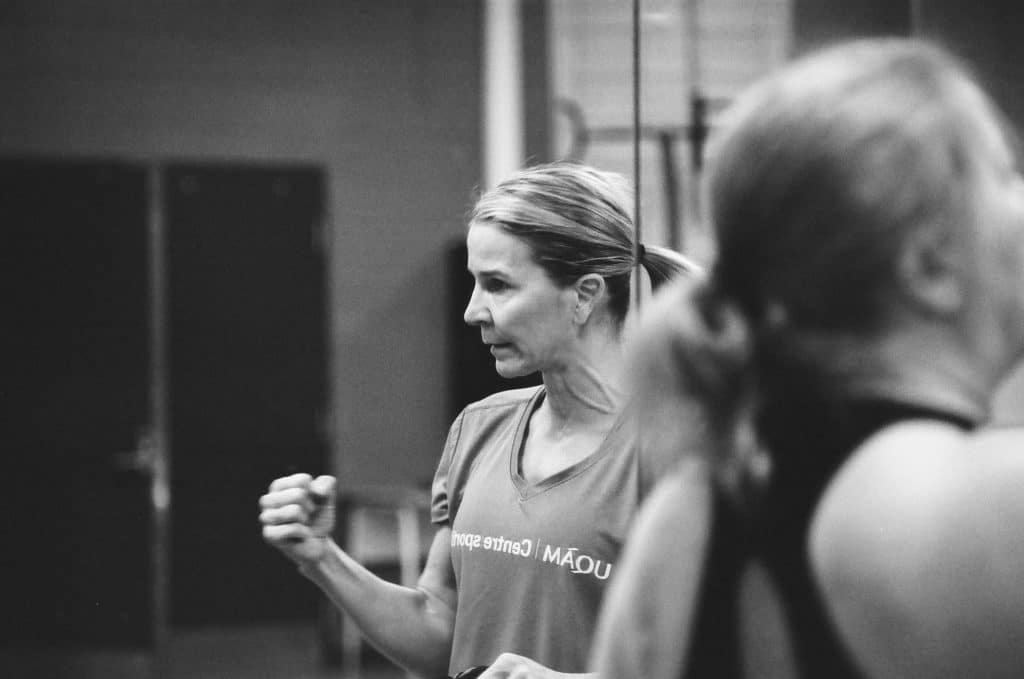
Nathalie Forget. PHOTO: Katia M. Briand
When Nathalie began her career as an amateur, boxing wasn’t yet an Olympic discipline open to women — that wouldn’t come until 2012. As in many other sports, the rules in women’s boxing are incongruously different from men’s boxing. Women get fewer and shorter rounds.
Nathalie tells me that women are considered to be more fragile and therefore less capable of withstanding blows. “What is ‘women’s boxing’? We don’t want to do women’s boxing, we want to do boxing. It’s the same sport. Give us the same rules.”
The cisgender male body remains the measuring stick used to judge athletic performance. Explosive qualities, like strength and force-speed ratio, are the generally accepted qualities of a high-calibre athlete. These social and scientific biases evidently trickle down into sports culture and shape the dynamics within gyms.
Women were not welcome in one of the gyms where Nathalie began her boxing career. Her coach pressured the owner of the gym, under threat of withdrawing the entire team of male fighters he had training at the establishment.
Nathalie was reluctantly included: she was forced to change in a broom closet and was considered a distraction to the men. But her rigour, seriousness and inevitably her talent wore them down and earned her their respect.
She cleared the way for many other women boxers who eventually followed in her footsteps and were admitted to the same training room: a legacy she is proud of to this day. It is a shame nonetheless that the dogged perseverance of an athlete of her stature was needed to prove that women are deserving of opportunities.
People socialized as women are convinced from childhood onwards that they are physically weak. Morgane observed that women who try sparring for the first time tend to either have poor control over their strength or are afraid to use it. She was among women when she was told she needed to learn to control the strength of her strikes. The men she trained with would never have admitted it. “Guys are either going to act as a punching bag or treat you like a punching bag.”
Women-only sparring sessions were initially added to Apex’s schedule to allow Morgane to improve her technique during one of her first training camps. The activity proved so beneficial that it was offered on a permanent basis to the women’s fight team and was later opened to all women who reach an advanced level in training.
Offering women opportunities to spar with other women is more than an attempt to shield them from the social biases reinforced by sports culture; it is also a chance for athletes to sharpen their skills in the appropriate context.
Against all odds
In October, I attended a women’s sparring event hosted by Ontario-based organization SHEspars held at the Hanumans Club. The non-profit community organization, founded by Damali Fraiser, a fitness coach and former Muay Thai fighter, offers activities reserved for women and girls who want to participate in Muay Thai in a space promoting growth and empowerment.
That day at Hanumans, participants engaged in three-minute rounds of sparring interspersed with one-minute breaks, switching partners at each new round. Participants calmly settled in the sunlit space waiting for the session to begin, as they stretched and wrapped their hands. The roughly 20 fighters, who came to represent gyms from across Montreal and even Ontario, quickly warmed up the narrow space lined with tatami mats.
From the first sound of the bell, laughter mixed in with the good-humoured advice exchanged between fighters. Many express the dire need for this type of activity at their own gym. The head coach and owner of Hanumans, Amélie Chartrand, rushed into the ring with her characteristic spirit and verve to help a young Ontario fighter adjust her stance.

Amélie Chartrand. PHOTO: Katia Briand
Amélie did not look the part when she discovered Muay Thai during a trip to Thailand around 15 years ago: “I weighed 180 pounds, I had no cardio, no muscle mass, no coordination, I had no agility, no balance.”
Muay Thai was a revelation for Amélie. More than a way to exercise and develop her physical skills, Muay Thai became her reason for living. Her passion transcended the obstacles placed in her path. But in addition to dealing with the inevitable setbacks linked to learning a new sport, she had to endure cruel remarks about her physique and her athletic potential.
In search of a place that would welcome her burgeoning passion, Amélie found a traditional Muay Thai club in Montreal, where she discovered the spiritual, traditional and cultural aspects of the martial art that already enchanted her for what it offers in terms of movement and strategy.
The kru, the name given in Thai tradition to the trainer, transmitted his love of the martial art which transformed into a vocation for Amélie. Unfortunately, the relationship she developed with her mentor quickly became abusive not only for her, but for all women who trained at the club.
Finding a gym that feels safe and welcoming as a woman remains a band-aid solution to a systemic problem that extends far beyond the world of sports. Not surprisingly, Amélie confided to me that sexual harassment is quite common in the industry.
Amélie and Frank Tanguy met at this Muay Thai club. At the time, Frank was still perceived as a woman. Frank has since come out as a trans man.
On his first visit to the club, the owner warned Frank that he does not train women. This categorical rejection only deepened his resolve. Unfazed by the lack of support, Frank claimed the space as his own and began training.
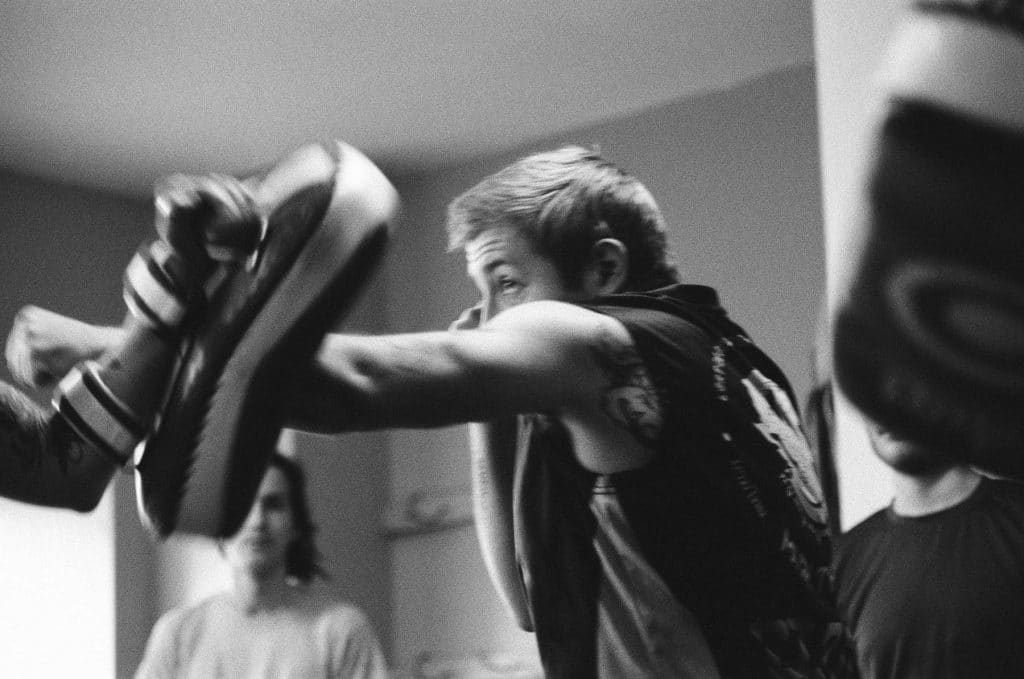
Frank Tanguy. PHOTO: Katia M. Briand
Few women felt comfortable persevering in this environment, but those who ended up joining Frank after two years — including Amélie — formed a close-knit crew that bonded in adversity.
In 2017, during a national tournament, the women’s team reached its breaking point after years of persisting despite the toxic climate. Frank specifies that the men’s team was not spared from the kru’s abuse, but the violence endured by the women fighters was unparalleled. “It felt like he wanted to break us, to show the girls that they weren’t cut out for it.”
Amélie says the coach often rubbed his penis against her when they grappled. Aware of her identity as a lesbian, he would claim: “You’ve never been fucked properly.” He repeatedly made sexual remarks about the women fighters’ breasts.
Frank overheard the kru muttering denigrating comments to Amélie while he massaged her body with oil, a traditional step in preparing for a Muay Thai fight. The man responsible for their safety, tasked with supporting them as they took hits and risked severe injury, spewed insults at the women and drained them of all motivation, mere moments before leading them into the ring. In the car on the way home, one of the fighters crumbles from sheer exhaustion. Through tears, she mumbles that she is ready to quit.
Today, Amélie proudly carries the title of kru at her own martial arts school. “Every coach or teacher has access to power. As a leader, you can easily misuse that power. Those who employ it in a positive way will entrust you with responsibilities, assign tasks, and work with you. That is the type of coach I choose to be.”
Amélie considers her mentor’s lack of faith in her potential to be the most damaging part of the whole experience. “Today, I offer my students the type of coaching I wish I had received at the time”. Amélie interrupts herself. The words catch in her throat. “This is how I heal.”
The will to fight
Fighting is a tradition Morgane inherited from the women in her family and was part of her life long before she discovered combat sports.
As a trade unionist, as an anti-fascist activist and in a past life as a member of the Quebec division of Femen, she puts her body on the frontline to defend the causes that are close to her heart. Her mother and aunts, whom she describes as rentre-dedans (fierce and unrelenting), instilled in her the importance of getting involved.
Activism now takes a backseat in Morgane’s life. Muay Thai allows her to channel certain explosive emotions and impulses which, in her words, made her want to “burn everything.”
Morgane no longer endorses some of the views she espoused as a member of Femen but hasn’t lost her ardor and commitment to social justice. Today, she channels her feminist values at Apex. “I don’t think everyone should have my personality to be able to break into this sport. I was given a chance and handed an opportunity.” She knows how beneficial martial arts can be for women and their self-confidence and wants to offer that opportunity to others.

Cory between rounds at West Side Muay Thai. PHOTO: Katia M. Briand
Culturally, the presence of women in the world of combat sports poses a challenge to the unkillable myth of the passive woman for whom aggression is unnatural.
I discovered kickboxing by chance, in a fitness class that paid no attention to technique. I was never inclined towards sports, but I immediately had a purely emotional attraction to this new hobby, learning to fight and take hits. Those around me are sometimes surprised that I find pleasure in practicing a sport perceived as violent.
Yet it seems to me that womanhood is largely a violent experience. At the pivotal age when I left my father’s arms, strange men began leering at my teenage figure. As I became aware of my body, of its power, it was ripped from me. Preyed upon, an unwilling participant in others’ crooked fantasies. I was considered inadequate, at times irrelevant. Passivity and complacency became modes of survival. I learned to shut down, to swallow myself whole.
The gym is a space where my body is mine, and I can reclaim the right to be unruly. I love hearing the echo of my shins striking the leather of the punching bag. I love the purple patterns bruises leave on my skin. I imagine myself spitting out the insidious violence that slithered its way into my flesh.
Frank agrees: “It allows you to regain control. I was socialized as a woman, in France no less, a particularly misogynistic environment. I think Muay Thai heals something in me. It increased my confidence, my ability to defend myself, taught me how to say no, and to feel at ease in my own body.”
While he continued to train competitively, Frank studied to become a firefighter. He officially entered the workforce in 2020 for the City of Montreal, at the height of the pandemic. Frank resolved to carve his place in another male-dominated environment. According to a census, only 11 per cent of firefighters in Canada in 2022 were women.
He came out at the end of his first year practicing the profession he had dreamed of since childhood. Integrating the workplace as a woman was a challenge in itself, but there were no trans firefighters in Quebec that he knew of. He reached out to allies in positions of power across the province for support while planning the announcement of his transition to his colleagues. He recognized the educational potential that his mere presence in an environment characterized by toxic and old-fashioned masculinity could have in the long term.
After several years of training as a woman, Frank was faced with a new reality riddled with its own set of challenges. His coach suggested that he should abandon competing: he did not know how to go about booking fights for Frank.
Fights are organized by weight as well as sex-segregated categories, based on a binary understanding of sex. There are simply no rules or procedures to govern the inclusion of a trans person who would like to practice kickboxing or Muay Thai competitively, neither at the amateur level nor at the professional level. Some gym owners are committed to providing a safe and inviting environment for members of the 2SLGBTQIA+ communities, but trans people find themselves hampered in their ambitions if they want to climb the professional ranks of the sport.
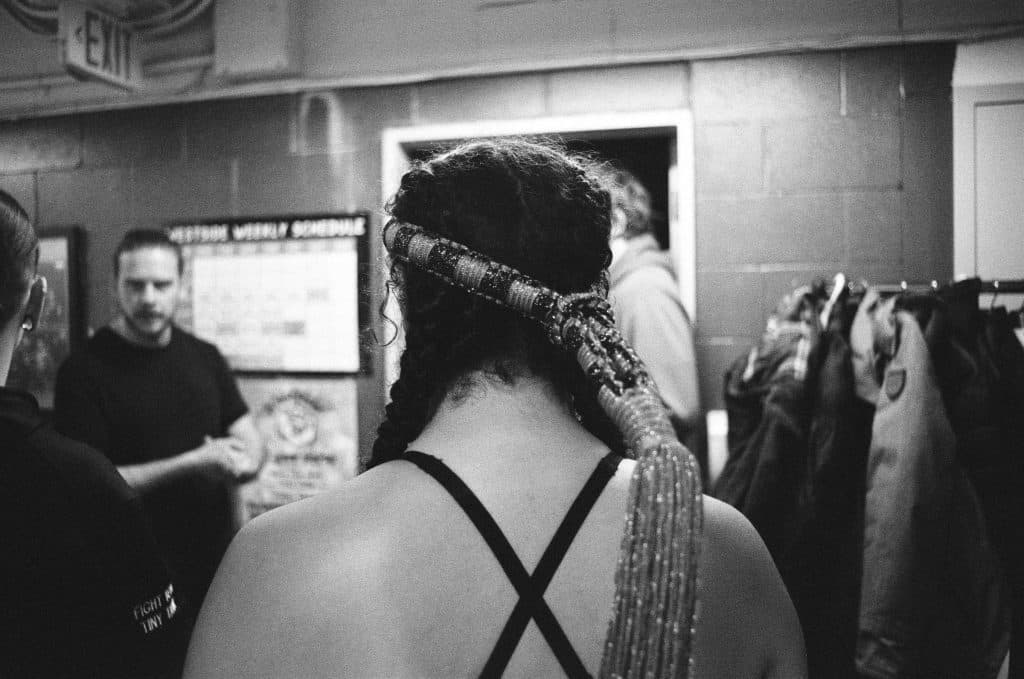
Cory before her fight. PHOTO: Katia M. Briand
While transphobic rhetoric has been gaining ground in Quebec public space in recent years, trans women specifically are targeted by those who believe that they present a threat to female athletes. The same rhetoric that weaponizes biology to justify the myth of male superiority over women thus serves to justify the exclusion and the dehumanization of trans athletes.
For Frank, anger and the desire to fight against injustice are driving forces. In his spare time, he coaches at the Black Flag Combat Club, a self-managed combat and self-defense club created in 2015 for women and queer and gender-diverse people who want to practice martial arts. Amongst their many projects and initiatives, the club offers a weekly class prohibited for cisgender men. Frank tells me that the Black Flag team is committed to piloting smokers for trans people, to test the best practices to adopt.
Frank is no stranger to the issues of inclusion, and the importance of safe spaces. He unfortunately had to retire from his job as a firefighter after a few years that left him emotionally and mentally drained. Recovering from a burnout, Frank confides that he is looking forward to starting a family. He can no longer afford to live in survival mode. I ask him what kind of career might be appealing to him now. He wonders if he might lend a helping hand in education, as a schoolteacher. I laugh. I wish I had an ounce of his determination and strength.
No winners are declared at the end of a smoker. Sometimes, as is the case that night at Westside Muay Thai, the feeling of victory is palpable nonetheless. Cory managed to land most of her punches on her opponent. A triumphant success for a first fight. With euphoric release coursing through her body, Cory screams: “I can’t wait to do that again!” Priscilla and Morgane surround her and shower her with praise, beaming with pride.
Regardless of the definition of the ideal athlete, the heart and spirit of a true fighter seem to be innate qualities, undeniable in some.
Author

Related Articles

Live from the Fall Classic: Game 7 with The Rover
Cheering for Canada’s Team in the World Series was a balm for my soul. But no matter what, my heart will always belong to the Expos.

Gaza: Rubble Invades the City and Its Memory
Can memories survive destruction and guarantee a future for Gaza City?

Opinion: Montreal Cycling Race a Win for Genocide Supporters
Montreal is being used as a prop to clean up Israel’s image on the international stage
Comments (0)
There are no comments on this article.