
McGill Encampment: Students Stand Firm Against Their Universities for a Boycott of Israel
Students are occupying the McGill Campus to denounce McGill and Concordia Universities’ financial and academic ties with Israel.
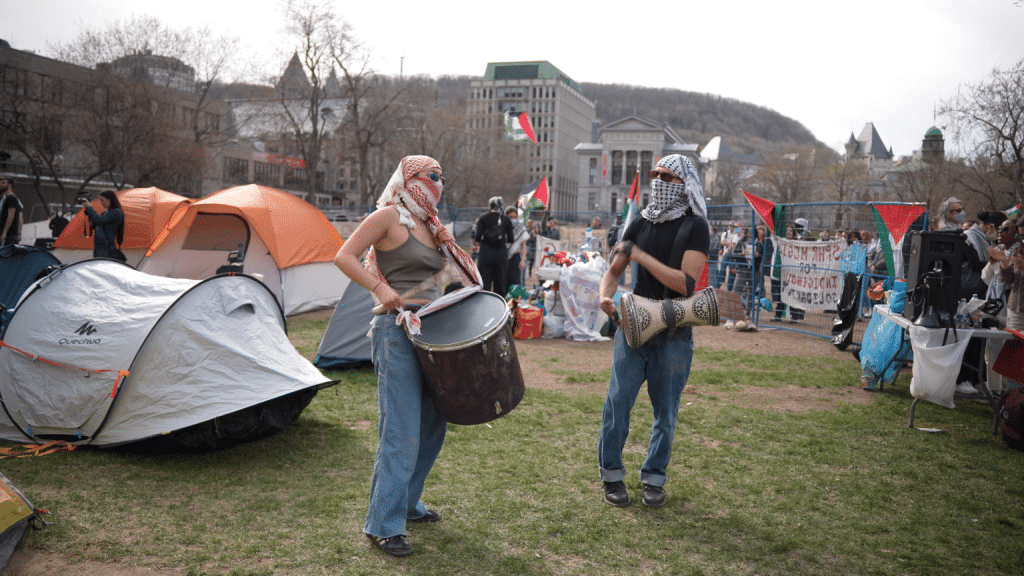
Demonstrators play drums at the encampment on McGill University campus calling for McGill and Concordia Universities to cut ties with Israel. PHOTO: Oona Barrett
Editor’s note:
This is an English translation of a French article that appeared in Pivot Monday. We’ve updated elements of it to reflect developments in the story. In this piece, the authors refer to Israel as an apartheid state, which many will contest, but this is the wording as it appears in Pivot and we chose not to censor it. If this is problematic for you, please feel free to email our editor-in-chief Chris Curtis at heytitocurtis@gmail.com.
Updated by Christopher Curtis
Translated by Savannah Stewart
This article was originally published in French by Pivot on April 29, 2024. It has been updated to reflect new developments in the story.
Montreal students are following the example of their peers in the United States, setting up camp on McGill University grounds to demand an academic and financial boycott of Israel by the institution, as well as by Concordia University.
McGill’s investments in companies linked to Israeli apartheid amount to several million dollars. Both universities have been resisting the repeated demands of their communities for months.
Since the first solidarity camp with Palestine at Columbia University in New York was established on April 17, Ali’s phone hasn’t stopped ringing.
“People were asking me, ‘When are we doing the same thing in Montreal?’” said Ali, a member of the movement. They are demanding that their universities divest from Israeli companies involved in violence against the Palestinian people and sever their ties with universities in Israel.
The student community was eager to replicate the action in Montreal, so much so that on Saturday afternoon, just hours after the first invitation appeared on social media to join a camp on McGill University’s lawn, about 100 people were already present.
About 20 tents were already set up by the end of Saturday. By Monday, the number had tripled. Professors, as well as students from UQAM and Université de Montréal, were also present. They celebrated the Jewish holiday of Passover and Palestinian film screenings and seminars in the encampment that first day.
The students say they will remain on McGill’s campus until their demands are met. In addition to severing academic and financial ties with Israel, students are also calling on their universities to publicly condemn the genocide in Gaza and to pressure the Canadian government to end its military ties with Israel.
“The initiative of the students at Columbia has united us. It has sparked a revolutionary movement, and it cannot be ignored because it is already significant,” Ali said.
Support Independent Journalism.
The action has set off a wave of protests across many university campuses in the United States, where students have also established camps and demanded that educational institutions end their investments and partnerships with Israel.
Similar actions have been carried out in Europe, particularly in Germany and France.
According to Ali, camps could soon appear on other Canadian campuses. On Sunday, the University of Toronto preemptively blocked access to its lawn by installing barriers.
At the University of British Columbia, students fortified an encampment with steel gates and set up portable toilets on site. They say they’ll stay until their university severs academic ties with Israeli institutions.
McGill, Concordia, and Israel
Compared to their francophone counterparts in Montreal, Concordia and McGill University currently maintain significant ties with Israeli companies and universities.
Students condemned McGill for investing over $70 million in companies that endorse or contribute to apartheid in Israel. Among these, McGill invests over $5.5 million in arms and military technology companies that have contracts with the Israeli army — companies like Lockheed Martin, Thales, Safran, Dassault, and Airbus, according to Pivot’s calculations.
Concordia University does not publicly disclose its investments, and their value is not known. However, the university maintains academic ties and partnerships with universities in Israel.
For several years, students from McGill and Concordia universities have been pressuring their administrators to implement a boycott, divestment, and sanctions (BDS) policy toward Israel.
Last November, McGill University students adopted a Genocide Policy encompassing the demands of the campers. This policy was requested by over 78 per cent of students who voted in a referendum initiated by the Solidarity Group for the Human Rights of Palestinians.
The administration opposed the policy, arguing that it would exacerbate divisions among students. Furthermore, an injunction, obtained by an anonymous student represented by a lawyer from the Zionist organization B’nai Brith Canada, quickly blocked the ratification of the policy on the grounds that it would be antisemitic.
In March, the university stated that it did not intend to “cut ties with Israeli universities and research institutes.”
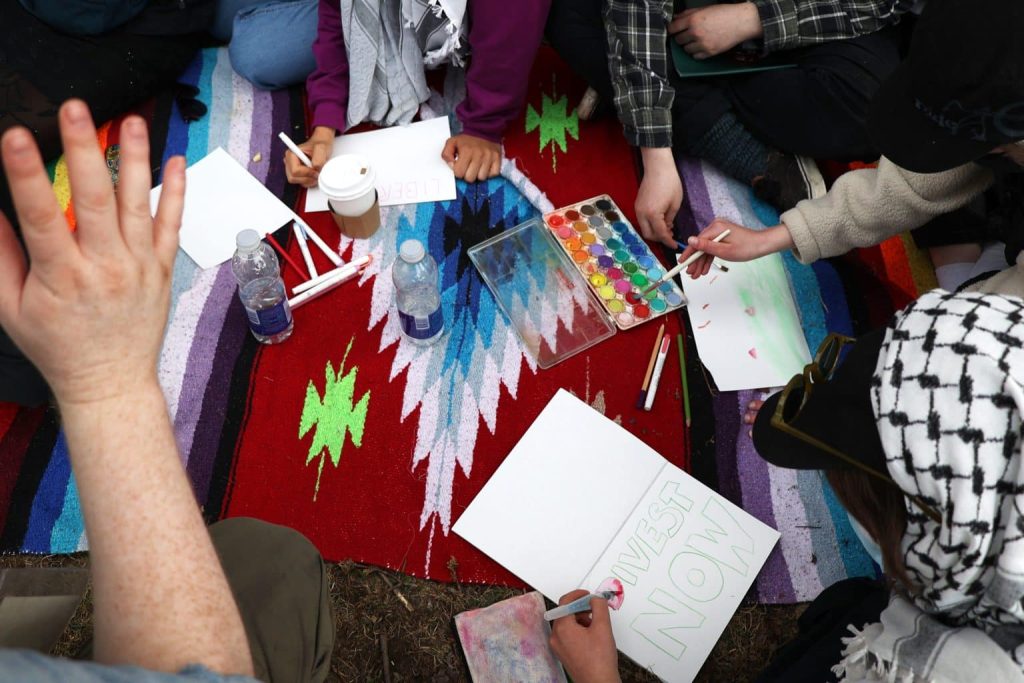
Campers prepare posters. PHOTO: Léa Beaulieu-Kratchanov
Stoic Universities
Through an email sent early Saturday morning, before the first tent was installed, McGill’s administration expressed concern about social media posts encouraging students to set up camps on campus.
“Camps are not allowed on our campus,” reads the email signed by McGill’s Associate Dean, Fabrice Labeau. Among other reasons, he cited the Student Code of Conduct, indicating that permission is required to pitch tents on campus.
For Danny Schwartz, an assistant professor at McGill, the administration is thus trying to “dissuade students and professors from expressing themselves and supporting the action.” Schwartz, who is Jewish, was present at the camp on Saturday, alongside a delegation of professors from McGill and Concordia universities who wanted to show their solidarity with the students.
“It’s extremely important to protect students, especially since the administration is spreading misinformation about students’ rights.”
McGill and Concordia did not respond to Pivot’s media requests.
Anticipated Police Repression
As of Monday, more than 48 hours after the start of the occupation, police had not yet been called to intervene on campus, according to the SPVM. Officers were seen on Monday morning, but reportedly left without intervening with the campers.
By Tuesday, administrators at McGill requested police assistance and the lawyer Neil Oberman filed an injunction request against the encampment in Superior Court. The injunction seeks to ban “any protest or actions related to protesting” within 100 meters of McGill for a period of 10 days.
There has been no violence on site but Oberman and others have argued that chants like “Intifada revolution” are calls for violence against Israelis. The Arabic word intifada simply means “uprising” and it refers to the first intifada, a struggle where Palestinians took on Israeli forces by throwing stones and Molotov cocktails to resist the construction of illegal settlements in the West Bank.
“When we say uprising, we mean for all people inside Israel’s borders — including Jews — to rise up and resist the government,” said one Jewish student at the encampment Tuesday.
Superior Court Judge Chantal Masse denied the injunction request Wednesday, ruling that the plaintiffs failed to demonstrate the encampment was blocking anyone’s access to campus.
“Police repression is something we always anticipate,” Ali said. He recalls that the administration had asked the police to intervene on campus last February when students blocked access to the Bronfman building, which houses the Desautels Faculty of Management, to protest its ties with Israel. The students counted about 30 police officers and 20 vehicles, including arrest vans.
“Concordia is proud of similar actions to ours that took place in the 1960s,” Ali remarks. “I guarantee you that in a few years, they will also be proud of what is happening today.”
In 1969, Black and Caribbean students occupied a computer lab to denounce the administration’s inaction in response to several accusations of racism within the university. The latter called on the SPVM riot squad to end the action.
Last year, Concordia publicly apologized for its mistreatment of protesters. On its website, the university describes the action as a “decisive moment” in its history.
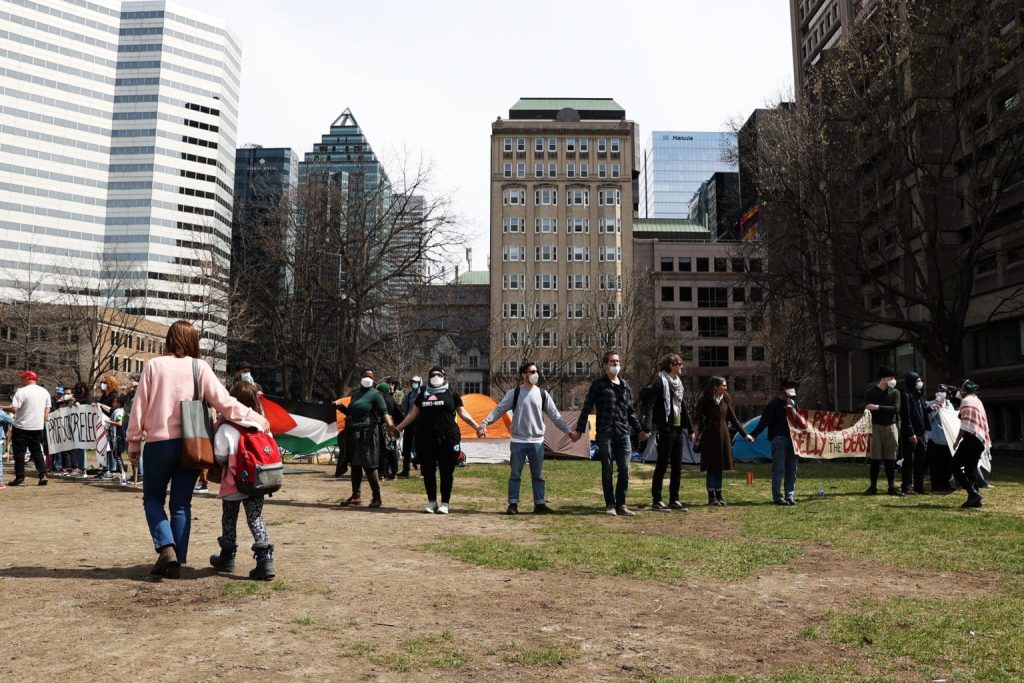
Demonstrators form a circle around the McGill University encampment. PHOTO: Léa Beaulieu-Kratchanov
“A genocide that is destroying everything”
Meanwhile, in Gaza, civil defence officials discovered hundreds of civilians’ bodies in the grounds of hospitals al-Shifa and al-Nasser, some of which had been bound and showed signs of torture, according to the aid organization Palestinian Red Crescent Society.
Nearly 35,000 people, including over 15,000 children, have been killed in Gaza since Oct. 7. On Monday, Egypt submitted a ceasefire proposal that would allow for the release of hostages to Hamas leaders.
At the same time, several media outlets report that the International Criminal Court is preparing to file war crimes charges against several senior Israeli leaders, including Prime Minister Benjamin Netanyahu himself.
“What is happening right now is a genocide that is destroying everything — life, land, infrastructure, generations, history, heritage, cultural heritage in Gaza, but also in the West Bank,” explains Nayrouz Abu Hatoum, an anthropologist specializing in Palestine and an assistant professor at Concordia University, who was present at the camp on Saturday.
For her, the silence of Western academic institutions in the face of the destruction of all universities in Gaza is deafening. “All the knowledge, thoughts, epistemologies that have been developed in Gaza are being destroyed,” she said.
“It’s not just the physical destruction of universities, but also the killings of so many professors, teachers, librarians, deans… their writings, materials, archives.”
Authors

Related Articles
School Board Votes to Support Candidate who Smeared Rival, Acted in ‘Undignified’ Manner
Julien Feldman gets off scot-free after falsely associating his rival candidate with antisemitism and referring to her as “Ms. Gaza.”

« Je veux juste qu’on me croie »
Victime d’une agression sexuelle alors qu’elle travaillait pour le gouvernement provincial, une femme lutte avec Québec depuis cinq ans.
Hundreds of Migrant Workers Compensated After Fraudulent Recruitment Scheme
The multinational Newrest and the Montreal agency Trésor must pay $2.1 million to migrants tricked into working without authorization under the false promise of obtaining a valid work permit in Canada.
Comments (0)
There are no comments on this article.