
Migrant Workers in Canada With Federal Program Fight to Stay After Alleged Abuse
Migrant workers in Montreal who prepared in-flight meals for one of the country’s biggest airline catering companies say they were defrauded and brought to Canada under false pretenses.
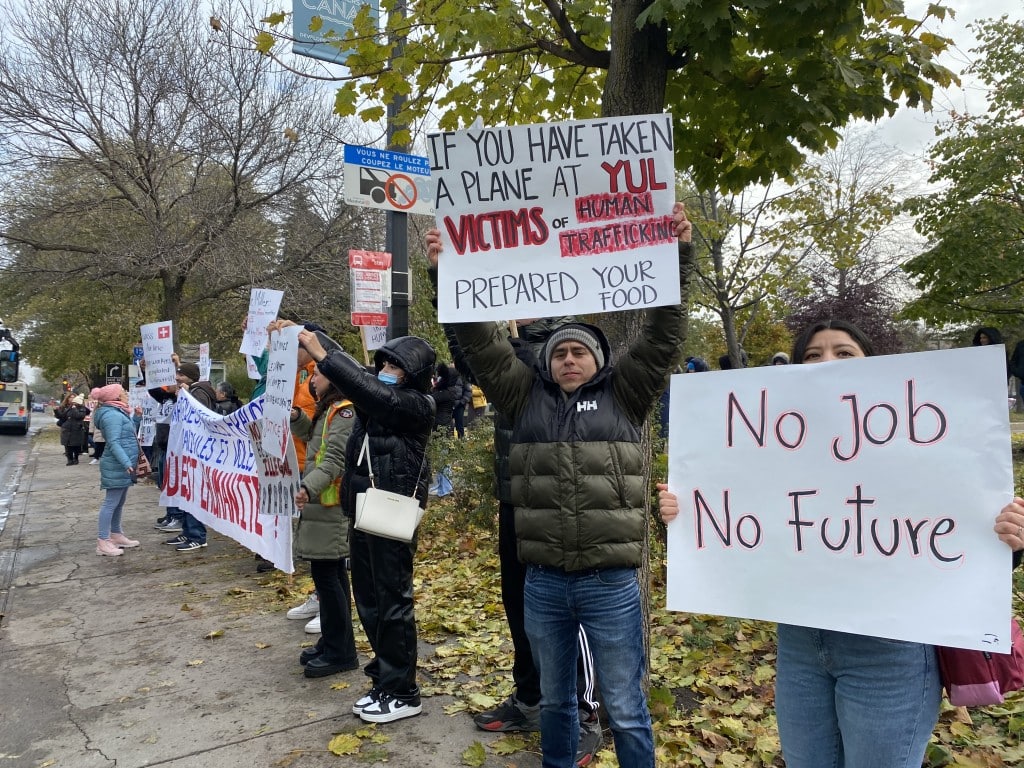
Fifty migrant workers gathered outside federal Immigration Minister Marc Miller’s Montreal office Tuesday, November 14, to protest abuses carried out under the Temporary Foreign Worker Program (TFWP). PHOTO: Christopher Curtis
Abdul hit the factory floor so hard he couldn’t feel his legs.
He assumed that, since he’d just been in a workplace accident, his supervisor would call an ambulance or send him to the clinic.
He was wrong.
“They told me to take Tylenol and go home,” said Abdul, a migrant worker who came to Montreal from Algeria last summer. “They said I wasn’t allowed to go to the doctor, that if I did, it would cause problems for the company.”
Abdul lay on the ground for three hours as the pain settled into his body, waiting for his colleagues to finish their shift and carry him to the metro. It was on that day in August, after he was warned not to seek medical treatment, that Abdul started to suspect his employers might be scamming him.
So he asked to see a copy of his employment contract with Newrest Montreal — a catering company that supplies the Trudeau International Airport with 9,000 inflight meals a day.
“I told them, ‘I don’t want to cause problems, I just want to see my contract,’” Abul said. “I just wanted some proof that I was in Canada legally. They told me not to worry.”
He was fired three days later.
This was one of dozens of horror stories that emerged Tuesday, as 50 migrant workers gathered outside federal Immigration Minister Marc Miller’s office to protest abuses carried out under the Temporary Foreign Worker Program (TFWP). The workers are suing Newrest and the Laval-based recruitment agency Trésor Inc., accusing the companies of deceiving migrants into working in Canada without a permit.
Though Newrest denies these claims, The Rover has uncovered documentary evidence that shows at least two of its high-ranking Montreal employees participated in the alleged fraud. After learning of the lawsuit, Newrest reached an agreement in principle with the workers to get them permits and pay restitution.
Support Independent Journalism.
It’s possible Newrest’s head office in France didn’t know what was happening in Montreal. But problems at the factory were flagged long before the workers filed suit last month. Immigration, Refugees and Citizenship Canada (IRCC) received “multiple complaints” about Newrest’s alleged abuse of migrant labourers at Newrest in 2022, according to a government source.
It’s unclear if there was any follow-up from Ottawa. The IRCC receives thousands of complaints every year and it’s possible they didn’t have the resources or sufficient evidence to investigate.
Hailing from Central America, South America and North Africa, the migrants say they were recruited by Trésor, an agency that promised to take care of their TFWP permits and put them on a path toward permanent residency. Trésor sent the workers to Newrest’s factory in Dorval, where they were told that the permits would only come to those who earned them.
In reality, there were no permits issued for an estimated 400 migrants working at Newrest, according to court filings.
The alleged scheme was only possible because of a series of changes the Liberal government made to the TFWP in 2020. Before the new rules came into effect, a company that wanted to bring in workers under the TFWP had to provide a labour market study, travel abroad to find workers, apply for their permits and get them approved before flying them into Canada.
But when the Liberals amended the program, they expanded it to allow people visiting Canada on a tourist visa to stay and get jobs through the TFWP. They also did away with the market study, arguing that Canada’s labour shortage demanded a quick and easy supply of workers.
The new rules made it much cheaper for recruitment agencies, but they also opened the door for abuse.
By the time most of the workers figured out they’d been tricked, most were either fired or extorted into staying silent. Some were told they’d be arrested and deported if they went to the police. After the alleged fraud became public in October, at least 160 workers were laid off by Newrest and replaced by new migrants.
Outside Miller’s office, the migrants spoke of fighting through panic attacks at the thought of being deported. Some felt ashamed of being taken in by someone they trusted with their passports, their personal information and their lives. But the resounding emotion Tuesday was a sense that these workers would no longer be bullied into silence.
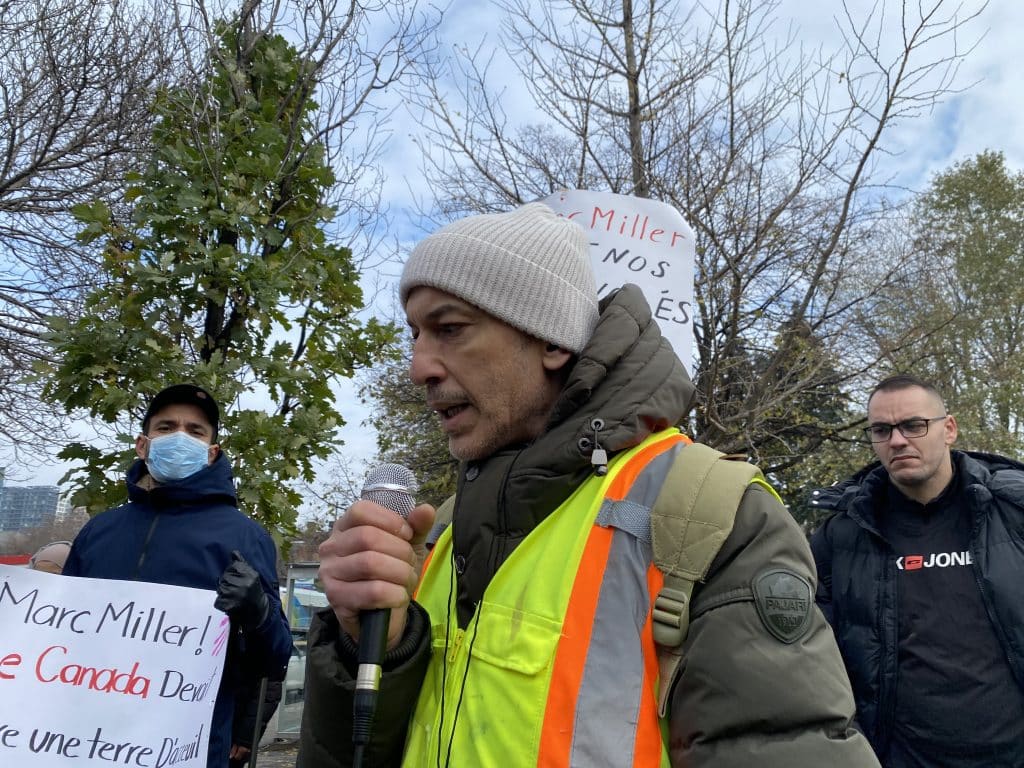
Fifty migrant workers gathered outside federal Immigration Minister Marc Miller’s Montreal office Tuesday, November 14, to protest abuses carried out under the Temporary Foreign Worker Program (TFWP). PHOTO: Christopher Curtis
“They treated us like farm animals who could be bought and sold. But now we fight back,” said Omar, who did not want his real name published. “If we didn’t work fast enough, if we talked back, if we advocated for ourselves, they’d just replace us with another migrant worker. The other factory workers — the ones with legal status — were treated fine. Us, they yelled at us like dogs.”
Newrest was not immediately available for comment but in previous statements, the company said it “scrupulously” follows Canadian labour and immigration laws. It says it is investigating the allegations internally.
After denying the workers’ claims in an interview with Canadian Press last month, Trésor president Guillermo Montiel has been unreachable and the company cleared out its Laval offices on Oct. 31, according to two sources. The Rover spoke to 12 workers who did not receive their final pay and have no legal means of providing for themselves and their families.
Despite his silence, Montiel has two attorneys on the case, according to court filings. Neither returned The Rover’s interview requests.
Just before the workers’ lawsuit was filed last month, a representative from IRCC told the migrants they’d be fast-tracked towards a work permit under the protections for victims of human trafficking program. The IRCC apparently provided guarantees, in writing, that the hundreds of remaining applications would also be fast-tracked.
But the government appears to have reneged on that promise, according to the law firm representing the migrant workers. The IRCC had initially set up a dedicated email address and high-ranking civil servant to handle applications for the Newrest/Trésor workers to obtain “open” work permits — meaning the migrants get to choose their own employer instead of being bound to Trésor.
A few weeks later, a representative from the IRCC told the law firm it would no longer be fast-tracking the applications because they believed the handful of workers who were given open permits went back to their jobs at Newrest. The IRCC representative also falsely claimed the workers were bound by a non-disclosure agreement signed with Newrest and that it would be impossible for them to speak out.
In a letter to the IRCC, lawyers at Trudel, Johnston and Lespérence claim this information is “false” and that, without the expedited applications, each file could take up to 25 hours in legal work, costing thousands of dollars per applicant in a process that could take months.
This misunderstanding, on the part of the IRCC, is what led dozens of workers to organize a protest outside Minister Miller’s office. They were joined by a representative of the Confédération des syndicats nationaux — one of Quebec’s largest labour unions — and New Democratic Party Member of Parliament Alexandre Boulerice.
“We’ve been following this situation for weeks and, from a human rights perspective, it’s an absolute debacle,” said Boulerice. “Some permits were issued a few weeks back but now it’s blocked and we don’t understand why. In Quebec, our economy would collapse if it weren’t for temporary foreign workers. And it’s not just the classic example of farm workers from abroad, we’re talking more and more about our manufacturing sector, transportation and trucking. But they need rights, they need a recourse to call out abuse otherwise this exploitation will continue.
“It’s always possible to reform (the TFWP). Closed permits — which bind workers to a single employer — should not exist. And people who come here and help our economy as these workers do, they deserve a path to permanent residency in Canada.”
As it stands, hundreds of migrants caught up in the alleged fraud are stranded in Canada with little money and no way home.

Fifty migrant workers gathered outside federal Immigration Minister Marc Miller’s Montreal office Tuesday, November 14, to protest abuses carried out under the Temporary Foreign Worker Program (TFWP). PHOTO: Christopher Curtis
“I’m not a beggar, I came to Canada to work. All I’m asking for is a chance to prove myself,” said Mourad, a former Newrest worker who hasn’t seen his children in six months. “I was doing fine in Algeria; I was an accountant with a good job. But my son is autistic and there are no services for him there, there’s no future for us over there. So I came here so that one day I could bring them over. I came here so that one day they can have a future.”
Tears streamed down Mourad’s face as he spoke about his children.
He says that, at Newrest, the threat of being replaced by another migrant was used to prevent employees from asserting their rights. Things like scaling a 15-foot shelving unit without a ladder, sorting boxes in a -22 ℃ freezer without a winter jacket or being denied basic medical care were all common occurrences in his time there.
Another worker, who we’ll call Myriame, says she’s owed roughly $1,800 in back pay for her final three weeks on the job. Without a permit, the only way she can pay rent and send money home is by working under the table and risking deportation.
“I put up with dangerous working conditions because I would have done anything to get a permit to stay in Canada,” said Myriame, who did not want her real name published for fear of reprisals. “I was lied to and I was taken advantage of. After Newrest found out a bunch of us hadn’t been paid by Trésor, they arranged to give us a “charitable” donation of $560. But I don’t need charity, I need the money that I earned with my labour.
“My grandkids are back in Algeria, my little boy was on the phone the other day crying, asking me ‘Maman, when are you coming home?’ and I don’t know what to answer. Aside from this terrible experience, I love it in Montreal. This is where I want to take my family, to give them a better tomorrow. We just want to be given that chance to show we belong.”
One man, who did not give his name, said he missed the birth of his daughter so he could stay and work in Canada.
“I’ve only seen her through a screen,” he said. “To be so far away from your baby, it is a pain I wouldn’t wish on anyone.”
There are over 1 million workers in Canada who aren’t permanent residents, with many here on “closed” work permits that bind them to a single employer. The closed permit system was denounced by the United Nations last summer as making migrants “vulnerable to contemporary forms of slavery.”
In response to the UN’s statement, Miller said he was disturbed to learn of abuses throughout the TFWP and vowed to reform the program. Specifically, Miller told reporters the IRCC is looking at giving more migrants a path towards citizenship and cracking down on abuses of the TFWP.
As for claims that the IRCC reneged on its promise to help fast-track the Newrest workers’ applications, Miller’s office would not comment publicly on the matter. But a source inside IRCC told The Rover Miller is pushing to have the situation rectified.
“When I left (Newrest) for my last shift on Oct. 31, I remember seeing the migrants they chose to replace us,” said Mourad. “They were students, young men and women who didn’t speak English or French and probably didn’t know what was waiting for them in that factory. It feels awful to be treated this way, to be used and thrown away like you’re nothing.
“But we are not nothing, we are people with families, with value, with dreams. We are human beings just like everybody else.”
Authors


Related Articles
McGill Spent Over $1 Million Fighting Unionization
Union organizers at the university say this is part of a broader trend towards corporatization of the public institution.

Rent Increases Set to Worsen the Housing Crisis
Experts warn that homelessness continues to grow as Quebec’s housing tribunal proposes a new way to calculate rental increases.

Montreal Leans on Condo Developers to Fix the Housing Crisis
As the number of unhoused deaths rises every year, experts say corporate interest in the housing crisis excuses the city and province from serving the public.
Comments (0)
There are no comments on this article.