
Montreal Filipino community mourns the victims of the Lapu Lapu festival tragedy
Community leaders call for structural reform in mental healthcare.
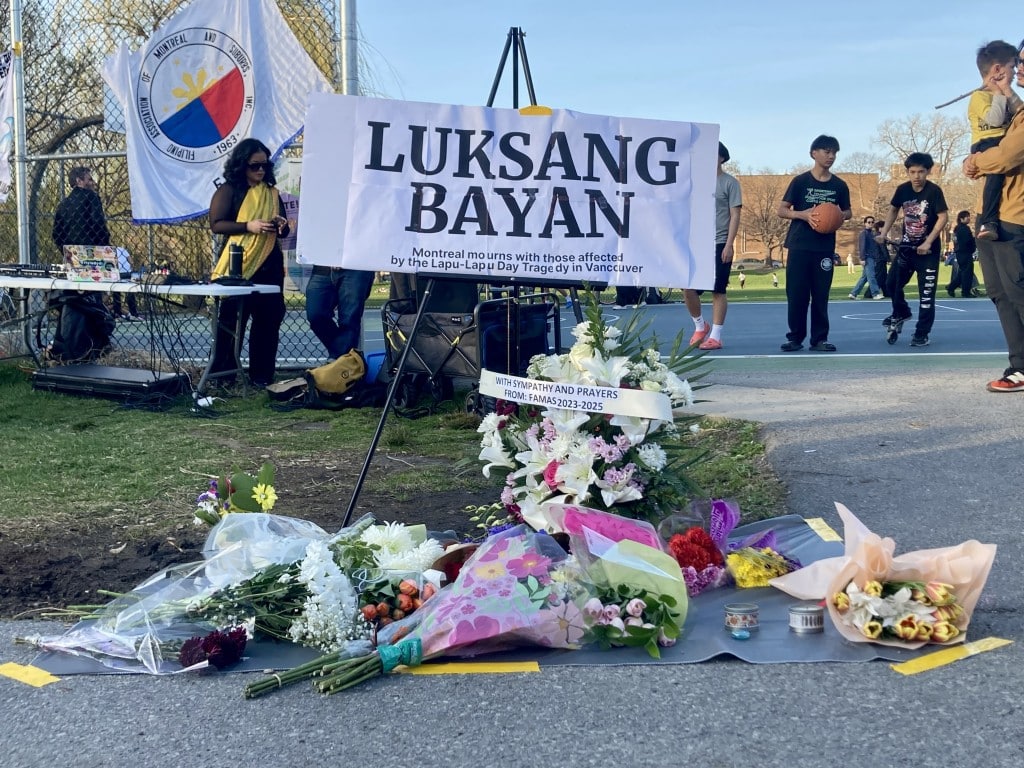
On the evening of April 28, as the country elected our next Prime Minister, the Filipinx community of Montreal gathered to mourn the victims of the Lapu Lapu Day festival tragedy in Vancouver on April 26.
Lolas, lolos, titas and titos gathered in MacKenzie King Park, in a predominantly Filipinx part of Côte-des-Neiges. The laughter of kids playing a game of basketball nearby reminded them of what they are here for – so their children could grow up without suffering such horrible traumas. Mourners placed flowers and candles in front of a sign that read “Luksang Bayan,” a day of national mourning called by Canada’s Filipinx organization Migrante Canada, to honour those affected by the car rampage.
Two days prior, Kai-Ji Adam Lo drove an SUV into a joyous street festival, killing 11, injuring nearly 30 and forever altering the lives of their loved ones. The festival, attended by many Canadians of Filipinx heritage, celebrates resistance against colonization. It is named after Lapu-Lapu, an Indigenous Filipino leader who resisted Spanish colonization in the 16th century.
Lo was known to Vancouver police as having a history of mental health issues.
“Let this be a wake up call that we are experiencing a silent, deadly, mental health crisis plaguing our community, beyond the Filipino community,” said Veronica Bertiz, one of the co-founders and the director of advocacy at Centre Kapwa, a Filipinx-Canadian mental health organization, in a speech to the crowd in Montreal. “This crisis is as Canadian as you and me, and we are all affected by this tragedy.
Support Independent Journalism.
“Filipinos are the number one exporter of healthcare workers, and yet we’re severely lacking carers within our community!”
“Knowing that the police already are aware of the background of the accused, and yet he was put in the society (speaks to) the lack of resources in general, how police handle this type of situation”, Bertiz later told The Rover. “We know that Vancouver is already suffering from a public health crisis […]. So it’s not a surprise that they are ill-equipped when it comes to handling mental health issues.”
“We’re also known as a community to brush it under the rug, so to speak, when it comes to mental health. And so it’s just an accumulation of everything that has failed him. His actions are unforgivable, but it also explains why. At the end of the day, it’s just pain towards everyone,” she added.

According to Bertiz, family separations — such as those created by Canada’s Family Caregiver Program and the Federal Skilled Worker Program — are an important factor affecting the community’s mental health. Through those programs, many Filipinx come to the country alone as nurses or domestic workers to earn money for their families back home and fill gaps in the Canadian job market. The immigration hardships they experience without loved ones nearby to turn to for support are major contributors to poor mental health in the community.
Therefore, family losses — such as the one the perpetrator suffered when his brother was murdered last year in Vancouver — hit particularly hard.
She says Western mental health models are not suited to the community.
“We have a lot of our ceremonies, we have our traditions, and those traditions are sometimes lost as you immigrate to another country,” she said. Bertiz called for more Filipinx mental health professionals who have cultural competency and for more gathering spaces for the community.
“The mere fact that Filipinos are the number one exporter of healthcare workers, and yet we’re severely lacking carers within our community! It’s just outrageous,” she said. “It’s nice to see a lot of people coming in here and talking about this, but we are the carers. We are, historically, the carers of North America, not just Canada.”

The healing power of community
Father Art Calaycay faced the crowd and crossed himself before leading a prayer. “Oh God of mercy and compassion, we come before you with broken hearts, grieving the loss of lives and the suffering of our brothers and sisters in Vancouver,” said Calaycay, a priest with the Philippine Independent Church.
After concluding his prayer, he led a procession towards the statue of Dr. José P. Rizal, a Filipino national hero who contributed to the liberation of the country from Spanish colonization. Mourners solemnly walked through the park to music, holding candles and flowers that they then laid in front of the statue.
Fatima Barron, one of the vigil’s organizers, said she strongly believes that mental health is a community responsibility and that it should be handled holistically.
“What’s interesting about (the) work or (the) services (of the Philippine Independent Church) is that … they’re not afraid to speak out about particular issues,” she said. “That’s something we also need within the faith space to ensure that we’re really doing what Jesus wants us to do, what God wants us to do.”
The fact that the vigil is on the day of the federal election was not lost on her. She wants elected officials to address the root causes of poor mental health.
“For instance, addressing the racist rhetoric that comes with immigration policies, addressing the high cost of living, addressing anti-people policies”, she concluded. “Once we start addressing that, that’s when we can truly work on healing.”
Did you like this column? Share it with a friend!
Related Articles

School Board Votes to Support Candidate who Smeared Rival, Acted in ‘Undignified’ Manner
Julien Feldman gets off scot-free after falsely associating his rival candidate with antisemitism and referring to her as “Ms. Gaza.”

« Je veux juste qu’on me croie »
Victime d’une agression sexuelle alors qu’elle travaillait pour le gouvernement provincial, une femme lutte avec Québec depuis cinq ans.
Hundreds of Migrant Workers Compensated After Fraudulent Recruitment Scheme
The multinational Newrest and the Montreal agency Trésor must pay $2.1 million to migrants tricked into working without authorization under the false promise of obtaining a valid work permit in Canada.
Comments (0)
There are no comments on this article.