
Municipal Elections: Will Montreal’s Nightlife Finally Get a Seat at the Table?
Venue owners and residents call for stronger action to protect the city’s culture after dark.

Montreal’s nightlife has long been one of its defining features.
But across the city, the small independent operators, the ones that keep the city’s nightlife thriving, fear an uncertain future amid the looming threat of noise fines and a speculative real estate market.
As municipal elections approach, Montrealers want to know: what will the parties do to protect the heart and soul of the city?
At a recent MTL 24/24 dialogue on nightlife, candidates from three major parties, Projet Montréal, Ensemble Montréal, and the newly created Transition Montréal, gathered with venue owners, nightlife advocates, and residents to present their visions for the future of Montreal’s nighttime scene.
For Sergio da Silva, co-owner of Turbo Haüs and city council candidate with Transition Montréal, the stakes are personal.
“I got involved because I thought I could do a decent job steering everything in a more positive direction,” said da Silva, who is running in the Saint-Jacques district downtown.
Support your local indie journalists
He expressed frustration with the current administration’s failure to act quickly to save Montreal’s venues from shuttering amid noise complaints and high fines. Back in 2023, his own venue was threatened with a fine that could range between $1,500 and $12,000.
“If you’re saying that you respect and care about nightlife in Montreal and see it as a community builder and economic engine, great,” he said. “But you were given the perfect opportunity to stand up for nightlife by saving La Tulipe, and you fucked it up.”
Noise complaints: Parties align on police involvement and agent of change principle
Earlier this year, beloved concert venue La Tulipe was forced to close its doors following repeated noise complaints from a single person in a neighbouring condo. Located in the heart of the Plateau-Mont-Royal on rue Papineau, the venue was known for hosting intimate performances from acclaimed artists like Feist, Patrick Watson, and Coeur de pirate.
The condo developer, the municipality later admitted, was mistakenly allowed to transform a commercial space into a residential one.
Though the city has revised its noise allowance policy, residents and nightlife advocates want more concrete protections for venues.
At the dialogue, Projet Montréal’s Ericka Alneus was quick to point out that following La Tulipe’s closure, the municipality implemented new regulations in the Plateau to prevent residential developers who build next to an operating venue from complaining about noise. The move, however, was criticized by many as being reactive when it should have been preventative.
Alneus said her party will continue to enforce the “agent of change” principle in a similar manner. Projet Montréal has committed to “strengthening” the Plante-era Politique de la vie nocturne, which includes soundproofing subsidies for venues and the creation of designated nightlife hubs with extended operating privileges.
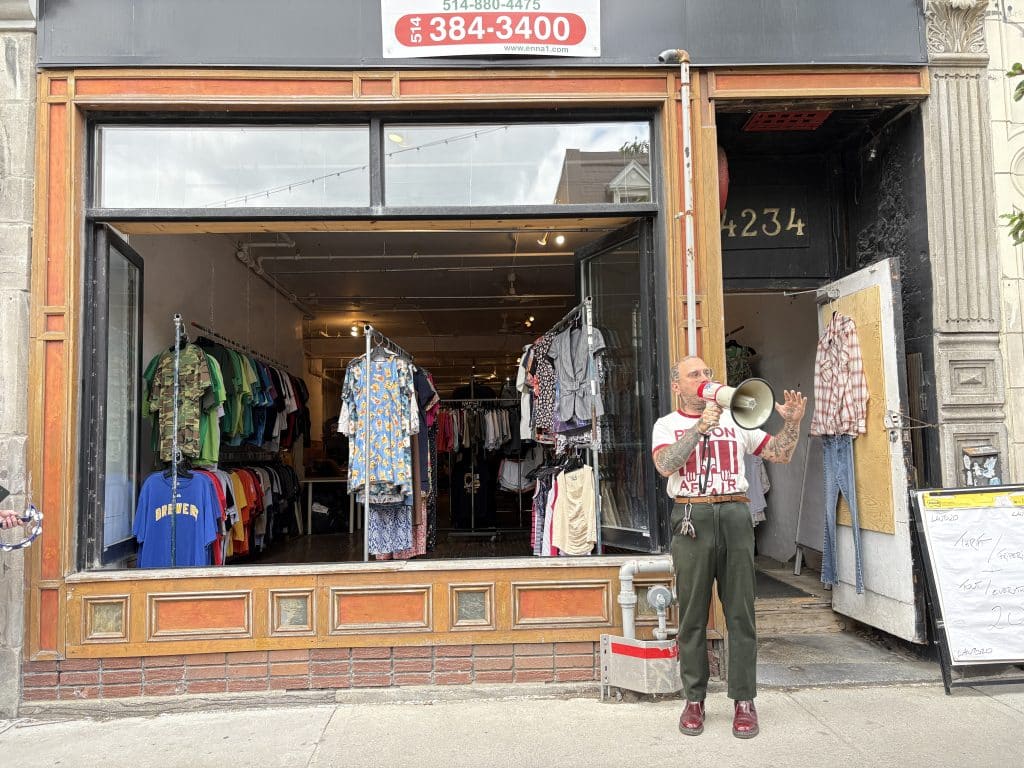
Transition Montréal has similarly promised to create protected cultural zones with clearer, more flexible regulations for venues. At the dialogue, party leader Craig Sauvé proposed extending these protections to individual buildings throughout the city, not just in designated nightlife zones. The party will also support venue soundproofing efforts.
Ensemble Montréal’s Jean Beaudoin spoke about reframing how the city thinks about noise, referring to it instead as the city’s “soundscape.” He argued that sound is part of a neighbourhood’s identity and vitality, and should not automatically be treated as a nuisance. He discussed the possibility of recognizing soundscape as an acquired right within zoning laws, meaning new developments must adapt to the existing sonic environment.
“It is not the place of police”
All three parties agree that police shouldn’t be first responders for noise disputes.
Alneus emphasized that under her party, police would no longer handle noise complaints. “The discretion that the police had, we’re removing it,” she said. “It is not the place of the police to come and manage or deal with these issues.”
Instead, independent mediation teams and dedicated inspectors would handle disputes, with fines maintained between $600 and $2,000.
Still, Montrealers won’t soon forget the party’s earlier proposal to raise first-time noise fines to $10,000, which was only scrapped after fierce backlash.
The proposal and its subsequent withdrawal highlight what da Silva calls a “chasm” between the city and Montreal’s cultural community.
“If it’s coming as a shock to you that people are upset about this after they’ve been losing one cultural space after another… then that shows a complete dereliction of your civic duty and as a steward of culture in your neighbourhood,” he said.
His party, Transition Montréal, has vowed to limit police involvement to safety and emergency situations and require mediation before any fine is imposed.
Ensemble Montréal supports a similar mediation-based approach, where noise complaints go to a dedicated administrative unit before any penalties are issued.
Venue owners need long-term stability, not speculation
Montreal has a gentrification problem, and nightlife advocates want the next administration to act to keep cultural spaces off the speculative market — a critical step, as most nightlife organizations are currently renters.
Transition Montréal plans to create a cooperative fund to help small venues purchase their spaces. “We love the idea of… creating a collective acquisition fund to buy buildings, return them to (a not-for-profit), and take them off the speculative market so bars and venues can thrive at fair prices,” Sauvé said at the dialogue. “We’ll do it if elected on Nov. 2.”
Projet Montréal has pledged to establish a $1 million social trust to collectively acquire independent venues and help cultural organizations gain ownership or control of their spaces. The party also wants to permanently extend property tax exemptions to cultural non-profits that rent, a benefit currently reserved for owners.
Ensemble Montréal’s platform makes no mention of a formal buy-back program, but Beaudoin suggested creating a mixed fund supported by the city, the private sector, and philanthropists to help venues secure their spaces. Montreal, he said, could also apply the housing co-op model to cultural institutions to help keep rents low.
No vacancy: Empty buildings pose a risk for Montrealers
Vacant spaces don’t just drain Montreal’s nightlife, they pose a real risk for residents.
“There is nothing more dangerous,” da Silva told me, “than dead spaces, abandoned buildings, and closed storefronts in a city.”
“The only way to make a neighbourhood more livable and safe without spending more money on more police is having more people there, having an active nightlife, having a lot of services.”
Da Silva’s party has proposed a tax on vacant buildings and unused land to encourage property owners to rent their spaces instead of letting them sit empty and speculating. This would also help free up space for community and affordable housing.
Projet wants to provide financial and regulatory incentives to encourage property owners to convert vacant spaces into artist studios and develop affordable housing projects dedicated to artists and craftspeople.
Ensemble has committed to establishing a public registry of vacant or abandoned properties within its first 100 days and launching a broad call‐for‐projects to give those buildings a new purpose in collaboration with non-profits and the private sector.
Ottawa has a night mayor. Will Montreal catch up?
Nightlife is its own ecosystem, and many have called for the appointment of a dedicated official with experience in nightlife to coordinate across departments.
Transition Montréal has committed to appointing a night commissioner within its first 100 days in office if elected. Under its administration, a single official would report directly to the city’s general management, with authority to coordinate across departments like water, public works, and urban planning.
Projet Montréal prefers to continue its current team-based model rather than appoint a single commissioner. The party plans to maintain dialogue with residents through the existing nightlife roundtable and consult its members on upcoming proposals.
Ensemble Montréal falls somewhere in between, with Beaudoin suggesting that all borough mayors collectively share responsibility for nightlife management.
“I think it’s all the mayors of all the boroughs, and collectively those who have responsibilities across the city,” he said. “It’s not the job of just one person; it’s part of our mandate and within our capacity to take action.”
“Yes, there will be a commissioner to centralize this, but that doesn’t absolve anyone of responsibility.”
Montreal’s heart beats in small venues
Across the dialogue, a common theme emerged: Montreal’s nightlife is the lifeblood of its culture, and should be respected and supported as a serious municipal responsibility.
Da Silva hopes to see this principle applied at every level, not just when it comes to the big players.
“For me, small independent venues are literally the best way to experience this kind of culture in Montreal. They’re important in and of themselves, not just what they can do as a feeding system to Evenko.”
More than launch pads, small venues are where Montrealers go to gather, connect, and find belonging. Da Silva wants the incoming administration to recognize that.
“In terms of building the economy, building culture, building community, there is nothing better than the nightlife. There is no better tool that we have than nightlife in the city.”
Did you like this article? Share it with a friend!
Related Articles

« Je veux juste qu’on me croie »
Victime d’une agression sexuelle alors qu’elle travaillait pour le gouvernement provincial, une femme lutte avec Québec depuis cinq ans.

Hundreds of Migrant Workers Compensated After Fraudulent Recruitment Scheme
The multinational Newrest and the Montreal agency Trésor must pay $2.1 million to migrants tricked into working without authorization under the false promise of obtaining a valid work permit in Canada.

Bill 94 Put Their Teaching Degrees on Hold
Two Muslim women who wear the hijab discuss the moment they learned they could no longer complete their education degrees in Quebec.
Comments (0)
There are no comments on this article.