
North of the 49th: Breaking Point
As Quebec embarks on a new wave of development in Cree territory, a people fight to preserve their way of life.
Morning splashes over Chapais like a cold bucket of water.
The sun won’t be up for another two hours but there are hectares of forest to clear and truckloads of lumber to ship south before winter comes.
Outside the boarding house on Springer Blvd., men drag their boots against the gravel and load chainsaws into pockmarked trucks. Diesel engines rattle to life then fade into the hills that surround Chapais, a village of about 1,500.
When the men come back, it will have been dark for hours and the crows that cawed at them as they left will be fast asleep. On the rare half day of work, loggers can get a haircut, buy groceries, or sit down over a beer at the only bar for 100 kilometres in any direction.
But most just get back to base, take a hot shower and crawl into bed. That 4 a.m. wakeup call comes fast in pine country.
The men come to Chapais from below the 49th parallel, blue-collar workers from cities like Val-d’Or, Amos, or Senneterre. Up here, they do what’s called a seven-and-seven — one straight week of 14-hour shifts followed by a week off.
“What’s the job like in the winter?” I asked one of them over breakfast.
“We fix our equipment. And sleep,” he said, smiling.
Chapais is at the southern edge of Eeyou Istchee, Cree territory — a landmass nearly three times the size of England. Out here, where the forests are still rich with game and the rivers abound with whitefish, the land sustains thousands of Cree families who live off hunting and trapping.
The handful of settler towns in the territory also depend on the land and its resources to survive.
Because this land is home to vast deposits of nickel, lithium, copper and other minerals that drive Quebec’s economy. What’s more, Eeyou Istchee’s rivers generate billions for the province with its hydroelectric dams, and its forests supply construction projects across southern Quebec.

Of course, this creates a tension between heavy industry and the Cree way of life. That’s meant to be kept in check by La Paix des Braves — a 2002 treaty that allows the government to lease land in Eeyou Istchee to industry in exchange for royalties and the Crees having a say in how their traditional territory is managed.
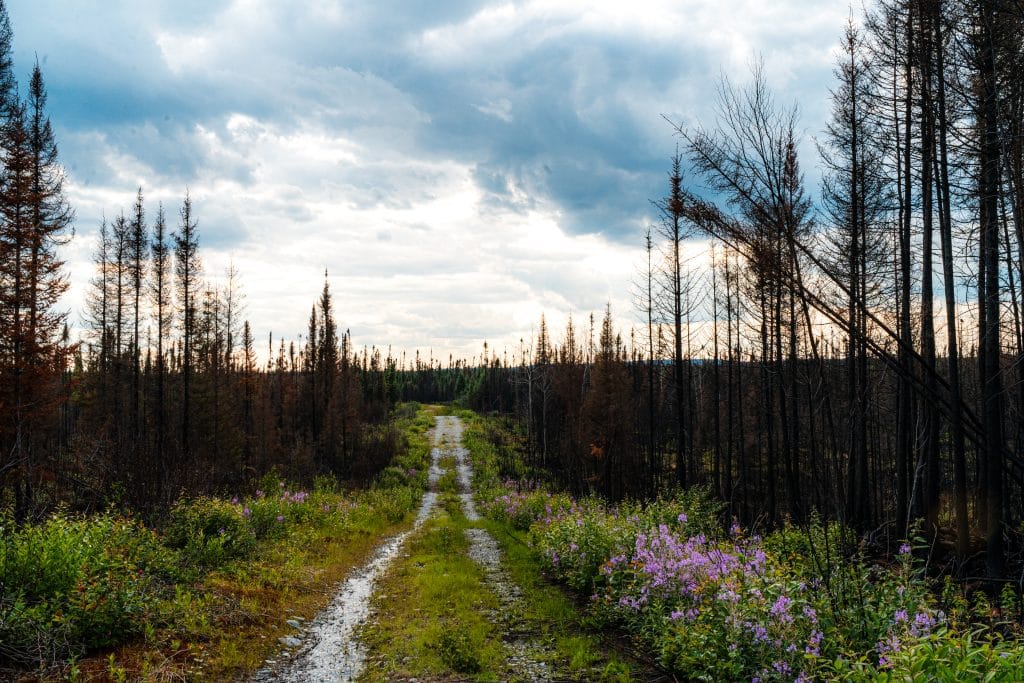
But some of the Crees who worked on the deal say it isn’t being respected. Moose herds that once fed entire communities have been dwindling as logging shrinks their habitat. Forestry also played a huge role in spreading the wildfires that have burned across Cree territory since the summer began.
Despite these threats to traditional Cree life, development will only intensify. Three years ago, Quebec and the Cree Nation Government signed a $4.7 billion deal to expand railways north and increase mining exploration on the territory.
In Waswanipi, about an hour’s drive east of Chapais, there are so many proposed mining projects that Chief Irene Neeposh says she’s lost count. Canada’s goal of reaching net zero greenhouse gas emissions by 2050 sparked a boom in the price of metals used to manufacture electric car batteries and solar panels.
“There’s just too many projects,” said Neeposh. “The biggest right now is lithium. We have a global climate target to reach if we’re going solar. It doesn’t come for free, they’re going to need a lot of lithium. I’m predicting it’ll increase, it’s really really going to go up if Canada is going to meet its (climate targets).
“Gold mining will remain, hydroelectricity too and of course forestry. They’re like mosquitoes, they just don’t stop.”
Last month, The Rover travelled to Eeyou Istchee in hopes of understanding the impact of development on Cree society. What we witnessed was a thriving community despite a rapidly changing climate and unrelenting pressure from heavy industry.
But how much more can the land and its people take?
***
Somewhere on the 120-kilometre road that links Waswanipi to Chapais, there’s a view that nearly stops tourists in their tracks.
From a hill that towers over the forest, the trees and lakes seem to go on until the edge of the earth. You can wander through this expanse for days without coming across another human being.
This place is home to dozens of traplines — vast swaths of water and land safeguarded by the families of Waswanipi. It’s in these traplines that children learn to hunt, fish and gather medicines. Even with the arrival of paved roads and processed foods from the south, they continue to provide the bulk of a Cree diet: moose in the fall, rabbit in the winter, goose in the spring, and whitefish in the summer.
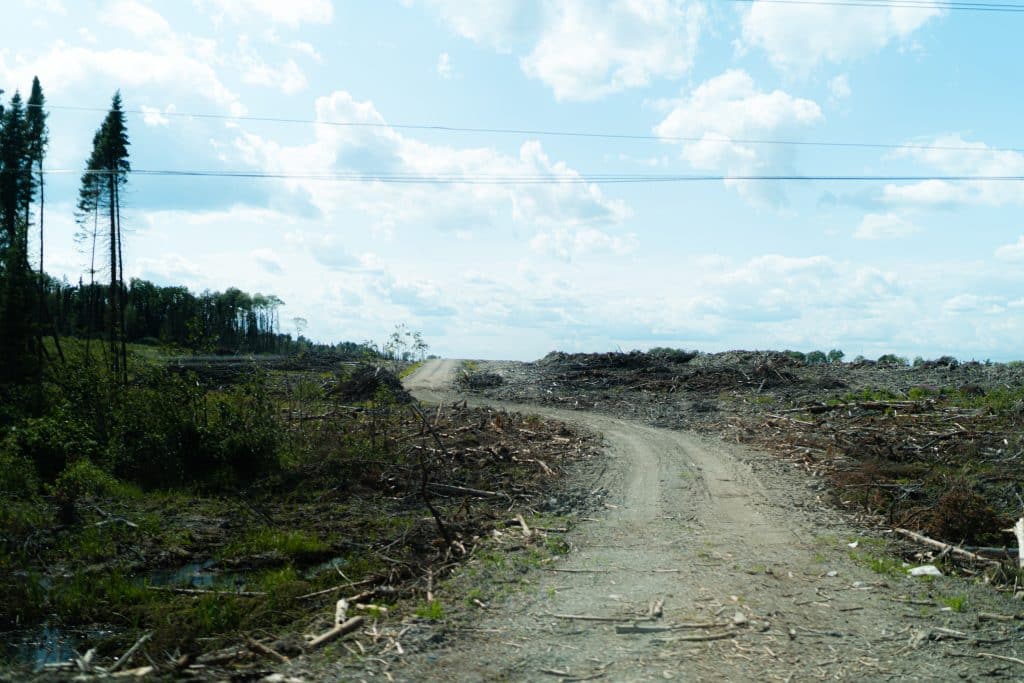
At the height of the logging, in the 1990s, some traplines lost more than half of their forests to clear cutting.
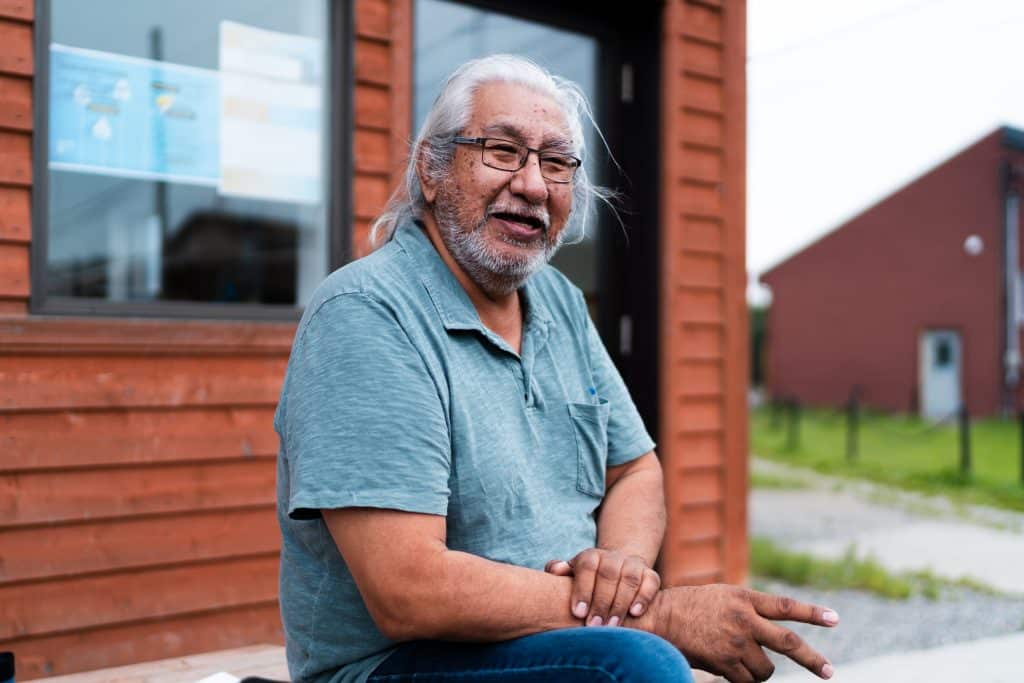
“If we lose these traplines, if we lose this connection to the land, can we still call ourselves Cree?” said Paul Dixon, whose family trapline was bisected by a nickel mine outside Chapais in the 1950s. “We are a hunting society and if you take that away, you’re taking away a practice that’s guided us for thousands of years.”
It was this threat to their way of life that led the Cree to push for a new treaty, La Paix des Braves.
The Paix came about after the Crees sued Quebec for its repeated failure to enforce environmental protections guaranteed in the 1976 James Bay and Northern Quebec Agreement (JBNQA). The JBNQA was supposed to give Cree, Inuit and Naskapi the right to curtail development on their traditional territory.
But the ink on the contract was barely dry before Cree noticed it wasn’t being respected.
“I started getting complaints in 1980, when the logging companies just came, clear cut hectares of forests, built access roads and left. There was no consultation process,” said Allan Saganash, a Cree trapper who was a technical consultant during negotiations for La Paix des Braves.
“By the 1980s, the logging companies started using these big machines. They were cutting something like one trapline a year. They just cut and cut and cut, (250 million square meters) a year. It was only a matter of time before we lost everything.”
No longer able to sit idly by while industry destroyed their land, the Crees outmaneuvered Quebec in court, gathering a bounty of evidence to bolster their claim.
It took nearly six years of negotiating, but the Grand Council of the Crees and Quebec settled on La Paix des Braves, an agreement that’s been hailed by the province as the gold standard of Crown-Indigenous treaties. The deal cut commercial logging by 50 per cent in Eeyou Istchee.
But over 20 years after it was signed, the very people who authored the treaty say it’s failing to live up to its promise.
“Forestry and the Cree way of life on the land are clearly irreconcilable,” said Romeo Saganash, the lead negotiator of the Paix and the Member of Parliament who represented Eeyou Istchee from 2011 to 2019. “I hope Quebec and the forestry companies remember what I said at the outset of the negotiations; that if one were to apply the JBNQA to the letter, forestry would not be viable in Cree territory. Full stop.”
Between 2009 and 2021, a 35 per cent decline in the region’s moose population forced local trappers to cap its annual harvest at 104 last year — well below the limits set in the JBNQA. Cree hunters say clear cuts and access roads have made it too easy for wolves to hunt moose through deep snow in the winter, making it nearly impossible for the herd to repopulate.
The decline in moose coincided with a construction boom that saw the value of lumber more than double during the COVID-19 pandemic. That’s when lumber farmers in Chapais and other logging towns mowed down millions of square meters of boreal forest to make way for their crops.
After tearing up all that soil, the loggers replaced Indigenous flora with dry, highly flammable pine trees to harvest timber and ship it south.
“Those roots they’re tearing up to plant their pines, those have been there for thousands of years,” said Dixon, a conservationist and lifelong trapper. “That’s the scientific knowledge our elders handed down to us.
“The aspen and poplar trees, the ones that keep our forests cool and the soil wet in the summer, they grow from the roots. When you tear that up, you’re making a fragile ecosystem even more fragile.”
That isn’t to say that the Crees aren’t against all forestry. There are two Cree-owned lumber companies with rights to harvest 350,000 cubic meters of lumber each year. And the revenue from logging helps generate wealth in communities that have traditionally been excluded from resource extraction on their lands.
If there were ever any questions about where the provincial government’s loyalty lies, the Coalition Avenir Québec appointed a former forestry lobbyist to the ministry that oversees the protection of wildlife and forests after taking power in 2018. The minister, Pierre Dufour, was moved off the portfolio last year but he remains an influential force in regional politics.
The Rover contacted three forestry companies that operate in Eeyou Istchee and only heard back from one, directing any journalist’s questions to their lawyer.
Trappers like Dixon say that the Cree Nation Government should consider forcing Quebec to impose a moratorium on forestry in their homeland. It isn’t that the volume of wood harvested has ramped up so much as the way the wood is being harvested — fields and fields of one species of pine drying up the land as summer temperatures rise to new records every year.
“Stop planting jack pine,” Neeposh said. “That’s all they’re re-planting. It’s not what we had before, they’re not replanting what they took. The practice isn’t sustainable. They’re growing it because it grows fast, for selfish reasons.”
Even now, after fire destroyed swaths of Cree territory, logging companies are given priority access to the burnt forests so they can continue the harvest. Many of the Crees, meanwhile, still don’t have access to the traplines that have been destroyed or damaged by wildfires.
Asked if she would consider a lawsuit to force a moratorium on logging, Chief Irene Neeposh of Waswanipi said she’s “open to it.”
“I’m just one chief, that’s just my view,” said Neeposh. “It will be the community’s decision. One of the things I hear from the community is the need to coexist. We do have an impact on (the forestry) industry. That impacts families and (settler) communities as well. Coexisting is a part of sustainability as well. But yes, to answer your question, I would be open to entertaining that idea.”
***
Allan Saganash was a late bloomer by Cree standards.
Though he’s among the last generation of Cree born on the land instead of a hospital, Saganash also saw his youth cut short by residential school.
He remembers some of those early years sleeping in moose hide tents or cabins on the traplines, fetching water from the lake and living through sub-arctic winters without electricity.
“We adapted to the land and the seasons because that’s what we’ve always done,” said Saganash. “We rely on the knowledge our ancestors passed down to us and we want our children and grandchildren and great grandchildren to keep passing that down.”
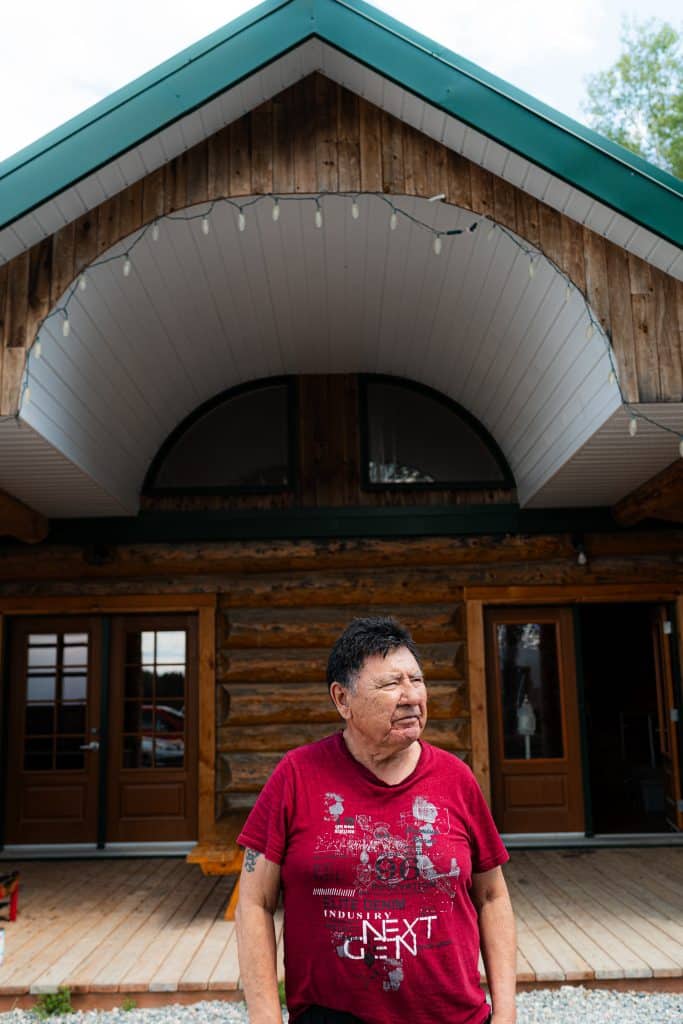
When he returned home after high school, his father Allan Sr. took him back onto the land for an entire summer. He hadn’t lost all of his Cree language but the only way to truly master it was working the traplines with his dad.
“We would be out on the land for months at a time, learning the things I should have learned as a child,” Saganash said. “In the winter, the older guys would tell me it was my job to clear the trail in my snowshoes. I don’t know if that’s really how it worked or if they just wanted me to do the hard work but I loved it.”
Saganash has lived through the biggest transformation of his territory since the arrival of European settlers hundreds of years ago. Communities that once moved with the seasons are now permanent fixtures across Eeyou Istchee, with some lost to the flooding that built dams across Cree territory.
In Waswanipi, the major driver of change was forestry.
“The one thing the logging companies have respected is they agree to stop cutting in some areas for one month during hunting season. To me, that’s not respecting the Cree way of life.
“There’s protocols in the Paix des Braves where they have to leave a buffer zone of up to 200 meters of trees between their job sites and the rivers. That 200 meters gives wildlife a chance to survive, but we’re seeing areas where it’s maybe a 20-meter buffer zone. That’s not nearly enough.
Allan Saganash
Some of these areas we’re trying to protect, they were places of ceremony, places where youths had their first kills, places of gathering. When we submit this to the forestry companies, we heard them say, ‘Woah, you want us to protect all that?’”
“Some of these areas we’re trying to protect, they were places of ceremony, places where youths had their first kills, places of gathering. When we submit this to the forestry companies, we heard them say, ‘Woah, you want us to protect all that?’”
There are conflict resolution protocols codified in the treaty but ultimately, it’s Quebec’s forestry minister that has the final say.
“How is that a nation-to-nation partnership?” Saganash said.
Last year, when the Cree were presented with a five-year development plan from Quebec and the logging industry, 96 per cent of the trappers rejected it. The document didn’t include environmental provisions the Crees had asked for so they compromised and approved a one-year plan.
The Crees have taken jobs in the logging industry to support their families but it’s becoming harder and harder to ignore the existential threat forestry poses to their culture and the land that sustains it.
“I used to be a lumberjack, my father too. And there was a time where you had hundreds of Crees working in forestry,” said Dixon. “Back then, we cut the trees with chainsaws or by hand and we had horses drag the trees out the hard way. But when they brought in the machines, we were basically all out of a job. It became a 24/7 operation, cutting the trees and ripping the earth. The land can’t sustain that.
“Does Quebec respect the Paix des Braves? No, of course not. It might be good for a few jobs and some money but it’s just not compatible with our way of life. For a hunting society that lives off the land, it’s like riding a dead horse. It doesn’t work.”
Author

Related Articles

Montreal Police Pressured Community Leaders not to Attend Vigil for Abisay Cruz
Sources say that while police spoke of listening to community after the killing of Cruz, they took a much harsher line behind the scenes.

Le refus de l’asile à Ranjit Singh
Militant pour le mouvement indépendantiste sikh de l’État du Pendjab, au nord de l’Inde, Ranjit Singh fuit les persécutions policières pour trouver refuge au Canada en 2019. Il y a deux semaines, sa demande d’asile est rejetée et sa déportation prévue le vendredi 6 mars 2026.

The Refusal of Asylum to Ranjit Singh
An activist for the Sikh independence movement in the state of Punjab, Ranjit Singh fled police persecution to seek refuge in Canada in 2019. Two weeks ago, his asylum application was rejected, his deportation scheduled for March 6.
Comments (0)
There are no comments on this article.