
Ottawa Imposes Hard Deadline for Mohawks to Resolve Political Crisis
Minister threatens third-party management of Kanesatake, setting the stage for a battle in federal court
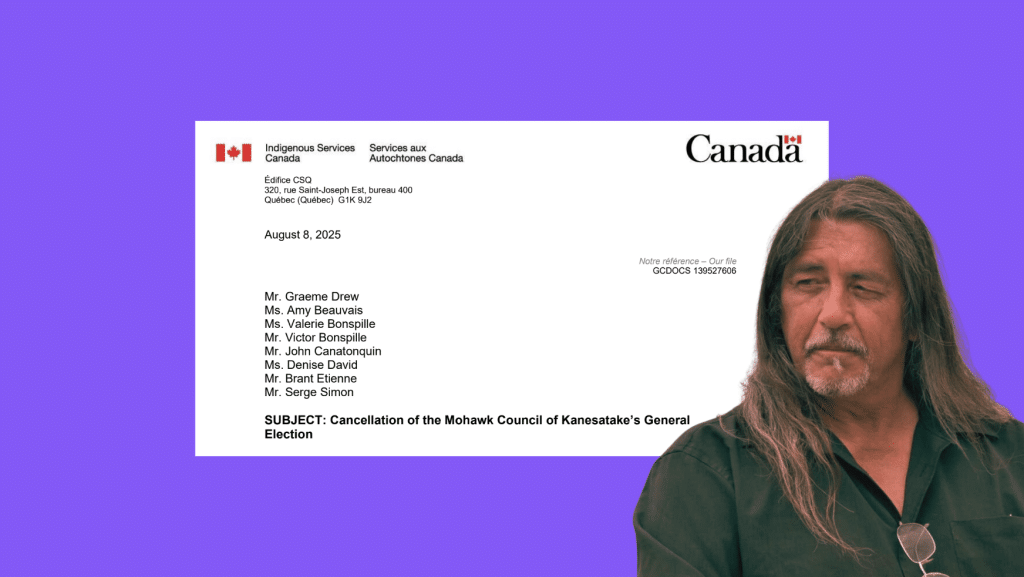
The federal government is giving the Kanesatake Mohawk Council until Wednesday at noon to resolve the political crisis triggered by the community’s cancelled Aug. 2 election.
If a majority of Kanesatake’s chiefs don’t sign a band council resolution extending their mandate before the deadline, Ottawa says it could impose third-party management of the Kanien’kehà:ka (Mohawk) community.
“In the absence of (a resolution), the department could consider that the council is in default of the Comprehensive Funding Agreement,” wrote Nathalie Turgeon, a regional director at Indigenous Services Canada, in a letter to council dated Aug. 8. “(The government) could take action, including appointing a third party funding agreement manager.
“This would be done to ensure delivery of essential services to community members.”
But this, one lawyer argues, is “clearly illegal.”
“If you follow the letter of the law, the entire council’s mandate expired on July 30, so who the hell do you want to sign the resolution?” said John T. Pepper, a lawyer who represented Kanesatake’s Mohawk council during the 1990 Oka Crisis. “They don’t know what the hell they’re talking about. Ottawa is asking the band council to create a backdated resolution, it’s absurd.”
Pepper is taking the matter to federal court on behalf of a community member who argues that the council’s mandate has expired and that the community needs to hire a new chief electoral officer to hold a new election as soon as possible.
In response to Ottawa’s deadline, community members met en masse Monday and Tuesday before signing a resolution to hire a new chief electoral officer and begin the process of a new election campaign. The document’s signatories are Gordie Oke — an elder who has been on council and is widely respected across all political factions in Kanesatake — and Karyn Murray, who launched a massive community garden last year to help with food security in the territory.
“One elder, one youth,” said Tracy Cross, Kanesatake’s former police chief and an advocate for political reform on the territory. “(This document) is for the ministers to chew on when they make their decision before noon (Wednesday) about whether to put us in temporary default or comply with the people’s will.”
Kanesatake’s Custom Electoral Code allows the council to extend its mandate by a maximum of six months under “extraordinary circumstances.” This clause was what Chief Electoral Officer Graeme Drew used to cancel the election and order the council to adopt a resolution extending its mandate.
But that clause also states that the council must first hold a public meeting and obtain the community’s approval, which hasn’t happened.
Drew called the election off just hours before polls were set to open on Aug. 2, citing “numerous” violations of the Kanesatake Custom Electoral Code. At the time, Drew told The Rover that if he had applied the code properly, it would have disqualified six out of 16 candidates from the ballot.
He also disputed The Rover’s characterization of the cancelled vote as a political crisis, arguing instead that the only solution is for the chiefs to extend their mandate and consult with the community to re-draft a code that’s workable. Though he and some of the candidates may have disagreed on how the legislation was interpreted, they all seem to agree that the electoral code, adopted in 2015, is in dire need of an overhaul.
Four candidates interviewed by The Rover, expressed disappointment in Drew’s decision, with most arguing he shouldn’t have taken the job if he knew the electoral code was unworkable.
Drew also disputes that point, referring to two band council elections he oversaw where the vote was cancelled and the chiefs’ mandates extended until they could draft better voting legislation. Since neither case was contested in court, Drew says this proves his way forward is the best.
Even so, the chiefs haven’t yet agreed on adopting Drew’s plan.
“No clear path has been agreed on yet,” said incumbent council chief Serge “Otsi” Simon. “I’m still talking with the other outgoing chiefs and (we’re aware of) Ottawa’s deadline.”
Politics and policies that work elsewhere are difficult to impose in Kanesatake, a community with a deep distrust of outside governance and the Indian Act band council system. For more than three centuries of interacting with outside governments, Kanesatake’s residents have seen 98.5 per cent of their land base stolen from under them as the rules of the game seemed to always change in favour of settlers.
In a letter sent Tuesday to the Ministers of Crown Indigenous Relations and Indigenous Services, Pepper’s appraisal of Ottawa’s performance on the Kanesatake file was blunt.
“Your inaction, as well as allowing (Regional Director) Turgeon to write such statements, could be setting the stage for a very unpleasant autumn.”
Author

Related Articles

Faced with a ‘Time Bomb Budget,’ the STM Turns to Real Estate for Revenue
Montreal’s transit body wants more money for crumbling infrastructure, continues negotiations with maintenance workers.

Guilty Until Proven Innocent: A Man’s 12-year Battle with Revenu Québec
Quebec’s tax agency freezes retirement savings, seizes assets and “ruins lives” with investigations based on mere assumptions.

School Board Votes to Support Candidate who Smeared Rival, Acted in ‘Undignified’ Manner
Julien Feldman gets off scot-free after falsely associating his rival candidate with antisemitism and referring to her as “Ms. Gaza.”
Comments (0)
There are no comments on this article.