
Police Raid Kanesatake Band Council in Corruption Probe
Local whistleblowers uncovered over $1 million in funds “not paid through the standard payroll system.”
Local whistleblowers uncovered over $1 million in funds “not paid through the standard payroll system.”

Investigators with the SQ’s financial crimes unit served two search warrants in Kanesatake Thursday. PHOTO: Chris Curtis
KANESATAKE — Detectives with the Sûreté du Québec dramatically ramped up their fraud investigation into the Mohawk Council of Kanesatake Thursday, executing search warrants on two band offices.
About a dozen officers carried boxes out of the band council office and the Kanesatake Health Centre (KHC) as SQ trucks stood guard at the three main roads leading into the Mohawk community. They’re searching for evidence of fraud and criminal breach of trust by a government official, according to sources who read the search warrant.
The police investigation began two years ago after whistleblowers in the community uncovered upwards of $1.2 million in misappropriated government funds. A forensic audit found that, over a 16-month period, one former chief paid themselves $469,000 using federal aid money meant to fight the spread of COVID-19. The audit, obtained by The Rover, describes “attempts at camouflaging” how emergency funds were spent and hundreds of thousands in salaries “not paid through the standard payroll system.”
“You had an elected official in a community of 1,500, making more than the highest-paid civil servant in Canada,” said Jeremy Tomlinson, a Kanesatake resident and former RCMP investigator. “Given my background, people in town — elders, language holders, people I respect — started asking me to look into this. So we rallied community members together and demanded accountability.
“What’s happening today is the result of dogged work from inside this community, from people who saw wrongdoing and chose not to look the other way.”
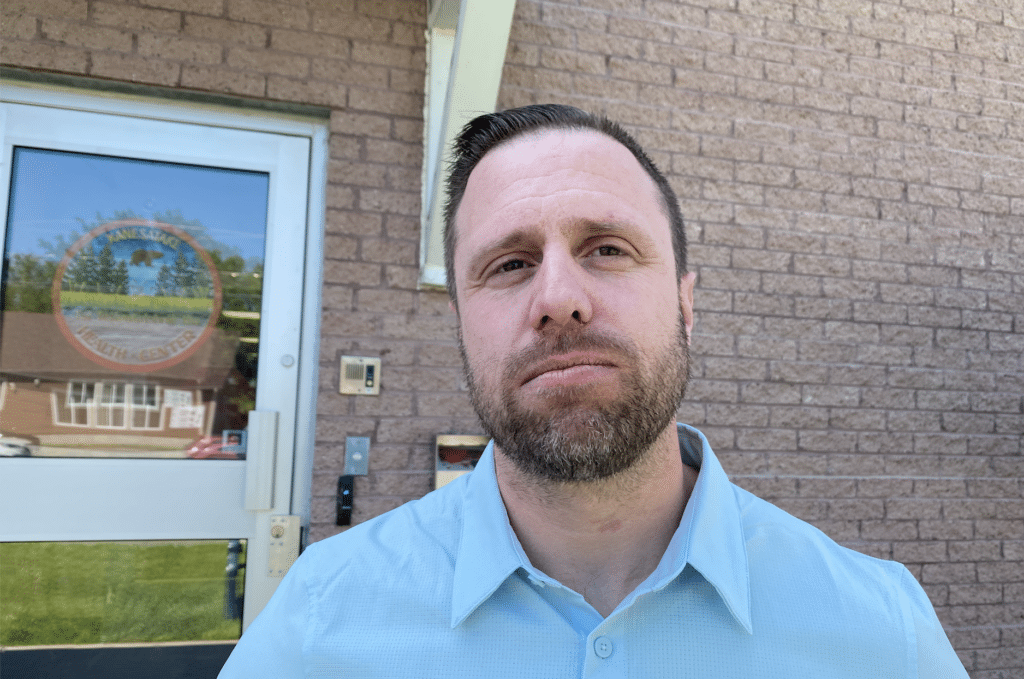
Kanesatake resident Jeremy Tomlinson was part of a group that pushed for an investigation into potential fraud at the band council. PHOTO: Chris Curtis
The two figures at the centre of the investigation are a former council chief and the former health centre director — both of whom were in charge of dispersing $3.89 million in COVID-19 funds. The chief acted as incident commander of the Emergency Response Unit (ERU), a task force charged with containing the spread of coronavirus.
Serge Simon, who was grand chief as these alleged crimes occurred, has not been named as a target of the probe and denies any wrongdoing. None of the allegations have been tested in court and no one has been charged with a criminal offence.
Support Independent Journalism: Subscribe to The Rover
Created in 2020, the ERU appears to have moved over $1 million in emergency funds via e-transfers and petty cash vouchers without the approval of council. In addition to her $469,000 salary as incident commander of the ERU, the council chief collected $129,000 in salary from her job on council. She worked under the supervision of the health centre director, who signed off on the pay and six-figure bonuses.
Trouble at the ERU began in the spring of 2020, when Tomlinson and six other band members wrote to council, demanding to see financial records related to the use of emergency funds. After their request went unanswered for eight weeks, they held a meeting in the band council parking lot, bringing together 100 community members for an unofficial vote of no confidence against Grand Chief Simon.
Though council continued stonewalling, Simon lost his re-election bid the following year during an election that brought sweeping reform to Kanesatake. The new council disbanded the ERU, fired the health centre director and ordered a forensic audit of the KHC’s finances. Tomlinson took over as head of the health centre and says he’s made it his mission to install checks and balances on how public funds are spent.
“There’s a lot of work to be done to restore trust in our public institutions but that’s what we’re working on,” Tomlinson said. “Before, the director of the health centre had an enormous amount of power and little oversight. Now, if they’re going to spend money, they need the appropriate department heads to sign off and, if anything looks fishy.
“We’re decentralizing power and giving more of it back to the community. When I arrived here, there was a culture of fear within the employees. We focus a lot on employee wellness, on transparency, on supporting people who have questions or criticisms about how things are done. It’s exhausting work but this is our community and we’re going to fight for it.”
Given its violent history with Kanesatake, the SQ’s authority is not generally accepted on the Mohawk territory. The provincial police hasn’t raided any of the cannabis dispensaries in Kanesatake for fear of re-igniting tensions and they keep a minimal presence on the rez. But officers encountered no resistance when they served warrants Thursday.
“At some point, there needs to be consequences for abusing your authority,” said one of the whistleblowers, who did not want their name published. “Most of us are traditionalists, we look at the band council as merely an extension of a foreign government. But that doesn’t mean we’re going to sit back and accept people misusing funds while so many in the community could use that help. A lot of this money was meant to go to small businesses struggling during the pandemic. This isn’t a victimless crime.”
Tomlinson says that reaction to the SQ investigation has played out along partisan lines. Those who support it are largely supporters of Grand Chief Victor Bonspille while its opponents are backers of former Grand Chief Simon. There’s also a large faction of traditionalists who still abide by the matrilineal form of government used by Mohawks for centuries.
While those three camps may differ widely on politics, each seems to agree the system isn’t working for Kanesatake. After losing the election in 2021, Simon ran for a council seat and won in a by-election last year but the results were contested in court by Grand Chief Bonspille’s sister Valerie. Ultimately, a federal judge ruled that Simon can sit on council but tensions remain high.
“There’s gridlock and dysfunction and it’s not helping anyone,” said Tomlinson. “But I think the more we put safeguards in place, the more we put our focus back on providing services to our community, that’s how we restore trust. At the health centre, we’re sponsoring community members who want to learn the Mohawk language and teach it, we have partnerships with McGill University, we’re building the foundation of something that can’t be undone by one bad actor.
“Yes, our politics are still incredibly messy and I sometimes wonder how much they can be changed from the inside. But we are creating the mechanisms for better government and our future is bright.”
Author

Related Articles

« Je veux juste qu’on me croie »
Victime d’une agression sexuelle alors qu’elle travaillait pour le gouvernement provincial, une femme lutte avec Québec depuis cinq ans.
Hundreds of Migrant Workers Compensated After Fraudulent Recruitment Scheme
The multinational Newrest and the Montreal agency Trésor must pay $2.1 million to migrants tricked into working without authorization under the false promise of obtaining a valid work permit in Canada.

Bill 94 Put Their Teaching Degrees on Hold
Two Muslim women who wear the hijab discuss the moment they learned they could no longer complete their education degrees in Quebec.
Comments (0)
There are no comments on this article.