
Reforest, Revitalize, Reclaim: Kahnawà:ke Plants a Food Forest
Community members in Kahnawà:ke join forces to bring new life to Tekakwitha Island by planting a food forest.
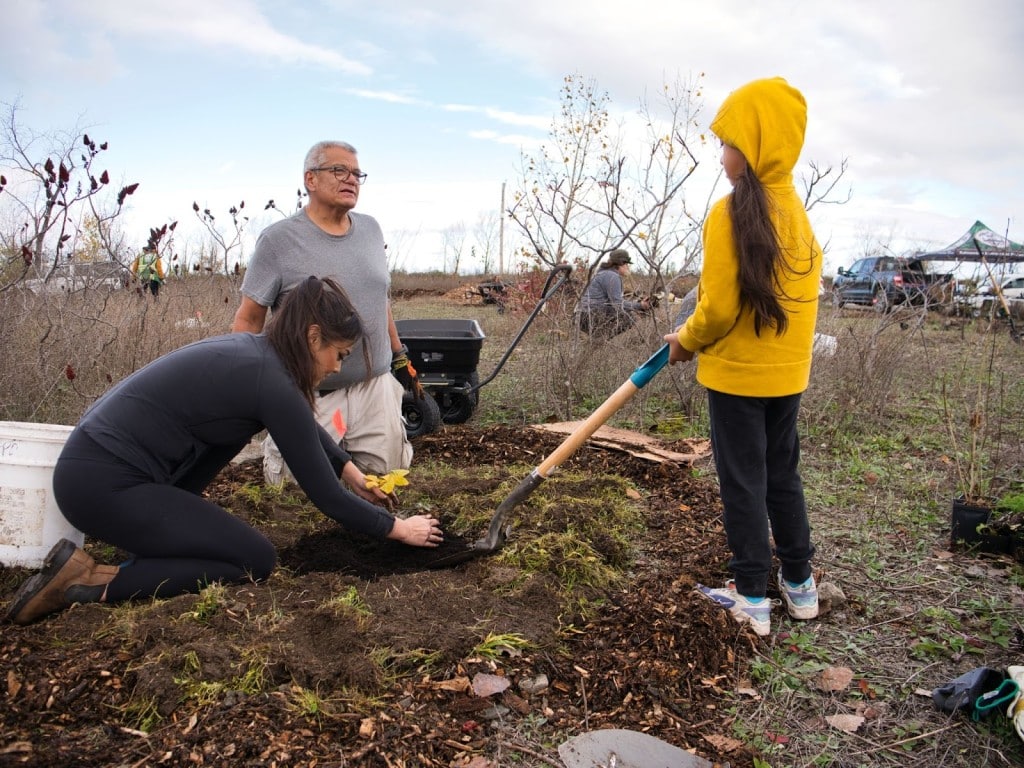
Sage Karahkwinetha Goodleaf, her niece, and Douglas Lahache plant together on Tekakwitha Island. PHOTO: Marieke Glorieux-Stryckman
Wind blows through Tekakwitha Island on a late October day, seeping into the bones of anyone who decides to stand still for even a moment.
A dozen volunteers bustle around this island at the northern shore of Kahnawà:ke, working together to renew its land after decades of damage.
Carrying plants and shovels, pushing around wheelbarrows full of compost and wood chips, they crouch down in the hostile soil and they start transforming it into Kahnawà:ke’s new food forest.
Their hope is that, in the next few years, the forest will bring new life to Tekakwitha Island and bring native plants and food back to Kahnawà:ke residents.
“If you could see it maybe 40 years ago, 50 years ago, it [Tekakwitha Island] was just a pile of rocks. Gray rock, nothing. It was just like a desert, a rock island,” said Michael Delisle, a community member who volunteered at the planting.
Tekakwitha Island was created during the construction of the St. Lawrence Seaway in the 1950s, when the shipping corridor was carved out of Kahnawà:ke’s shoreline.

Julie Teio’keráthe Delisle and her mother plant a tree at the edge of the food forest. PHOTO: Marieke Glorieux-Stryckman
The clay and shale at the bottom of the river were heaped onto five existing islands, destroying the existing ecosystem and creating a rocky terrain hostile to plants and animals. It also cut the community off from the St. Lawrence river, an important source of food.
Recent restoration projects have made the island more appealing to the residents. It is now a popular place for a hike or bike ride, and it hosts Kahnawà:ke’s yearly Powwow.
Douglas Lahache, another volunteer at the planting, was hopeful that the food forest could help renew Tekakwitha Island. “It’s a landfill site that was built from the seaway, and we should turn it into a paradise,” he said.
Harvesting knowledge
Throughout the summer, Marina Gosselin spoke with community members and knowledge keepers to form a plan for the food forest.
A food forest is a way of planting an orchard that imitates the ecosystem of a forest. It includes plants in several layers, including canopy, subcanopy, shrub, ground cover, and root layers.
“The idea is to make a space that community members can come and enjoy,” said Gosselin, environmental projects coordinator at the Kahnawà:ke Environment Protection Office (KEPO). “They can collect fruit or nuts or medicine.”
The project was born at the end of 2022 and is the latest in a series of projects led by KEPO to restore, or revitalize, Tekakwitha Island.
Support Independent Journalism.
“I don’t know if ‘restore’ is the right word because what is there to restore? The environment won’t be what it was before,” said Gosselin. “We can’t go back, but maybe give it new life or new use.”
This summer, KEPO completed the bay restoration project on Tekakwitha Island. This project took 15 years to complete and included studying the island and the bay to find ways to revitalize it. Now, the island once again welcomes native plants, birds, and turtles.
The food forest site is next to another KEPO project: a pollinator garden. In addition to beautifying the island and nourishing its ecosystem, the project is easy to hear during a summer walk on Tekakwitha Island, with the buzz of bees filling the air.
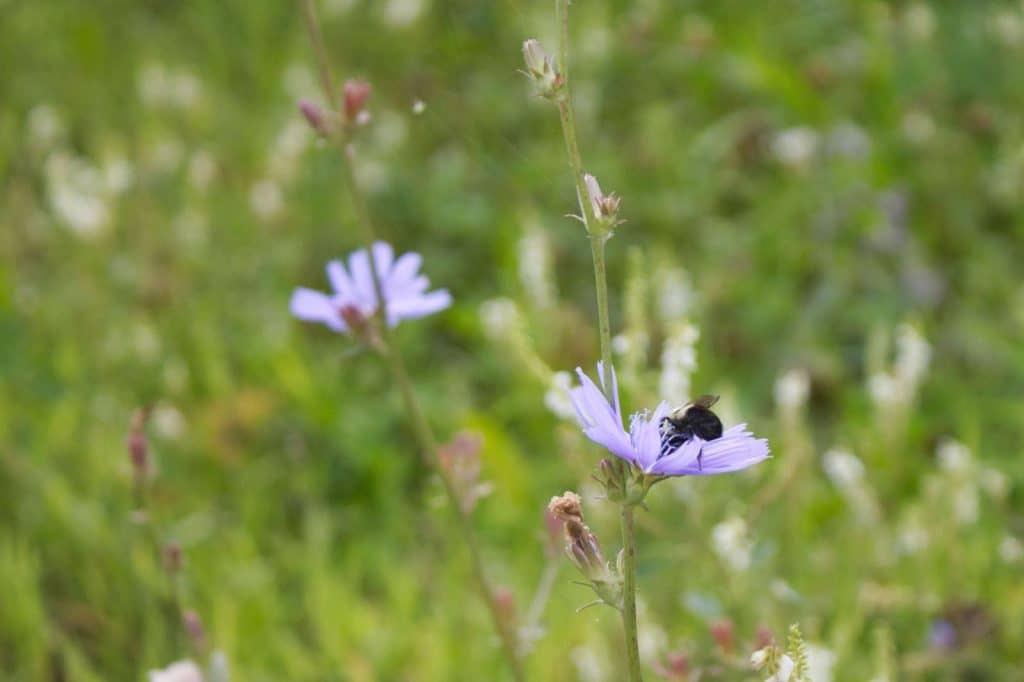
A bee visits the pollinator garden next to the food forest site. The pollinator garden was planted a few years ago and is part of the effort to revitalize Tekakwitha Island. PHOTO: Marieke Glorieux-Stryckman
This all ties into KEPO’s broader climate change plan, and Gosselin hopes the food forest will be used as a tool to teach community members about native plants in the area.
With the help of Julie Teio’keráthe Delisle, who works in education and outreach at KEPO, Gosselin sent out a survey and met with community members to work out what to include in the food forest, and how to ensure it meets the community’s needs.
“Everybody has so much knowledge already about our plants and our traditional medicines and traditional foods, and how to grow them, and what works and what doesn’t work for planting, based off what they’ve experienced,” said Delisle.
“It’s not just us bringing these things and being like: ‘Okay, this is how we’re doing it. This is what’s happening.’ It’s really a community effort
Gosselin remembers an interview where, instead of exploring the site of the future food forest, she and the interviewee went around the island, looking at and learning from the different plants that were already managing to grow there.
“The island has terrible soil, but things are still growing here,” said Gosselin.
That’s the biggest challenge for Gosselin and her team: soil quality. Since the island was created with material for the bottom of the St. Lawrence, its soil mirrors the river: the closer to the surface of the island, the further underwater the soil comes from.
Over the next few years, a lot of KEPO’s work will be to build up soil quality in the food forest by creating layers of organic material and waiting for it to decompose.

Marina Gosselin observes the overgrown field that will soon become a food forest. Gosselin is the environmental projects coordinator at the Kahnawà:ke Environment Protection Office. PHOTO: Marieke Glorieux-Stryckman
“Every time we’ve participated in a community event, and we’ve presented the project, people have been really excited about it,” said Gosselin. “A lot of people have been like: “Oh, you’re planting on the island? Good luck!”
“I’m just hoping no one expects it to look like a beautiful forest in the first couple of years, because it won’t,” Gosselin said. “That’s the thing with this sort of project, especially tree planting. You’re not really doing it for yourself. You’re doing it for future generations.”
Learning on the land
Despite the relentless rain, a few people came out to Tekakwitha Island on Oct. 21 for a permaculture workshop in preparation for the food forest planting.
Taking care not to step on any of the snails out enjoying the weather, Graham Calder, founder of P3 Permaculture, helped plant the first tree in the food forest.
He laid out the plan to deal with poor soil quality: the lasagna garden technique. That involves creating different layers of organic material like cardboard, compost, good-quality soil, and woodchips, which will eventually decompose and create a more nutritious environment for the plants.
“It’s kind of like mimicking what would happen on a forest floor,” explained Gosselin.
Calder teaches permaculture workshops around the world and offers consultations for people trying to greenify their space. Through his work, he wants to reconnect people with the land they live on.

Graham Calder explains the lasagna garden technique. This technique will help improve the soil quality of the food forest. PHOTO: Marieke Glorieux-Stryckman
“The connection to the land and to the cycles of nature and the flows of energy and the connection to people and places and things has really fallen away,” he said. “For me, permaculture kind of empowered me with the ability and even just the knowledge that we actually can have an incredibly positive impact.”
Calder said that permaculture parallels the way Indigenous peoples in Canada have always interacted with the land and the food it provides, as they are based on observation of the resources that are already available in nature.
Gail Taylor, a community member who attended the workshop and volunteered at the planting, remembered playing on Tekakwitha Island as a child.
“Our family, we used to fish off the side. You know, when bullhead season was there, people would come and they’d have big giant fires and fish for bullhead,” she recalled.
Growing food has always been part of Taylor’s and her family’s life, though their access to land was restricted over the years. “My grandparents were farmers. My great-grandparents were farmers. That’s what we did. And my mom, having moved into the village proper area, we didn’t have a lot of land base. So we had a garden. Every year my mother made sure we had a garden to subsidize our food.”
“We’re trying to bring back and ensure that we continue growing our traditional corn, beans, squash gardens and anything else that we would have grown, like strawberries and any of our medicinal plants,” said Holly McComber, the general manager of the Waste Management Department of Kahnawà:ke and former KEPO employee.
“This food forest will be a combination of food sovereignty and security.”
Planting the seeds
On Oct. 28, the day of planting, Gosselin chose to plant only the hardiest plants to make sure they would survive, including apple, plum and walnut trees.
“There’s about 12 trees to plant today, but then there’s 600 support species, which includes shrubs, flowers, medicinal plants,” she explained. “So yeah, it’s quite a big mix.”
Gail Taylor and her husband, Douglas Lahache were hard at work in the food forest on planting day.
“I can’t wait for the next five to 10 years, to come on out here and actually maybe even have some of the fruits that we planted today,” said Lahache.
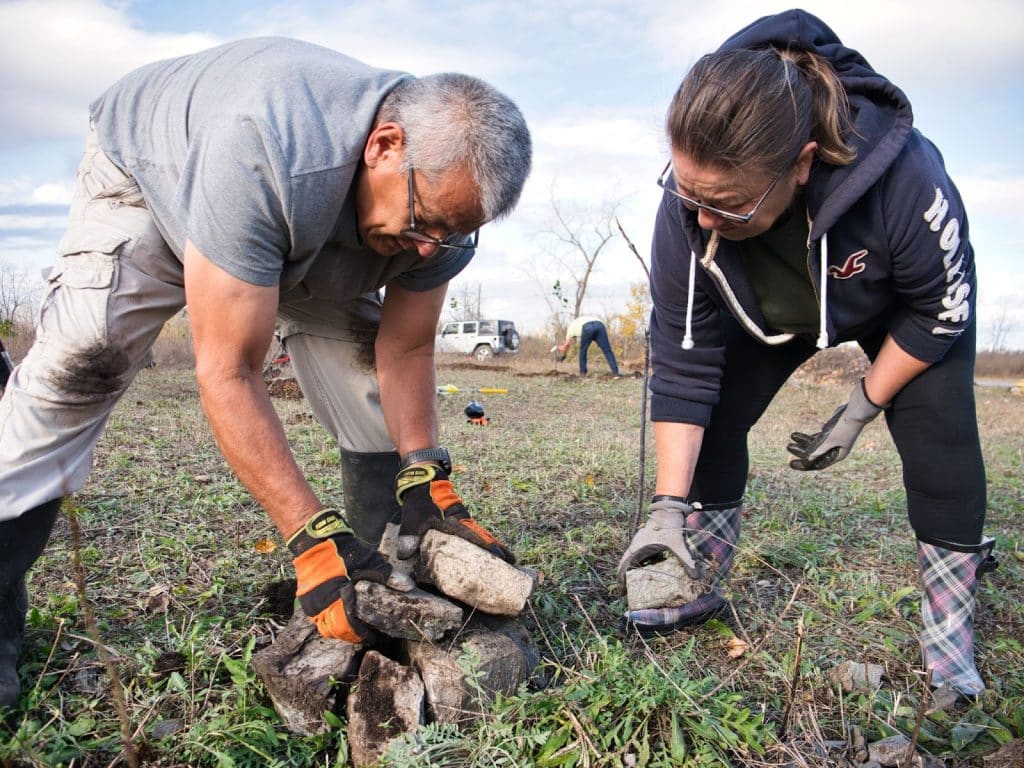
Douglas Lahache and Gail Taylor pile up rocks to make a snake shelter. Snakes will act as pest control in the food forest ecosystem. PHOTO: Marieke Glorieux-Stryckman
“And the medicines too,” added Taylor. She was happy to see the change that the new trees and other KEPO projects have brought to the island.
“It was an eyesore when I was growing up, but I didn’t see that then,” she said. “But now that they’re working on it in phases and slowly, it’s slowly starting to look like it’s a place to be.”
Lahache shared his efforts to support food sovereignty in the community and bring back native plants and foods. “I sought after and I was able to find our original corn that we grew in the community, and it hasn’t been here for maybe 50 years,” he said. “I found some and I planted it. So now, I’m developing a small seed bank. I gave it to other people who are interested in doing the same thing.”
Next to Taylor and Lahache, Sage Karahkwinetha Goodleaf and her niece planted their own tree and companion plants like mint, boneset and strawberries.
“There’s a lot that we don’t know if we can actually eat. Especially with the fish, too, in the St. Lawrence, everything is just all polluted. It’ll be good to know that we have a designated area that’s being watched by KEPO and that we can consume from.”
As the morning came to a close, the volunteers helped Gosselin and Delisle pack the planting equipment back into the KEPO truck. In the spring, Gosselin will check on the soil quality and, she hopes, start planning to add more fruit trees and plants to the forest.
An ecosystem grows into its inhabitants: if people love a fruit or a nut, they will plant it and cherish its trees to ensure it lives on. On Tekakwitha Island, a piece of land that was a simple overgrown field a few months ago has been transformed into a fledgling food forest through the care of the people who will visit it.
Author

Related Articles
Le refus de l’asile à Ranjit Singh
Militant pour le mouvement indépendantiste sikh de l’État du Pendjab, au nord de l’Inde, Ranjit Singh fuit les persécutions policières pour trouver refuge au Canada en 2019. Il y a deux semaines, sa demande d’asile est rejetée et sa déportation prévue le vendredi 6 mars 2026.
The Refusal of Asylum to Ranjit Singh
An activist for the Sikh independence movement in the state of Punjab, Ranjit Singh fled police persecution to seek refuge in Canada in 2019. Two weeks ago, his asylum application was rejected, his deportation scheduled for March 6.

Faced with a ‘Time Bomb Budget,’ the STM Turns to Real Estate for Revenue
Montreal’s transit body wants more money for crumbling infrastructure, continues negotiations with maintenance workers.
Comments (0)
There are no comments on this article.