
Runaways in youth centres: staff denounce a “broken system”
After the rise of the hashtag #SurvivantedeCentreJeunesse, some employees are speaking out about abuses in youth centres.
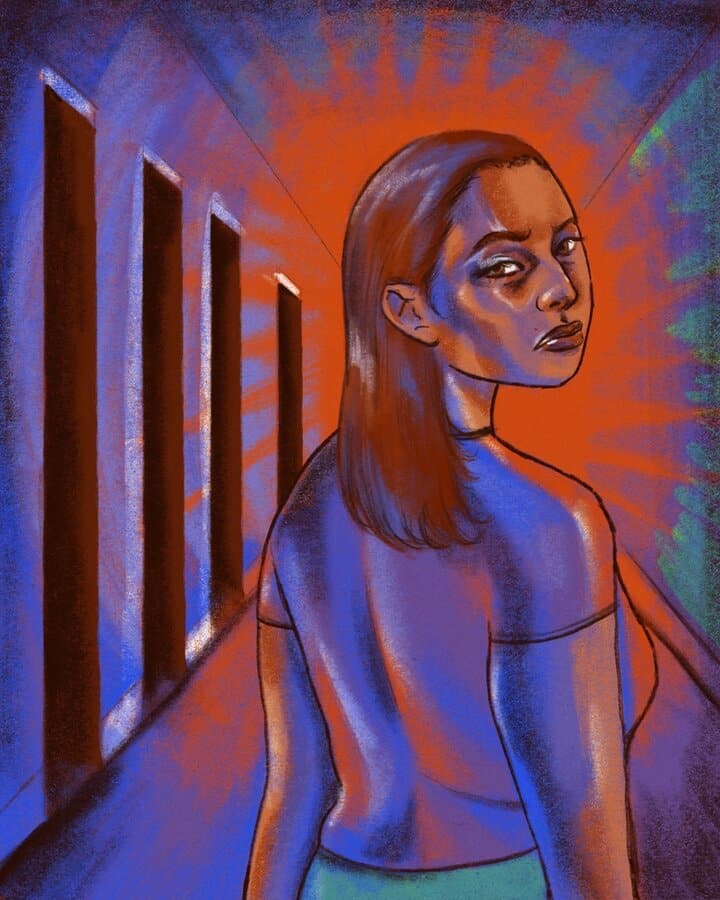
GRAPHIC: Sonia Ekiyor-Katimi
Editor’s Note: This is the second part of an investigation led by La Converse into the rise in runaways from the Centre jeunesse de Laval. Chris, editor-in-chief of The Rover, joined forces with La Converse’s journalists to help with conducting interviews and determining the structure of the investigation, and he wrote a portion of this second installment.
Find part 1 here.
We have to reiterate that this investigation was made possible by La Converse’s deep ties to the communities they serve. Please go check them out on their website and their Instagram, and if you can, please consider donating to allow them to continue their important work.
-Savannah
This article was translated from French by Savannah Stewart. Find the French original here.
Tired of being singled out, worn down by a system they consider to be failing, frustrated at not having the means to carry out their youth protection mission, a social worker, a youth centre teacher, and a Direction de la protection de la jeunesse (DPJ) employee are speaking out. After Shayna’s testimony and the rise of the hashtag #SurvivantedeCentreJeunesse, they in turn denounce the problems within these establishments, which the Director of youth protection, Lesley Hill, also acknowledges.
For almost a year, the Centre jeunesse de Laval has seen one runaway after another. According to the CISSS de Laval, 298 young people have run away in the last 10 months. This is the highest number since 2020. This increase can also be seen in the rest of Quebec. “There has been an even greater increase in runaways among girls than boys in recent years,” notes Lesley Hill, the National Director of the Direction de la protection jeunesse DPJ.
Neither the reports nor the Laurent Commission findings seem enough to stem the tide. While the reasons for running away are many, the living conditions in youth centres drive some to try to leave, as several young women who have passed through the Centre jeunesse de Laval told us in the first part of this investigation. They are not alone in speaking out. Despite the ban on communicating with the media, youth protection professionals are sharing their stories. Like the young people, they are calling for awareness and fast changes.
Youth centre: “It really is the last resort”
La Converse spoke to an employee of the DPJ who will be referred to as Florence to preserve her anonymity.
Like many online, she discovered Shayna through the video the young girl posted on TikTok on February 7. “It made me really sad, but I was really happy it was out there.” She salutes the teenager’s courage in speaking out on camera to denounce what she’s experiencing at the Centre jeunesse de Laval. “She has the right to express herself! I think young people need to talk about what they’re going through inside the system, and that a social worker who does their job well shouldn’t worry about it,” she adds.
Florence knows the “system” from the inside, as she is one of those employees who must manage the reports made to the DPJ and decide on the fate of these young people. She said that she always avoids placing young people in youth centres if she can.
In her opinion, some of the children placed in these facilities don’t belong there. These centres house teenagers who have committed crimes, children who are victims of parental neglect or physical or sexual abuse, and children who no longer have parents to care for them.
“If you’re placed in a centre at 15 because you’re being abused by your father and your mother doesn’t believe you, you need to be taken care of! Imagine the anger that creates, feeling alone at that moment, seeing caregivers who won’t help… You can’t feel like you’re there to be taken care of if your room looks like a prison cell!” laments Florence. According to the DPJ employee, the coercive culture of youth centres sends the wrong message to the young people placed there. “These young people get the idea that we want to punish them by putting them there and, honestly, I’m not going to argue with that — it looks like a big punishment!” confides Florence, exasperated.
That’s what happened to Laurie*, now 27. As a teenager, Laurie was placed in a youth centre after running away from home following the death of her mother. In her unit, she discovered almost prison-like rules. She was not allowed to speak with other young people without the presence of a social worker. “I had just lost my mother and I had no support for that, no follow-up, no care.”
She claims to have witnessed acts of mistreatment by employees at the centre.
Support Independent Journalism.
“I remember one girl who didn’t want to be taken to the isolation room. Then there were very loud cries of pain, and when I saw her come back several hours later, she had bruises on her arms,” asserts Laurie. Despite repeated requests for placement in another institution, Laurie remained in the youth centre for four long years. She left when she came of age. “I spent four years there, and nothing was done for me,” she said.
Neglected girls
Florence, for her part, doesn’t mince words when she talks about the lack of attention paid to residents of youth centres in Quebec: “Don’t we give a damn about young people? We really don’t! People don’t care!” she exclaims.
“Sexual exploitation is invisible, whereas a guy who shoots another guy in the street, we’re going to see it and hear about it! A dead body is concrete, but sexual exploitation takes place in silence…” she continues. “You have to understand that these are teenage girls in distress, and the perfect guy comes along and offers them everything they want… Some of them get on board. Sometimes they’re found; sometimes it’s a vicious circle: they run away again, and so on… Others flee to the other end of Canada, where they’re never found, and end up turning 18, making a living in drugs or becoming sex workers.”
With no role models or healthy emotional patterns in their environment, these young girls lack the guidance they need to build themselves up. “Most of them would like to become architects or lawyers, but everything around them is already too destroyed for them to develop enough self-confidence and self-esteem,” said Florence. “The system contributes to this, with caregivers changing all the time and your parents not being able to take care of you. So, you’re stuck there with young people who are always in crisis because you’re not able to calm yourself down, you fall into a kind of vicious circle, you go crazy…”
These girls need special supervision, but it’s not always available. “A junior social worker is just a free pass for them to run away, or to react harder because they feel misunderstood,” explains the DPJ worker. “There’s something extremely frustrating about talking about your situation with someone who looks at you with fish eyes. These young people need very experienced counsellors.”
Florence says that the problem with youth centres is systemic and starts with staff recruitment. First and foremost, the selection criteria are not high enough. “We need more extensive skills tests and interviews to ensure that we have employees who are capable of taking care of young people.”
With the shortage of skilled labour, the psychosocial support Florence wants to see is rarely a reality. “It’s not an environment where social workers have time for gentle intervention, even if the children need it,” she explains. “It’s a broken system.”
She told us about her difficult start at the DPJ, which required her to adapt quickly to the particular workings of this institution. “When I started working at the DPJ, I often had trouble with the things I heard, the things my colleagues said. They weren’t aware of their biases and what they were going to inflict on families because of their lack of education,” confides Florence.
She’s adamant that the system needs to change. “I’d like to see this shaken up and the government no longer have a choice but to act to require extensive skills testing and interviews to ensure we have employees capable of caring for young people.”
When asked what better youth centres might look like, Florence closes her eyes and describes a friendly gathering place: “It should be a big house, it shouldn’t look like a prison. It should be like a mansion, a living environment. Even if the [furniture] is fixed to the floor, there’s a way to make it beautiful, to personalize the place.”
Low wages, lack of resources, violence — unattractive jobs
One youth centre employee, whom we’ll call Hélène*, agreed to talk to us about her working conditions, despite fears of the repercussions on her career. At 14, Hélène was also placed in a youth centre. She remembers being put in isolation and confined to her room for several days at a time. Some of the consequences were more severe.
“I spent four months without being able to leave the building. It was a prison, and kids have no business there,” she says. According to her, things have changed since the days when she was under state guardianship. “But it also brought a form of structure to my life at a time when I needed it. I had a bad environment, I could have ended up in human trafficking if I hadn’t been placed in a centre.”
Hélène decided to return to the centre as an employee to better help the young people who end up there, but she believes that even the most dedicated teachers and social workers can’t do their job properly because the workload is so heavy.
“When you’re a social worker and you’re responsible for 200 cases instead of 60, you can never really be there for the children,” she explains.
In a context where the most urgent matters must always be dealt with, gentle intervention is not possible. “We stop seeing them as people, we focus on the need to deal with them as quickly as possible to move on to the next one,” she admits bitterly. “These young people need love and attention. But, in too many cases, they’re treated like numbers.”
Heavy workloads, low salaries, exposure to violence and the impossibility of carrying out their youth protection mission drive many youth centre workers to give up. Others give it a try before throwing in the towel, unable to cope with the daily grind. Such is the case of Marie*, who worked as a youth centre teacher for years before leaving the sector in 2015.
She says budget cuts and constant staff turnover put youth as well as the adults entrusted with their care in danger. When she was working at a Montreal-area youth centre in 2013, they cut security staff on her unit from three guards to two. The next day, she was punched in the face by one of the students.
Teachers being injured on the job meant more staff turnover and more uncertainty for the children.
“In a five-day week, there were times where, three of those days, the kids were being taught by a (substitute teacher),” Marie said. “They don’t know this person, they don’t trust them, we’re constantly throwing this uncertainty at them at a time when they’re desperate for stability.”
In her time at youth centres, she saw a noticeable drop in the food quality and an obsession with budget cutting that got so bad, the youth centre lowered the quality of plastic used in the students’ medicine droppers.
Though she hasn’t worked at a youth centre in a decade, Marie is still in touch with former colleagues who say things have only gotten worse.
“Our social safety net is crumbling,” she said. “Kids are being pushed to their limit. We take them out of their homes, put them in an area that’s poorly organized and borderline chaotic and it’s obvious to them their wellbeing isn’t a priority. They’re extremely perceptive.”
The new National Director of the DPJ admits there are systemic problems
Lesley Hill, National Director of the DPJ, who took up her post last fall, is well aware that she has inherited a network mired in difficulties. With a career in social work, having directed several rehabilitation centres and served on the Special Commission on Children’s Rights and Youth Protection, she knows the centre and its problems.
From the outset, Lesley Hill acknowledged the existence of “a lot of discourse and a lot of issues” linked to youth centres, as well as an increase in the number of runaway girls in recent years. The national director of the DPJ assures us that she intends to change things radically. “No young person should have to spend their adolescence in a rehabilitation centre. Just the word ‘rehabilitation’ means: it’s temporary, you go there, you’re ‘rehabilitated’ in quotation marks, and you leave,” she says.
The director points out that “control measures should be exceptional, not standard procedure.” The use of these measures is in fact regulated. Section 118.1 of the Youth Protection Act states that: “Force, isolation, any mechanical means or any chemical substance may be used as a measure to control a person in a facility maintained by an institution only to prevent him from inflicting injury on himself or others. The use of such a measure must be minimal and exceptional, and must take into account the person’s physical and mental state.”
Yet several testimonies describe solitary confinement for many hours — 12 hours in the case of our source Shayna — for reasons that have more to do with punishment than safety. “I’m absolutely opposed to this type of practice (…) One hour is the maximum desired, or tolerated, for a teenager (…) It’s unacceptable to me. If there are young girls out there who are still saying things like that, they need to lodge a complaint, or else I’ll ask my colleague, who’s already there in Laval, to meet them there,” Lesley Hill says.
“It’s not right. After a runaway, when a young person comes back to the centre, she should be welcomed properly: see if she’s cold, give her soup, something to eat, ask her why she ran away, what happened to her, etc. So, what’s clear is that it’s not an isolation room that it takes!”
According to the DPJ director, repression must be replaced by prevention and reparation in youth centres. “I think people are so busy trying to manage risk that they sometimes fall into methods that are really too controlling. They’re stuck with this risk management. But I’d rather see less risk management, even if it means more runaways, and more feedback from the young people,” explains the woman who believes that this approach, while provoking fears in some parents, would enable better long-term support.
An institution paralyzed
Since the wave of runaways in 2016, little seems to have changed, if multiple testimonials from young people and professionals are to be believed.
Speaking of the Centre jeunesse de Laval, Lesley Hill assures us that things will change. It’s just a question of when. “I think Laval’s leadership knows that things have to change. They’re in action and they’re moving for real. But you don’t bring about a cultural change by shouting ‘scissors.’ Culture change doesn’t happen quickly,” says Hill.
“I’m currently working at the Laval centre with a colleague (Editor’s note: in December, Manon St-Maurice was appointed as external accompanier-expert) to review the way Laval uses what are called control measures: isolation, restraints (…) In Laval, this prison environment, if I had a magic wand, I’d throw it all out, then I’d rebuild something else… Management has a rebuilding plan, and I think their vision is the right vision.” The project calls for the construction of small units, but is neither endorsed nor financed. It will therefore be many years before the Centre jeunesse de Laval sees these changes.
More generally, the director wants to make some major changes. In youth centres, young people are placed in units: so-called “open” units, where they have the most freedom; “closed” units, with stricter supervision; and “secure” units, also known as “high-dynamic” units, with total control over their actions. For 30 years, these units have been the subject of debate. The Laurent Commission repeatedly questioned their legality.
“I’m not saying I’m going to demolish or remove everything tomorrow, but children under the age of 12, eventually, I wouldn’t want to see any of them in rehabilitation centres at all,” says Hill. She hopes to create centres that are “much more open to the community”: “Yes, young people run the risk of running away, and they can screw up, but we have to be there to pick them up, support them and accompany them. I really want our network to get back to the core values of our professions, which are much more humanistic.”
In this respect, Hill acknowledges that staff recruitment is one of the areas in need of improvement. “Yes, the responders are young, and yes, there are cases that get out of hand. So, whenever there are cases that get out of hand, I expect us to take stock of the situation within the facility to understand, and to try to improve,” she says without elaborating.
While noting that many young people talk about the help provided by certain dedicated educators or counsellors, she admits that more background checks and more screening of candidates are needed before any hiring. But is the institution really ready for an in-depth change in its methods?
Abusers within the institution
Recruitment problems linked to staffing shortages, the unattractiveness of the social professions, and shortcomings in background checks can sometimes lead to dramatic situations. A number of cases of sexual assault and abuse have come to light in recent years.
On October 19, 2023, the Commission des droits de la personne et des droits de la jeunesse (Human rights and youth rights commission) opened an investigation following two reports of sexual abuse perpetrated in 2021 by a trainee specialized educator on adolescents housed at the Centre jeunesse de Laval. In January,, the Commission published its conclusions: “The Commission has reason to believe that the rights of the child (…) have been violated by the DPJ of the CISSS de Laval.”
After several months of investigation, the Commission considers that the DPJ failed in its duty “to prioritize the interests of children and ensure their protection.” It also criticizes the DPJ for an “incomplete and erroneous analysis of the sexual abuse situation,” a lack of diligence, non-compliance with certain processes, and a failure to meet its “obligation to communicate regularly with the child and provide him with adequate social follow-up.”
Several recommendations were made, starting with ongoing training on intervention in situations of sexual abuse, revising intervention practices, and creating evaluation tools.
This is not an isolated case. In 2019, Benoit Cardinal, who murdered his wife Jaël Cantin the following year, allegedly used his position as an educator to sexually assault nine teenage girls aged 13 to 17 at the Centre jeunesse de Laval. Six days before the murder, he had resigned from his position for “inappropriate behaviour.” These allegations were not presented at his trial for the murder of Jaël Cantin, the mother of his six children, for which he was sentenced on appeal to life imprisonment in 2021.
*Names of sources were changed to protect their identities.
Help us get the word out — share this article with a friend!
Authors



Related Articles
Guilty Until Proven Innocent: A Man’s 12-year Battle with Revenu Québec
Quebec’s tax agency freezes retirement savings, seizes assets and “ruins lives” with investigations based on mere assumptions.

School Board Votes to Support Candidate who Smeared Rival, Acted in ‘Undignified’ Manner
Julien Feldman gets off scot-free after falsely associating his rival candidate with antisemitism and referring to her as “Ms. Gaza.”

« Je veux juste qu’on me croie »
Victime d’une agression sexuelle alors qu’elle travaillait pour le gouvernement provincial, une femme lutte avec Québec depuis cinq ans.
Comments (0)
There are no comments on this article.