
Runaways: Sounding the alarm at the Centre jeunesse de Laval
At least three of the four young girls who went missing from the Montreal region in early February are placed at the Laval youth detention centre.
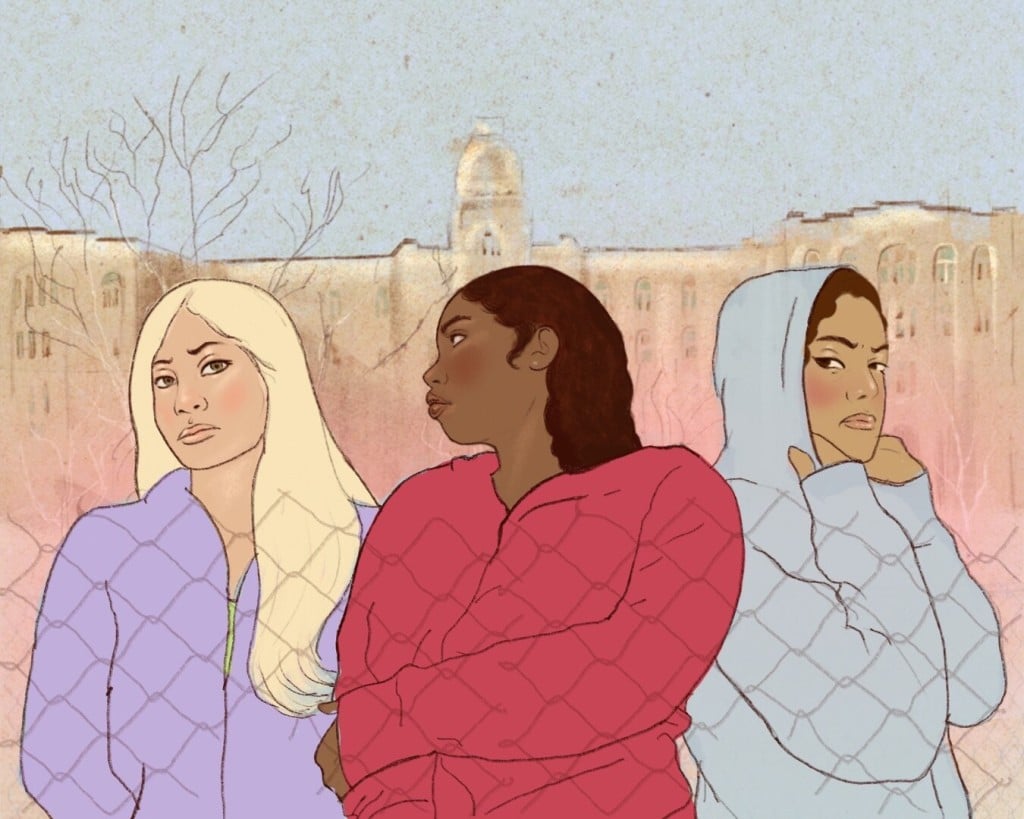
ILLUSTRATION : Sonia Ekiyor-Katimi
Editor’s Note: This is Part 1 of a two-part investigation led by La Converse following the wave of youth disappearances in the greater Montreal area last month. The Rover editor Christopher Curtis helped out with setting up and conducting interviews, talking out the structure of the investigation, and writing a portion of Part 2 which we’ll publish (in English) next week.
Both parts have already been published, in French, over at La Converse. Go check them out if you’re interested!
Finally, we have to highlight the fact that this investigation was made possible by La Converse’s deep ties to the communities they serve. They are doing the hard work of documenting the issues that impact the racialized communities in and around Montreal, and training the BIPOC journalists of tomorrow. We’re so happy they exist and proud to be able to collaborate with them. If you can, please consider donating to La Converse to help them continue to fulfill their vital mission.
-Savannah Stewart
This article was translated from French by Savannah Stewart. Find the French original here.
“We’re not running away from home, we’re running away from the centre” — Investigation into a system in crisis
In early February, the photos of seven missing teenagers circulated massively on social media in Quebec. Their similar age, height, and weight soon sparked speculation online, with some raising the possibility of a human trafficking network. A week later, all the young people were found.
By investigating these disappearances, La Converse was able to confirm that at least three of the four girls were placed at the Centre jeunesse de Laval (Laval youth centre), in the girls’ unit, Notre-Dame de Laval (NDL). It is also noted that at least one of the boys is in a youth centre. Since the start of the 2024-2025 period, which is still ongoing, the CISSS de Laval has already registered 298 runaways, compared to 231 for the whole of 2023-2024. Why do adolescent girls run away from this institution so often? What are they living through within its walls?
The sun beat down hard on the parking lot of the Centre jeunesse de Laval when La Converse stopped by.
Cars came and went. Opposite, there were a few shops and a neighbourhood post. The building is massive, cold, intimidating. When you’re in front of it, it’s hard to ignore the impression it gives: a prison.
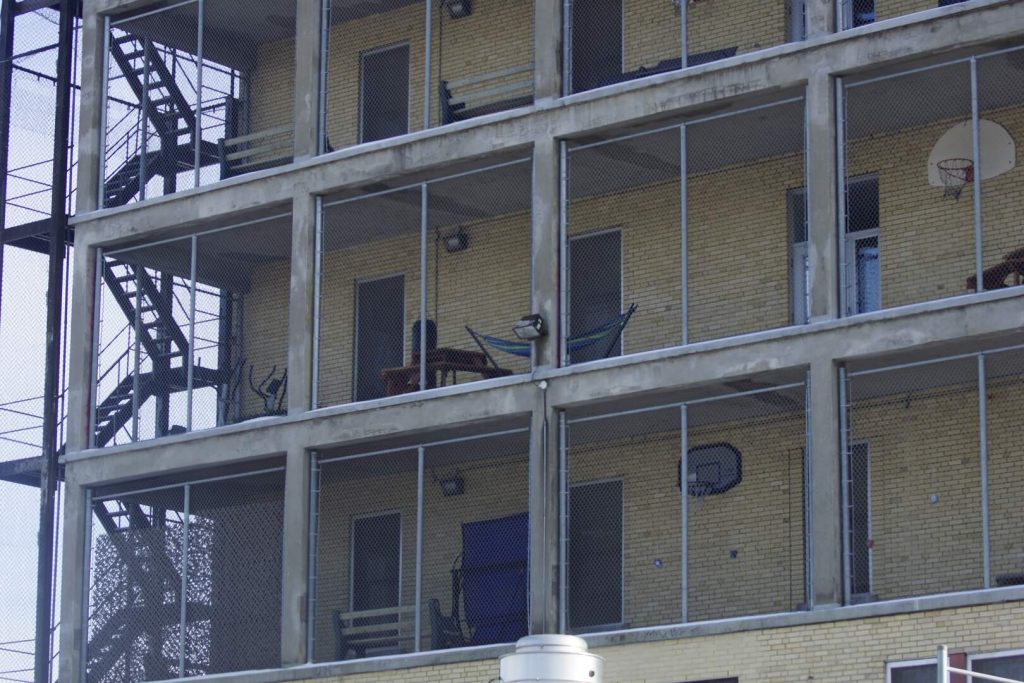
The centre consists of 12 units, separating boys and girls. On the left, a small yellow building draws attention. Regulars call it NDL — for Notre-Dame de Laval. It has 110 places for young girls aged 12 to 17. The balconies of the buildings are screened, transformed into cages suspended over several floors. Sometimes you can see teenage girls looking out into the distance. Behind the centre, a park leads to Mont-de-la Salle school, which several girls from the centre attend. In just a few meters, you switch from one world to another — on the one hand, peaceful residential streets; on the other, a locked structure, a place that young people try to flee.
“They locked me up in isolation for 12 hours”
On the night of Thursday to Friday, February 7, Shayna published a video on social media.
In front of the camera, she denounced her experiences at the Centre jeunesse de Laval, and said she knows the young girls who were missing until mid-February. She describes degrading treatment characterized by strip searches and extended periods of forced isolation.
She explains that the young runaways did not flee their homes, but from the youth centre they attended together.
“All these girls disappeared because of the centre (…) Because of the centre, the girls who disappeared put themselves in danger, they go into prostitution,” Shayna said. “Because they no longer know where to go, and that’s exactly what the pimps look for; so, they are selling their bodies.”
When she woke up on Friday morning, her video had gone viral.
That same evening, we met Shayna at home with her mother — that’s where she spends her weekends. At the family home in Laval, we discovered a calm, thoughtful and articulate teenager. Looking at her, you can tell her penchant for fashion. For over an hour, Shayna tells us about her life at the Centre jeunesse de Laval. She has been placed there intermittently since the age of nine. Now 16, she has lived in NDL for seven years. She ran away eight times.
“You have to wait for a release. For me, I go out from Friday evening to Sunday evening,” she said. “On Sunday evening, rather than going back to the centre, I left. The aim was to show that I was not running away from home but from the centre. That’s why I didn’t leave until Sunday night. Every time I left, or was declared a runaway, it was Sunday evening,” she said.
She insists on this point. And she is not the only one. Among the four young girls who disappeared at the beginning of the year, two also ran away on a Sunday, one on Saturday and another on Monday.
Last October, after a trip to the beach, Shayna claims to have been placed in isolation for 12 hours for refusing a full-body search.
“Cold air passed through the window and an air conditioner was blowing nonstop. It felt like I was outside,” she said. Wearing a swimsuit, she was shivering without being able to drink, eat, or go to the bathroom. “I have sickle cell anemia, it’s very dangerous,” she adds. Exhausted, she finally gave in to the search so as not to miss her father’s visit. “Nothing was found on me.”
Traumatized by this experience, she filed a complaint against the institution and is waiting to know when she will go to court.
Notre-Dame de Laval. PHOTO : Amélie Rock
Runaways
One Sunday, Shayna ran away with two girls from NDL, but the police stopped her before she was even declared a runaway.
Upon her return, she was placed in a reflection room. When she got upset, the agents escorted her to “the tide,” a calming room where she must spend 30 minutes. After half an hour, she was told that she had to stay longer due to “the hustle and bustle of the group.” Her stay was extended. “I finally fell asleep and stayed there for 3 hours instead of the planned 30 minutes.” For two days, she asked for an explanation but was told that it was a communication error. “I didn’t file a complaint because it was just three hours… but I guarantee you I already did more than that.”
Three weeks later, she ran away again with four girls, including one from NDL.
On the third day, feeling like she was in danger, Shayna sent her whereabouts to her mother, who found her.
“(The people she was with) were getting ready to send her to Toronto,” her mother tells us. When she returned to the centre, Shayna had to go through a “bedbug protocol” which required her to remove her clothes to avoid an infestation. Refusing to undress in front of anyone, she was placed back for nine hours in one of the centre’s three isolation rooms.
“I arrived at 3:00 a.m. and got out at 12:30 p.m.”
She says that she was woken up every 15 minutes to ask if she had changed her mind. An educator, who had supported her in the past, finally intervened. “She came back at 12:30 and said to me, ‘Get up, this makes no sense. Go change in the bathroom and go to sleep.’ I still had to do nine hours of isolation, and that bothers me.”
Shayna is speaking out to denounce practices she considers unacceptable. “I made mistakes that led me to a youth centre, but that doesn’t mean that I deserve to be treated like that,” she said. She believes that the treatment given to young people encourages some to run away. At any given moment, in NDL, Shayna says there’s always at least one girl missing. A runaway.
She says runaways are often long-term residents. “They try to leave the centre, but no one helps them. Before looking for runaways, the centre should give them a reason to want to come back.”
But the risks are immense.
“To run away is to live with fear: where to sleep, when to eat, how to survive? There are always Bad Trips, moments of panic,” Shayna said “And running away from the police is a constant burden.”
Especially since there is another threat: pimping networks. “All vulnerable adolescents are exposed to them, but for a girl at the centre, it is even easier to be coaxed. We think the pimps want to help us.”
Shayna believes that the way educators talk to young people fuels this unease. “At the centre, you don’t have the right to your opinion. They control everything, even when you want to go to the bathroom.” Conversations between young people are also monitored, under penalty of punishment for “unclear contact.”
“It’s an abuse of power. I need to talk, to confide in others,” said Shayna.
She also denounced the use of force by security agents. “I saw a girl carried by four agents, her head pressed against the wall. She was bleeding from her nose and ear.
“A friend was crying. They put her in solitary confinement and told her that she would not go out as long as she cried,” Shayna said “But they didn’t give her any breathing techniques, nothing. How does that help someone? ”
Shayna says these treatments turned her into a totally different person.
“I started having tantrums. I had a rage that I could not control,” she said.
Today, Shayna says she is feeling better, but it’s been a difficult journey. “Learning to manage your anger in a place where everything is controlled and then entering a freer world is a shock,” she said.
NDL, from mother to daughter
Stefania, Shayna’s mother, settles down next to her daughter.
Their two stories echo each other. She is only 37 years old. Like her daughter, she experienced life in a youth centre during her adolescence. Of her five children, four were placed at the Centre jeunesse de Laval. Today, she believes that her past, marked by the interventions of the DPJ — Quebec’s youth protection service — followed her in her parenting.
“I was sexually abused when I was 14. I asked for help at school, and the DPJ came into my life from that moment on,” she said. Because of the trauma caused by the abuse, Stefania was no longer herself. “They said that I was behaving violently. But they didn’t know what I had been through.”
Stefania was then removed from her family by the DPJ to be placed in care. “I thought it was a good thing — then I went through the system: foster family, group home, open centre, closed centre…” she said. “My mother fought a lot, then she didn’t have the strength to fight anymore.”
She too was placed in NDL, and said she experienced abuse at the centre. “I’ve been through these things for years, and only now am I able to open up. To do some digging, they put me on the ground, they put their foot in my face, it was really very violent.”
At 16, Stefania ran away with a girl from NDL.
Over the following two years, she joined a network under the influence of a pimp and started working for him. “It was the same recruitment system; I met a girl who said we could find ways to run away together,” she said, fearing that her daughter would be recruited in the same way.
Stefania sometimes returned to the youth centre by herself, especially if she felt she was in danger. She then made sure that the police were not alerted: “If the police find you and take you back to the youth centre, the consequences are more serious. You can go three months without leaving the centre”
Inside the youth centre, looking to the future is a challenge. For some girls, sex work and crime seem to be the only way out. Stefania believes that the repression experienced in these institutions pushes several young people to develop behavioural problems, which reinforces a cycle that is difficult to break.
According to her, young people are all the more likely to run away because they see the image of the runaway being glorified by popular culture, with programs like Fugueuses and La décadence de Montréal. “The world wants to look like that. Now they want to become like the singer Enima,” she said, referring to the character in the show La décadence de Montréal.
It was nearly 8 p.m. and Stefania’s phone rang, interrupting the conversation. A youth centre worker on the other end of the call informed Stefania that Shayna must be back at 10:00 p.m., without prior notice. The teenager thought she could spend the weekend here at her mother’s house as usual. On the couch, her hands shook. She was afraid to be made to pay for her viral video when she returned to NDL. Her mother managed to negotiate with the intervener.
In the end, Shayna would be spending the weekend at her mom’s house.
Stefania wants to use her experience to talk to mothers of young people who are in youth centres. “We all make the same mistake in thinking that they will learn thanks to the centre. That’s the wrong approach,” she said. “The centre is not the option; working together is the option! With specialists, the DPJ — yes, there are good people working there, they are not all bad — but if you go against each other, nothing will succeed.”
Today, she works in counselling and is studying in this field. “I am someone who can best understand people. That’s why I chose this path.” Despite her commitment, she refuses to work in youth centres. The pain is still too severe. “If I saw children being abused there, I don’t know what I would be able to do.”
She doesn’t mince words about the institution where she spent her adolescence, and where her children lived despite her. “I want to bring down the youth centre. I want it destroyed and rebuilt. With good people, who have good values,” she said.
The mother of the family wants young people to be able to communicate freely with their peers and thus help each other. But, she says, it starts with their guardians.
“If, as adults, we don’t support each other, young people won’t see that as an example,” she said. “What should be done, in my opinion, is to dialogue a lot with young people. Locking them up is not the solution.”
Stefania is standing by Shayna after she spoke out. “The centre called me to tell me that they could pursue legal action, that it could be considered a reputational attack,” she said. However, she doesn’t give up. “They’re trying to put pressure on me, and I’m not going to give in, not this time.”
#SurvivantedeCentreJeunesse

Centre jeunesse de Laval. PHOTO: Amélie Rock
Shayna’s video seems to have given courage to other young people, who in turn are speaking out.
Supportive reactions and testimonies were overwhelming. “There were 40-year-old people who told me that things hadn’t changed since their time there. It’s not normal to tell me that you went through the same thing as me. Where is the evolution? ” Shayna asks. Many young girls who have gone through various youth centres denounce an environment marked by violence, isolation and a severe lack of resources. Some are speaking using the hashtag #SurvivantedeCentreJeunesse.
We collected the testimonies of two former residents of the Centre jeunesse de Laval.
“It’s the first time I’ve shared what I went through. I arrived there on the 25th of the month… There are dates like this that you never forget”, said Alex*, in a tone so low it was almost a whisper.
Now 27 years old, they spent a little over a year at the Centre jeunesse de Laval, from 2011 to 2012. They’re speaking today in hopes that things can change: “For me, it was more than 10 years ago and nothing has changed. The public needs to know the reality of what’s going on in these places, because people have no idea, and there’s a lot of judgment and prejudice about the young people who are there.”
They say it’s important to understand that these young girls are not running away from home, but from a centre that is not fulfilling its mission of psychosocial support and where they said there are sometimes cases of abuse.
“I have run away several times, and you have to understand that these young people who have run away think that nobody loves them, that no one is on their side in these centres,” they said. “Outside, certain networks take advantage of them, of their fragility, to lead them into illegal activities.”
At the age of 13, Alex discovered the Centre jeunesse de Laval. They had “behavioural problems” that their mother “couldn’t manage” and their father was out of the picture. First placed at the Dominique-Savio Rehabilitation centre for Young People with Adaptation Difficulties, whose approach is more flexible. They were taken to the Centre jeunesse de Laval one evening in the fall. “Obviously, they felt that I needed a stricter framework,” they said.
Upon arrival, they complied with a standard search and were taken to their new dwelling. For the 13-year-old, it was a shock. “The room looked a lot more like a prison cell than anything else. The bed was a tablet attached to the wall with a thin mattress on it. There was a tablet attached to the wall as a desk, and the only other piece of furniture was a chair.”
They said that, during their stay, their room was “completely turned over” twice as part of drug searches.
More painful for them, they recall the day they learned about the death of their grandfather. “I was 13, and the support to grieve was not there. They told me, ‘It’s not important, he was just your grandfather.’ I was let out for a day for the funeral and that’s it, I had to manage it by myself,” said Alex.
Above all, the youth was marked by loneliness and the deleterious effects of the constant lack of social relationships.
“We were never allowed to talk to each other without someone’s supervision. So, quickly, I became small, because I was very afraid of being sent to an even worse place,” Alex said. “I followed all the rules, I never tried to bring in anything forbidden, I did everything I could to leave as soon as possible. But even then, I still remained for more than a whole year in deep discomfort.”
Now a bookseller, they had found refuge in the books in the small library of the Centre jeunesse de Laval: “We were allowed to take two or three books a week, and I always took the biggest ones I could find, regardless of the subject, just to get away from it all. From my room, I could hear the girls’ screams. Sometimes some of them disappeared and you didn’t see them again until two months later.”
Alex denounced the placement of children whose problems or life stories did not suit these particularly restrictive closed units.
“In retrospect, it is clear that this was not a place for me, and that it did not help me at all. I was 13, I was the youngest in the group, the others were between 15 and 17 and were there for drugs or prostitution problems, while I just had trouble managing my emotions, but I had never hurt anyone or been violent,” they said.
Nearly 15 years after their stay at the Centre jeunesse de Laval, Alex said they cannot think back to this period of their life without fighting a complex post-traumatic syndrome linked to their experience, but also, in part, to their stay at the Centre jeunesse de Laval.
“I am better today, but I don’t understand that we are still there and that young girls continue to suffer this. This is not the way to protect children.”
“It’s a prison for children”
Gabriela spent a week at NDL in 2024. She has a painful memory of those few days.
“How do you represent that? It’s a prison for children. Never, but really never, have I felt so alone! I just wanted to leave there,” said the 17-year-old, who now lives in a supervised apartment.
Raised by her grandparents since her early childhood, in a house where her uncle and aunt also lived, Gabriela did not have the chance to be born in a family conducive to her development.
She said she first experienced sexual assault at the age of 12 when a loved one forcibly kissed her “with tongue” while on vacation in the South. “And then, I experienced physical violence and insults at home from some members of my family,” she said.
She then mustered up all her courage to confide what she was experiencing to the social worker at her school, who reported it to the DPJ.
“I was 13 at the time. The school told me that it was going to call my grandparents to inform them of the report, and I warned them that I would not go home anyway.” She ran away with a friend. “I went to the house of a friend and her parents, and two weeks later, they knocked on the door,” she recalls. “They” are the police sent by the DPJ. When she got in their vehicle, she did not know it yet, but she was on her way to the Centre jeunesse de Laval.
“When I arrived at the youth centre, I didn’t even know what it was, but I knew it was a place I didn’t want to be,” said Gabriela. She said that, when taken to a small room, she was then asked to undress and put on a hospital gown. “They were holding a towel in front of me, and I took everything off. They put my stuff in a trash bag and asked me to do jumping jacks to make sure I wasn’t hiding anything anywhere.”
She then put on the clothes she was given and was taken to her room.
“It’s a very small room with no windows! On the door, there were several holes without glass and a curtain, so they can look and hear at any moment,” she said. “Then I was given some work to do: these questions on a sheet of paper that must be answered, otherwise you can’t get out. I had to say why I was there, what I needed to improve… when I was a victim!”
She said that the young girls must ask for permission for everything they do, including going to the bathroom, and that it sometimes takes a long time to get permission to go. “Throughout the week, I was never able to shower in hot water, there was only cold water. I couldn’t talk to anyone, and since they didn’t plan to put me in either internal or external school, I was left alone in my room with crosswords all day,” she describes.
She feels that after reporting serious events in her family, she did not get the necessary support. “I think that every young person, despite their problems, needs to talk. But if a young person does not feel comfortable talking to the social workers at the centre, it is because there is a problem,” said the young woman. “These centres are not suitable! When some young people need help, we don’t give it to them. I was there, even though I had done nothing, and no one tried to help me or to know if I was well.”
Speaking out for everyone else
Sixteen years old and motivated by her experiences, Shayna is determined.
“I wanted to speak out for a while, but I was too young,” she said calmly. “I’m going to talk about it as much as I can.
“Several times, I asked to file a complaint. I was told that the complaints were ongoing,” she said, while nothing seems to be progressing. She denounced the legal system, which, in her opinion, is unsupportive. She wants to leave the youth centre and said that her lawyer is struggling to follow up. “I started my complaint procedure in October, I have been waiting a long time.”
Shayna does not feel listened to during the process. “In front of the judge, we were just talking about everything I had done wrong, but never about the reasons behind my denunciation. When I talked about abuse, they said that now was not the time to talk about it and that it would be in another court. Each time it was put off.”
Shayna has a message for the institutions. “I would tell them to reassess their rules. The rules of the centres date back a really long time ago. Yes, it has to be strict, but there are limits! Some rules should be changed that don’t really make sense,” she said.
Later, the teenager wants to work in fashion design.
“And continue to speak for people in youth centres,” Shayna said “I would like to change some things in youth centres. Even if I have my passion on the side: design.”
Contacted by La Converse, the management of the CISSS, which oversees the Centre jeunesse de Laval, initially refused to grant us an interview. After an agreement in principle to conduct an interview, the communication service finally notified La Converse that the director of youth protection, Jean-François Payette, was “not available” because he was traveling abroad.
We then requested an interview with the director of the youth program, Anick Deslongchamps, who was also “not available” because of the 48-hour deadline we proposed. Converse then offered to postpone the interview, but no representative seemed more available, neither the following week, nor the week after, nor the one after that.
We therefore sent 15 questions to the CISSS in Laval. For the only response, we received the following statement:
“The CISSS de Laval wants to offer a safe environment to all housed users. With this in mind, since December 16, an external counsellor, Manon Saint-Maurice, appointed by the National Director of Youth Protection, has been supporting the CISSS de Laval in order to help teams analyze and reduce the use of control measures. This joint decision between the CISSS de Laval and the National Director is the result of the desire to act on the issues concerning the use of the control measure and thus ensure the well-being of children and the respect of their rights.”
We did not get any answers to questions about the abuses reported by the girls and women we met during this report.
Asked about the runaways from the Notre-Dame de Laval unit of the Centre jeunesse de Laval and the emergency measures taken to supervise young people, the office of the Minister of Social Services, Lionel Carmant indicated that “several runaways are of very short duration and do not constitute a danger for the adolescents concerned.” He added that these escapes can “come from several different reasons, for example a need for freedom, valorization, experimentation, flight, contestation, the search for identity or autonomy. However, some adolescents may be at risk, especially girls, who can sometimes be at risk of sexual exploitation.”
In the second part of this report, we will explore the systemic dimension of the failures of youth centres.
*Alex’s first name has been changed to protect their identity. Alex uses they/them pronouns.
Authors



Related Articles

McGill Spent Over $1 Million Fighting Unionization
Union organizers at the university say this is part of a broader trend towards corporatization of the public institution.

Rent Increases Set to Worsen the Housing Crisis
Experts warn that homelessness continues to grow as Quebec’s housing tribunal proposes a new way to calculate rental increases.
Montreal Leans on Condo Developers to Fix the Housing Crisis
As the number of unhoused deaths rises every year, experts say corporate interest in the housing crisis excuses the city and province from serving the public.
Comments (0)
There are no comments on this article.