
STM Management Reaches Truce with Some Workers while Mechanic Strike Looms
Mechanics say cockroaches on buses, coolant pipes bursting on passengers and private contractors who don’t know how to change a tire are just some of the obstacles that have come with outsourcing their jobs.

To strike or not to strike?
This question has plagued workers at Montreal’s public transit body, the STM (Société de transport de Montréal), for the past year.
The workers’ collective agreements expired in January. Budgets are tighter than ever. And with a new labour law that would restrict workers’ ability to strike, tensions inside the STM have boiled over into a series of work stoppages that have disrupted the city three times since June.
STM management says these strikes have “held the city hostage.” Maintenance workers still haven’t reached a tentative agreement. The union represents 2,400 employees, including plumbers, electricians, mechanics, elevator technicians and cleaners.
Maintenance workers argue that short-term inconvenience is necessary — not only to protect their jobs, but also to safeguard the long-term quality and reliability of public transit.
Behind the scenes: a maintenance worker’s view
Much of the public never sees what happens behind the scenes at the STM. The Rover spoke with a veteran STM maintenance worker, who will be referred to as Mark* to protect him from professional repercussions. He says that frustrations have been mounting among maintenance workers for the past decade. He traces the decline back to the firing of former director general Carl Desrosiers under Denis Coderre’s municipal administration.
“I feel the new management is literally tearing down STM piece by piece to bring it to full privatization,” said Mark.
According to both Mark and STM union president Bruno Jeannotte, the STM has shifted from preventative to reactive maintenance, spending more on emergency repairs.
Consider pest control.
“When I started, buses were treated for cockroaches twice a year,” he said. “Now they only act when a driver or passenger reports one. So probably 50 to 60 per cent of buses have cockroaches.”

He adds that private pest-control contractors bill the STM hundreds of dollars per call — far more than regular in-house prevention would cost.
Take tow trucks: STM mechanics operate two of them, but dispatchers frequently call a private company instead.
“Our mechanics know the fleet and know each other,” Mark said, which makes repairs faster. “But with the private tow company, we can wait four hours.”
The STM used to have its own service truck to change tires, but now mechanics have to call a private company. When Mark called in a flat, he said the tire change was done improperly by the subcontractor:
“He didn’t know what to do. He was just winging it,” said Mark.
“I was like, ‘If you lift the bus in that place, you’re going to break the suspension.’ And he told me, ‘Oh, this is what I do all the time.’ So I’m like, ‘OK, whatever. Do as you wish. At this point, if the bus flips over, I don’t care. It’s your problem.’ (He’s) proving that STM is taking the lowest bidder that doesn’t even have the qualifications to do the job.”
He said this tire change damaged the bus’s floor.
Support your local indie journalists
Mark also pointed to a severe failure involving articulated buses, which were recently pulled from service due to a “cooling issue.”
“There’s practically no more maintenance on buses. We’re doing repairs,” said Mark.
The real cause, he claims, was a neglected maintenance requirement: a flexible hose meant to be replaced every few years. Hot coolant flows through this hose, and over time, it can crack and split open.
“There are two buses that had incidents where (coolant) dripped on passengers. And when I mean dripped, it’s literally gallons of hot coolant… The pipe burst on top of the passengers. Seven passengers went to the hospital. Nine were injured, including an infant,” says Mark.
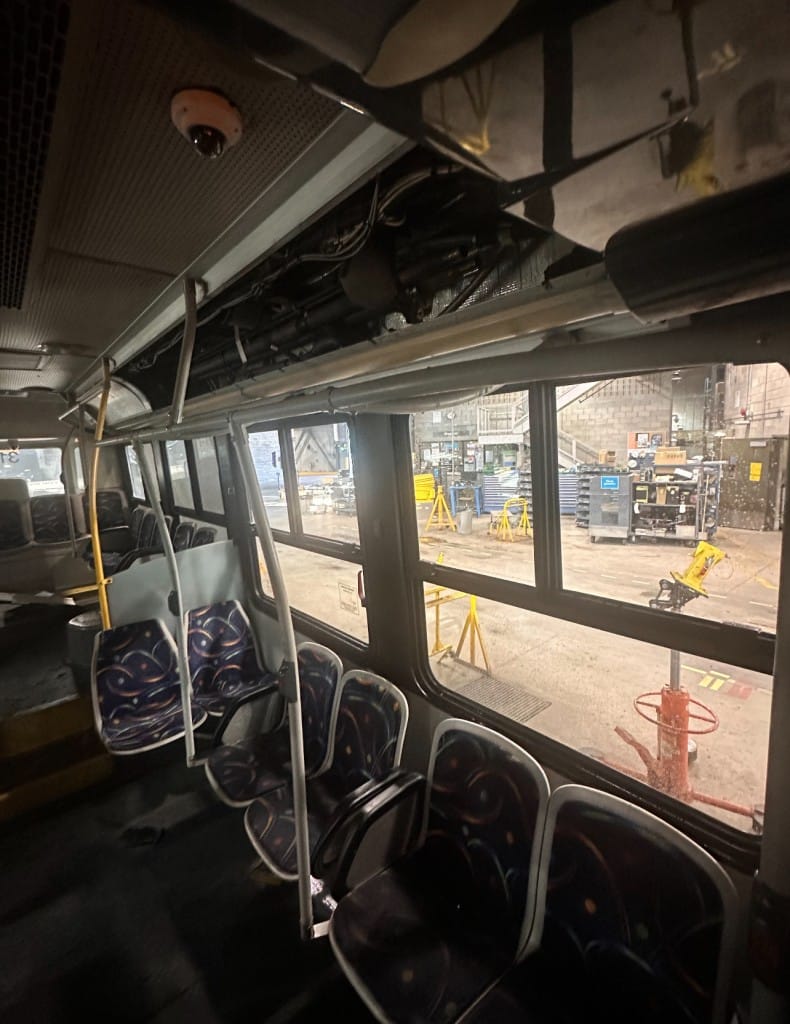
In addition to threatening the quality of maintenance on STM fleets, outsourcing has also reduced the overtime available to employees, and starting rates for new hires are not competitive, says Mark. Combined with frustrating working conditions, Mark says that it’s difficult to keep and hire qualified people.
“I’ve seen bad brake jobs, armed transmission driveshafts that fly off the bus because the guy didn’t put it right. But hey, you know what? That’s what you get. You get employees who are either too stressed or not experienced,” says Mark.
Why all the strikes?
This discontent is not isolated to maintenance staff, but they remain the sole group of workers who have not reached a deal with the STM.
STM management narrowly averted two strikes in November.
They reached a tentative agreement with the union of bus drivers, operators, and station agents on Nov. 14 — the night before these workers planned on walking off the job for a full weekend, bringing all public transit to a halt. A few days later, the administrative staff’s union and management reached a tentative agreement of their own.
The unions cannot comment on the contents of these agreements until their workers have evaluated the deals’ terms.
Meanwhile, the maintenance workers’ union just announced an overtime strike from Dec. 11 to Jan. 11. Metro and bus services will run as usual, but last-minute repairs and other maintenance work usually done in overtime hours could lead to fewer vehicles on the road.
The main holdup, according to the maintenance workers’ union president Bruno Jeannotte: STM management wants “carte blanche” to outsource maintenance work to private contractors.
“The employer wants to withdraw articles (in our collective agreement) that protect us from subcontracting. We’re not saying our working conditions are not good. We know we have competitive working conditions,” says Jeannotte.
While Jeannotte and STM CEO Marie-Claude Léonard have confirmed that the union is working with management on a framework to decide what services could be subcontracted, Jeannotte says that management is determined to have the final say in distributing these contracts, even if maintenance staff advise against it.
“(Management is) not acknowledging to what point they’re putting our reliability and quality of service in danger with the services we subcontract,” said Jeannotte.
Jeannotte argues that outsourcing risks higher long-term costs, poorer service, and the erosion of institutional expertise built over decades. And, in the long run, could threaten the job security of unionized maintenance workers.
“I’ll draw the parallel with healthcare,” says Jeannotte. “Privatizing our healthcare system didn’t bring in cost reduction, it didn’t improve the quality of service. We’re not better served with a two-tiered healthcare system in Quebec.”
Jeannotte says the private market has no vested interest in providing cost-effective services in the long run.
“Subcontracting services can look like a form of savings in the short-term, especially when you go with the lowest bidder,” said Jeannotte. “But we have examples where the lowest bidders didn’t do the work properly, and we have to restart the work. And the lowest bidder offered such a low price initially that they’re not always able to deliver that same price.”
Bill 89
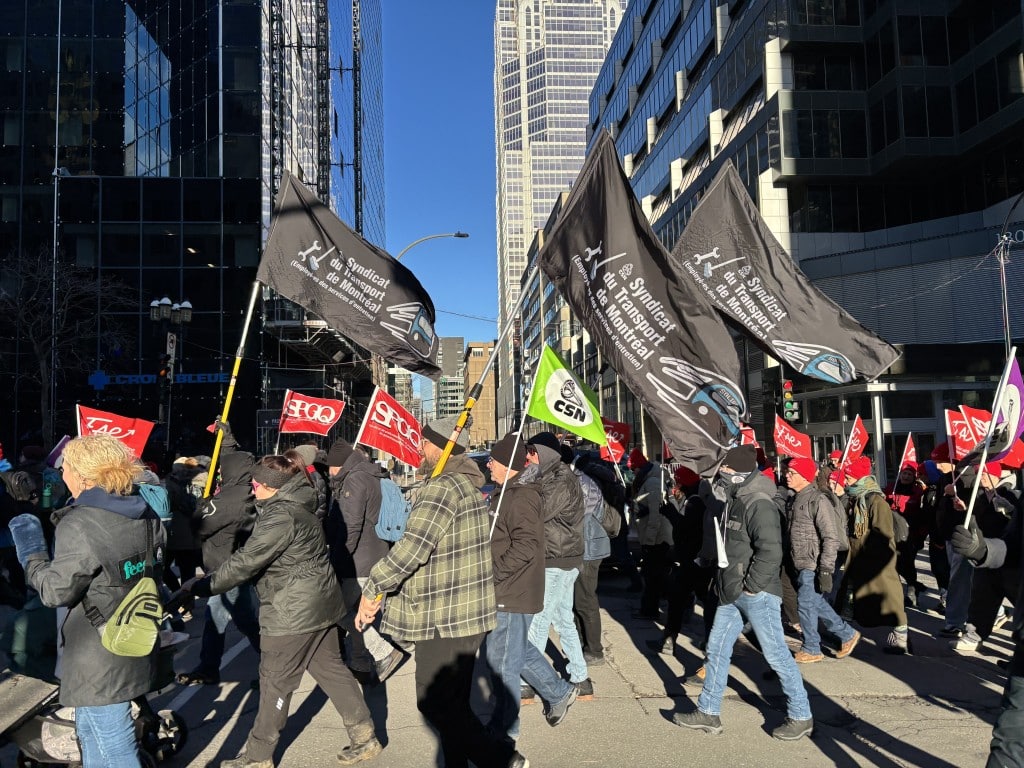
The union president says that part of the reason workers have gone on strike repeatedly is that Bill 89 came into effect on Nov. 30. Bill 89, or Law 14, allows Quebec’s labour tribunal to force public sector employees back to work without passing special legislation.
If negotiations are taking too long, the law also allows the government to impose arbitration — a process in which a third party decides the terms of a labour contract.
Arbitration, according to Jeannotte, “is a very slow, demoralizing process that restrains all ability to strike, or at least seriously limits our ability to apply pressure to reach an agreement. It can take a year and a half, even two years,” he said. The maintenance workers’ union decided to end their strike early to prioritize negotiations before the law comes into effect.
“We’d rather reach an agreement in the next days or weeks than be stuck in a process that limits our right to strike and is unfavourable to both sides.”
In early November, Quebec Labour Minister Jean Boulet wanted to move up the implementation of the law to put a stop to the multiple strikes, but was blocked by Québec solidaire at the National Assembly.
Quebec’s labour ministry declined The Rover‘s interview request.
STM management says it will evaluate outsourcing
At a press conference on Nov. 13, STM CEO Marie-Claude Léonard said management would prefer to establish new contracts through negotiation rather than leave it up to arbitration, but felt that unions were not being flexible.
The STM said that it is doing everything in its power to stretch a thin budget to offer better salaries to its employees. The province allocated the STM $258 million less over the next three years for maintenance.
“We need to find ways to self-finance to give working conditions to our employees that we want to keep. Our employees are good. I appreciate them. They do excellent work… But they already have great working conditions, they have salary increases and job security in an unprecedented financial situation,” said Léonard.
As far as outsourcing goes, Léonard said management is working with unions to evaluate which maintenance duties, if any, should be done by private contractors. She said that subcontracting is useful for “urgent” repairs.
“If it’s less expensive (internally), we keep this work internal. If we’re more expensive, we’ll give ourselves a timeframe to re-evaluate our work methods and processes so that we can adjust our spending,” said Léonard.
As of writing, a tentative agreement between the maintenance workers’ union and STM management has not been reached.
Comments (1)
Leave a comment
Related Articles

Guilty Until Proven Innocent: A Man’s 12-year Battle with Revenu Québec
Quebec’s tax agency freezes retirement savings, seizes assets and “ruins lives” with investigations based on mere assumptions.

School Board Votes to Support Candidate who Smeared Rival, Acted in ‘Undignified’ Manner
Julien Feldman gets off scot-free after falsely associating his rival candidate with antisemitism and referring to her as “Ms. Gaza.”

« Je veux juste qu’on me croie »
Victime d’une agression sexuelle alors qu’elle travaillait pour le gouvernement provincial, une femme lutte avec Québec depuis cinq ans.
This article is full of unconfirmed and anecdotal information. The journalist seems to have neglected to verify the informations provided by the anonymous worker.