
The Grind: A Franco-Ontarian’s Perspective on Minority Language Rights
Not all linguistic minority communities face the same challenges.

Minority official language communities grind to survive.
They work at it on the daily, as they must. Indeed, the survival of minority languages does not happen by accident. It is the result of countless personal, quiet but consequential daily decisions by individuals who choose to use their mother tongue whenever and wherever they can, even when it is inconvenient. But grinding to survive is no way to live.
For a minority language community to thrive, we need more. The social and legal environment must permit – and ideally encourage – members of the minority group to live, learn, work, worship and play in their language.
Sociolinguists call it “institutional completeness,” — that is, the extent to which a minority group can establish a network of social institutions (daycare, schools, universities, churches, workplaces, businesses, etc.) that sustain the minority language and culture.
Institutional completeness is at its peak when governments recognize, support and even celebrate the minority group’s language, heritage and institutions. In such an environment, members of the minority group can fully commit to their cultural identity, all while cultivating relationships with the majority group and larger society.
But these supportive ecosystems are very rare and, even when they exist, they come with no guarantees. At the end of the day, it boils down to the daily grind of individuals and families who tenaciously cling to their language and culture.
I know this grind well. As a law professor and litigator specializing in language rights, I have studied it and written books and articles about it. I have also taught classes and argued cases about it at every level of court, including the Supreme Court of Canada.
But my real knowledge of the grind comes from lived experience. I am a Franco-Ontarian.
Support Independent Journalism.
Life in a Northern Town
I was born in North Bay, Ontario and grew up in nearby Sturgeon Falls, a small town on the shores of the Sturgeon River and Lake Nipissing.
The archeological record shows that the Nbisiing Anishinaabeg have lived there since time immemorial (at least 10,000 years). But like many small communities that speckle Ontario’s Northern wilderness, the town of Sturgeon Falls was founded with the arrival of the Canadian Pacific Railroad in 1881.
The booming lumber and pulp-and-paper industry attracted diverse settlers, but when the Abitibi Power & Paper plant closed in 1930, many English speakers left the area, resulting in the town becoming 75-80 per cent French-speaking. The mill eventually became a cardboard recycling plant before finally closing in 2002.
Today, Sturgeon Falls remains a predominantly francophone town of roughly 6,000 people. It is the main service centre for smaller surrounding communities that make up the amalgamated municipality of West Nipissing, an area that lives off tourism, agriculture, hunting, fishing, and chip stands.
Like most children in Sturgeon Falls, I spoke French at home and at school. I started learning English in grade 3, from television and our summer cottage neighbours (Americans from Ohio), but my life was lived almost entirely in French. That is no small feat when one considers that Francophones currently make up 4.8 per cent of Ontario’s 13.6 million people.
Growing up, I was mercifully unaffected by my census status as a linguistic minority on account of Sturgeon Falls’ high institutional completeness and rich history as a centre for Franco-Ontarian rights and culture.
It is useful to recall here that, from the time of Confederation until the late 1960s, Ontario’s official policy towards Francophones teetered between indifference and hostility. Past governments actively suppressed the French language through different schemes, such as the infamous Regulation 17 that outlawed French language education at the beginning of the 20th century. Outraged Franco-Ontarian parents organised, founded the Ottawa-based newspaper Le Droit, protested noisily in the streets and sued the government.
Regulation 17 was eventually repealed in 1927, but Ontario still waited until 1968 to officially recognise and fund French-language schools.

The Franco-Ontarian flag displays the fleur-de-lys, a symbol of French-Canadian heritage, and the trillium, Ontario’s floral symbol.
Sturgeon Falls Education Crisis
In 1971, the Nipissing region had 1,600 high-school-aged students, 1,200 of whom were Francophones. Despite these numbers, the Nipissing School Board refused to establish a French-language high school in Sturgeon Falls.
The Board reasoned that the cost of maintaining a separate school for 400 anglophone students would be too high. Thus, the town’s only high school, it was decided, would remain English.
Once again, outraged Franco-Ontarian parents and students organised, signed petitions, picketed and eventually occupied the school building, effectively preventing the 1971-72 school year from starting. By October, the Minister of Education called an emergency commission that recommended creating a French-language high school in Sturgeon Falls.
By December, the School Board relented: the anglophone students would get a new school, and the larger francophone community would keep the existing building, which was renamed École secondaire catholique Franco-Cité. It was a grind.
The Sturgeon Falls Education Crisis of 1971, as it is now known in our history books, was the catalyst for other community movements across the province demanding greater recognition of Franco-Ontarian education rights and access to justice.
Francophones in Penetanguishene followed the Sturgeon Falls playbook and got their French language high school in the late 1970s. During this same period, a civil disobedience campaign called C’est l’temps! pushed the government to reform its legal system and permit the use of French in Ontario courts.
A community’s sense of self is forged in the flames of such struggles and successes.
In the 1970s, the Franco-Ontarian awakening was accelerated by the rise of the Quebec separatist movement and the Québecois identity. At the federal level, going forward, it was no longer French vs English, but rather Quebec vs The ROC. Quebec nationalism directly challenged the salience of a unified French-Canadian identity, forcing Francophones everywhere to ponder their own provincial uniqueness and adopt new identifiers (e.g. Franco-Albertan, Fransaskois, Franco-Manitobans, etc.).
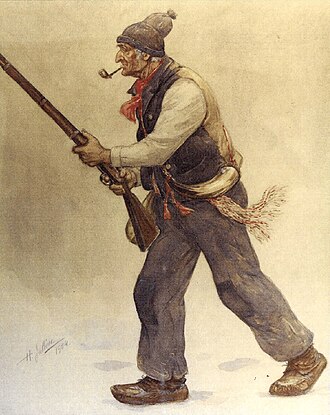
Le vieux de ’37 is a painting by Henri Julien depicting a French-Canadian patriot who fought in the Patriots’ War of 1837-1838. At l’École secondaire Franco-Cité in Sturgeon Falls, this symbol served as a model for its sports teams’ logo.
The Franco-Ontarian Renaissance
It is around this time that a new, more self-confident and assertive Franco-Ontarian identity emerged.
In the headiness of those halcyon days, an artistic collective called CANO (la Coopérative des artistes du Nouvel-Ontario) came to life in Sudbury, spawning cultural institutions that empowered young Franco-Ontarians and helped them make sense of their place in the world through music, literature, theatre and research — institutions like the band CANO (the Franco-Ontarian prog-rock echo to Québec’s Harmonium), le Théâtre du Nouvel Ontario, les Éditions Prise de Parole and the Institut Franco-Ontarien. Young community leaders created new symbols and cultural events, such as the Franco-Ontarian flag and la Nuit sur l’étang, a joyous annual concert that CANO co-founder André Paiement described as “la folie collective d’un peuple en party.” There was indeed much to celebrate.
In Sturgeon Falls, at l’École secondaire Franco-Cité, those names, events and institutions were part and parcel of our education.
By the early 1990s, many of the long-haired teenagers who picketed and occupied the school in 1971 had become passionate teachers. They taught us the history of the Franco-Ontarian grind as a part of Canadian history. And they leaned heavily on Francophone symbolism: our school mascot was the Frog, an old pejorative that my school proudly reclaimed, and our sports teams were called Les Patriotes, complete with a logo modelled on Henri Julien’s 1904 famous painting Le vieux de ‘37.
Ours was a special kind of school spirit, imbued with the confidence acquired when one grows accustomed to punching above one’s weight. My teachers regularly compared our school and town to the small village of the indomitable Gauls from the Astérix comic book, where Roman invaders are kept at bay thanks to a magic potion that gives the villagers superhuman strength. Our magic potion, they told us, was our language and sense of belonging.
For a small town of 6,000 people, Sturgeon Falls has churned out more than its share of notable Franco-Ontarians: elite athletes (Olympians and NHL players), politicians and cabinet ministers, celebrated musicians, poets, playwrights, scholars, entrepreneurs, and an astonishingly high number of lawyers and judges. Even a Justice of the Supreme Court of Canada!
I’m not sure what explains this unusual concentration of hometown heroes. Maybe there is something in the water. Maybe it has to do with growing up proud in a tiny but mighty community that is used to the grind.
The Importance of Government Support
Ontario is also partly responsible. The province that once tried to legislate French into oblivion has since enacted laws to protect minority language rights and promote francophone culture and symbols.
Starting in the 1980s, Ontario has constitutionally enshrined the right to French language education (1982); made French an official language of the courts (1984); started enacting all its laws in both French and English and offering French services in certain designated areas (1986); established a French-language services commissioner (2007); declared September 25 la Journée des Franco-Ontariens (2010); officially apologized for the indignity and harm caused by Regulation 17 (2016); established the Université de l’Ontario français (UOF), Ontario’s first French-language university, and set up the Ministry for Francophone Affairs (2017); recognized the Franco-Ontarian Flag as an official emblem of Ontario to be flown permanently at the Legislative Assembly (2020); and enhanced the rules on the active offer of French language services across the province (2023).
Taken together, these measures send a strong message of government allyship and goodwill to the Franco-Ontarian community, strengthening their overall sense of linguistic security.
But things are not all rosy in le Nouvel Ontario. Occasionally, the government reverts to its old anti-Francophone tendencies, always when Conservatives are in power, and usually under the guise of financial prudence. In 1997, as part of Mike Harris’ Common Sense Revolution, the government attempted to shut down the Montfort Hospital in Ottawa. In addition to being an important historic institution for Franco-Ontarians, as a university hospital, Montfort was – and remains — a crucial training ground for Francophone doctors and nurses.
Once again, outraged Franco-Ontarians organized, holding a rally at the Ottawa Civic Centre with over 10,000 people chanting “Monfort fermé, jamais!” The ensuing court challenge ended in 2001 when the Ontario Court of Appeal unanimously held that the government’s decision was unreasonable for failing to consider the overriding importance of Franco-Ontarian rights and institutions.
In 2018, Doug Ford’s Conservatives defunded l’UOF and abolished the Office of the French Language Services Commissioner. These policy decisions were unannounced and buried in an omnibus bill ironically called the Restoring Trust, Transparency and Accountability Act, a law that also abolished the offices of the Environmental Commissioner and the Advocate for Children and Youth. Cheery stuff.
Once again, outraged Franco-Ontarians organized, wrote letters and held protests all over the province, in which an estimated 14,000 people chanted “Nous sommes, nous serons!”
The public outcry drew national and international media attention. In solidarity, Francophone communities in several provinces held demonstrations, while the Quebec and Federal governments publicly criticized Ontario. The Ford government eventually yielded, sort of, by agreeing to fund the UOF (but only if Ottawa picks up the tab for the first five years) and restore the French Language Services Commissioner (but only as a non-independent employee of the Ontario Ombudsman).
In 2021, when Laurentian University was on the brink of bankruptcy, its administrators fired over 100 professors and gutted nearly 70 programs, the majority of which were offered in French.
Laurentian abolished the only French-language midwifery programme outside Quebec. Francophones can no longer study Earth Sciences, Computer Engineering, Chemistry, History and French literature (!) at Laurentian. The full list of abolished programs is too long and depressing to include here.
The French Language Services Commissioner received hundreds of complaints about these draconian cuts. The Commissioner found that the Ford government and the University both breached their legal obligations by failing to consider the impact the program closures would have on the Franco-Ontarian community.
By then it was too late — the cuts could not be reversed. Laurentian University and the Ford government unwittingly contributed to the fulfillment of Lord Durham’s 1839 assimilationist plot against French Canadians. At Laurentian, Franco-Ontarians are quite literally “a people with no literature and no history.”
These recent bleak events confirm what Franco-Ontarians have always known: even with constant vigilance and advocacy, every gain remains precarious. Despite ostensible government support and the community’s own obstinate commitment to its language and culture, the demographic weight of Francophones in Ontario continues to dwindle.
In Ontario, Francophones fight against erasure. The grind is real.
Not The Same
I am not insensitive to the parallels that exist between the daily grind of Franco-Ontarians and Anglo-Quebecers. Both communities are bilingual out of necessity, constantly negotiating between integration and preservation. In English-Quebec as in French-Ontario, schools, universities, healthcare, and businesses form a fragile ecosystem perpetually at risk of encroachment by the majority.
But the similarities between the situation and prospects of those two minorities can only be taken so far. They are, fundamentally, not the same.
As a matter of constitutional law, English has been an official language of the Quebec judicial system and legislative assembly since 1867. Anglo-Quebecers are not just surviving; they are thriving. The number of English speakers has been steadily increasing in Quebec for decades, especially in Montreal, thanks in large part to immigration.
Bilingualism is also on the rise as more French-speaking Quebecers see the undeniable advantages of learning English. Quebec’s minority Anglophone community is supported by world-class well-funded institutions, like the English Montreal School Board, Bishops, Concordia and McGill Universities, that all shore up its legitimacy and influence in the province. The annual Montreal Jazz Festival and various other cultural events also showcase the vibrant Anglophone presence in la Belle Province.
However, since the 1970s this extraordinary institutional completeness has been dampened by Quebec language laws explicitly aimed at promoting the primacy of the French language.
The Charter of the French Language (Bill 101) and its compliance bureau – the Office québécois de la langue française – loom large in the lives of Quebec Anglophones, imposing French-first signage and rigorous service standards, which leave some feeling like second-class citizens. The struggle of Anglophones in Quebec is for respect and influence in a province that sees their language as a threat to the survival of French in Quebec and North America.
Therein lies the fundamental difference between Franco-Ontarians and Anglo-Quebecers. Ontario does not perceive French (or any other language) as a threat to the hegemony of English. There is no need for a “Charter of the English Language” in Ontario, or in Canada for that matter. English is quite safe in this country and on this continent.
Unfortunately, the same cannot be said of French, hence the need for careful language planning and strong legislation.

On Relativism and Empathy
« Quand me je regarde, je me désole. Quand je me compare, je me console ».
I’m not sure there exists an equivalent aphorism in English. An exact but inelegant translation would be, “When I look at myself, I feel sorry for myself. When I compare myself, I console myself.”
My parents would roll out this chestnut of melancholy wisdom whenever I felt envious of my older brother’s privileges or of a classmate’s shiny new toy. The adage is a reminder to appreciate one’s own good fortune, to not minimize one’s situation by jealously coveting what others have. One should not be defeatist either, and simply resign oneself to unfairness and injustice, but there is solace in gratitude and optimism.
Canada’s constitutional structure irresistibly lends itself to French-English comparisons. Francophone communities in the ROC would have a better future, it is often argued, if they enjoyed the same level of institutional completeness and constitutionally enshrined language rights as Quebec Anglophones. This, of course, is a variation of the worn rhetorical cliché that Quebec-Anglophones-are-the-best-treated-minority-in-the-world.
To be sure, Métis, Inuit and First Nations communities across Canada would marvel at the possibility of having the same institutional, cultural and financial support for their languages and cultures as Anglo-Quebecers and Franco-Ontarians, for that matter.
However noxious it may appear to some Quebec Anglophones, Bill 101 cannot be compared to the 18th-century expulsion of Acadians in the Maritimes, to the unconstitutional Manitoba law proclaiming English as the sole official language of the province in 1890, to Ontario’s 20th-century ban on French language education, and even less so to the horrors of the residential school system.
These calamitous policies were visited upon linguistic minorities in a centuries-long bid to ensure the dominance of the English language in this country. Anglophones should bear this dark history in mind when they feel irritated at the sight of French-first signage in Quebec. Conversely, minority Francophones should empathize with the Anglo Québécois struggle for respect and inclusion in their Belle Province.
If empathy and enlightened self-interest won the day, both official (read: colonial) language communities would support Indigenous efforts to reclaim and revitalize their traditional languages. Their grind is far more urgent and existential.
The first Official Languages Act (1969) was meant to reboot the language relations in this country by codifying the principle that French and English, at the federal level, enjoy equal status, rights and privileges. This principle was later enshrined in the Canadian Constitution, and it cannot be amended without unanimous approval of Parliament and the provincial legislatures.
In a very real way, the continued existence of the Canadian federation as we know it is irrevocably tied to the vitality of its minority official language communities. Similarly, sincere reconciliation with Indigenous peoples demands a serious commitment from us all to Indigenous language revitalization. The stakes could hardly be higher.
Comments (1)
Leave a comment
Related Articles

Live from the Fall Classic: Game 7 with The Rover
Cheering for Canada’s Team in the World Series was a balm for my soul. But no matter what, my heart will always belong to the Expos.

Gaza: Rubble Invades the City and Its Memory
Can memories survive destruction and guarantee a future for Gaza City?

Opinion: Montreal Cycling Race a Win for Genocide Supporters
Montreal is being used as a prop to clean up Israel’s image on the international stage
While it is certainly true that Quebec anglophones are not part of an endangered species, and the situations are not “the same”, the author undersells the problem for some Quebec Anglo communities. I am a native of one such – Trois Rivières, or our “Three Rivers”. The reasons are complex, and no need to go into them here, but the institutional completeness that existed there when I was growing up (age 5 to 16, 1953-1965) is totally gone. The English speaking schools (plural) and churches (ditto) are gone except for what was my own school, then one of two major local schools but now just the regional English elementary school for all of the Mauricie. So far as I can tell, there is no true English-speaking community there at all, and it would be totally impossible to “grow up in English” as the author did in Northern Ontario in French – and I did in the 1950s-1960s.
I suppose this is many ways is a “good thing” for most of Quebec, and one would not want to go back to the days of my T-R neighbour a certain M. Duplessis whose funeral across the Parc Champlain from my home at the no-longer-existing manse for St.-Andrews United Church I remember well. Further, the economy of T-R is very different now, as is to the extent I can understand it the culture – less pulp and paper, more poetry and higher education (en Français). But I still mourn our beautiful little community. It is, for the most part, gone.
Here in Montreal our “Anglo” community is doing fine, thank you very much. But the devolution of “Anglo Three Rivers” shows that institutional completeness does not survive the removal of institutions in one’s own language.