
The “Political Footballing” of Trans Youth
The Quebec government is courting the anti-trans politics sweeping across the country as violence towards the LGBTQ+ community rises.
Annie had always assumed her son was a typical teenage boy.
He played soccer but wasn’t what you might call a jock, had lots of friends and was “very much into girls.” She says her child was a bit of a nerd and some of the other boys would pick on him for being sensitive. But that didn’t worry Annie.
“We’re both like that, it doesn’t take much to make us cry,” Annie said. “Sometimes kids gang up on someone like that. But otherwise there was no huge teenage crisis. We’re very close so I was always sure that, if anything was up, I would have known it.”
It turns out something was up.
During the early days of COVID-19, when Annie and her kids were holed up in an apartment together, her son came out of the closet. He was pansexual.
“Of course, support your kid no matter what, right? You want them to trust you and tell you what they’re feeling and the way you do that is by supporting them,” Annie said. “Eventually, I get the question ‘Hey, would you mind buying me a dress?’ There was like a second coming out, she identified as a woman. So the family got together and we supported her. We started the process of getting a doctor and transitioning.
“It has never, not even for a moment, changed the way I feel about my child. I just want her to be happy. And she is. She’s in college now, she’s had the same girlfriend as she did before she transitioned. She has most of the same friends from high school. She’s a loving, wonderful person.”
Others have not been so understanding.
Support Independent Journalism.
Annie’s daughter goes to school in a factory town about an hour east of Montreal and sometimes, when she’s out shopping, people make degrading comments. On a few occasions, people have pulled out their phones and filmed her.
“Typical small-town shit,” Annie says. “You see your child going through something like that and it’s scary. She can defend herself, I know that. She’s six feet tall and even taller with her heels on. But all it takes is one person with hate in their heart.”
Like a lot of parents, Annie is alarmed at the rise in hate crimes against trans and nonbinary kids across North America. And with good reason.
Last week, at a high school in Oklahoma, 16-year-old nonbinary student Nex Benedict was beaten to death in a girls’ bathroom. Nex had been bullied for their nonbinary status for months leading up to the attack. And though authorities are investigating, there have been no arrests in the case.
Oklahoma is one of at least 10 states that recently adopted legislation regulating access to public bathrooms based on gender assigned at birth. There were a total of 550 anti-trans bills introduced in legislatures across the United States last year. The laws range from restricting bathroom access to outlawing gender-affirming care for minors. And each time a new bill is introduced, protests, counter-protests and violence often follow.
In November, the FBI and Department of Homeland Security warned of an epidemic in attacks and threats towards the LGBTQ+ community — including bomb threats to schools, libraries and other public spaces that host LGBTQ events. Some 33 people were murdered in the United States last year because of their gender identity, according to the Human Rights Campaign Foundation.
“I know we’re not like that here, or at least I know that in Quebec this wouldn’t happen,” Annie said. “But you look at Alberta and you look at what (federal Conservative leader Pierre) Poilievre said this week and you realize maybe we’re not totally immune from it.”
Poilievre said Wednesday that “biological males” don’t belong in women’s spaces and indicated support for provincial legislation restricting bathroom access. Poilievre also supports legislation that restricts access to gender-affirming care for minors.
And though that may only be a throwaway line from a politician who lives for the culture wars, Poilievre’s Conservatives are leading the Liberals by double digits in every major national poll.
The party’s rejection of “radical gender ideology” comes at a time when hate crimes against the LGBTQ+ community are on the rise.
The latest study by Statistics Canada found a 64 per cent increase in hate crimes against the LGBTQ+ community in 2021 compared to 2019. There were some 465 anti-LGBTQ+ hate crimes reported to police in 2021.
In provincial politics, conservative leaders are leaning into the fight against trans rights. Saskatchewan Premier Scott Moe invoked the notwithstanding clause last fall to circumvent the Charter rights of trans youth in public schools. Alberta, meanwhile, is tabling similar legislation.
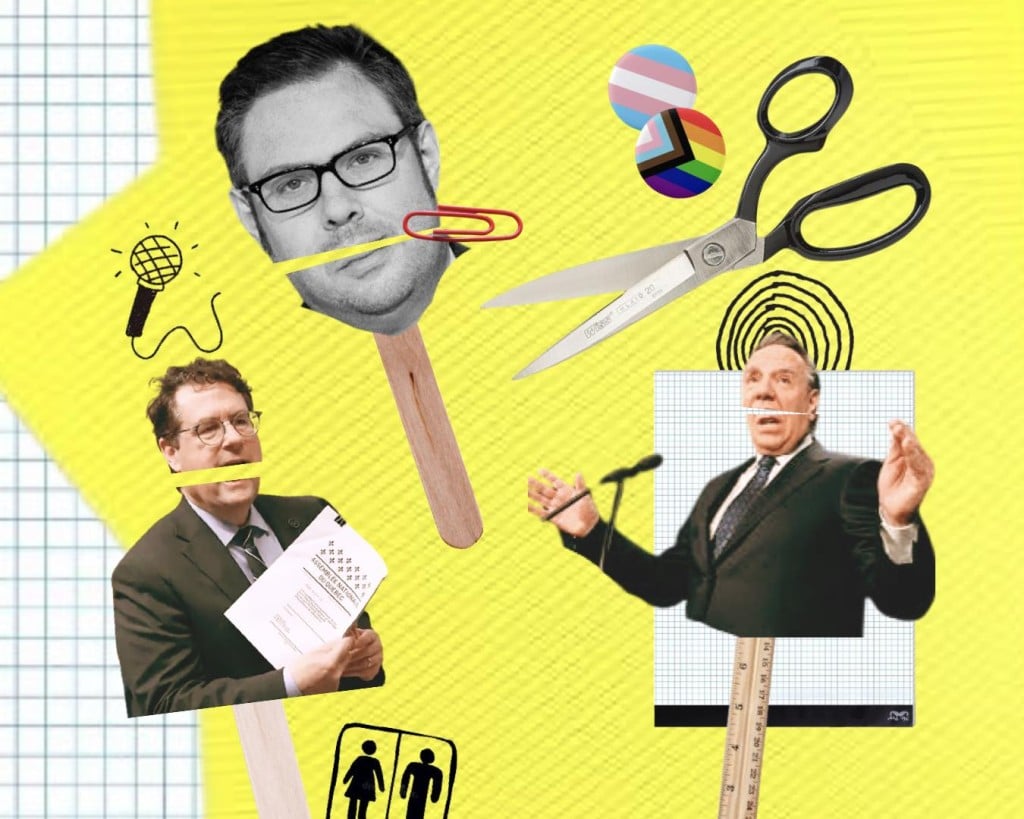
Closer to home, Premier François Legault created a committee last December to study the issue of LGBTQ+ rights in school and whether Quebec should further codify access to bathrooms and other public spaces. He also froze policy changes that would have allowed nonbinary people to use an ‘X’ gender marker on government-issued ID.
Legault made this decision despite the National Assembly having already commissioned and published a guide on the issue less than three years ago. The guide outlines best practices for schools to create a “more welcoming, safe and inclusive environment.”
Legault’s change of heart came — as it often does — after some of the province’s conservative newspaper columnists began pushing the bathroom issue last fall. In particular, they praised Education Minister Bernard Drainville for ordering a school in Abitibi to halt construction on gender-neutral bathrooms.
The government insists the committee will not result in diminished rights for trans and nonbinary Quebecers. But two of the three committee members have ties to PDF Québec — an organization that has repeatedly compared transitioning to “genital mutilation” and organized a smear campaign last year against a trans teenager. The teenager in question, Université de Montréal law student Celeste Trianon, said she received multiple death threats and a slew of online harassment after being targeted online by PDF.
Under the Coalition Avenir Québec, PDF has received over $500,000 in government grants.
Committee member Patrick Taillon, for his part, has supported measures that would allow high schools to out trans students to their parents — something they’re currently prevented from doing under the Canadian Charter of Rights and Freedoms. No one on the committee is trans or nonbinary, a fact that’s earned this government criticism from LGBTQ+ advocates.
“This is the most dangerous time for our community since the AIDS epidemic,” said Trianon, in a telephone interview with The Rover. “What you’re seeing across North America is an attempt to cleanse trans people from public spaces. And the language being used — referring to us as biological males — that just reinforces this idea that we’re monsters.”
Liberal MNA Jennifer Maccarone says Legault’s government is using trans kids as a “political football” to score points with the electorate. She points out that the government already instituted its own policies in 2021 and only changed course after a few “hysterical” newspaper columns.
“It’s a dangerous game they’re playing,” said Maccarone. “For trans kids and their families, this is literally a life or death issue. Not only because of the increase in hate crimes but also because the public discourse is extremely alienating. And that isolation can be very dangerous for someone struggling to figure out who they are.”
Trans youth are 7.6 times more likely to attempt suicide than cisgender youth, according to the Canadian Medical Association Journal. But when kids are supported in their decisions by trusted adults — like parents and teachers — the risk of suicide decreases by over 90 per cent.
“It’s impossible to describe how it feels to be trans but not be able to live as your true self,” Trianon said. “Imagine a feeling of such intense sadness that even the strongest antidepressants won’t put a dent in it. You just want to be able to be yourself but there’s so much pressure for you to just not exist.”
While conservative politicians warn of “irreversible” changes being pushed onto confused teenagers, the reality of transitioning is much more nuanced.
In Quebec, the only surgery approved for minors is a double mastectomy — often referred to as “top surgery.” But that can only happen under the recommendation of two doctors, a mental health professional, and after going through a process that can take years. Puberty blockers, which are reversible, are also available to minors but it is a similarly long and complicated process.
“The families who come to us, they don’t necessarily know where to turn anymore,” said Alexandre Rainville, who works for Jeunes Identités Créatives, a group that supports trans children and their parents. “Our job is to follow the kid at their own pace. What kinds of questions do they have? Are they truly in the process of transitioning or are they just asking themselves questions about their gender? We don’t push anything.
“Kids don’t just wake up at 18 and start thinking about their sexuality. That’s not how it works. Some kids, at a very early age, will explore what gender means for them. In some cases, maybe they’re curious about using a different pronoun, a different name, a different haircut, it really varies from case to case.
“But it’s not because we refuse to talk about it or create physical spaces for it that we won’t have kids and teenagers asking themselves these big questions. Or feeling terribly alone because of these big questions.”
Rainville says some of his work involves deconstructing the myth that kids are being pushed to transition and regretting it later. In fact, an American study on gender dysphoria found that, of the nearly 2,000 respondents followed through the process of transitioning, less than 1 per cent regretted their decision.
“This perception that there’s a sudden craze of kids claiming to be trans is a false one,” Rainville said. “When you go from there being zero visibility of trans people in public life to a little bit of visibility, people can distort that. And when you create a safer society for trans people, they’re going to be more visible. When you stop preventing trans kids from existing, they’re going to be more visible.”
But perhaps the most important role Jeunes Identités Créatives plays is the simple act of creating a space for parents to understand their kids better.
“We have a private Facebook group where parents can just ask other parents for support,” Rainville said. “Sometimes it’s something as simple as finding a seamstress who can make a certain kind of underwear or asking how to find chest binders. But there are deeper connections that form, parents helping out parents, children who get to meet kids going through similar changes.
“It can be frustrating to look at the political climate but then you look at these families supporting their kids. We need more of that.”
Author

Related Articles
Le refus de l’asile à Ranjit Singh
Militant pour le mouvement indépendantiste sikh de l’État du Pendjab, au nord de l’Inde, Ranjit Singh fuit les persécutions policières pour trouver refuge au Canada en 2019. Il y a deux semaines, sa demande d’asile est rejetée et sa déportation prévue le vendredi 6 mars 2026.
The Refusal of Asylum to Ranjit Singh
An activist for the Sikh independence movement in the state of Punjab, Ranjit Singh fled police persecution to seek refuge in Canada in 2019. Two weeks ago, his asylum application was rejected, his deportation scheduled for March 6.

Faced with a ‘Time Bomb Budget,’ the STM Turns to Real Estate for Revenue
Montreal’s transit body wants more money for crumbling infrastructure, continues negotiations with maintenance workers.
Comments (0)
There are no comments on this article.