
The Province at War with Unions
François Legault and his government have launched the most anti-democratic, anti-union laws in modern Quebec history. He might not have been as ready to fight this battle as he claimed.
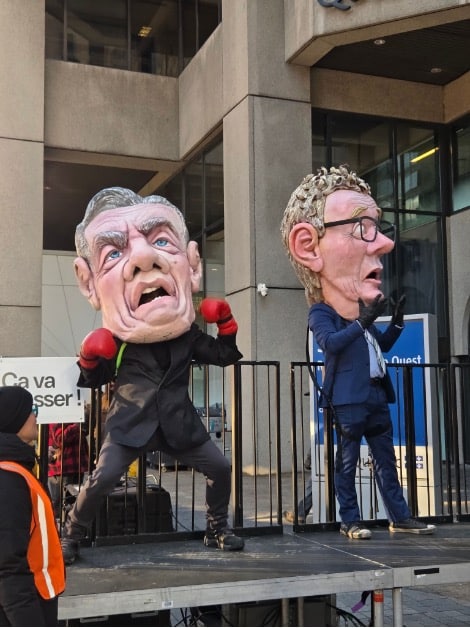
When Premier François Legault said he was ready for war with Quebec’s unions, he may not have expected them to be as prepared as they were.
During a cabinet shuffle this fall, Legault declared his intention to “modernize the union system.” The backlash was immediate across almost every sector in the province, prompting Labour Minister Jean Boulet to walk back the Premier’s remarks.
Boulet’s words and his actions stood in stark contrast. Bill 3 and Law 14 (formerly Bill 89) are a historic regression on union rights since the Quiet Revolution. Unions, human rights groups, and activists responded by protesting in downtown Montreal on Nov. 29, with more than 50,000 people turning out. They aren’t ruling out a general strike and are already taking the government to court over Law 14.
This escalating showdown comes on the heels of other laws targeting the rights of workers and individuals in Quebec. Earlier this year, Bill 101 passed, which is “creating a two-tier system to the detriment of women,” according to the president of the CSQ, by withholding worker safety regulations from health care and education sectors — predominantly staffed by women. Meanwhile, the now-infamous Bill 2 restructures how doctors are paid, and is already leading to many family doctors announcing that they will have to end their practices, and to vulnerable populations losing service. On Dec. 11, a tentative deal was reached between the doctors and the province that will postpone the enactment of Bill 2 and change aspects of the law. The details of the new agreement have not been announced as of publication.
Support your local indie journalists.
“This is a drift that is becoming increasingly authoritarian,” Caroline Senneville, President of the Confédération des syndicats nationaux (CSN) said. “This is a law that aims to restrict the right to strike… When strikes last too long or are too disruptive — according to the government — the government can unilaterally end the strike, end negotiations, and request arbitration.”
Law 14 massively expands the definition of “essential workers” beyond its traditionally accepted meaning.
Barry Eidlin, associate professor of sociology at McGill, explained that Law 14 “eviscerates workers’ right to strike.” With the law, the labour minister can declare nearly anything an essential service, expanding the government’s powers to order people back to work in the event of a strike.
This spits in the face of what “essential worker” has meant since the 80s. “The labour minister could make a plausible case that the work that these workers do is essential, (and that a strike) is too disruptive, and is causing too much pain to the public,” Eidlin said.
He noted that the aspect of the law which is “autocratic” is how it gives no definition of what makes something “too disruptive,” and thus leaves the power entirely in the hands of the labour minister to unilaterally declare a strike illegal — forcing people back to work and into arbitration.
“It’s going to fundamentally undermine workers’ constitutionally protected right to strike, which is to say that workers don’t have a meaningful right to strike in Quebec … and that’s going to have a corrosive effect on collective bargaining,” Eidlin said.
The law is already being contested in court. “This law is unconstitutional as it (is) an attack on the freedom of association protected by the Quebec Charter of Human Rights and Freedoms, and the Canadian Charter of Rights and Freedoms,” a spokesperson for the Fédération autonome de l’enseignment (FAE) said.
The governing Coalition Avenir Québec (CAQ) took a second angle to attack unions this winter.
While limiting the ability to strike, the CAQ also wants to fundamentally restructure unions’ finances so they won’t be as politically active.
“This is an effort to regulate the internal affairs of labour unions. And this is something that is much more prevalent in the US than in Canada,” Eidlin said. It divides union dues into two — mandatory fees and optional fees. The former is a portion that’s used for the negotiation and enforcement of collective bargaining agreements. The latter is a portion that would be used for political campaigns or advertising. Canada has historically had a laissez-faire attitude toward union organization, treating them as private clubs and allowing them to run their own affairs.
“It’s based on an assumption that workers represented by unions have political opinions that are at odds with the union’s leadership,” Eidlin said. “The general idea of this is to limit unions’ ability to serve as sort of broad social actors beyond the workplace. Historically, at least for the past 60 years since the Quiet Revolution, Quebec labour has really distinguished itself.”
The Quebec labour movement has won more social gains than any other province in Canada, and has allowed its welfare state to be more robust than the rest of Canada, despite decades of cuts to social services. Socialized childcare, the Parental Insurance Plan, anti-scab laws,the Pay Equity Act — the list goes on.
These laws, alongside the introduction of a Quebec Constitution, which experts warn threatens abortion rights and shields the government from challenges from Quebec citizens, call to mind Quebec before the Quiet Revolution — la Grande Noirceur.
Frédéric Bérard, constitutional lawyer and doctor of law, said that Quebec may be in a worse place than it was under the rule of Maurice Duplessis. “I don’t think that Duplessis ever tried to stop people from challenging bills,” he said.
The unions see these actions as a way to prevent anyone from challenging the government.
“It’s evident that (the CAQ) is trying to muzzle counterpowers,” said Éric Gingras, president of the Centrale des syndicats du Québec (CSQ). He called out Legault for moving further and further to the right in what looks like his final year in politics. “No one is fooled by the fact that the government is creating a distraction to gloss over its poor record,” he said.
This is not the first Quebec government in recent memory to try and quash union strength. The province has been trending in that direction since the 90s. “There were anti-union laws under (premier Jean) Charest as well,” Senneville said.
In the early 2000s, Charest passed laws that allowed the health sector to contract out to private companies, with ripple effects still being felt today. Charest also amended the labour code to allow companies to replace union workers by subcontracting, leading to problems such as STM buses being in disrepair and full of cockroaches.
This seems poised to be the CAQ’s final year in power. Based on polling, the Parti Québecois is waiting in the wings. Yet this version of the PQ, traditionally a pro-union party, has moved towards the far right, echoing support for Bill 2, and has been accused by the Syndicat de la fonction publique et parapublique du Québec (FPSQ) of being a far-right populist candidate. “René Lévesque must be rolling in his grave,” they said of Parti Québécois Leader Paul St-Pierre Plamondon, due to his position on reducing the size of the state during the strikes of 2023-2024.
Unions might be in for a long-term fight with anyone who has a chance to win power. The union is ready to take on any government that acts like this, but is willing to give a new government time to prove itself. “If a new government is elected, perhaps give it a little chance before calling a general strike,” Senneville said.
Despite the lack of political will in Quebec’s power structures to strengthen unions, a new fighting spirit seems to be welling up within the unions themselves.
“The past couple of years we’ve seen a reassertion of union strength, at least in more strikes,” Eidlin said. “I mean, there’s this broader context of a decline in labour’s power since the 70s, which we’ve seen on a pretty much a global scale, (but) Canada has actually done better than most. It’s one of the few countries in this group where unionization rates have remained in the ballpark of where they were in the early 70s.”
“There is a unity in the unions like there’s never been before, and a social unity as well. Social organizations, feminists, environmentalists, they all mobilized,” Senneville said. “Unions participating in civil society — it’s a part of the Quebec system, it’s a part of Quebec society.”
Author

Comments (2)
Leave a comment
Related Articles

School Board Votes to Support Candidate who Smeared Rival, Acted in ‘Undignified’ Manner
Julien Feldman gets off scot-free after falsely associating his rival candidate with antisemitism and referring to her as “Ms. Gaza.”

« Je veux juste qu’on me croie »
Victime d’une agression sexuelle alors qu’elle travaillait pour le gouvernement provincial, une femme lutte avec Québec depuis cinq ans.
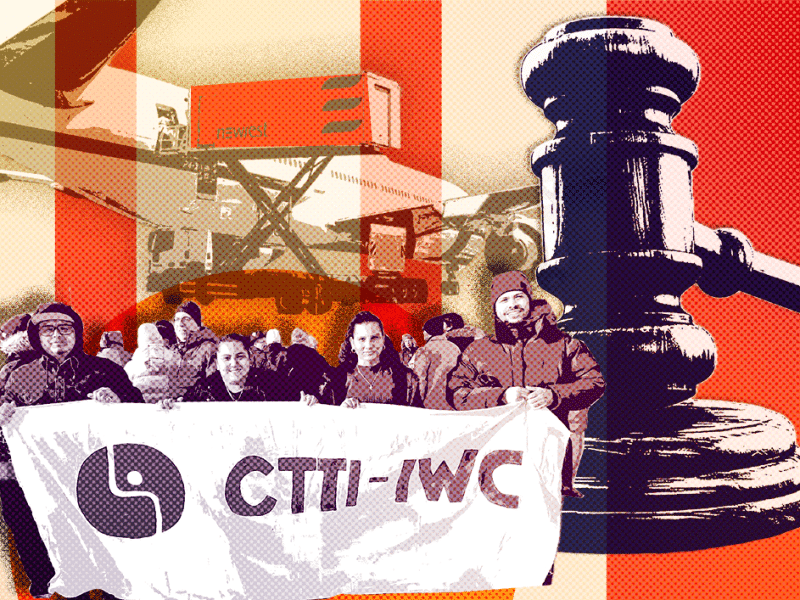
Hundreds of Migrant Workers Compensated After Fraudulent Recruitment Scheme
The multinational Newrest and the Montreal agency Trésor must pay $2.1 million to migrants tricked into working without authorization under the false promise of obtaining a valid work permit in Canada.
No fan of union-busting, but we see too many examples of labour disputes making hostages of those least able to find alternatives to whatever service is disrupted. This isn’t as black and white as you present. Perhaps it’s my own bias, but we hear what too many academics think and not enough from
real people who pay the price. Any system based on extortion is inherently unfair, however noble its aims.
Caroline Senneville is the President of the CSN not CSQ