
This Time in English : The Rover Debate Coverage
We watched the debate so you don’t have to! Here’s what our team took away from the English leaders’ debate.
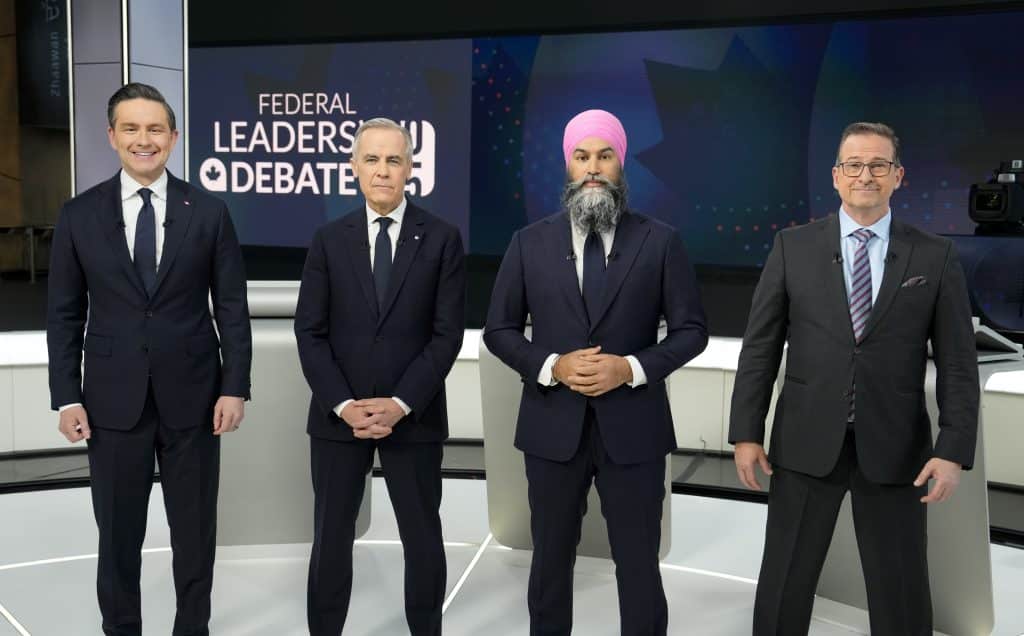
Post-debate circus does a disservice to local media
By R. Pratka
Under normal circumstances, representatives of small, local media outlets like the ones I freelance for have a slightly better chance of posing a question to a party leader than I have of suiting up for the Montreal Victoire.
That changes during an election campaign, when journalists with local outlets have a chance to buttonhole candidates and leaders at campaign stops. They also get in line to ask their questions at in-person debates. Since, as all four leaders acknowledged, the short campaign made it difficult for them to travel around as much as they would like. And since hastily-organized campaign communication operations have turned a straightforward interview with le candidat du coin into a challenge, getting in line at the debate and hoping for the best was the only chance many journalists had to get a question in.
The (exceptionally) open accreditation system for the debate and the post-debate scrum was clearly designed to give access to smaller, independent outlets alongside larger media — as the assignment editor of a minority-language paper in Quebec City with a circulation of less than 2,000, I was surprised and delighted to get my pass.
After the French debate on Wednesday, Rebel News and other right-wing outlets successfully gamed the open system in place to ask long, agenda-heavy questions, which ate up time during the already-short question periods (11 minutes!) that journalists had with each leader. The next day, in the lead-up to the English debate, arguments between those reporters and reporters from other outlets boiled over in the media room. Leaders’ Debates Commission (LDC) director general Michel Cormier to cancel the question period, stating that the commission could not guarantee a “propitious environment” for it.
As Isabelle Hachey of La Presse wrote, the LDC was mandated to ensure “more predictable, reliable and stable” leaders’ debates.
They dropped the ball — once when the French debate was rescheduled with a day’s notice to reduce overlap with a hockey game that had been scheduled for months. Again, when Green Party Leader Jonathan Pedneault was declared ineligible with less than 12 hours’ notice. And again when they rather tamely gave up on organizing a question period that was the only chance small-town and minority-language outlets like mine would ever have to speak with party leaders.
Minority communities, including Indigenous and linguistic minority communities, were deprived of their voices.
In principle, I love the fact that the accreditation system for the debates is so much less restrictive than that for events on Parliament Hill or at the Quebec National Assembly. I don’t support censorship. I believe the Rebel delegation had as much right to be there as anyone else, because refusing outlets based on ideology is an incredibly slippery slope. But it’s also incredibly sad that the LDC didn’t have a structure in place — a timer? A way to ensure that outlets couldn’t send more than the prescribed two journalists? — to keep the scrum from going off the rails. You had one job…
For the record, I was hoping to get a question in for Pierre Poilievre, who so eloquently defended Radio-Canada for its role in francophone minority communities — including his own Franco-Albertan community — while maintaining his commitment to defund the CBC. He argued that the public broadcaster plays a key role in informing francophone communities in their language about issues that matter to them. In a decade of working for minority-language media, I have heard the same argument in defence of CBC, from minority anglophone communities in Quebec City, in the Eastern Townships, in Eastern Quebec and on the Lower North Shore.
Is there any room for a community-centred English Quebec CBC in Poilievre’s plan for public broadcasting? Unless his campaign manager reads this and decides to send me an email, we’ll probably never know.

Indigenous rights
By Emelia Fournier
Conservative Leader Pierre Poilievre was asked Thursday if his tough-on-crime policies would disproportionately affect Indigenous people, as they are overrepresented in prisons. He replied that he cared more about the fact that Indigenous people were more likely to be victims of crime.
He said he wants fentanyl traffickers to serve life sentences in prison, make parole impossible for mass murderers, and implement a three-strikes model, where parole would include a requirement to be sober from any drugs. Indigenous people have higher rates of addiction than non-Indigenous people, according to the National Institute of Health.
In a departure from the harm reduction model used in cities across Canada, Poilievre said he wants to defund safe consumption sites and reallocate that funding to private recovery centres. This would include funding based on “success rates” — the amount of time clients stay sober after release.
Singh said he’d prefer to increase mental health and addictions services to improve public safety.
As mentioned in Wednesday night’s coverage, Poilievre wants to axe Bill C-69. He repeatedly hammered away at that point in both debates. The law imposes more robust Indigenous consultation from energy companies who want to mine or drill for oil and gas near traditional territory.
Canada’s biggest oil and gas companies want the law repealed, Poilievre said. In its stead, he would create a one-stop shop for consulting. He did not elaborate on if Indigenous people would be consulted, let alone if he would obtain Indigenous consent in this streamlined permit process.
Carney said we need to engage in “consultation with a purpose,” identify resource development projects with national interest that are consistent with long-term goals. He said that they would double the Indigenous loan guarantee program to help Indigenous people invest in resource projects on their territories.
Carney indicated that “we are in a crisis and must react with maximum force” when it comes to accelerating natural resource projects. Whether Indigenous opposition to these projects would be met with “maximum force,” like the RCMP involvement in Wet’suwet’en territory, remains to be seen. He did add later on that “You need to get First Nations and Indigenous people behind (national resource development projects).”
Singh said that he’d prefer to focus on the development of critical minerals and hydro, which would require consent of local communities affected along with Indigenous support. Blanchet says he respects Indigenous nationhood, but he is a proponent of Quebec’s Bill 96, which many Indigenous people say is a threat to their sovereignty.
In an interesting exchange, Carney said the contentious oil sands in Alberta — its development opposed by some First Nations in the area — were “made possible by Canadian ingenuity.” Blanchet interjected that the oil sands represented “the worst pollution in the world.”
On crime, Singh said he supported investing more in Indigenous police forces — something the AFNQL and other First Nations have been requesting the Quebec government take on.
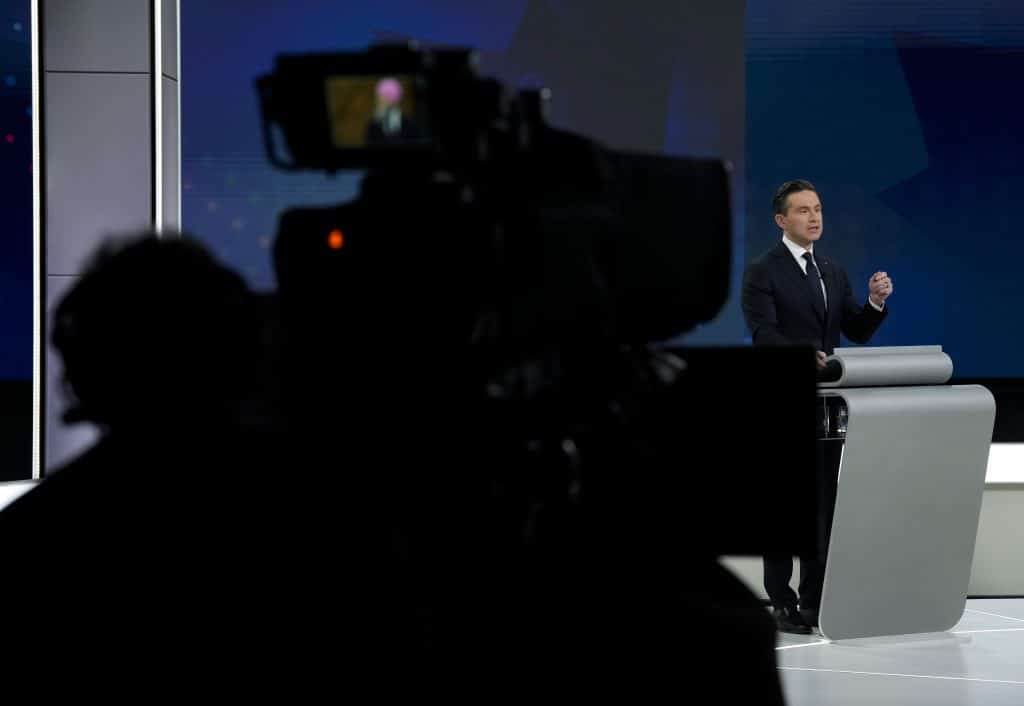
Crime and Punishment
By Isaac Peltz
The four leaders discussed crime tonight.
Most of it was not rooted in fact. Bloc Québécois Leader Yves-François Blanchet didn’t even discuss the subject, and instead pushed his talking points on immigration, and how there is no order around the introduction of immigrants to Quebec specifically.
Carney wants to stop protestors from blocking off certain routes, specifically around places of worship — an unsubtle nod to Gaza protesters. Poilievre wants to ignore parts of the Charter of Rights and Freedoms in order to protect the Charter of Rights and Freedoms, and seems relatively convinced that we live in complete anarchy in Canada. Singh believes that crime needs to be stopped before it happens by increasing social services and blocking drugs and guns from the border. Let’s break it down one by one.
Blanchet was asked if he had anything to say about fentanyl. He replied by saying that questions about fentanyl have little to do with Quebec and mainly concerns the west. This is not true. He instead discussed immigration, and said that Quebec didn’t want to have so many immigrants. There isn’t much to say about Blanchet’s response, since it didn’t have much to do with crime. At the best, we can say he wants to secure the borders, but not against drugs or gun smuggling, but against immigration.
Poilievre claims Canadian families are afraid to go outside. He told several stories about people on the street, multiple time murderers who have been released without serving their sentences. This is not remotely true. In fact, many things that Poilievre said during the debate were falsifications, although not outright lies like we’ve seen in the United States with Donald Trump.
Poilievre’s three-strike laws, if he wins the race, will most likely be deemed illegal by the Supreme Court. They reflect US Bush-era laws that have led to the USA having the highest incarceration rate in the world. Meanwhile, he also wants to use the Notwithstanding clause in order to force through some other laws. These are likely to be called cruel and unusual punishment by the Supreme Court. These are the same laws that Harper tried to implement, and got shot down — although Harper didn’t use the Notwithstanding clause. In brief, even if Poilievre were to win and tried to push through these things, it would be unlikely that he would wind up being able to.
Carney wants to bring back gun buyback programs, which were poorly organized, and, generally speaking, wrongly targeted. It was a large investment of public resources when legal guns are not the problem. Guns being smuggled in from the United States are increasingly common and are usually what is used in violent crime. Carney did speak about significantly increasing the number of border agents, which would be a more effective use of resources, since most fentanyl and weapons are brought in from the States. He also addressed that federal governments shouldn’t use the Notwithstanding clause, saying that the charter is to protect Canadians from the government — which is true. Overall, he didn’t have a lot to say about crime.
Singh argued for preventative measures and community-based solutions instead of police tactics or punishment tactics. He wants to increase social systems that would help people before problems occur, and increase border security. This has been proven to be the best way to prevent crime and is backed by data. Another effective way to reduce crime is to reduce poverty, which seems to be a priority of Singh’s. Overall, it seems that his proposals were the strongest of the four.
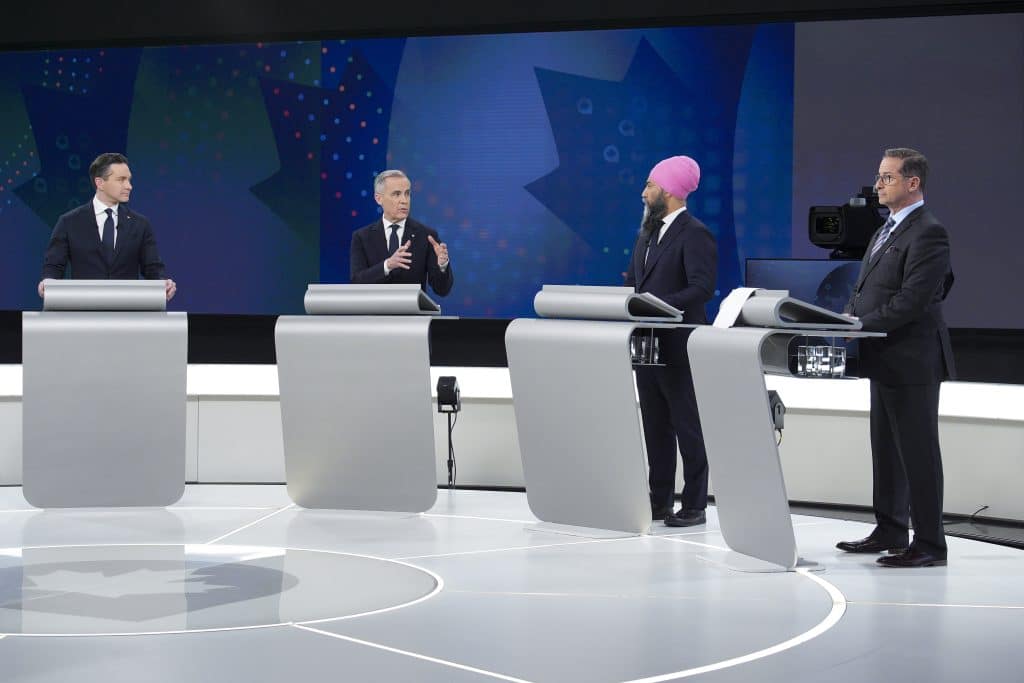
Housing plans slowly, slowly trickling in
By Savannah Stewart
The leaders had more to say about their housing plans tonight than they did during the French language debate, but not by a whole lot.
Mark Carney is emphasizing the construction of new homes, promising to use Canadian lumber, Canadian tech and Canadian workers to build at the fastest pace since World War II and double the rate of homeowners in the country. Left unsaid was where Canada would get the skilled trade workers for this, as the country is still in a labour shortage — an issue that has been left on the back burner so far this election.
Both Carney and Pierre Poilievre agree on the need to cut development costs, at least some of that taking the form of tax credits, and Carney and Singh agreed on removing the GST for first-time homebuyers (Poilievre would cut the GST for everyone). Poilievre repeated that governments need to get out of the way of housing developments, decrying the bureaucracy and red tape surrounding housing construction. He’s said in the past that he would withhold money from municipalities that don’t get housing projects approved fast enough, and reward those who do.
And renters?
Quebec is a renters’ province. Not surprisingly, only Bloc québécois leader Yves-François Blanchet and NDP leader Jagmet Singh presented measures that could have tangible effects for renters. Both brought up the need for more social housing, with Blanchet focusing on providing funding for municipalities to build, and Singh focusing on using federal land for social housing projects (like in the Bridge-Bonaventure sector, a large swath of public land just south of downtown Montreal that sits waiting to be developed). Singh also wants to “ban” corporate landlords from buying up multiple units, but it remains to be seen how.
Prior to the 1980s, the federal government had a significantly larger role to play in the housing file than it does now, as it spent the end of the 20th century passing its powers down to the provinces. This can partly explain the lack of imagination demonstrated by the federal parties, but doesn’t mean the federal investment shouldn’t have a role to play in social housing, which is one of the only ways to build housing that is guaranteed to remain affordable long-term.
It’s worth asking the Liberal leader why he’s been silent on federal assistance in social housing construction up till now, which we would have tried to do had the question period not been cancelled tonight and derailed by right-wing provocateurs last night.

The minority will never be Canadian enough
By Iness Rifay
During the French federal elections debate question period Wednesday, the Liberals’ Mark Carney delivered an expected but frustrating response when he was asked about the “amount of genders there are.”
Not only that, but he accepted the question from TrueNorth, an infamously far right outlet.
“In terms of sex, there are two,” Carney responded. He thanked the reporter for the exchange.
In January 2025, Poilievre stated that he is “only aware of two genders” and the year before, that “female spaces should be exclusively for females, not for ‘biological males’.” The “how many genders” question from True North to Carney delved into similar territory.
There were no other mentions of transgender people in the French or English debates, despite the fact that transphobic discourse from the United States has echoed in Canadian politics. We’re seeing it in other G7 countries too, like the April 16 United Kingdom Supreme Court ruling that the legal definition of a woman is bound by what the court considers a “biological woman.”
There were also no questions regarding the recognition and regularization of the half a million undocumented immigrants currently in Canada, who fill jobs that are essential to the the Canadian economy. In the English debate, Poilievre mentioned Canada’s weak borders due to the “flawed” temporary immigration program.
“People coming here have to leave their foreign problems behind,” Poilievre said.
While the candidates voiced an importance to maintain support for Ukraine in its besieged state, there was no effort to recognize Israel’s genocide in Gaza. That is, outside of NDP Leader Jagmeet Singh demanding Carney call it a genocide. Carney mentioned a two-state solution was necessary for peace in the region but otherwise avoided speaking about Gaza. Poilievre and Bloc québécois Leader Yves-François Blanchet both said its essential to destroy Hamas.
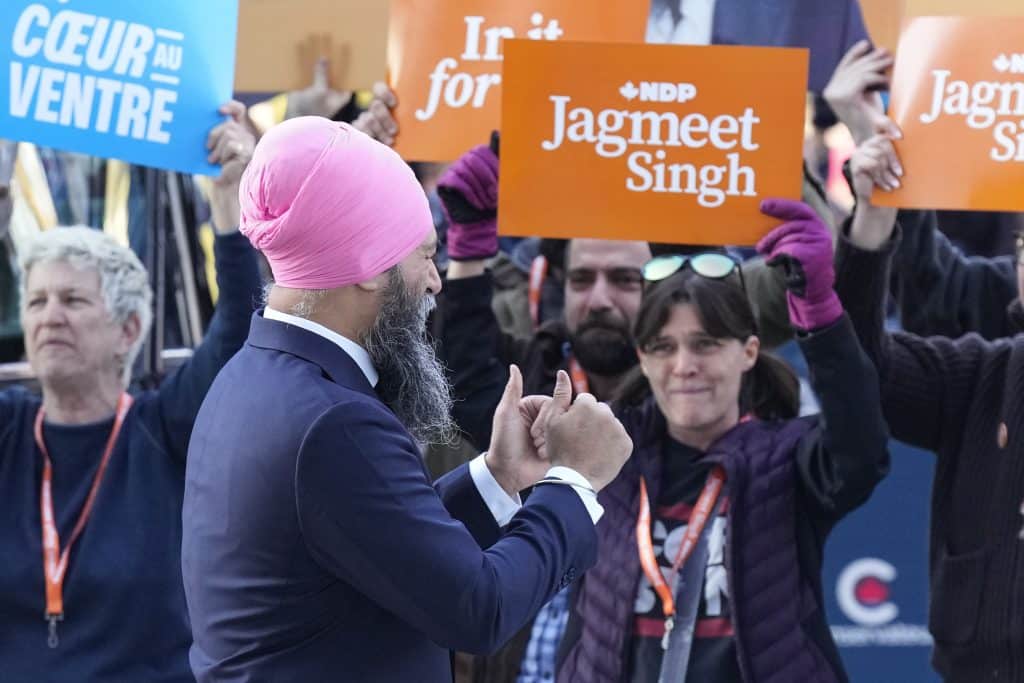
Jagmeet’s Last Dance
By Christopher Curtis
The Leader of the New Democratic Party struggled to get a word in edgewise.
That was the story of Thursday’s debate for Jagmeet Singh but it also sums up his eight years as leader of the NDP. And it’s entirely possible that Thursday’s debate — which saw Singh clock in just 20 minutes of total talking time to Liberal Leader Mark Carney’s 30 — was Singh’s last as party leader.
Throughout both debates, Singh touted the New Democrats’ ability to secure legislative victories from Trudeau’s Liberals in exchange for keeping the scandal-plagued government out of an election. The Liberal’s Pharma care, dental care and childcare plan were all passed with the cooperation and influence of Singh’s party.
“The New Democrats are there to make sure the Liberals think about people they forget,” Singh said, during Thursday’s debate. Even in his most optimistic projections, the NDP Leader never seemed to see himself as a prime minister in waiting.
Singh did well in spurts, pushing for more substantive discussions on Gaza, healthcare and price caps for essential food items as France and Greece have implemented. He also linked Carney’s history as an executive at Brookfield Asset Management and the company’s practice of buying up rental properties in bulk and jacking up the price.
But Singh could never keep Carney pinned against the ropes — yes, another boxing metaphor in federal debate coverage. At a time when housing costs have doubled in the past 10 years and government services are quietly being privatized across Canada, Singh should have had an easier time working Carney over.
Of course, it’s hard to just blame the NDP leader. He was struggling before Trump started the trade war and now that Canadians are up against a wall, it seems no one sees him as the one to lead us to victory.
CORRECTION: This article previously stated that Poilievre would cut the GST for first-time homebuyers. In fact, he would cut the GST for everyone. We regret this error!
Authors


Related Articles
McGill Spent Over $1 Million Fighting Unionization
Union organizers at the university say this is part of a broader trend towards corporatization of the public institution.

Rent Increases Set to Worsen the Housing Crisis
Experts warn that homelessness continues to grow as Quebec’s housing tribunal proposes a new way to calculate rental increases.

As Media Habits Change, Montreal’s Christmas Fund Takes a Hit
The Montreal Gazette’s Christmas Fund has supported struggling families across the city since 1967. But as newspaper readership declines and consumer habits shift, shrinking donations mean this year’s cheques may have to be cut.
Comments (0)
There are no comments on this article.