
Threats of “SLAPP Suits” Undermine Student Democracy at Vanier and Dawson
Legal notices filed by pro-Israel lawyers targeted a student newspaper and prevented an association from amending its own bylaws.

This is an English translation of an article from Pivot. Read the French original here.
Threats of legal action caused the Vanier College Student Association to back down from its plan to allow its student clubs to engage in political discussions. At Dawson College, a cease-and-desist letter targeted a student newspaper that published an issue on Palestine. In each case, these actions were taken on behalf of anonymous students by lawyers known for their Zionist positions.
Last May, the Vanier College Student Association (VCSA) received a cease-and-desist letter. It was filed on behalf of two anonymous students and aimed to prevent a vote from being held at an upcoming general meeting.
The student association wanted to propose amendments to one of its bylaws, which requires its executive council and student clubs and committees to maintain a position of “political neutrality.”
The amendment was intended to clarify this obligation, considered to be broad and vague by members of the executive council. Its primary aim was to free clubs from their duty of political neutrality on issues relevant to college student affairs and in the context of political discussions that are “educational in nature.”
However, the principle of political neutrality would have continued to apply to other entities of the association, such as the executive council, explicitly including neutrality in the context of “geopolitical conflicts.”
The formal notice, sent to Pivot by anonymous sources and authenticated by Pivot, is signed by Michael Hollander, of the firm Choueke Hollander. It states that these amendments would likely “expose the Vanier campus to radical activism” and that such changes would be detrimental to Hollander’s clients, notably by giving more freedom to the Palestinian student club.
At the time the document was sent, the intentions of the advisory committee responsible for proposing these changes to student policies had not been made public — nor would they ever be.
This is not the first time the student association has received this type of legal threat. In December 2023, another formal notice was filed for the same reasons by an anonymous student, this time signed by another lawyer, Neil Oberman of the firm Spiegel Ryan.
Although the two letters are signed by different lawyers from different firms, their wording is remarkably similar. For example, they state that the proposed amendments are being put forward by “internal and external organizations” as well as “student groups” whose goal is to “promote hatred and intolerance against an identifiable group.”
“The resolution will be used to bring extremist groups, ideas, and actions to Vanier campus,” both documents state.
In each case, these formal notices succeeded in getting the student association to back down, arguing that the proposed amendments would violate its bylaws and “be detrimental to the well-being of students.”
The amendments were never presented to the entire student body, and no legal action was taken, according to information gathered by Pivot.
“I think that letting this prevent us from presenting something to the general assembly is what violates our regulations,” explains Sasha*, a student at Vanier College who was part of the advisory committee that proposed the amendments.
“Apart from elections, general assemblies are the only place where students can express themselves freely and vote on specific issues,” Sasha said.
“They weren’t given the opportunity to make their voices heard.”
Similar situation at Dawson
At Dawson College, Oberman is also involved in other similar actions, notably one targeting the student newspaper The Plant.
On November 16, the newspaper published an issue devoted to Palestine, immediately sparking debate on campus.
The day after publication, the newspaper’s editorial staff, the Dawson Student Union (DSU), and the college administration received a formal notice signed by Oberman, representing 23 anonymous students.
The students claimed to have been exposed to “aggression, bullying, threats of violence and anti-semitism on campus,” due in part to the actions of the student newspaper.
“It was so vague,” said Sanad Hamdouna, one of the newspaper’s contributors, in an interview with Pivot.
“The Plant was accused of promoting hatred towards Jewish students, without specifying how.”
In the document, the complainants request that all “articles, cartoons, and statements” deemed “anti-semitic,” be removed, without specifying which ones — only one cartoon, initially published in Mondoweiss, is directly singled out.
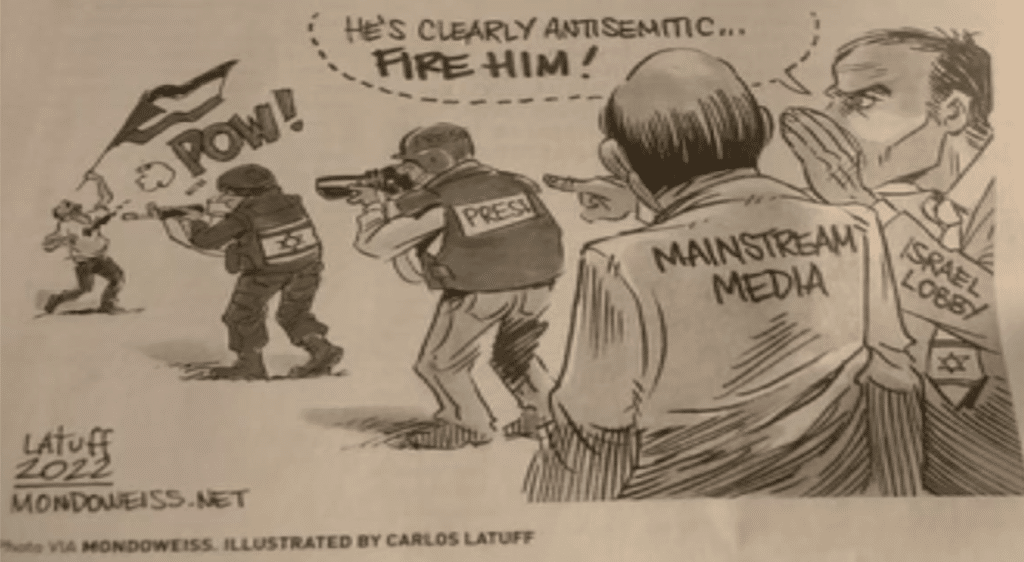
The formal notice states that “All persons involved in the dissemination of hatred and anti-semitism will be held accountable under the law.”
The Plant is also asked to publish a “counter-article in the same size and format” to “correct the anti-semitism.”
A few days after the formal notice was sent, the college and the student association issued statements distancing themselves from the newspaper.
On Dec. 11, 2023, Oberman signed a second formal notice, this time addressed to the student newspaper alone. The complainants are not named in the letter, which refers only to Oberman’s clients as “students.”
This time, the document lists four articles and a cartoon deemed problematic and “rooted in anti-semitic discourse,” without elaborating on these allegations. The newspaper’s editorial staff and contributors were asked to submit a letter of apology and remove the articles in question, failing which “immediate legal proceedings” will follow.
“We were just trying to understand what they wanted,” says Sanad Hamdouna.
Through its lawyer, Mark Phillips, The Plant first attempted to negotiate with Oberman. The formal notices contained “broad and unclear complaints,” Phillips said in an interview with Pivot.
“From what I could gather from the somewhat vague, but quite intense and vitriolic letter — the core was this issue of the magazine that had been published that was highly critical of the actions of the State of Israel,” he explains. But, “the accusations that were made were in my view totally out of line and had no bearing on the criticisms of Israel.”
Following the recommendation of its lawyer, the student newspaper refused to comply with the demands, and to date, no legal action has been taken.
“Personally, I was determined not to comply with their demands and was prepared to go to court if necessary, but it never came to that,” says Sanad Hamdouna.
Nevertheless, the whole affair caused a great deal of stress for the students targeted by the formal notice, who felt they were being watched, not knowing whether their classmates were behind the judicial action against them.
“I remember when I was at school, I was extremely anxious in the hallways,” says Aimé*, who contributed to the newspaper at the time. She also claims to have experienced bullying from other students after the first issue on Palestine was published.
SLAPP suits?
“Formally, a demand letter is kind of a formal notice to give someone the chance to bring themselves to conformity with the law, to avoid going to court,” summarizes Phillips, who represented The Plant.
However, “In practice, there’s an element of intimidation in there too to be totally frank, often lawyers are trying to exert pressure — not just give warning, but exert pressure,” he said.
“But I found in this case, with the letter that The Plant received from Neil Oberman and some of my immediate communications (with him), that was really intensified, beyond what I generally remember seeing in other cases like this.”
“I can’t reach inside Oberman’s mind to know exactly what he was thinking, but based on the facts that I could see, based on the really intense threats being sent out to other campuses across the city, it seemed to me this was mostly an attempt to silence criticism of Israel, more than anything else.”
If the case involving The Plant newspaper had gone to court, Phillips says he would have argued that the lawsuit was a SLAPP suit (strategic lawsuit against public participation), intended more to threaten and intimidate his clients than to obtain compensation for a real grievance.
Two lawyers with Zionist commitments
Outside of their legal practice, on social media, Oberman and Hollander make no secret of their pro-Zionist positions, i.e., the promotion and defence of the State of Israel. In this regard, they seem to share the views of their clients at Dawson and Vanier.
Oberman, who ran in the last federal election for the Conservative Party, is also involved in a number of legal actions against the pro-Palestine movement on university campuses in Montreal.
For example, he supported student groups calling for the cancellation of a presentation by the United Nations Special Rapporteur on the Occupied Palestinian Territories, Francesca Albanese, at McGill University in the fall of 2024. In posts on X, he accuses the lawyer of giving “anti-Jewish hate lectures,” thus conflating criticism of Israel with anti-semitism.
Also at McGill, Oberman had requested an injunction against the student encampment in support of Palestine in May 2024.
In January 2024, at Vanier College, Oberman also signed another formal notice addressed to the college’s administration and targeting a literature course on Palestine. He requested that his clients be exempted from the course, which was granted by the college.
However, email exchanges with the administration obtained by Pivot show Oberman’s insistence, as he still asked to know what would happen to the course content.
In a number of legal documents reviewed by Pivot, Oberman represents students who attend the institutions concerned, but whose identities are kept secret.
Only some of these cases were ultimately brought before the courts.
On social media, Oberman also indicated that he had filed a complaint that led to ministerial investigations at Dawson and Vanier Colleges, launched in November 2024 to determine whether the institutions had adequately protected their students in the context of the protests surrounding Palestine.
The lawyer said he was satisfied with the report resulting from these investigations, which targeted pro-Palestinian groups and suggested tightening the supervision of student associations. The report was strongly criticized by teachers and students at both institutions, who pointed out several factual errors.
“We filed a complaint because it needed to be filed,” said Oberman on social media after the report was released last June. “Strong independent students stood up and were heard — not only them, their parents. And we’re very proud of that, because not only the lawyers have to do the job, it’s a community effort.”
It should be noted that while the legal documents conducted by Oberman were a source of stress for the targeted students interviewed by Pivot, particularly at Dawson, the ministerial investigation report, which was supposed to highlight the climate of fear in these two educational institutions, makes no mention of this.
On social media, Oberman frequently attacks the Liberal government, targeting in particular his opponent in the last election campaign in the riding of Mount Royal, Anthony Housefather, whom he accuses of not sufficiently defending Israel on the international stage.
During his election campaign, the lawyer also promised to cut funding to universities that did not do enough to combat anti-semitism on their campuses.
The second formal notice sent to the Vanier College Student Association regarding the updating of its regulations was signed by Hollander of the Choueke Hollander law firm.
This lawyer was involved in a similar case at Concordia University in December 2024, representing the Zionist student club Start Up Nation in its effort to block amendments to the student association’s regulations. The changes could have caused Start Up Nation to lose its club status.
On his Instagram profile, Hollander posts videos promoting Zionism, arguing that criticizing the State of Israel is contrary to the religious prescriptions of the Torah. In a more recent post, following the Canadian government’s recognition of the Palestinian state, Mr. Hollander describes Palestine as a “fictitious” country.
Although they are affiliated with separate firms, Hollander and Oberman share similar political views, particularly on Israel and Palestine, and they collaborate on cases related to this issue in Montreal.
This was the case, for example, in December 2024 at McGill University, where the two lawyers attempted to block the ratification of the undergraduate student association’s policy on anti-semitism, which distinguishes between anti-semitism and criticism of Israel. Last April, the Quebec Court of Appeal finally ruled in favour of the association, deciding that preventing ratification violated students’ freedom of expression and democratic rights.
On social media, Oberman and Hollander appear together in posts and videos.
For example, Hollander supported Oberman’s federal election campaign in November 2024. In a video posted on social media, he even admitted to having crossed party lines, now preferring the Conservatives to the Liberals, particularly because of “changing times,” especially “since October 7.”
Oberman and Hollander declined Pivot‘s requests for interviews, stating that they did not have their clients’ permission to discuss these matters. Hollander also declined to answer our questions submitted by email. Oberman declined to receive questions from Pivot by email.
Author

Comments (2)
Leave a comment
Related Articles
Guilty Until Proven Innocent: A Man’s 12-year Battle with Revenu Québec
Quebec’s tax agency freezes retirement savings, seizes assets and “ruins lives” with investigations based on mere assumptions.
School Board Votes to Support Candidate who Smeared Rival, Acted in ‘Undignified’ Manner
Julien Feldman gets off scot-free after falsely associating his rival candidate with antisemitism and referring to her as “Ms. Gaza.”

« Je veux juste qu’on me croie »
Victime d’une agression sexuelle alors qu’elle travaillait pour le gouvernement provincial, une femme lutte avec Québec depuis cinq ans.
Oh no, the spooky evil zionists are at it again. Someone stop them already! How dare they speak up against discrimination and harassment, and for Jewish civil rights. They should know their place, and they should know that no one gives a rat’s a** about Jews, especially not leftists/progressives who normally love to pretend that they support marginalized minorities. Thank you Rover for your excellent journalism. Maybe next time you’ll actually reach out to one of these spooky zionists and ask their side of the story. But what do I know, I’m not a journalist.
Alex, maybe next time you’ll actually read the article you’re commenting on.
“Oberman and Hollander declined Pivot‘s requests for interviews, stating that they did not have their clients’ permission to discuss these matters. Hollander also declined to answer our questions submitted by email. Oberman declined to receive questions from Pivot by email.”