
Toxic Secrets: A Dirty Deal in Blainville
American-owned toxic waste company Stablex is drawing backlash over a provincial government-backed expansion plan that would devastate a nearby wetland.
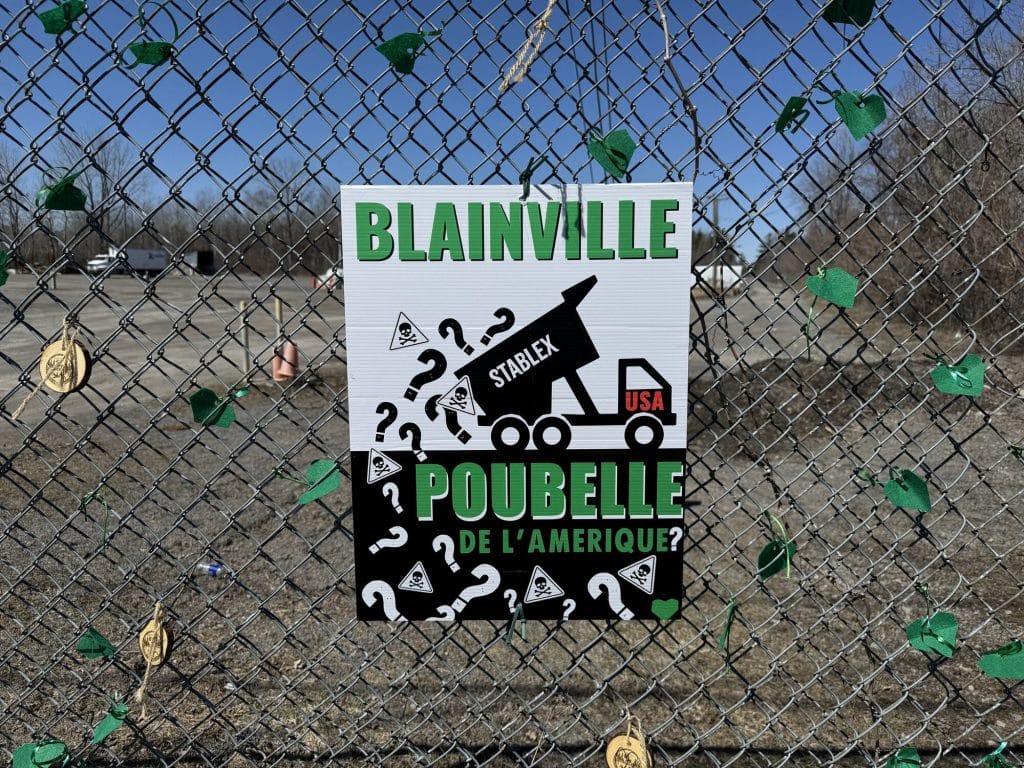
As the mid-April spring breathes life into the thawing permafrost, a lone goose returns home after another brutal Quebec winter. But where it once found shelter in a lush forest, it now sees only ruin — millennia of habitat shredded by the woodcutter’s blade, splinters flying like shrapnel, as the scent of sap hangs in the air.
It lets out a haunting cry — a lonely wail for its vanished flock, echoing across the scarred landscape.
Something sinister is unfolding in Blainville.
Since 1981, Stablex — a privately owned American toxic waste company — has operated a dumpsite in Blainville, just north of Montreal, on land bordering La Grande Tourbière marshlands at the edge of the city.
The dump has made headlines in the past few weeks thanks to a very public dispute involving local citizens, the city of Blainville, and the Coalition Avenir Québec (CAQ) government, amid the backdrop of a trade war between Canada and the United States, with its plans to expand into the wetland.
On March 28, the CAQ rammed through emergency legislation, Bill 93, described by the opposition as tailor-made for the American company. This effectively forced the City of Blainville to sell over 60 hectares of public forest land to Stablex, shut down debate at the National Assembly and granted the company permission to bulldoze ahead with construction.
Support Independent Journalism.
“This area was like a zoo — it was full of animals. I saw beavers every day, along with turtles, birds, and even moose,” said Louis*, a 35-year Blainville resident and former employee of Orica, a nearby company that once operated on land within the wetlands, now earmarked for Stablex’s expansion.
“It was incredible to see the wildlife there; the area was thriving, but Stablex doesn’t care. They don’t care about the animals, the wetlands, or your health; they just want that hole. They tell us that they’re doing us a favour, that they are clearing out a forest of weeds, but this place was alive,” he said.
“There is something really fishy going on here, and I cannot understand why more people are not looking into this.”
Stablex has argued that suspending operations would leave hundreds of Quebec companies without a safe place to dispose of hazardous materials. However, over 40 per cent of the waste processed at the site comes from outside the province, with nearly 30 per cent arriving from the United States — although Stablex disputes these figures.
The company has also claimed that if it doesn’t begin construction imminently, it will reach capacity by 2027, despite conflicting studies showing that the site has until 2030 before its limit is reached.
The city of Blainville says the expansion threatens the nearby wetland and ancient forest. It disputes the company’s urgent timeline and says Stablex has rejected an alternate site proposed by the city because it would cost more money than expanding current operations into La Tourbière.
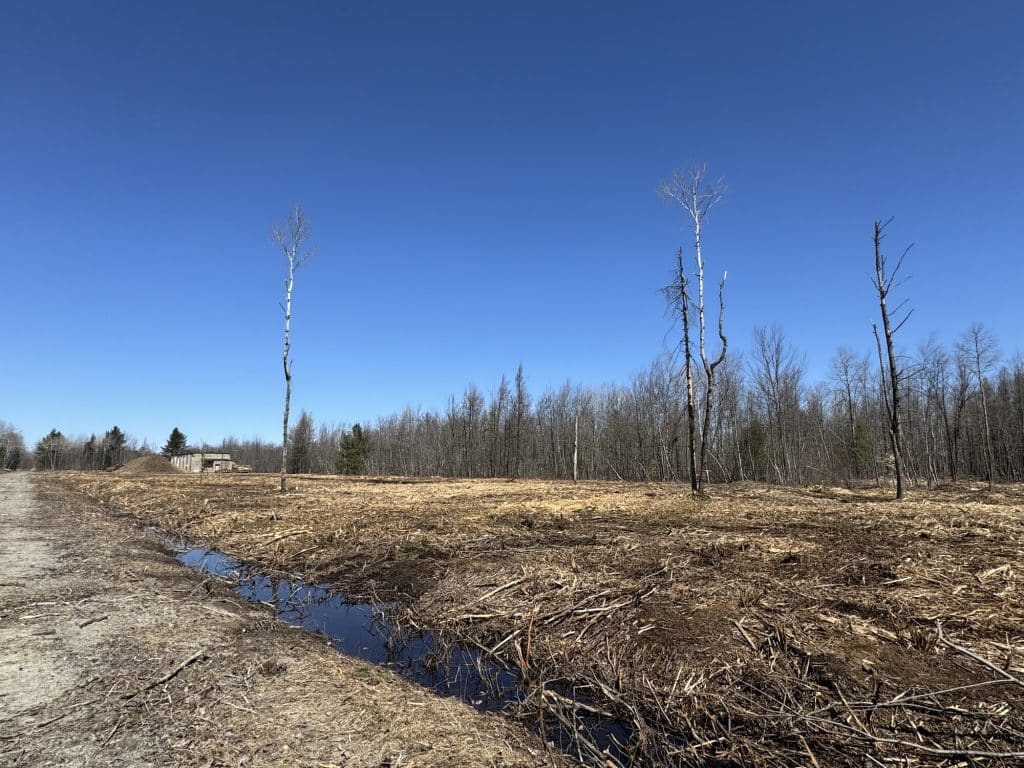
To make matters worse, independent water testing supported by Mères au Front has revealed severe contamination in the surrounding wetlands, confirming that Stablex’s dumpsite is already leaking into surface waters. Cadmium — a carcinogenic toxic metal — was found at levels over 340 times the acceptable limit in a ditch near the plant, alongside high concentrations of copper, chromium, arsenic, and nickel.
This stands in contrast to the company’s claims that its hazardous waste is safely treated and contained within lined dumpsites to prevent leakage. Maxime Couture, an associate with Stablex, spoke on the independent test results, denying that the high cadmium levels come from the site.
“We don’t know which cadmium level they are referring to. There is a high level of cadmium that can be found in nature. That could be in a field, a lake, a river, or in drinking water,” he said.
“We don’t know which level they are talking about. It’s possible that they may have interfered with the testing when they were doing it. Even the environmental minister came and said that there was no trace of contamination.”
Still, the CAQ government insists Bill 93 is necessary to protect public services, brushing aside concerns raised as early as 2023 by Quebec’s own environmental watchdog, the Bureau d’audiences publiques sur l’environnement (BAPE), which concluded that Stablex’s practices were outdated and recommended against expansion.
In early April, Stablex rushed to begin clearing trees on the property. The company was racing against an April 15 deadline, when federal protections for bird nesting sites would come into effect. However, Bill 93 shields Stablex from legal consequences for any actions taken before that date, effectively allowing it to bypass due process.
The move has sparked backlash, with protesters maintaining a daily picket at the site entrance. A larger demonstration on April 12 aimed to halt the clearance, but what unfolded that day revealed even darker realities to all those present.
Anne-Marie*, a local health worker, chained herself to the entry gate to delay the machinery. What followed left her fearing for her life.
“I got to Stablex early that morning. Some people made it inside to try and stop the machines,” she said. “They were begging the workers to stop, but they completely ignored them, endangering everyone.
“The police just stood there, watching. They did nothing, even though it’s illegal to operate heavy machinery with civilians nearby and no safety equipment.”
Workers allegedly continued felling trees at full speed, sending splinters flying toward protesters.
“It was really reckless. It’s a miracle only one person was seriously hurt,” Anne-Marie said.
While others were inside the site perimeter, Anne-Marie remained tied to the gate by the neck as police approached.
“I was sitting on the ground, the lock around my neck, and they towered above me, maybe six or more,” she said. “They started pushing the gate. I couldn’t breathe. I begged them not to touch the lock because it would strangle me. But they didn’t listen. They didn’t care.”
“I was lightheaded; I couldn’t breathe. Every move they made tightened it again and again. It was terrifying.”
It took nearly 40 minutes before she was freed. But the psychological toll has been lasting.
“To be honest, I’m really fearful of the police now,” she said. “I’m scared that someone knows my face, my address. They are not a resource for us. From what I experienced that day, it is clear that they’re not here to protect us.”
Anne-Marie’s account echoes the growing fears of Blainville residents: that when it comes to Stablex, they are up against not just a powerful corporation but a government and police force seemingly more interested in protecting private interests than public ones.
“We’ve done everything — petitioned, demonstrated, spoken to the city. We’re fighting a project that could generate billions for a foreign company while destroying our wetland and our local economy,” she said.
“But against this kind of power? We’re alone. How safe can we be against these types of people? We have nothing that resembles the power they have. This is not democracy.”
Others at the site shared similar fears. Among them were local residents Audray Garneau and Danny Duquette, both regulars at the daily pickets, who said the events of that day only deepened their sense that something sinister was at play in their town.
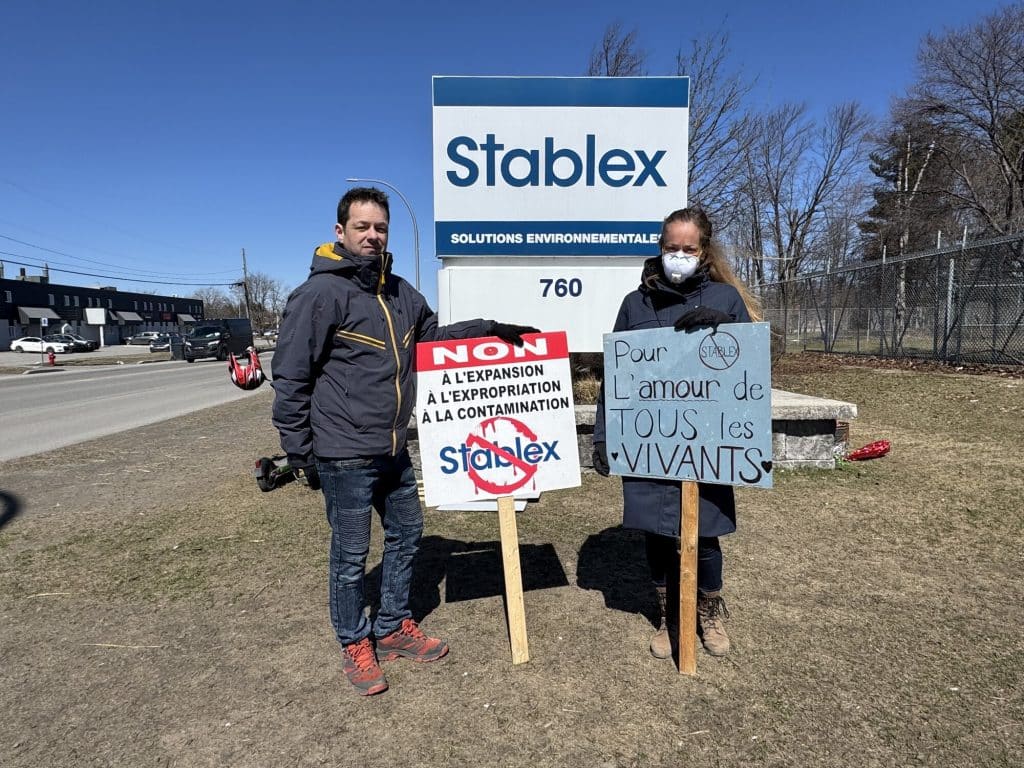
“The police were not there for the protestors. They were there to give a show of force and intimidation to us,” said Garneau. “There is something really strange going on here; it really feels like a scary movie.”
Stablex has also hired a private security firm that allegedly follows and photographs those who pry too closely into the plant’s affairs — a tactic some believe is designed to scare away dissenters. Duquette shared Garneau’s point of view.
“There’s an omertà going on here between the powers involved. We need transparency,” he said.
“We’ve asked questions, but the information that has been given to us makes no sense, and it was very surface-level. They gave very vague responses, but people are asking very specific questions. All they are saying is everything is fine; don’t worry. So what is really going on here? We deserve to know.
“The show of force was because citizens demanded answers. It seems there is nothing anybody can do about Stablex. Not even the government. It’s a bit like the population’s hands are tied, like they’ve stuck a rainbow on it and expect us not to ask any questions about what they are doing.”
Meanwhile, Stablex’s representative, Maxime Couture, said he has little knowledge of any such tactics of intimidation by either local police or the company’s own private security firm.
“I don’t have any information on that; I don’t know what you’re referring to. There are a lot of issues with the security of the site,” Couture said. “Like any industrial site, we have private security. We need to avoid people coming on site, but as I said, I don’t know anything about taking pictures of people. I don’t have any information about that right now.”
There are fears about what is happening beyond the gates of the plant, — and whether a public health risk is being quietly covered up behind the scenes. “My biggest fear is that the population will be contaminated. If we rely on the surface-level tests on the rivers, then we can already see that the water is extremely contaminated,” Garneau said.
For Louis, who worked on-site and lives locally, the situation has become unbearable. He is now in the process of selling his home of 35 years and moving someplace far away from Stablex’s toxic shadow.

“I really do think that the water we drink is contaminated; we’re all too sick, and it’s too late by now to do anything about it,” Louis said. “I think the government knows what’s going on, and it’s too late, so they’re just trying to cover each other’s ass.”
“They are all linked: Stablex, CAQ, and the police. The cops will ignore the laws being broken by Stablex, but they will kick you out for trying to protest it and highlight it.
“Just imagine if someone came out publicly and said that Stablex is a wasteland and it’s dangerous; imagine how much it would cost. No one would want to buy a house anywhere near here.”
Meanwhile, the fight to save the wetland continues. Every morning, a small picket of dedicated locals keeps watch as trucks filled with hazardous waste line up outside the plant.
On Thursday, May 1, an activist, perched on a wooden structure chained to the perimeter fence at the entrance to Stablex, blocked access to the site and demanded an immediate halt to expansion. Blainville police are said to have charged the activist with mischief and obstruction.
Speaking in a press release, the activist involved, Samuel Touchette, called for action against the expansion project.
“This project is being imposed by force and disregards the ecological value of the Great Peatland,” he said. “The government is once again showing that it serves the interests of billionaires at the expense of the well-being of people and nature. Resistance must grow to protect the land and its people.”
*The Rover agreed to conceal their real identity to protect them from reprisals.
Author

Comments (3)
Leave a comment
Related Articles
Ombudsman Rules in Favour of Student Suspended for “F*ck Israel” Post
The English Montreal School Board was ordered to retrain staff on its anti-bullying policy and students’ rights.

Will Bill 21 ‘Erase’ a Generation of Muslim Teachers from Quebec?
The legal battle over Quebec’s religious symbols ban has reached the Supreme Court in a case that will make Canadian history.
Nunavik Police Get a Pay Raise Amid Community Concerns
Inuit activists say the pay raise should match police efforts to rebuild trust with the communities.
In acceptable!!!
Which region will the next ?!😵💫😡😱😱☠️☠️
Is there a petition to sign?
Petition:
https://www.change.org/p/sauvegardons-la-grande-tourbi%C3%A8re-de-blainville?utm_source=share_petition&utm_medium=custom_url&recruited_by_id=c0b90f80-c4e2-11ed-953d-b19cc959994b