
Why is Cree Territory Still Burning?
The unrelenting pace of development in Quebec’s north is turning Indigenous land into a tinderbox

Allan Saganash and his wife Lola had to flee their homes to get away from the forest fires in Cree territory. PHOTO: Diane Yeung
Allan Saganash remembers a different forest from the one currently on fire.
He knew the Waswanipi forest in northwestern Quebec as Nhodo Istchee, Cree for “hunting grounds.” His first hunting and trapping trips were with his father when he was sixteen years old, right out of residential school. Back then, in 1966, the woods of Eeyou Istchee (the People’s Land) were a lush sanctuary.
“It was teeming with an abundance of mixed forest. There were both soft and hardwood trees, like black spruce and jack pines, poplar and birch,” Saganash said. “It was a beautiful place. It was my home.”
Saganash’s home has been aflame since the end of May. Nearly 1.5 million hectares of Quebec forests have burnt this year, including the woods in Waswanipi. The areas affected total to a landmass more than 30 times the size of Montreal. As of Wednesday, 69 fires are reportedly active in the province, according to the Société de protection des forêts contre le feu (SOPFEU). A map of active fires is dotted with icons, indicating that three are currently out of control, and 24 are high-priority. At its peak, more than two dozen out of control fires were reported in June.
Various public ministries in Quebec report that hot and dry conditions, including a lack of rain, are major causes of the fires. “Hot” and “dry” refer to atmospheric conditions, which are vague and general descriptors for global warming. And indeed, it is nearly impossible to link one culprit as the direct cause of Quebec’s ongoing natural disaster.
But Indigenous experts say that Quebec’s forests have become ecologically dryer, hotter, and more flammable than ever before, and that these are symptoms caused by unrelenting development. They say the forestry, mining, hydro-electricity and tourism industries are contributing to more frequent and unprecedented fires.
“I’m looking at the fires right now on the laptop in front of me,” said Saganash, who now serves as a consultant on the forestry file for the Cree First Nation of Waswanipi. “I’ve never seen anything like this in all my life. Never.”
—
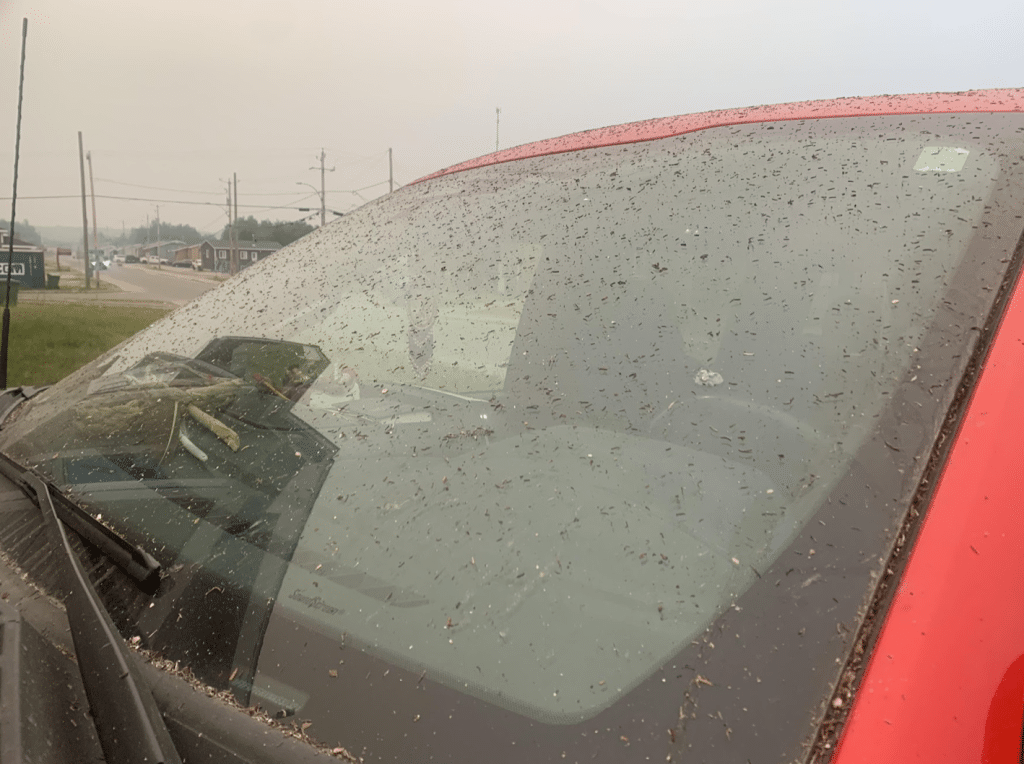
Ash and burnt wood rain down on Cree homes and vehicles. PHOTO: Courtesy Allan Saganash
The largest fire in Waswanipi began as a much smaller one.
“It grew and grew, and eventually ate the other fires around it,” Saganash said. “And now that fire is four times the size of Montreal.”
Boreal forests, which populate in northern regions throughout Quebec, are known to be particularly dry and prone to forest fires. But what’s unprecedented about the current fires is how quickly they’re spreading, making them harder to contain than past years. Third-generation Mohawk tree farmer Chuck Barnett says that if the fires seem to be spreading uninhibited, it’s because they are.
“The difference is the fires [now] are burning longer, hotter, and spreading far faster than in previous years”, said Barnett, who recently became the first Indigenous expert to consult on agro-forestation in the City of Montreal through his forest rehabilitation work in Parc Jean Drapeau.
In early 2002, the government of Quebec and the Grand Council of the Crees signed La Paix des Braves, a 50-year agreement that would allow the Quebec government to lease an established area of Cree territory for development in the hydroelectricity, forestry, and mining sectors. And as the southernmost community in Cree territory, Waswanipi is the most affected by development than any other, with “90 per cent of [its] forest fragmented by forestry development,” according to Saganash.
As the years went by, Saganash saw large swaths of his home overtaken by lumber farms, and the paved roads that came with them began to stretch like veins into the boreal forest.
Quebec’s lumber farms, which favour black and white spruce, have encroached into the northwestern forests en masse. Today, most homes are built with wood from spruce trees, because they’re relatively cheap softwood that grows straight and moderately fast compared to other species like maple and oak. But Barnett says such human-engineered environments require mono-culture farming, which means eco-diversity is sacrificed.
“A forest is a community of living things that depend on each other. And within a community, you need to have some sort of diversity. Whether it be opinion, family, biology, whatever it might be, in order to create a healthy community,” Barnett said. “A healthy community has to have diversity both in terms of humans and in terms of woodland species.”
“For forestry companies, there isn’t a financial incentive for diversity. What they’re creating is a product, and that product is usually spruce lumber, which is harvested from spruce trees,” he said.
Liquid resin — also known as “pitch” — flows through spruce and other coniferous trees. It acts as a natural pesticide, and can sometimes be used as a medicinal salve. But pitch is also highly flammable, with some wilderness survival experts suggesting that it can be used to make a fire torch.
“This resin was the Mohawk peoples’ original superglue. Now, as a kid, if you ever lit superglue on fire, you’d know that it goes into flames super fast. These trees are packed with resin,” Barnett said.
What’s worse, mono-cultured spruce farms are largely planted on razed soil, cleared of other natural elements on the forest floor, like moss and leaves. And slow-burning deciduous trees, like oak and maple, are removed in order to make way for faster-growing spruce. Deciduous trees drop leaves, which can hold up to four times its volume in moisture. Leaves and moisture-retaining moss are replaced with resin-filled pine needles littered throughout the forest floor, fueling the spread of fires.
“Typically, in a natural or Indigenous-engineered forest — and I want to specify that we were and always have been forestry managers — many of these forests were planted with a balanced approach to natural ecology management. We plant certain species not for commercial reasons, but to rehabilitate the land,” Barnett said.
Commercial tree farms are also packed with only around 16 feet of space between trees, which Barnett describes as “crammed together in an area like a crowded bus.” The effect results in a sort of wind corridor, creating a vacuum that leads to even faster spread of fire.
“So by creating these corridors of mono-cropped, highly-flammable trees, you’re setting the stage for the perfect storm,” Barnett said. “All it takes is one little ember.”
—
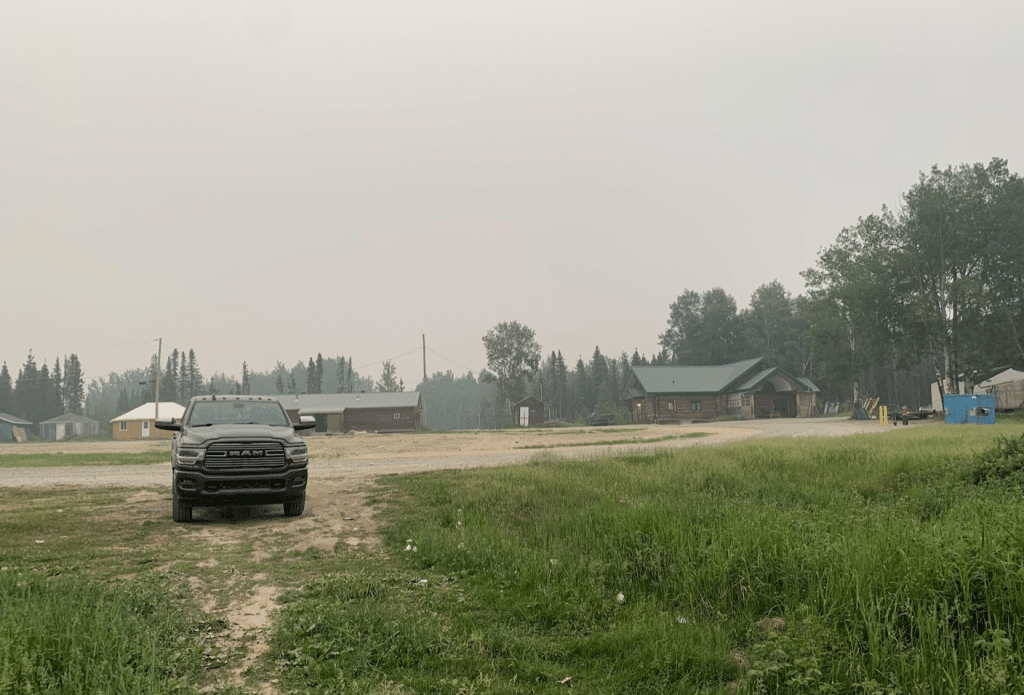
Not a cloud in the sky but smoke and ash blot out the sun. PHOTO: Courtesy Allan Saganash
Saganash was with his son the first time he saw an area he had traditionally hunted on overtaken by forestry.
“We went to one of the mountains that I always hunted on, and one day, it was just gone,” Saganash said. “I couldn’t control myself, and I cried right there.”
But it wasn’t just the forestry sector. With lumber farms came paved roads, and with paved roads came mining projects and non-Indigenous tourists. Camps belonging to non-Indigenous hunters began to crop up along the 62 traplines in Waswanipi. Among them are outfitting camps, which belong to wilderness tourism companies bringing flocks of non-Indigenous visitors into the forest.
“Where you bring humans, you bring fire,” Barnett said. “Humans love their fire no matter what it’s for.”
In a statement to The Rover, Quebec’s Ministry of Natural Resources and Forests said, “Since the beginning of 2023 (as of June 26, 2023, 1 p.m.), 254 fires have been started by lightning (about 48%), while 271 are of human or undetermined cause (about 52%). However, the areas affected by lightning fires represent 98% of the total areas affected. The lack of precipitation in the spring and early summer in the northwest of the province also created favorable conditions for the outbreak of lightning fires and their spread.”
Since the end of May, the Quebec government has banned access to forests, though some restrictions were lifted as of Thursday.
But Indigenous people say the government isn’t acting quickly enough. On June 18, a collective of land and water protectors issued a letter to the Attorneys General of Canada and Quebec, calling for a moratorium on industrial practices in the forests until the end of 2023.
“Given the unprecedented ecological disaster caused by the forest fires that devastated our
territories in the last weeks, we, traditional Ilnuash, Atikamekw, and Kanien’kehá:ka
titleholders, call for a moratorium on logging and industrial activities such as mining
north of the St. Lawrence valley for 2023,” the letter read. “Our ancestral forests can no longer be the industry’s playground.”
Kuekuatsheu Makanaskina, member of the Mashk Assi Collective that co-authored the letter, is an Innu land and water protector. He says the conservation of forests and natural environments in Quebec are tied to traditional ways of living that Indigenous Peoples hold sacred.
“We are demonstrating our sovereignty, as well as maintaining our role as the original guardians of these lands and waters,” Makanaskina said. “And we are totally within our rights to protect our lands, because we never gave our consent to [its] exploitation. And the court knows it, the companies know it, the government knows it. But they’re blind, and they continue.”
Saganash, Barnett and Makanaskina have echoed their connections to the land, and emphasize that the fires could pose detrimental and potentially long-lasting impacts on Indigenous ways of living, consequences which aren’t being considered by governments and industries.
“As a person who’s very connected to the forest, what I see out there right now — and I haven’t seen it in person yet — but I know the damage just by looking at the pictures,” Saganash said. “It gets pretty emotional. It’s heartbreaking. I’m so connected to the land, to the wildlife, to the Cree way of living. I consider the forest my home. And at the moment, my home is burning.”
Author

Related Articles
Rent Increases Set to Worsen the Housing Crisis
Experts warn that homelessness continues to grow as Quebec’s housing tribunal proposes a new way to calculate rental increases.
Montreal Leans on Condo Developers to Fix the Housing Crisis
As the number of unhoused deaths rises every year, experts say corporate interest in the housing crisis excuses the city and province from serving the public.
“I Just Want to Be Believed”
Woman wages a five-year battle with Quebec after she was sexually assaulted while working for the provincial government.
Comments (0)
There are no comments on this article.