
Quebec’s Climate Refugees
Wildfires across the province are forcing thousands of Cree to flee their homelands
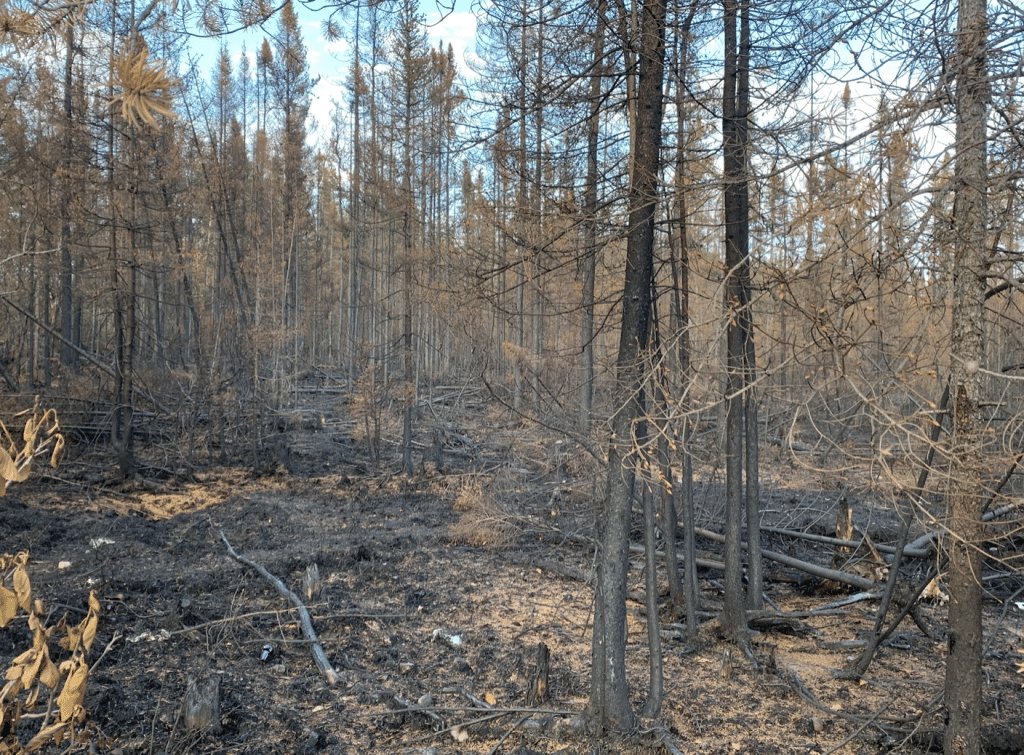
A forest fire 30 times the size of Montreal has wreaked havoc in Cree territory. PHOTO: Courtesy Allan Saganash
Wildfire smoke followed Allan and Lola Saganash everywhere they fled.
The Saganashes were on an errand in Val d’Or when they found the roads back to Waswanipi shut down due to forest fire smoke on June 2. Without notice or preparation, they were forced to find refuge in a hotel three hours from their home. For 16 days, Allan and Lola were separated from their family and Cree community.
“It’s like a second pandemic to me, these forest fires. We’re separated like COVID-19 did to us. It’s the same thing, but it’s worse because we’re all over instead of at home,” Allan said. “Some of my family went to Quebec City, some of them are in Montreal, some are in Gatineau. And we’re alone here in Val D’Or.”
Allan’s niece, Maïtée Saganash, was displaced from Waswanipi too. Before the evacuation order came, she lived under a thick cloud of wildfire smoke. The electricity was on and off, and so was cellphone reception. The water in the community was contaminated, so there was a boil water advisory too. When there was electricity, community members were advised not to turn on their air conditioners, because the air was so polluted that if it leaked into the home, it could cause permanent lung damage.
“You could see the smoke rolling in sometimes. The moon was bright red because of the smoke,” Maïtée said.
Support Independent Journalism
The Saganashes were among thousands displaced from Quebec’s unprecedented forest fires still raging through the province’s north. Innu, Atikamekw, Anishnaabe and Cree communities were among those affected by evacuation orders throughout the last five weeks, dispersed in gymnasiums, hotels, and other temporary lodging.
News of the fires entered global consciousness when it was reported that wildfire smoke from Quebec had drifted to New York City and Montreal. Images of Manhattan beneath an orange haze and punctuated with a red sun flooded headlines. Smog blanketed cities across North America, including Toronto, Detroit, Minneapolis and Chicago. By month’s end, satellite images captured by NASA revealed that the smoke had traveled across the Atlantic, affecting Portugal, France, Spain and other parts of Europe. And those were just from the fires in Quebec. Record-setting wildfires have been ravaging forests in Alberta, Nova Scotia and Ontario since March. As of Tuesday, a total of 51 active fires were reported in the province, with some reportedly moving north, towards the Cree communities of Waskaganish and Wemindji.
As the world scrambled to make sense of what the Air Quality Index (AQI) meant, and whether it was still safe for people to participate in outdoor activities like jogging and picnicking, Indigenous communities in Quebec’s north were faced with far greater concerns: becoming climate refugees on their own land.
“This is clearly due to the climate crisis, things we’ve been saying over and over for decades now. Climate change that is exacerbated by resource exploitation on stolen land and resource theft that’s still ongoing in our territory. And now our homelands are burning,” Maïtée said.
“For some people, it may not seem like a lot, but for us it’s everything. We rely so heavily on harvesting out on the land, our culture, our well-being, our livelihood; as Crees, we really depend on the land and its health. And this is just adding to the layers of grief we’ve been experiencing for the past decades. So it’s a lot for Crees to see fires of that magnitude and to be told that it’s only going to be worse.”
The largest road to Waswanipi was clear enough to drive on two weeks after the evacuation orders were issued. But the skies didn’t clear. A few days after community members traveled home, schools were shut down because the smoke from nearby Lebel-sur-Quévillon fires descended into town.
The Saganashes were home for less than a week before they were forced to evacuate again.
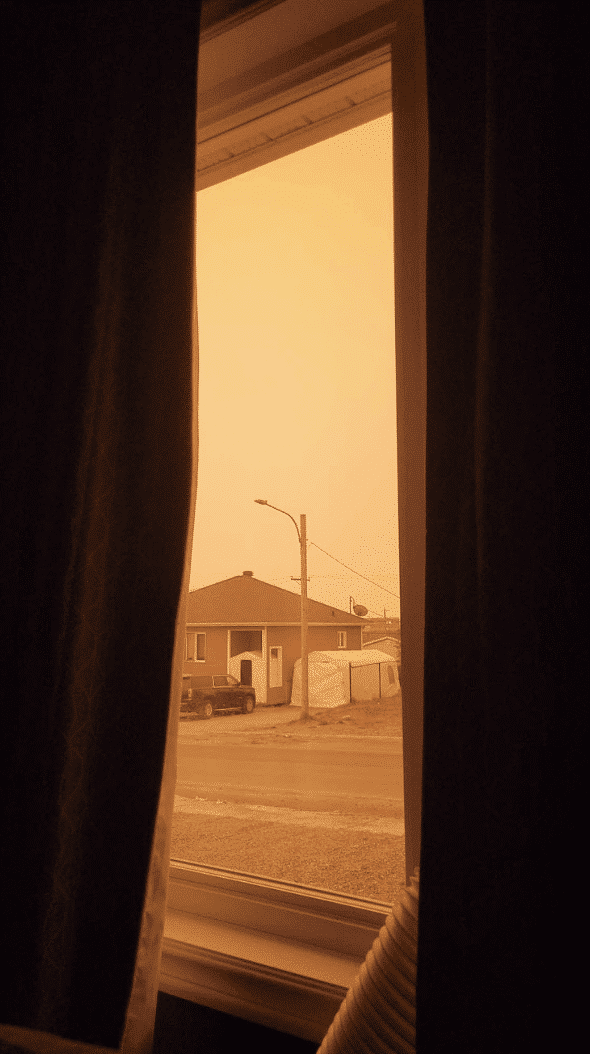
Wildfire smoke blots out the sun in the Cree community of Waswanipi. PHOTO: Courtesy Maïtée Saganash
—
Living in a hotel couldn’t be more different than the traditional Cree life the Saganashes were accustomed to. For starters, they couldn’t go out on their land—the forest where they met and spent most of their lives connected to wildlife. As evacuees, they spent most of their time in the hotel room or lobby, watching the orange-yellow haze following through the window. And city food, like hamburgers and hot dogs, was making them sick.
“We’re traditional people, and we eat a lot of traditional food, like moose, sturgeon, walleye, bear meat. You know, our diet. Sixty per cent of our diet is traditional food when we’re in Waswanipi,” Allan said. “You don’t feel good after changing your diet, you feel sick.”
Allan and Lola weren’t the only ones who became sick after evacuating. Two and a half hours away from Waswanipi, the Cree community of Mistissini was faced with its own evacuation. After smoke began seeping into homes and indoor spaces, a general evacuation was issued and community members fled five hours away to a school gymnasium in Jonquière. But the smoke followed them.
“Even though we were no longer in danger from fire, the conditions were pretty atrocious in the school. The air quality here in Saguenay was also horrendous, and the smoke was leaching into the school,” said Dr. S, a non-Indigenous general physician with the Cree Health Board who also worked in the mobile clinic at the refugee centre and wishes to remain anonymous.
“The smoke [in Jonquière] was actually worse compared to Mistissini because the wind pushed it down. So people were having headaches, shortness of breath, nausea and worsening breathing disorders like asthma. We had to transfer some patients to hospital as a result.”
It’s hard to contextualize the poor quality of air, but Dr. S said that the AQI monitored while outdoors in Saguenay was equivalent to smoking one cigarette an hour. The smog eventually dissipated due to the wind, but living in a refugee centre brought other health problems.
“We [were] seeing patients in need of mental health care, because people have been moved from their home into an institutional-type setting, and I think these can be traumatizing,” Dr. S said. “I think being in a school, sleeping on a cot, having food from the outside that is unfamiliar to you, are very reminiscent of the times of residential schools.”
The evacuation also divided the Mistissini community between Quebec City and Jonquière, which in some cases split families apart, Dr. S said. Even temporarily, the centres are far from ideal.
“We’re seeing a lot of insomnia related to uncomfortable settings — like sleeping in a gym with 1,000 other people,” Dr. S said. “And we’ve seen gastro outbreaks, seeing symptoms like vomitting and diarrhea. It spreads very quickly in this type of communal living setting, like sharing the same bathroom and eating in large communal spaces. Much like gastro outbreaks common in daycares, camps or military settings.”
And being served institutional foods isn’t just triggering from a mental health perspective. It’s also part of a diet that Indigenous Peoples are not only unaccustomed to, but also generally unhealthy compared to their traditional diet.
“Overall, it’s less healthy, because they’re eating more processed, carb-heavy foods,” Dr. S said. “A lot of patients are also diabetic so it’s not good for sugar spikes when they eat non-traditional, processed foods.” Diabetes is a reportedly high risk in Indigenous communities, and studies have linked Canada’s history of colonial practices, like malnourishment in residential schools and racially segregated “Indian Hospitals” to the condition.
For Dr. S, the most frustrating thing has been listening to discussions of the forest fires as theoretical, or the climate crisis as a distant future.
“People I know in Montreal are saying that these fires are ‘up north’ as if it’s a far removed and abstract thing. But it’s now real,” she said. “There are now climate refugees in Canada, they’re Indigenous and they’re the ones who are feeling the first effects of what we’re going to see for many years to come.”
—

Allan and Lola Saganash. PHOTO: Courtesy Allan Saganash
Chief Irene Neeposh of the Cree First Nation of Waswanipi is bracing herself for what’s left of the forest after the fires. She says the community is doing what it can to reduce stress, but that ultimately, there are big lessons to learn for everybody.
“As an Indigenous politician who’s pursued a western education, I won’t even attempt to begin to understand the scope of devastation from this. I’m preparing myself for what’s to come, being very mindful of access to the land in order to preserve culture. And access to the land is making sure you have a place to stay. So the impacts on camps that are lost, they’re not just camps to us, these are our homes. They’re not just dwellings, they’re part of the heritage of our families. So I honestly cannot begin to fully grasp the impact,” Chief Neeposh said.
“I would really like to see the science community be more receptive to Indigenous knowledge because the Indigenous community has been talking about this for a long time. I know it’s something that gets repeated often, and it’s just taken for granted. But it shouldn’t be.”
The Saganashes have been home for nearly two weeks, but the fires and their effects are never far from reality. Allan, who receives daily updates from the Société de protection des forêts contre le feu (SOPFEU) through his work as a consultant on the forestry file for the Cree First Nation of Waswanipi, is tracking wildfire activity and beginning to make his first trips onto the land.
“It’s really sad what I saw,” Allan said in a text message. “Miles and miles of burnt forest along the highway.”
The smoke from the fires has exacerbated Allan’s asthma, and symptoms of toxic smoke inhalation brought him on several visits to the Waswanipi clinic. Even with puffers and anti-inflammatory medications, Allan finds himself coughing and struggling to breathe at night.
Maïtée began feeling pressure in her chest after the smoke started leaching into her home, too. She worked through long hours as part of the emergency response team, on the communications arm of the Cree Health Board and Social Services for James Bay. But the stress eventually took a larger toll than she could handle, and she was forced to take leave.
“All of this is really overwhelming. I was planning on building myself a house in Waswanipi, and now I don’t know if the insurance is going to skyrocket because of fires. I don’t know if it’s going to be a viable plan. I’ve been working towards that for the past five, six years. So to think that my dream of living in my own community, in my own house, might not be an option anymore, is very devastating,” Maïtée said. “It’s already like that anywhere, but on my own land, in my own community? The land that my family has occupied since time immemorial?”
Author

Comments (1)
Leave a comment
Related Articles

Blainville Teenager Takes Stablex Fight International
After concluding that local avenues had been exhausted, a 14-year-old Blainville resident has brought the fight over the Stablex hazardous waste expansion before the CEC, an international environmental body established by Canada, the United States, and Mexico.
Stripper Strike Provokes Internal Discord, Media Circus — and Worker Mobilization
While the majority of strippers did not strike on May 23, sex workers report feeling motivated to continue the fight for labour rights.

Murder in Mohawk Territory: Sources Say Organized Crime Ramping up Violence Around Cannabis Shops
A 24-year-old was shot, killed and had his body dumped in a hole in Kanesatake last week.
Our carcéral system is an outdated one and I mean the provincial ones across Canada. Years of neglect budget cuts staff cuts departures non replacement of personnel is really having a goal. It is ridiculous that we are still sending psychiatric cases, people with unpaid fines or people with minor offenses like shoplifting to prison. It is for 2 years less a day. Leave the prison system to violent criminals drug dealers firearm infractions or that pose a menace.
As for the fires, well we seen with the clouds n skies the effects. We smelled it. Oh I am sorry according to Pierre Polievre and his regime there is no climate problem there is no threat to humanity it’s a woke problem. This is unfortunate because this man might be our leader with his right wing extremist regi.e. God help us with him in power!