
Is There Life after PEQ? Montreal’s Immigrants Search for a Path Forward
When the Quebec Experience Program ended in 2025, thousands of immigrants lost a near-guaranteed route to permanent residency. Facing the strict criteria of the PSTQ with no grandfather clause, what recourse do they have?

In a sea of union flags, fluorescent tuques and anxious faces, laughter rings out.
A tightly bundled-up child who is no older than six jumps excitedly, determined to play in spite of the biting -20 C windchill. He takes a moment to face his family — who are standing opposite the Ministère de l’Immigration, de la Francisation et de l’Intégration (MIFI) — and smiles at them proudly, as he waves a homemade picket sign.
He seems blissfully unaware of the CAQ’s decision to end the Quebec Experience Program (PEQ), which pushed his family to protest alongside hundreds on Feb. 7, 2026, in search of a way to remain in Canada.
The PEQ was a fast-track immigration pathway designed to offer permanent residency to international students and temporary foreign workers already living in Quebec. Providing they fit the eligibility criteria, they had the opportunity to build their lives here.
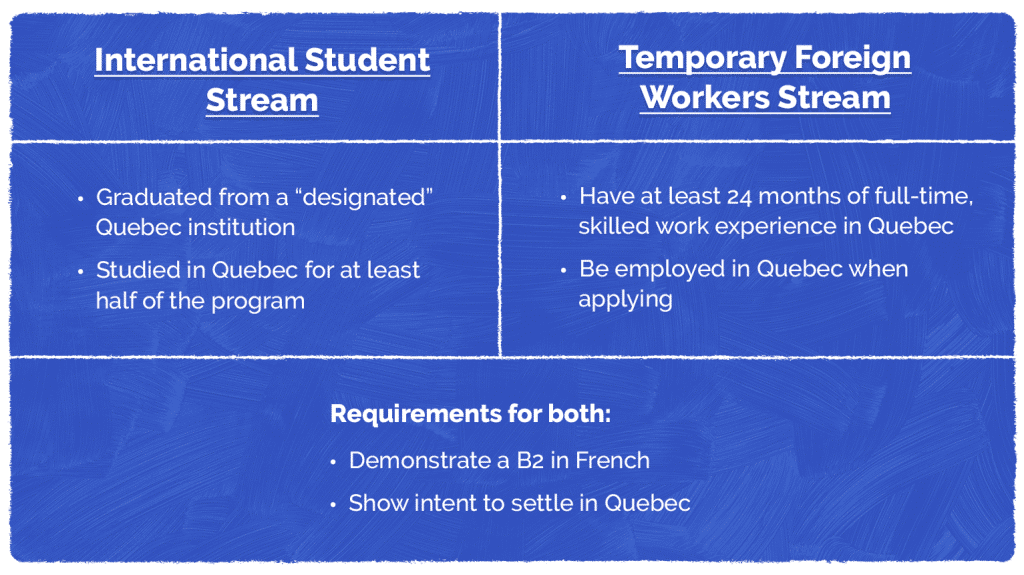
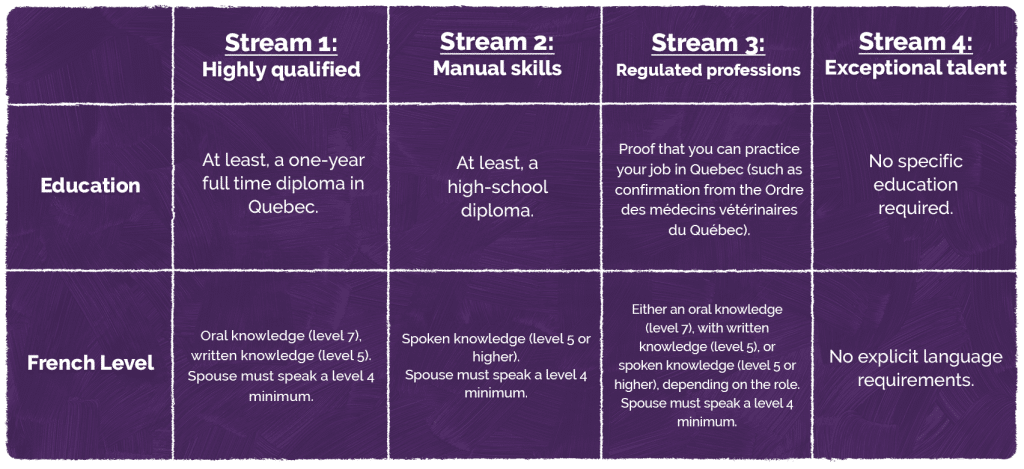
This has been replaced by the Skilled Worker Selection Program (PSTQ). This is a points-based competitive immigration program which places skilled applicants into one of four streams, where criteria such as a high level of French and working outside of Montreal can boost their score.
Support your local indie journalists
Quebec’s Immigration Minister Jean-François Roberge had previously stated he would not grant a grandfather clause. This clause would enable immigrants who were in the process of applying for permanent residency through the PEQ to continue to do so, rather than losing their progress and having to reapply under the PSTQ.
As of Apr. 8, Roberge is under investigation by the National Assembly’s Ethics Commissioner for sharing analyses from MIFI with the two candidates campaigning to replace François Legault as CAQ leader and premier of Quebec regarding the impact of their future plans for the PEQ. This includes potentially issuing a grandfather clause for certain individuals.
Workers’ woes
Critics have argued that failing to implement a grandfather clause is unfair, as immigrants did not know they would suddenly have to meet the PSTQ requirements.
One of them is IT contractor Florent Chevalier. Speaking loudly over the beat of a drummer at the protest, Chevalier relayed how he left his friends, family and home in New Caledonia (a French overseas department off the coast of Australia) to get a fresh start in Montreal after working as a public servant for 10 years.
“Before Montreal, I’ve always lived in New Caledonia,” he said. “I grew up there and completed my studies in computer science — I hadn’t seen much outside of the island. I wanted to move to Montreal because it was a good compromise for me. I could do something different, explore a big city, and speak French too.”
This hopeful outlook prompted Chevalier to get a Canadian working holiday visa. While his international move to Quebec’s sprawling metropolis in 2023 was initially daunting, he soon settled in and began to make a life for himself.
“It’s hard to describe the move with just one emotion. At the beginning, I felt a lot of uncertainty and worry because I arrived alone. There were so many unknowns with finding housing and a job. But Montreal pleasantly surprised me: I made great friends here — I even met my girlfriend, who is Québécoise.”
Chevalier now had a reason to stay in Montreal, so he decided to take the next steps to make his dream a reality. While he initially planned to apply for the Regular Skilled Worker Program (PRTQ, an ancestor of the PSTQ), disaster struck when the program was suspended in November 2024.
Determined to gain permanent residency in the face of this sudden change, Chevalier thought he’d try again — this time, with the PEQ. But for a second time, the government slammed the door in his face.
“Once I reached two years of work experience, I thought I’d be able to apply for the PEQ. Just before I reached two years, it closed. I’ve had really bad luck with the timing,” Chevalier admitted.
The question remains as to whether Chevalier will be able to obtain enough points to qualify for Stream 1 of the PSTQ, which prioritizes “highly qualified and specialized skill” immigrants. Despite his degree, fluent French, and his work in a high-demand sector, it’s possible he could lose out to a similar candidate with slightly higher points.
If “highly-skilled” immigrants like Chevalier can struggle to qualify for such a competitive stream, immigrants who work in manual labour will experience these difficulties tenfold.
Stream 2 of the PSTQ is for “Intermediate and Manual Skills.” As with all PSTQ streams, it prioritizes applicants who live and work outside of Montreal. But many workers don’t have the flexibility to relocate to one of Quebec’s regions. Activist and community organizer Manuel Salamanca Cardona witnesses the consequences of this first-hand at the Immigrant Worker’s Centre’s (IWC-CTI) weekly legal clinics in Montreal.
“The PSTQ is not accessible to 90 per cent of the people we’ve seen. As we know, if you work outside of Montreal in the regions of Quebec, you can get more points. How are you supposed to do this with a closed work permit?” Salamanca Cardona said.
Applicants to Stream 2 must demonstrate that they can speak an intermediate level of French (equivalent to a B1). But this is no simple feat: recent studies have shown that the majority of Quebec’s immigrants are allophones, speaking neither French nor English as a first language, though the rate of francophone immigrants is increasing.
Workers hoping to apply for this stream must juggle learning French whilst working between 35-40 hours of manual labour each week. With the MIFI cutting financial aid for Francization courses in September 2024, many simply cannot take time out of their jobs to attend unpaid classes without losing wages or violating the terms of their closed work permits.
Those who do achieve the level of French required for Stream 2 often struggle to develop their career further.
“Some of the immigrants that come here to work have a level of French which allows them to work in manual labour, but not intellectual labour,” Salamanca Cardona explained. “This system keeps people where they are, rather than allowing them to progress.”
Salamanca Cardona explained that the transition from the PEQ to the PSTQ would affect certain jobs more than others. Either way, Quebec will benefit economically.
“This is going to affect people working in factories, butchers, the warehouse centre… But at the end of the day, these types of immigrants are going to work to survive, sometimes under the table or under minimum wage.”
The strain on employers
Quebec’s businesses are already feeling the impact of the PEQ’s absence on their workforce. Alstom, the French rail manufacturing titan, won a major contract to assemble 70 subway trains for the Toronto Transit Commission earlier this year. The trainsets will be designed in Saint-Bruno-de-Montarville and partially manufactured in La Pocatière, with the help of 14 Brazilian workers hired last November.
“It’s impossible to think that we’re going to grow and meet all our contractual obligations with the current workforce that we have in place,” asserted Olivier Marcil, the vice president of communications and public affairs for Alstom Canada. “In La Pocatière, we’ve tried very hard to locally fulfil our workforce, but in the end, we needed the help of our Brazilian colleagues. You could interview 20 of my colleagues in other manufacturing companies, and they would tell you similar stories.”
In 2025, the Government of Canada reported that almost half of Quebec’s manufacturing jobs are located in the Montreal census metropolitan area, including Alstom’s Saint-Bruno site. This sector is already set to face employment disruptions until 2027 at the earliest, according to the federal government, due to trade disputes with the United States.
Marcil noted that 153 foreign temporary workers at Alstom will need to renew their permits within the next 18 months. While he believes that both the federal and provincial governments are entitled to change immigration policies as they see fit, he is concerned that the abrupt transition from the PEQ to PSTQ could prevent specialized production from taking place, which often relies on international expertise.
“Our wishes would be to recruit 100 per cent of our workforce locally, but there’s just not enough people out there to fulfill all the jobs that we need. For example, we have never built high-speed rail in Canada. So we would benefit from bringing expertise from Europe, which has been doing this for around 50 years.”
Rail manufacturing is not the only industry to be affected by this. The Council of Canadian Academies (CCA) published a news release in November 2025, stating that “Canada continues to fall further behind peers in key measures of science, technology and innovation,” citing the importance of international collaboration in Canadian post-secondary institutions as one way to bolster Canada’s innovation ecosystem.
The impact on universities
But a future that encourages this type of international collaboration appears further and further away without the PEQ.
Samya Lemrini, an immigration lawyer for a university in Montreal, recalls the emotional anguish she witnessed from both students and faculty in the days after the end of this immigration pathway.
“The day they announced the suspension of the PEQ, we were blindsided. I had someone message me and say, ‘Samya, I was missing one document!’ They had planned to apply that very day,” she said. “That’s why one of my best tools at work is a box of Kleenex.”
Some students are now applying for master’s and PhDs to extend their stay in Montreal.
“A lot of students didn’t have in mind that they were going to pursue grad school. But the truth is, if you finish your undergrad and then get a post-graduate work permit (PGWP) with no permanent residency in sight, you don’t have many other options.”
The shift from the PEQ to the PSTQ has also affected non-Canadian professors when it comes to which streams they are eligible for.
“I worked with a professor of veterinary science, who had originally filed their application for Stream 3 of the PSTQ as a vet,” said Lemrini.
Stream 3 covers “Regulated Professions,” which is tailored for professionals whose role requires a license or authorization to practice in Quebec. This includes jobs like dentists, nurses and veterinarians.
“When the time came for me to review their application, I had to change their occupation to ‘professor,’ because this is what was listed on their original closed work permit. They ended up losing 200 points,” lamented Lemrini.
Just a slight reduction in an applicant’s points can have a devastating impact on their chances of being invited to the PSTQ. In January 2026, invitations for Stream 1 required at least 782 points or higher. But Lemrini’s highest scoring client had just 609 points.
“These are people who have PhDs, that speak French, that don’t get invited. I have to tell students this, so that they don’t get their hopes up.”
Lemrini is now trying to help this professor get invited through Stream 4, but this pathway for “Exceptional Talent” isn’t any easier to obtain. “You have to be amazing,” she said. “I worked with a professor who was one of six applicants that was invited through Stream 4. She was a Canada Research Chair — her CV felt like it was hundreds of pages long. Most applicants don’t have that.”
The economic impact
Florian Mayneris, a professor of economics at Université du Québec à Montréal, asserts that this change in immigration policy is already deterring international students from choosing Montreal.
“We have quotas for international students, and currently, we don’t even fill them,” he said. “Foreign students, considering all the mess around the immigration policy recently, don’t want to apply here anymore.”
It’s no secret that international students are an economic catalyst in Quebec, supplying $3.4 billion to the provincial economy in 2022. But between April 2024 and April 2025, international student applications dropped by as much as 46 per cent. By 2025, at least seven universities in Quebec expected budget deficits for the upcoming academic year.
The effect of this ripples beyond campuses. Since the PSTQ offers more points to candidates in the regions outside of Montreal, which has strong economic consequences for the city.
“When the government increases points for people that will settle outside, this penalizes Montreal,” Mayneris said. “It’s a big part of the economy of Quebec, a huge contributor to the Quebec GDP.”
In 2023, Montreal made the largest contribution to Quebec’s economic growth, with a 49.6 per cent share. A recent analysis by the Institut du Quebéc stated that immigration was the sole driver of labour force growth in Quebec between 2015 and 2023 (adding around 384,000 workers). To top it off, as of 2025, Greater Montreal accounts for 60 per cent of all Quebec’s job vacancies, with over 75,000 positions to fill.
There is no guarantee that Montrealers or Canadians from other provinces will be able to fill these gaps, Mayneris affirmed. “This is not only a moral issue, but it’s also the government creating obstacles for its own future immigration policy.”
What will the CAQ’s new leader do?
Guillaume Cliche-Rivard, the Québec solidaire MNA for Saint-Henri–Sainte-Anne and a lawyer specializing in immigration, finds Immigration Minister Roberge’s blatant refusal to enact a grandfather clause “absurd.” This criticism comes as both Christine Fréchette and Bernard Drainville, the leading candidates in the CAQ’s upcoming leadership race, support reopening the PEQ based on specific criteria.
“Considering that both of his potential future bosses stated there will be a grandfather clause, I really don’t understand why we’re losing that much time,” said Cliche-Rivard.
“We’re going to have to wait until the resolution of this leadership race. During this time, every single day, we’re losing some workers,” he said. “We know that they will be protected down the road, so why can’t we move forward now and protect these workers that have been contributing so much to the economy and to our social services?”
When asked to describe what the transitional scenario will be from the PEQ to the PSTQ at the National Assembly on Mar. 25, Roberge vaguely stated that a plan would be presented to the next CAQ leader. The open investigation by the National Assembly’s Ethics Commissioner suggests that this plan could already have been put in motion, without the public’s knowledge. Just one day away from the Apr. 12 election, the timeline for the resolution of this issue remains uncertain.
Looking to the future
For people like Chevalier, a grandfather clause is not just a technicality. It’s a lifeline after spending countless hours and dollars building a life in a province that promised them a future.
“I’m waiting to see how things evolve, but it feels like a race against time. Right now, I’m on a closed work permit, but it’s only until the end of the year. There’s a lot of uncertainty about whether I’ll be able to continue with this company because they’re unsure if they can renew my contract,” Chevalier said.
When asked about the future, Chevalier is frustrated. But he still holds out hope.
“In my experience, these programs change all the time. I always try to keep a plan B, plan C, look for other options instead of only relying on one. So yes, I have hope, but I have to stay realistic.”
“A grandfather clause would bring a solution right away. We need quick answers to get things moving, to allow people to start planning, to stay and work, and to participate in Quebec society.”
As the winter begins to thaw in Montreal, perhaps the CAQ’s frosty attitude towards Quebec’s immigration policy will, too.
Author

Related Articles

‘Everybody Who’s on the Stage Is Part of Your Community’: Ctrl+Alt Festival Returns for a Third Edition
Free festival stacked with queer, local performers to take over the Place du Village July 24-26.

Moving Day: A “Desperate” Struggle for a Growing Number of Montrealers
July 1 is now a race against time for families facing homelessness once their lease expires.

Quebec Workers Experienced a “Counter Revolution” Under Jean Boulet: Experts
The outgoing labour minister leaves behind a legacy of attacking the Constitutional right to strike.
Comments (0)
There are no comments on this article.