
In Kanesatake, “Our Land Has Been Traumatized”
Illegal dumping and government inaction have destroyed swaths of Mohawk territory.
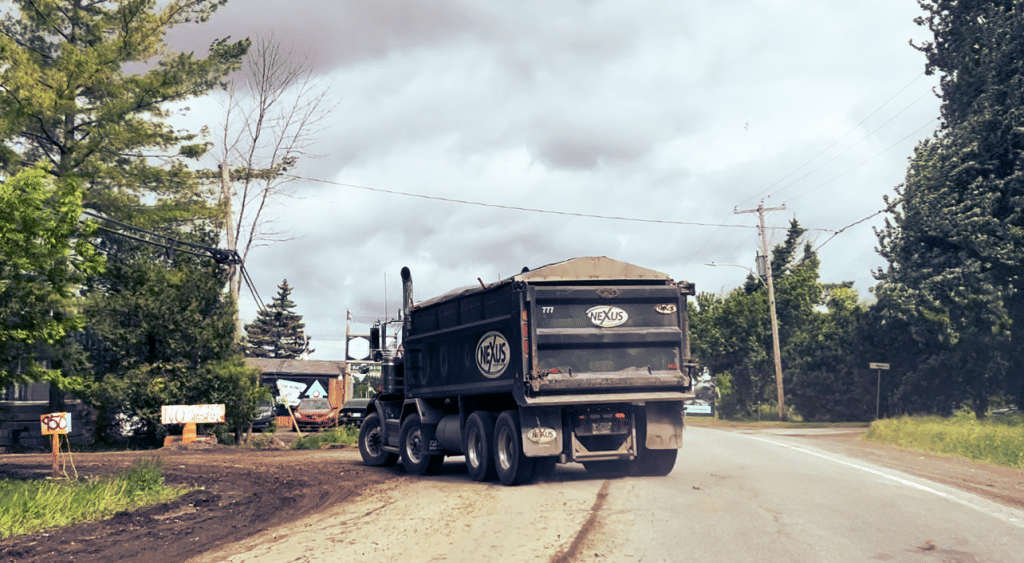
A Nexus truck full of soil pulling into a lot in Kanesatake Mohawk Territory on Tuesday, May 28. PHOTO: Chris Curtis
It was almost too good to be true.
After seeing their lands contaminated by illegal dumping for years, the Kanien’kehá:ka (Mohawk) settlement of Kanesatake secured a $3.5 million grant to reclaim some of what was lost. The federal grant would allow the Mohawks to buy a farm and teach traditional agriculture as a community service.
There was just one problem.
The Kanesatake Health Centre, which applied for the grant in March, couldn’t find 60 acres of uncontaminated land within the settlement. So they put an offer on a farm in a neighbouring village.
“Our land has been traumatized. And what little is left is being poisoned by all this dumping,” said Kanesatake’s health director Jeremy Tomlinson. “We always talk about ‘The land was stolen from us, the land was taken.’ But my perspective has changed.
“The land doesn’t belong to us because, in our culture, we’re just one part of the natural world. The land wasn’t taken from us, we were taken away from the land. This project is about healing from that.”
Support Independent Journalism.
For the past 20 years, dump trucks have come from across the region to unload contaminated soil on Mohawk land.
Though the community has repeatedly tried to stop this from happening, a handful of Mohawks have cashed in by allowing trucks to dump on their property. Most notably, a lot owned by Gary and Robert Gabriel operated a “recycling centre” that allowed 400,000 cubic meters of industrial refuse to accumulate on the territory between 2014 and 2020.
The 40-foot mountain of garbage was so saturated with methane gas that it would sporadically catch fire, according to provincial inspection reports obtained by The Rover. A lab analysis of dump water leeking into a nearby creek contained 144 times more sulfur than is legally permitted, according to a report by La Presse (which The Rover was able to independently verify).
This happened in part because the Gabriel brothers were only legally permitted to store 27,800 cubic meters but accepted 15 times more refuse on their property.
The provincial government had been aware of this for years but only revoked the dump’s permit after a 2020 investigation by The Rover, Ricochet Media and The Eastern Door revealed the extent of the damage to Kanesatake’s lands. That investigation was only possible because of Mohawk whistleblowers who put their safety at risk to fight for their community.
Still, the dumping continued.
These construction companies would come from across the region to dump on Mohawk land because it was cheap and there is no police force on the reserve.
Sources close to the band council say there are at least 18 more dump sites on the tiny North Shore settlement. For reference, the community’s 12-square-kilometre area is slightly smaller than the Ville Marie borough but contains enough toxic waste to fill 160 Olympic-sized swimming pools.
The largest dump site is a swath of land that plunges into Lake of Two Mountains just off Highway 344.
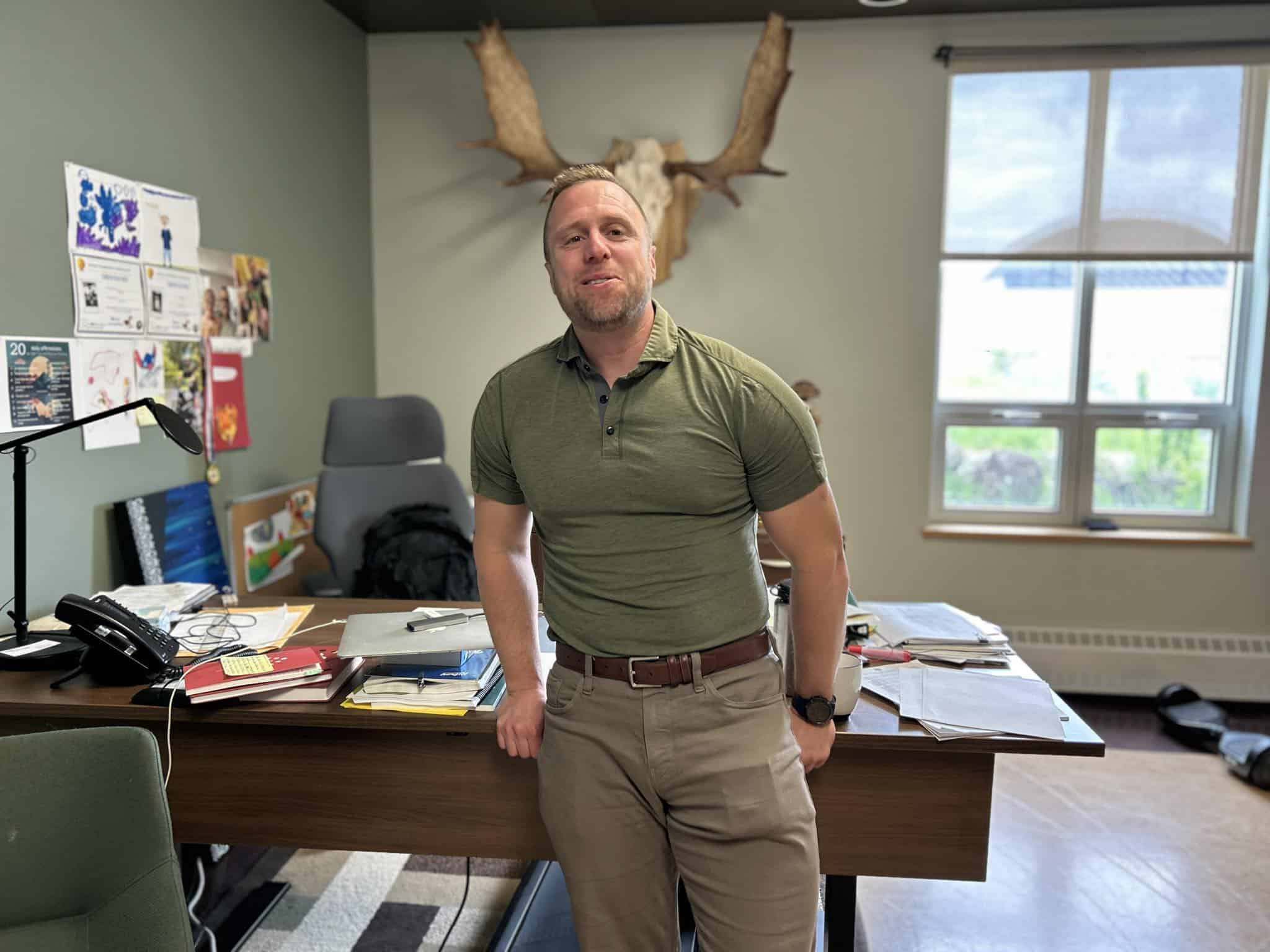
Jeremy Tomlinson, director of the Kanesatake Health Centre. PHOTO: Chris Curtis
During one visit to Kanestake this week, I counted 12 trucks dumping on the lot in just 30 minutes. Locals say they’ve seen and documented as many as 100 loads in a single day, but it’s impossible to know what exactly is being dumped because the property’s owner refuses to let inspectors onto their land.
When council chiefs Serge Simon and Brent Etienne tried to force their way onto the land to collect soil samples last month, the land’s owner put Simon in a chokehold, according to witnesses who spoke to The Rover. They had brought along inspectors from the provincial government but didn’t involve Kanesatake’s grand chief or environment protection office.
“They went in like cowboys and it devolved into a fight,” Grand Chief Victor Bonspille said. “I don’t know what they expected would happen but it wasn’t the way to deal with this situation. Environment Quebec, after seeing this, postponed their attempt to get a soil sample.”
The owner of the site is a Mohawk working with the company Nexus Construction, a Laval-based firm that specializes in paving and excavation.
“The truth is, we just don’t know what’s being dumped,” Bonspille said. “And that’s a huge problem. My understanding is the property is being converted to a large house for the owner’s daughter but we can’t say what sort of soil is being dumped there.
“Is it clean? Is it contaminated? Because it’s right on the water and if anything gets into the water, that won’t just affect our community, it’ll affect all of the North Shore.”
The environmental crisis is being exacerbated by a political one.
Bonspille was elected three years ago after a scandal-ridden final term for Simon, who served as grand chief from 2011 to 2021. During Simon’s last mandate as grand chief, two members of his inner circle came under criminal investigation for allegedly embezzling upwards of $1.2 million in government funds.
In 2023, the Sûreté du Québec seized a trove of documents from the band office, health centre and a shipping container in a privately owned lot away from the band office, according to court filings obtained by The Rover.
Though Simon’s name doesn’t appear in any of the unsealed court documents, one of the people suspects was his vice chief and closest political ally. Another worked under Simon on a COVID-19 task force in charge of dispersing over $3 million in emergency funds during the pandemic.
The Crown has not laid charges related to the criminal probe. But just last week, the SQ asked the Court of Quebec for a 12-month extension on its investigation — codenamed Raturer.
Simon did not respond to multiple requests for comment.
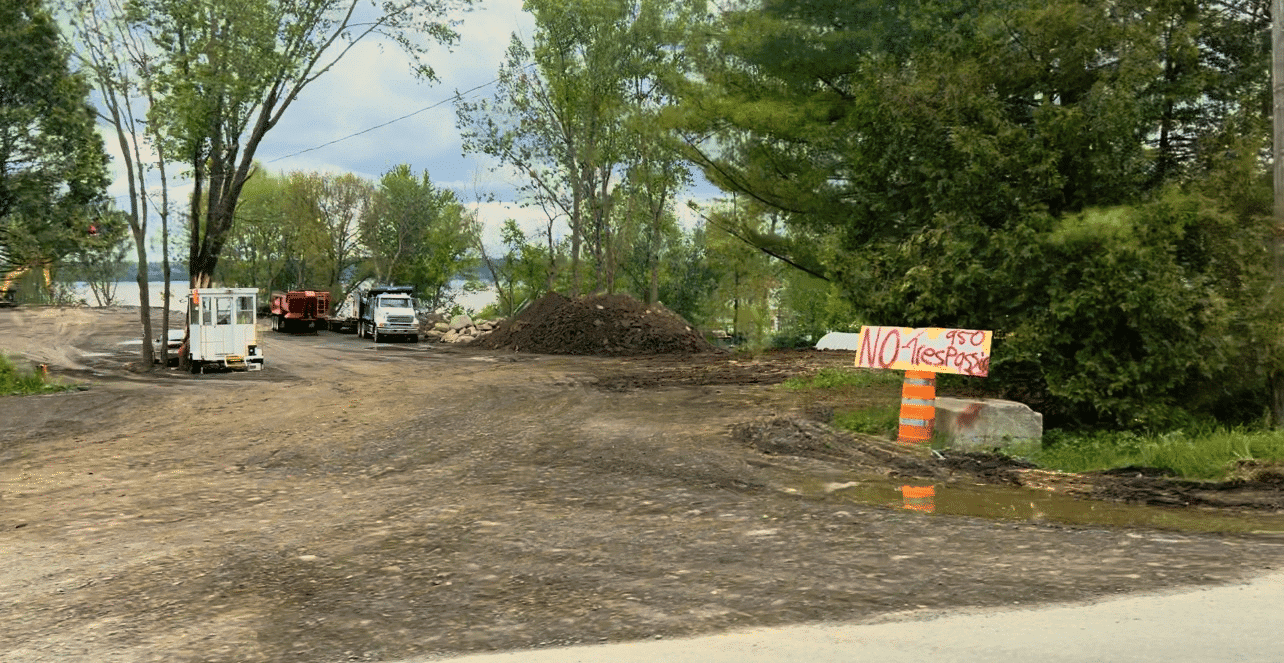
A large dumpsite by the Lake of Two Mountains in Kanesatake. PHOTO: Chris Curtis
As outrage over illegal dumping and the embezzlement scandal spread throughout the community, Simon lost his bid for a fourth term as grand chief in 2021.
He re-entered Mohawk politics last year, winning a controversial by-election for a seat on council. The results were thrown out by Kanesatake’s electoral appeals board over alleged violations of the band’s electoral code. But Simon’s victory was later reaffirmed by a court decision.
Now Simon and four of the six council chiefs are at odds with Bonspille, who says he’s been locked out of his work email and saw his keycards deactivated at the band council office.
Despite this political gridlock, the federal government is moving forward with a $100 million plan to clean up the Gabriel brothers’ dump.
Indigenous Services Minister Patty Hajdu announced last month she’d be awarding federal funds to the Indigenous-owned firm W8banaki to begin the work of cleaning up the dump. But the firm’s expertise has been questioned by Bonspille and Kanesatake’s environmental protection office.
The one contract executed by W8banaki in Kanesatake — an asbestos removal job at the Kanesatake high school in August 2022 — went poorly, according to documents obtained by The Rover. In a letter to the Kanesatake Health Centre, a health officer from Indigenous Services Canada outlined a series of concerns with basic health and safety violations.
“It is concerning that the contractors carrying out the work to remove asbestos tiles did not seal off access points,” the email reads. The officer also mentions reports that some workers on site were not using protective masks while handling asbestos, a highly cancerous substance.
“This is a class action lawsuit waiting to happen,” said one community member who witnessed the alleged safety code violations. “If a worker gets sick or severely injured working in our high school, we’re liable. There was asbestos dust everywhere and they were letting community members in the building. I don’t think they can be trusted with a $100 million contract.”
Jean-Denis Garon, the Member of Parliament from Mirabel, told La Presse he doesn’t think W8banaki is the best choice for a contract of this scale. And though Hajdu had promised chiefs she would let the community decide which firm would be hired for the clean-up, W8banaki was awarded the contract without any community consultation.
Bonspille and Kanasatake’s environmental protection office want to hire Senexen — a South Shore firm specializing in water remediation — to do the clean-up.
“W8banaki has never handled a file of this magnitude, Senexen has,” Bonspille said. “We want the best contractor, not the less expensive contractor. We want this done right, it’s our land we’re talking about here.”
Even so, W8banaki is the preferred choice of Simon and four of six chiefs on council.
“I know that disagreements persist but … when there’s a quorum of chiefs, it has the necessary authority to take these decisions,” Hajdu wrote, in a May 17 letter to community members. “This work is urgent and members of your community are expecting everyone to cooperate so it can be done as quickly as possible.”
Bonspille says it feels as though the federal government is rushing the clean-up process after stalling for years.
“This has been going on for years and years, the government has known about it for years and years and they did next to nothing,” Bonspille said. “Now suddenly they’re in a rush to get the job done. I don’t like it.”
For community members who’ve spent the past 10 years pushing for government action, Hajdu’s letter came as a shock.
“It’s just so dismissive, after everything we’ve been through to get them to take this seriously,” said one community member, who endured repeated threats to his family in his fight against illegal dumping.
“We’re doing this for our kids. I don’t care what happens to me, what they wanna do to me, I don’t care. But my kids and their kids, I care about them living on contaminated land. I’ll fight to the death for that.”
Author
Related Articles

Quebec Workers Experienced a “Counter Revolution” Under Jean Boulet: Experts
The outgoing labour minister leaves behind a legacy of attacking the Constitutional right to strike.
« Combien de mères avez-vous fait pleurer? »
À Montréal-Nord, la communauté se soulève contre la brutalité policière et le profilage racial.
“How Many Mothers Have You Made Cry?”
In Montréal-Nord, a community rises up against police brutality and racial profiling.
Comments (0)
There are no comments on this article.