
Street Hymns: A Memorial Service in Cabot Square
Some 37 unhoused people have died in less than two years in west downtown.
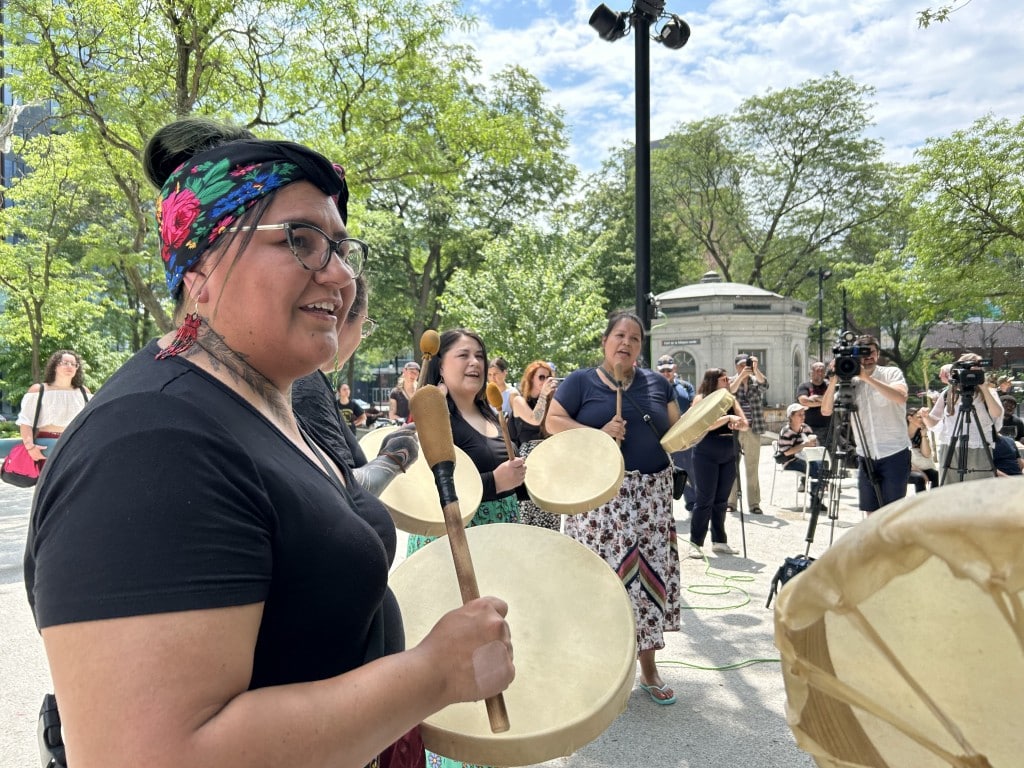
PHOTO: Chris Curtis
Vanessa LaPrise says she’d be dead if it weren’t for Mohawk Mike.
“He was the biggest man we had, on our streets and in my heart, I knew Mohawk Mike was there for us,” said LaPrise. “He took care of the women, took care of the people.”
LaPrise stood in front of a few dozen mourners at Cabot Square on June 5, grappling with the scale of the tragedy.
At least 37 people who frequented the west downtown park have died since 2022. They were once members of a community, people who’d offer up a loose cigarette or half sandwich to a struggling comrade, people who kept each other company while the rest of the world pretended they didn’t exist.
Some of them, LaPrise said, saved lives.
“I wouldn’t be here if it weren’t for these acts of kindness from people like Mohawk Mike,” she said. “When someone opens their door for you or they stand up for you or they give you a reason not to give up, that’s what keeps so many of us going.”
Support Independent Journalism.
Before the memorial, I noticed a familiar picture on a poster next to photos of the other victims.
I hadn’t seen Nogeeshik, who also went by the name Mohawk Mike, in almost a year and a part of me held out hope that it was a good thing. Maybe he’d gotten a bed in medical detox or found some family to stay with for awhile. Maybe he got out of the life.
I remember speaking to Nogeeshik after Amanda, a woman he called his street sister, died of an overdose in 2021. He was with her when it happened, using chest compressions to get her blood flowing again before the ambulance arrived.
“It was an awful thing,” he said, wiping tears from his eyes. “I just can’t do this anymore, I want to give up.”
We met when my parents were volunteering at Cabot Square four years ago, handing out food on Saturdays during the pandemic. He was enormous and sometimes his emotions got the best of him but there was a tenderness to Nogeeshik. One weekend, a wound on his hand was so badly infected that my mother practically scolded him into coming to the pharmacy for first aid.
He obliged and my mom helped him clean the wound. For some months after that, Nogeeshik would ask how my mother was whenever we saw each other.
He died this spring.
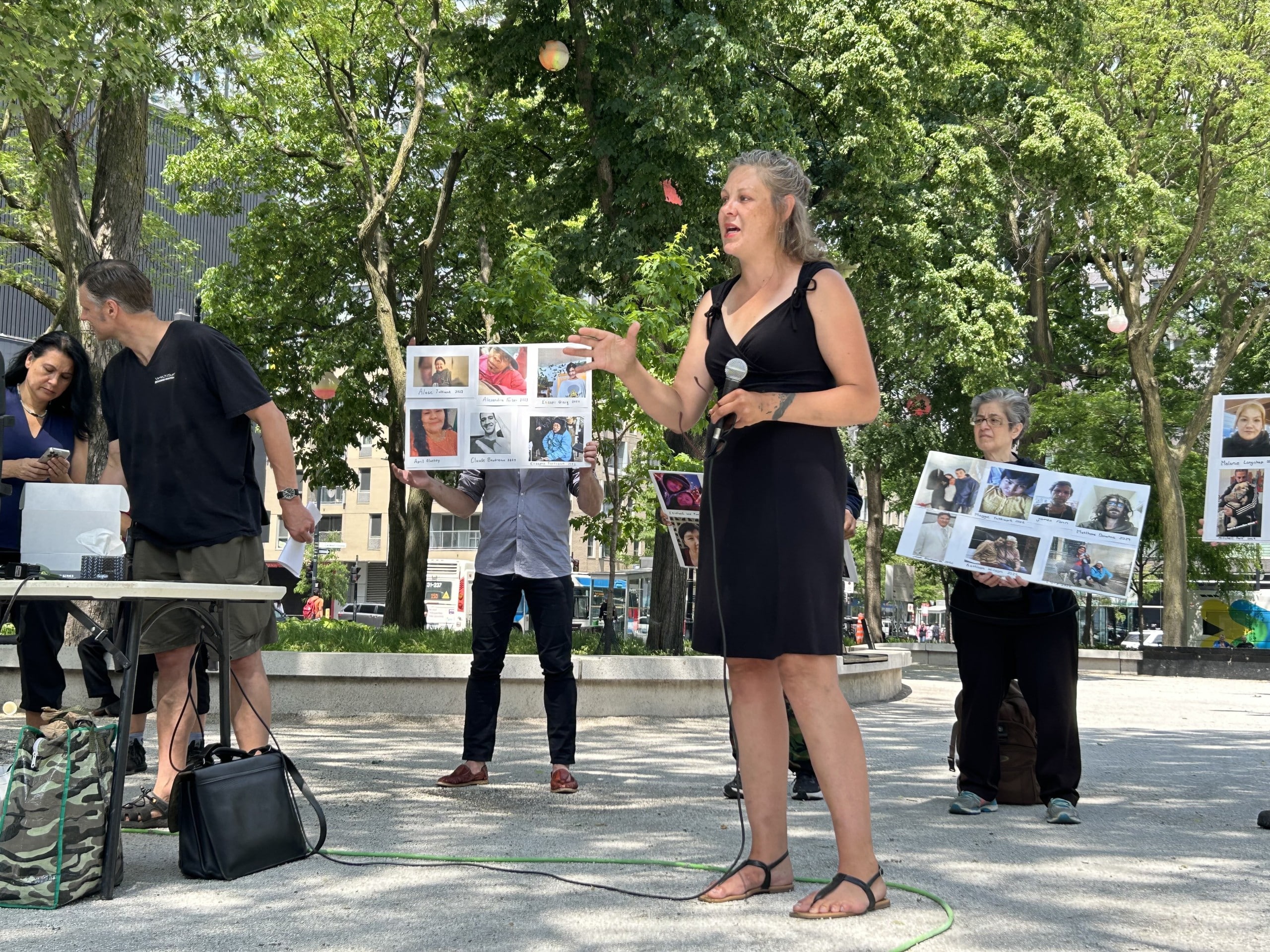
PHOTO: Chris Curtis
The death that stalks west downtown is a symptom of something much bigger. Montreal’s unhoused population increased by 57 per cent from 2018 to 2022 and street workers say those numbers are only going up. With Montreal’s moving season just a few weeks away, the number of people at risk of finding themselves on the street when their lease expires has increased by 150 per cent since last year, according to the Coalition of Housing Committees and Tenants Association Quebec.
But instead of a change in public policy or a growing sense of solidarity among Quebecers, there’s been a backlash against the homeless.
Not just instances like a major newspaper columnist posting lurid photos of the unhoused without their consent. Or a lawyer trying to have a safe injection site shut down because children in a nearby school have had to see people going through a substance abuse disorder (at a time when nearly two Quebecers die of an overdose every day).
Pressed on the near doubling of homelessness that’s happened under his watch, Quebec Premier François Legault blamed immigration, asylum seekers and Justin Trudeau. Legault said the “explosion” of homelessness, the lack of availability of affordable housing and the rise in people with mental health problems is related to the “explosion of asylum seekers” coming into Quebec.
“This is a classic case of conflating three different challenges that produce a similar set of outcomes,” said Sam Watts, the CEO of Welcome Hall Mission. “Yes, there is a housing affordability crisis. Yes, more people are visibly struggling with mental health concerns. Yes, there are more asylum seekers. But the roots of each is very different.
“The first two result from poor policy choices by all orders of government and ineffective responses over the past 30 years. The challenge of refugees and asylum seekers is a function of a worldwide phenomenon and the movement of people. Quebec isn’t sheltered from this reality. Our immigration system is not constructed to address the needs of the present numbers of people trying to move here.
“There isn’t much value in pointing fingers at the victims. Instead, leaders need to accept the responsibility that has been given to them by the electorate and work on solutions.”
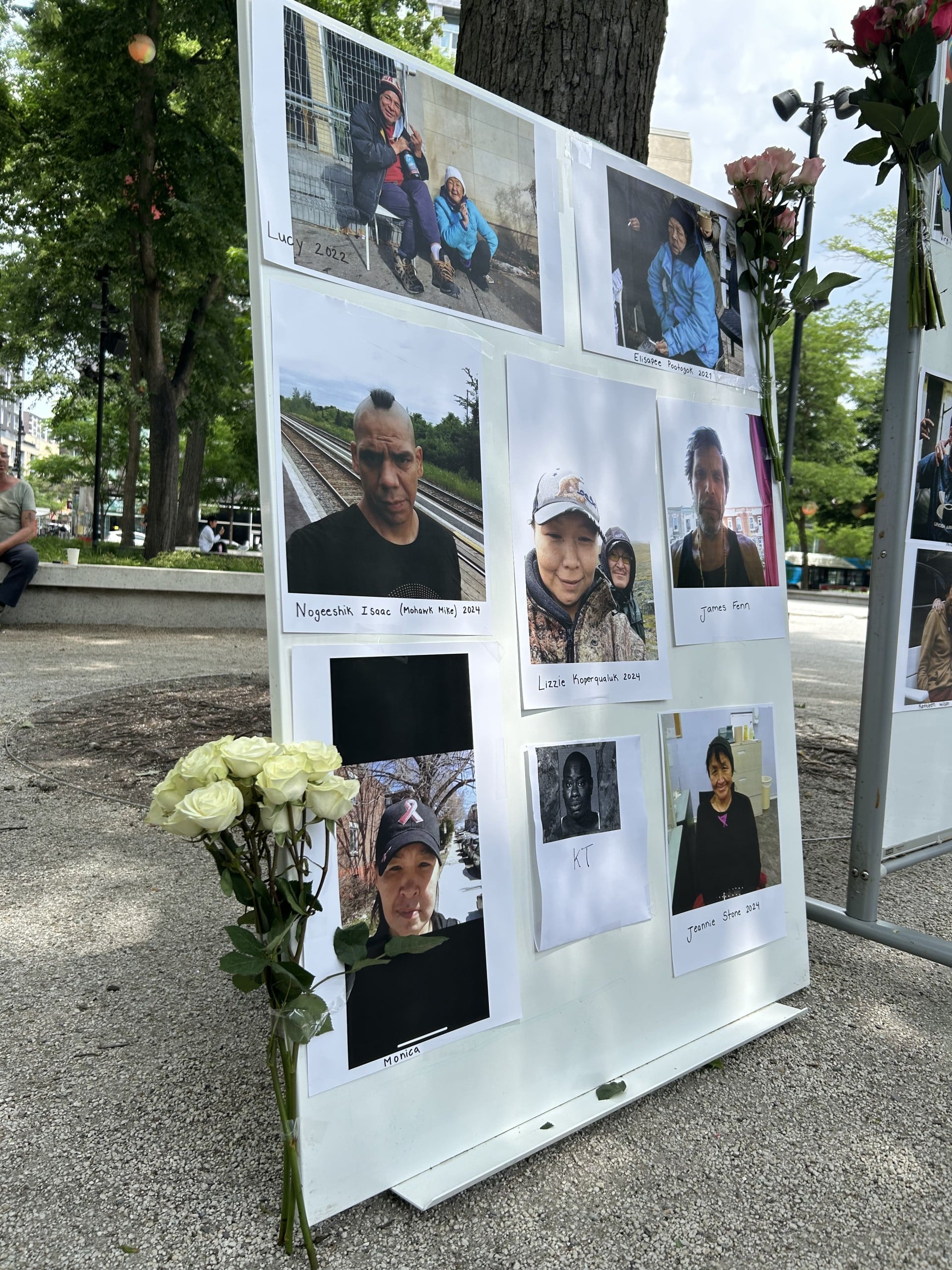
PHOTO: Chris Curtis
A less polite criticism would be that Legault has gutted Quebec’s social housing programs and done nothing to slow a runaway real estate market that’s making the premier, his colleagues and his party’s biggest donors richer. And while it’s true that Legault’s government has ramped up investments in programs to help deal with the symptoms of homelessness, that funding is little more than a Band-Aid.
The funding also comes from a five-year plan based on 2021 numbers — when we thought Montreal’s unhoused population was about 3,000 — versus current estimates that put the population closer to 5,000.
At the funeral in Cabot Square last week, the street workers on the frontline of the crisis looked exhausted. And with good reason. Though they work in public health, they’re paid by NGOs whose funding varies widely and can’t offer workers the benefits they need to make a living.
There’s been talk of unionization or even a public pressure campaign but any disruption in work would be catastrophic for a shelter system that relies on cheap labour to stay alive.
“Well-meaning people say, ‘Oh, you’re so noble’ or ‘I respect what you do so much’ but that’s kind of bullshit,” one worker said. “If you really thought that, you’d be pressing the government to do more, you’d be fighting down here with us. This isn’t a sustainable career, seeing all this suffering and death and not even being able to make ends meet.”
That may sound hyperbolic, but 37 unhoused people have died in one tiny neighbourhood in just over two years. Similar scenes are playing out in Montreal’s Centre-Sud district, Chinatown, and in encampments that are pushed further and further into the shadows by constant police raids.
And one of the biggest culprits of these deaths — fentanyl being found in everything from MDMA and crack to dilaudid and cocaine — isn’t being addressed. In fact, the only safe consumption site in Montreal, Maison Benoît Labre, had to close for weeks this spring because it didn’t have the staff to stay open. Given the mounting pressure campaign against the site, it may be forced to close, which would put more people at risk of a fatal overdose.
LaPrise was one of just a few people who had the energy to speak last week at the memorial. Even in tragedy, she took the time to find gratitude. Towards the end of her eulogy, she pointed to the poster board with the photos of the dead.
“I believe there’d be a lot more of us on that board if it wasn’t for the (street workers) who reach out every day, from the bottom of their heart, to make sure that families are protected,” LaPrise said. “I appreciate everything they’ve done.”
Author
Related Articles
Editor’s Note: The Rover Does TV News, Our Way
The Week Is Rover will bring our independent journalism to YouTube, where we’ll fight the information wars on a new front.
The Bombings Continue… Life at a Standstill in Gaza
“Calling this a ceasefire is a joke.”
“Compassion” Is Being Weaponized Against Unhoused People
A recent Montreal Gazette op-ed warns of compassion fatigue towards homelessness, yet there is no compassion in how unhoused people are treated.
Comments (0)
There are no comments on this article.