
Group Threatens to Blockade Highway Over Illegal Dumping in Kanesatake
Citizens in and around the Mohawk Territory say they’ve had it with waiting for governments to act on the growing environmental crisis.

PHOTO: Peter McCabe
The operator practically laughed her off the phone when Julie Tremblay-Cloutier called to report an environmental emergency on Mohawk land.
“He actually told me, ‘Come on now, this situation is well known, it’s not an emergency,’” said Tremblay-Cloutier, who has fought against illegal dumping in Kanesatake for over three years.
“I had called Urgence Environnement three months earlier and they assured me they were taking actions to end illegal dumping. Then a few weeks back, I called them for an update, I told them ‘It’s actually getting worse and we have proof’ but they treat me like it’s all a big joke. Well, I don’t think they’ll laugh at what comes next.”
Tremblay-Cloutier says there are about 100 Kanien’kehá:ka (Mohawks) and non-Indigenous residents of Oka ready to blockade the highway and country roads that lead into Kanesatake if the dumping doesn’t stop.
This comes after an investigation by The Rover found some of Montreal’s biggest condo developers using Kanesatake as an illegal dumping ground for their contaminated soil. What’s more, the Quebec government has been aware of this practice for years but did nothing to prevent it.
Support Independent Journalism.
“Frustrated after so many years of official complaints and denunciations to our public institutions, citizens are demanding a public meeting with François Bonnardel, the provincial Public Security Minister and Dominic Leblanc, the federal Public Safety Minister,” reads a statement sent to The Rover and La Presse. “If the situation persists, we’ll have no choice but to join the Mohawks and assume control of the heavy trucks in Oka.”
The statement comes from ReconciliAction — a group of Indigenous and non-Indigenous activists who’ve used a combination of lobbying efforts and pressure tactics to get government action on the file.
Neither minister could immediately be reached for comment. But in previous statements from the Quebec government, Indigenous Affairs Minister Ian Lafrenière acknowledged the illegal dumping problem and said that both Bonnardel and Environment Minister Benoît Charette were working on a solution to the crisis.
The scale of illegal dumping on Mohawk territory is such that it would be impossible for any politician from the region to claim ignorance. Tremblay-Cloutier says the owner of a bakery in Oka held a contest to see who could count the most trucks passing through town in a single day.
“The winner counted about 300,” she said. “And that’s just on the main road leading into town. There’s a backroad through the farmlands too. Three hundred trucks filled with contaminated soil. In one day. This has been going on for years.”
In a community of just a few thousand residents, the presence of 300 heavy trucks a day is destroying the quality of life.
“We used to be able to walk along the main road, bike down the road, have the kids play outside with no fear,” said a Mohawk whistleblower who goes by the codename Optimum. “You can’t have that today. The trucks constantly going by, the dust, the pollution. When I was young, this was a quiet place, people had more respect for the environment, respect for the water. Now it’s a free for all.”
One Mohawk whistleblower says they are reaching out to the ministers because the situation has deteriorated from an environmental crisis to a public safety one. People speaking out against illegal dumping have been threatened, had their cars followed, one had their car rammed by a truck and some say they’ve even been visited by men with alleged ties to organized crime. Another source says he won’t leave the house without a shotgun under the dashboard of his car.
“I was almost driven off the road with my kids in my car,” said one whistleblower.
Video evidence obtained by The Rover last week shows three trucks from the company Nexus Construction dumping directly into Lake of Two Mountains. Moments later, a steamroller flattens the soil.
That footage also shows an excavator from Nexus being delivered, by flatbed truck, to a property on the reserve’s shoreline — suggesting the company is taking a more active role in the scheme than was initially reported. After months of dumping and excavation work, there are now homes and shops built on sites that once used to sit under water. Some of the sites are reinforced with cement blocks that would act as a flood wall should the community be hit by a spring flood as it was in 2017 and 2019.
The only attempt at collecting a sample of one of the lakeside sites was rebuffed last month when a local property owner chased two council chiefs off his land using brute force.
Provincial police and officers with Environment Quebec witnessed this but did nothing.
That the soil is contaminated and the dumping is illegal isn’t up for debate. The Rover and La Presse witnessed trucks carrying and unloading contaminants like asphalt and cement near the lake, a violation of provincial and federal law. The trucks came from construction sites in Laval and the West Island, sites that are legally bound to dispose of contaminated soil in a provincially-sanctioned landfill at roughly $30 per tonne.
Instead, sources on the Mohawk territory say trucking companies Nexus, GTM Construction and others are unloading the soil in Kanesatake at a fraction of the cost, passing the savings on to contractors like Pentian, Clobracon and Loracon. Those contractors have a combined portfolio of condo and housing projects worth millions, often selling a single luxury apartment for over $500,000.
When contacted repeatedly by The Rover, none of these companies accepted an interview request.

A Nexus Construction truck driving through Oka on the way to Kanesatake in May 2024. PHOTO: Peter McCabe
“If this goes on for much longer, the damage being done to the environment will be irreversible,” said Rébéca Pétrin, the director general of Eau Secours, an advocacy group that fights for public access to clean drinking water. “There’s the risk of surface water being contaminated, whether it’s streams or on Lake of Two Mountains itself. What people need to realize is that roughly 1 million people live on or near the lake. They depend on it for potable water and this dumping is seriously putting that at risk.
“We don’t know what’s in the soil. There could be hydrocarbons, heavy metals, a whole mess of contaminants. It’s a huge risk. What’s worse, there’s also a risk of contaminating the groundwater. That means farmers that need well water for their crops will be affected, it means Mohawks who use a well for drinking water will be affected. When the well water gets contaminated, it’s basically irreversible.”
Like so many advocates who’ve tried to stop the dumping, Pétrin says it’s been far too easy for the federal and provincial governments to “play ping pong” with the file, passing it back and forth to avoid taking responsibility.
Because Kanesatake sits on federal land but inside Quebec’s borders, it can cause complications when dealing with the provincial government. Even so, the band routinely works out agreements on healthcare, education and other areas where jurisdictions may overlap.
“We’ve tried to get provincial and federal ministers involved — the minister for the environment, the minister of Indigenous services, the ministers of public security — we’ve tried to meet with local mayors, local members of parliament, and still the dumping continues. This warning, of a possible blockade, is the result of citizens saying enough is enough. It’s only possible because Mohawks and non-Mohawks got together and took action.”
After The Rover and La Presse detailed the extent of the dumping this past month, Quebec’s Environment Minister tasked one of his staff to meet with a team of engineers on how to prevent illegal dumping. Two years earlier, these same experts warned Minister Charette that far too many contractors circumvent provincial laws and illegally dispose of their contaminated soil.
The engineers recommended that municipalities across Quebec should require that companies register with Traces Québec — a system that tracks shipments of contaminated soil — before being issued building permits. The minister could have introduced legislation to that effect into the National Assembly. Instead, he did nothing.
For Optimum, there is some empathy for Mohawk property owners who accept payment for illegal dumping on their land.
The Mohawks of Kanesatake have seen over 97 per cent of their traditional territory stolen by settlers who’ve built Catholic missions, homes, farms, golf courses, strip malls and highways along the 689 square kilometre swath of land granted to the nation by the King of France over three centuries ago.
That’s roughly 1.5 times bigger than the Island of Montreal. Now, only about 12 square kilometres remain — reducing the once sprawling landmass to one smaller than the downtown borough of Ville Marie.
“Many of us, we live in the kind of intergenerational poverty that becomes the norm when everything’s been taken from you,” Optimum said. “It’s like being in a non-stop emergency, you’re always just looking to pay the next bill, to keep your head above the water. This poverty makes us desperate and that desperation can be a dangerous thing.”
In the end, Optimum is relieved that settlers in neighbouring communities have rallied to their cause but says it also belies a darker truth about politics in Canada.
“Red voices don’t count, white voices count,” said Optimum. “When white people are hurt, when they’re disturbed, when they’re threatened, that’s when it matters. When Red people are threatened, when their safety is at risk, it doesn’t matter. It’s divide-and-conquer bullshit. Let them hurt themselves, let them suffer.
“So I’m grateful that so many of our non-Indigenous allies are joining the fight, I’m also sad that it takes white people’s pain to make the government react. That’s just life in this place called Canada.”
Author

Related Articles
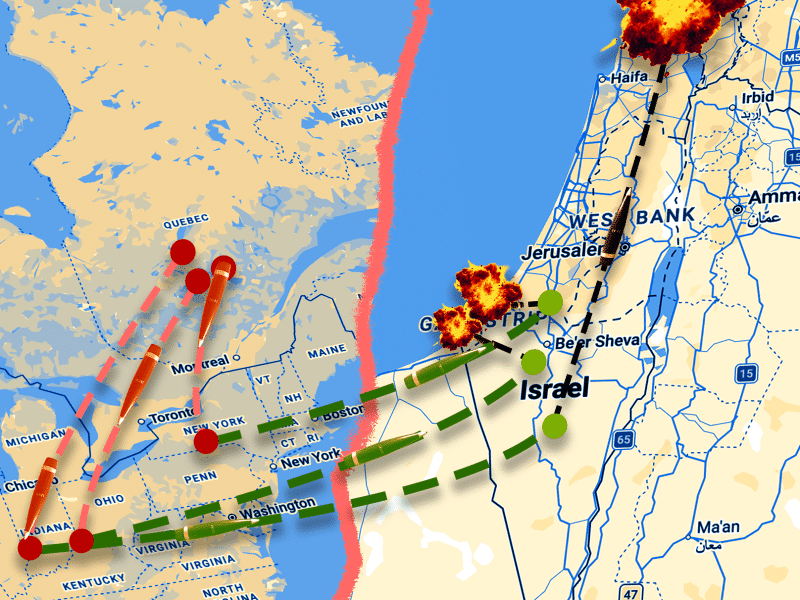
L’expansion d’une usine de munitions québécoise soulève des questions sur les chaînes d’approvisionnement liées aux Forces de défense israéliennes
Le projet d’expansion de l’usine de General Dynamics à Salaberry-de-Valleyfield suscite des critiques concernant les risques pour la santé publique et la crainte que ses produits ne servent, à terme, à soutenir les opérations des Forces de défense israéliennes via les chaînes d’approvisionnement américaines.
Quebec Munitions Expansion Raises Questions Over Supply Chains Linked to the IDF
The planned expansion of the General Dynamics facility in Salaberry-de-Valleyfield has drawn criticism over public-health risks and concerns that its products may ultimately support operations by the Israel Defense Forces through US supply chains.

Après la fermeture du PEQ, la population immigrante de Montréal cherche une issue
La suspension du Programme de l’expérience québécoise, en 2025, a privé des milliers d’immigrant·es d’une voie quasi garantie vers la résidence permanente. Entre la rigueur des critères du PSTQ et l’absence de clause de droits acquis, quel recours leur reste-t-il?
Comments (0)
There are no comments on this article.