
A Road Trip Through Trump’s America
What a week in West Virginia reveals about the direction of the United States.
My trip to West Virginia began with Amos 5:24.
The guy checking me out of the Hertz rental garage at the Pittsburgh International Airport was named Tom. Tom asked me, “Where are you headed?” I explained I was going to West Virginia to take a political pulse and visit an ailing friend in the Bethany area. Tom grabbed hold of my arm in a tight grip as it rested on the open window of the Jeep.
“We need to pray for your journey and your friend. Have you taken Jesus as your Lord and Saviour?”
I told Tom I hadn’t. He was undeterred. We had an impromptu prayer session right there next to the check-out booth. “Let justice roll down like waters, and righteousness like an ever-flowing stream.”
The guy behind me, who had been honking, paused. “Oh, you guys are praying.”
Tom was telling me that Donald Trump’s ascension to the presidency is prophetic and that these are the lead-in days to something biblical.
I drove away with the sense that the United States of America had started to fray at the seams.
Two days later, Charlie Kirk was assassinated in Orem, Utah.
Support your local indie journalists
***
Route 2, Brooke County.
I was heading southbound when I reached Follansbee, West Virginia. It had been about 40 years since I’d last driven that stretch of road. From 1981 to 1985, I was a communications student at Bethany College, about 20 kilometres away.
I looked for the smokestacks of the Mountain State Carbon Plant along the Ohio River — dozens of ovens heating coal into coke for steelmaking. You couldn’t miss them.
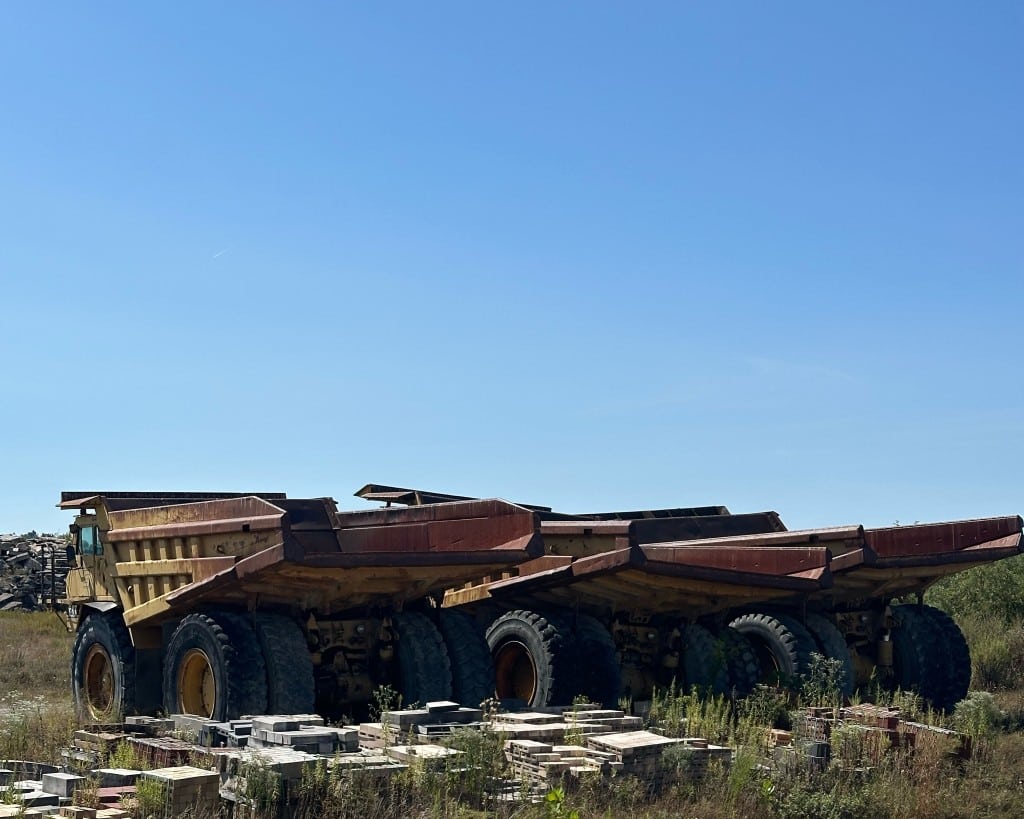
The smokestacks were still there. The rest of the plant — acres of it — was gone. Demolished. The plant closed in 2022.
Weirton Steel followed a longer arc before meeting the same fate. In 1982, National Steel told workers it would abandon the mill unless they bought it themselves — with a 20 percent pay cut and $1 billion in upgrades. They did. For a time, it worked.
Then came bankruptcy in 2003. And in April 2024, the final shutdown — 900 jobs gone.
The Ohio River towns along Route 2 have always risen and fallen on cycles of production and collapse. This time, the collapse feels deeper.
Brooke County has just over 21,000 people. Median household income is about $52,100. In 2024, Trump won 71.4 per cent of the vote.
***
Bethany
Bethany College still feels suspended in time — pastoral, isolated, culturally distant from Montreal, just as it did when I arrived in 1981.
In 1983, I was in my third year of studies when Gary Kappel returned to Bethany College to work with the theatre department. A 1974 graduate, he went on to earn his MA and PhD from West Virginia University. His career at Bethany College spanned more than three decades, much of it as a professor of European and military history. The last time Kappel and I crossed paths was in 1985, the year I graduated.
Forty years later, we met for breakfast at Chambers General Store on Main Street in Bethany.
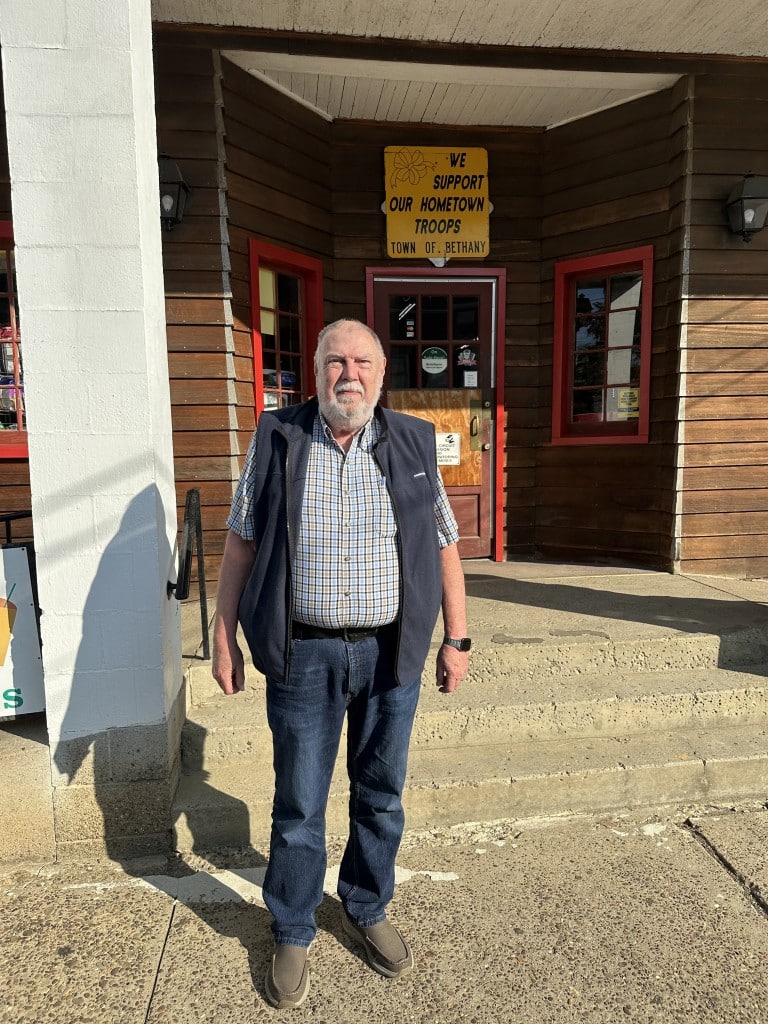
“Everything I was taught as a child, everything I taught for 40 years, everything I believed in, is now completely upended,” Kappel said.
“You can’t believe it. Thank God my parents are dead. They would not have been able to handle this. And I don’t know how well I’m going to handle it, either. I know that it’s not going to end well.”
Kappel spent decades studying the interwar period.
“They’re following the playbook almost page by page.”
I told Kappel about the prayer session at the airport – how it feels as if the seams holding the country together are unravelling.
“I think you’re absolutely correct,” Kappel said. Even in a state that went 70 per cent for Trump, he added, some people are now finally beginning to understand what they had done. “But I don’t think most Americans understand the shitstorm that’s coming our way. The ICE raids — this is just the beginning.”
“To watch 80 years of blood and treasure spent on maintaining a world order that was very beneficial to us be overthrown in months… a few months.”
“Almost 30 per cent of soybean farmers in this country are on the verge of bankruptcy already because the Chinese said, ‘Okay, we’re done. We’ll buy from somebody else.’”
“You know, they voted to be racist, not to go broke.”
I told him about a conversation I’d had earlier that morning, recalling — in paraphrase — president Lyndon B. Johnson’s line that if you can convince the lowest white man he’s better than the best Black man, he won’t notice you’re picking his pocket. Give him somebody to look down on, and he’ll empty his pockets for you.
“Oh, yes,” Kappel said. “Rather than allow the minorities in this country. And by that, I mean, even women, but also people of colour, immigrants, the gay community — rather than allow them to enjoy the same rights, they will burn the place down.”
He believed the reaction was rooted in fear. Not hatred, though hatred is there. A deeper fear. “I think that it comes from a sort of visceral fear that once these groups that have been discriminated against by the white majority for 400 years gain political power in the system, they’re going to do to the whites the same thing that they’ve been doing to them for the last 400 years. It is motivated by fear more than anything else.”
I asked Kappel if he had any thoughts on what the endgame was.
Kappel told me, “I wish I knew. History doesn’t repeat itself, but it does rhyme — and as the saying goes, the future will resemble, if not reflect, the past. Unfortunately, I think we’re headed for a real catastrophe. The last time this happened in a major advanced nation, it took a world war and 70 million dead to put an end to it. This time, I think it’s going to be much worse.”
He paused.
“Now, I hope I’m wrong. I say no war is inevitable until the first shot is fired. I still believe in free will. People always have the right to say, ‘No, I’m not going to do that.’”
What baffled him most was how quickly institutions folded: universities, industries, pillars of civic life. “These guys, these industrialists, just like the Germans in the 30s, they thought they could control Hitler. You know, that if we put him in place, he’ll leave us alone. That’s right. No. He won’t. What you need to be looking at is those guys falling out of fourth story windows in Russia.”
He said he’s largely stopped following the news. “I can’t watch the news anymore. I’m 72 years old now. I’m almost happy that I’m closer to the end than to the beginning, because I know what’s coming, and I know that I will not be able to withstand very much of it.”
The conversation ended as Kappel related that even routine interactions felt surreal:
“You don’t know where to turn,” he said. “You go to the doctor, and you get to my age, they ask you these questions. ‘Do you feel safe in the home? Have you fallen recently? Are you depressed?’
“Who the fuck isn’t?”
***
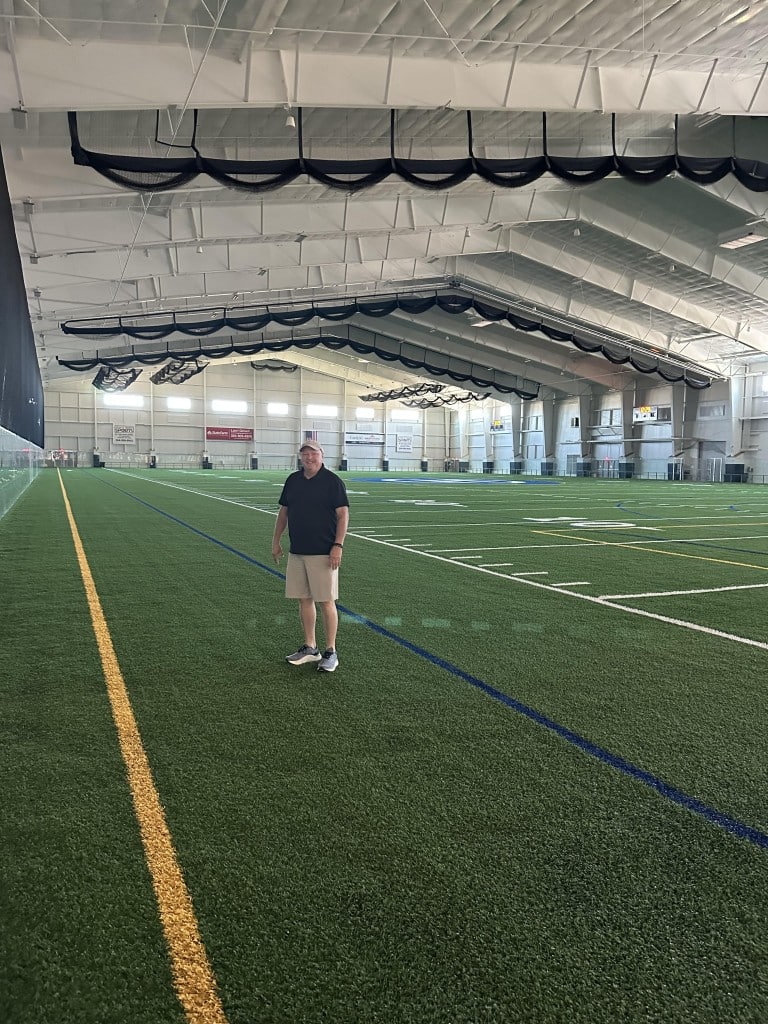
Mark and Dawn Swiger live on rolling land between West Liberty and Wheeling. Solar panels cover their barn roof — quietly disproving the idea that renewable energy doesn’t belong here.
Mark is a former civics teacher.
“The country was formed — and you hear people talking about ‘This is a religious nation’ and things like that. We were born out of the Enlightenment, which was the opposite of that.”
“We’re not using reasoning. We’re just handing over, abdicating power to a regime and saying, ‘I trust them.’ It’s nothing more than a medieval monarchy.”
What surprised him most was how readily people accepted it. “That’s shocking to me — that people have fallen for that. That we even need to have this discussion.”
When we talked about structural barriers, his voice grew sharper, more strident.
“Politicians are now choosing their voters rather than voters choosing their politicians. There’s a lot of problems with how we elect people now. And we give an unbridled amount of power to very wealthy people to dictate what happens in elections.”
I asked Swiger when West Virginia began its ideological shift.
“In the mid-70s,” he said. “When you saw steel and coal and all those things beginning to slow down, you could see a shift. It was a shift from the labour left, which had always been West Virginia, to the religious right. And it happened strategically in the 70s — intentionally, from the right — to bring those people in. And we saw it a lot in the ’80 election with Reagan really hitting the evangelical right. A lot of it happened here first.”
He traced the economic story back even farther.
“In the 1950s, I think we had 120,000 miners,” he said. “Now it’s only 20,000. But they’re mining as much coal. Mechanization… not the so-called ‘war on coal,’ corporations creating technological solutions for their mining operations. It had nothing to do with running people out of work. It was just technology mining coal more efficiently.”
Swiger said today’s grievances are rooted in that long decline.
“And now you have someone who was able to capitalize on the people who were left behind. In the Appalachians, rural America, the ‘flyover states’ as they call them. The farmers, agricultural workers, industrial workers in the Midwest, the Rust Belt… not ideology. People who lost their livelihoods — and someone figured out how to capitalize on that.”
His deepest worry came from familiar patterns. “My biggest fear — as a history and civics teacher — it’s easy to draw comparisons to the 30s and 40s. It won’t repeat exactly — history rhymes. But some people are pressing to make it seem like turning toward fascism is the right way.”
The erosion of civil liberties protections particularly frustrated him. “Those due-process amendments drive me the craziest. Everyone on American soil has a right to protect property and person from illegal search and seizure. Back to due process: cruel and unusual punishment, Fifth Amendment — the right not to testify against yourself, the right to a speedy trial. They don’t even get a trial. And then protection from cruel and unusual punishment.”
He didn’t shy away from the implications. “A concentration camp is a work camp. Without a trial. Those amendments are violated every day by ICE and others. My biggest problem: people don’t know their rights. Even those ‘here illegally’ — they have to be proven illegal in court.”
Despite everything, Swiger didn’t describe himself as fatalistic. Not in the way you might expect from someone who could list every constitutional fracture without checking notes.
“It sounds like doom and gloom, but I’m not… I think we all have to live together when the smoke clears. I have great relationships with neighbours who don’t share my beliefs. I don’t think of them in derogatory terms. They’re good people who voted for people who aren’t good.”
The future, he said, will still require community.
“Something happened that we’ll have to work through. But you don’t throw away relationships now.”
He paused, then added quietly, “I might be wrong — but I don’t feel threatened.”
At first light, I thanked the Swigers for their hospitality and headed back toward the main road. Their porch felt like a bit of treasured ground where a civics lesson could still happen at scale — measured, thoughtful, grounded in what the Constitution actually says.
But as I drove south towards Marion County, I kept thinking of what Mark said about abdication — how easily power slips away when people no longer believe they hold sway.
Fairmont was next on my path, and I was about to meet someone living inside that reality.
***
Marion County
Fairmont sits in Marion County, a place of just over 55,000 people, most of them working hard to stay rooted despite an economy that has been shedding ground for decades. Median household income hovers around $67,500. Roughly 7,400 people live below the poverty line. In the 2024 election, Trump carried the county by more than 30 points.
This is where I met Senator Joey Garcia — one of only two Democrats in the West Virginia Senate.
Garcia met me at his law office, in a building that looks like it was once a large home converted into commercial space. He greeted me with the steady calm of someone who understands the math of his political landscape and has decided to work anyway.
I asked him what it’s like dealing with a Republican supermajority.
“I think the complexity about politics in West Virginia is that it can change pretty quickly. I don’t think anybody, 15 years ago, in 2004, would ever have predicted how big of a shift there was.”
He recounted the old era — decades of Democratic dominance.
Then 2014 hit, and the floorboards gave way. A legislature that had been 53–47 Democrat flipped almost overnight. The Senate became 18–16 Republican after one Democrat switched parties.
“Everything changed overnight,” he said.
The early years after the flip felt unpredictable, but not chaotic. There were moments when the pendulum looked ready to swing back. The 2018 teacher strikes tightened the numbers — but not enough.
By 2020, Trump’s down-ballot pull obliterated the Democratic bench. Garcia ran that year and survived — “by the skin of my teeth.”
When 2022 came, the Democratic footprint shrank again. Now they are in what Garcia calls “the super-minority period.”
He knows the odds.
“There’s no chance we’re going to win the majority in the next election. Mathematically possible, but not practicable.”
So he thinks in years, not cycles.
I asked how Democrats rebuild from being reduced almost to a rumour.
“I’ll tell you,” he said. “The hardest part right now is that a lot of people — regardless of what they think politically — want to be involved with who they perceive as the ‘winner.’”
He hears legislators privately condemn the policies they vote for — and vote for them anyway. Winning has become its own ideology.
“A lot of politicians do that. In the shadows they’ll tell you they hate this… but they do it anyway because they believe, often rightly, that that’s how they win in this environment.”
“Then you have other people… who have given up. And I don’t blame them, because it can be a struggle with the amount of — I’ll just say it — stupidity out there.”
People asking where the money is.
Garcia shifted to Washington.
“In eight short months… Project 2025 — half of it’s been completed. During the last election people said, ‘Oh no, that’s just far-right people talking.’ But that is absolutely what’s happened.”
Federal support has long been West Virginia’s economic backbone — roads, interstates, poverty programs, Medicaid, energy transition grants, NASA, the FBI.
Now those supports are eroding.
“We’re only starting to see the effects on our economy,” he said. “It didn’t have to happen.”
I asked if he was surprised by the speed.
“I think in the first administration, there were folks who held back his worst instincts — told him no or ignored him. The people around him now are the ones who enable him.”
“And we have a court system that has not pushed back, at least at the Supreme Court level.”
“They allow government officials to get away with a lot more than they used to.”
What he said next stayed with me:
“Of all the manifestations of power, restraint impresses men the most.”
He doesn’t see much restraint anymore.
When I asked about his deepest worries, the conversation shifted.
“This is where I intend to stay,” he said.
He talked about population loss.
“I find it sad that the aggressive, hateful tone we have in our state is pushing people away. Our biggest problem is population loss. We’re one of the oldest states. One of the highest disability rates. And the younger generation has either left or fallen victim to opioids or a failing education system.”
“We’ve had opportunities to overcome. But if we push people out, we won’t have the workforce to attract businesses — or to care for people.”
I told him what I’d heard upstate: people voted for Trump because they felt abandoned. Now they feel abandoned again.
“That’s what’s hard,” Garcia said.
“You asked earlier: how do you build back a party that’s been decimated? It starts with small acts — building trust.”
He described a “kitchen table tour” — 10 cities, listening sessions.
“Will that change everything? No. But it’s a first step.”
He’s frustrated by the national Democratic Party — the messaging, the inability to speak plainly.
“Even when I agree with the policy, they don’t explain why it’s right. They don’t explain how it helps people.”
We talked about Andy Beshear in Kentucky — clarity, humility, consistency.
“To gain trust, we have to listen. Talk in ways that connect. Not expect people to get to where we are.”
I asked why he chose politics.
He told me about his grandfather, Manuel Garcia — deputy mayor, city council member — helping veterans at McDonald’s get Veterans Affairs benefits, connecting people.
“So I always liked the idea of helping people.”
He tells students that legislators are not geniuses.
“In a part-time legislature, you see the ‘three Rs’: the rich, the retired, and the retained.”
Government, for him, is a place where advocacy is public, not partisan.
“Often I’m one person on a committee of 16. We know we’ll lose the vote. But we stand up, ask the questions, make the public record.”
He smiled — tired, but unbroken.
“With four Democrats we could do so much more. With six? Even more. But even with two… we’ve been damn effective.”
He paused.
“It’s banging your head against a wall. But when people say, ‘Thank you for trying,’ I think: we’ve got a long way to go. But I want to be part of building what government is supposed to be.”
***
Kanawha County
From Fairmont I drove south toward Charleston, the hills pulling in close again before opening wide along the Kanawha River.
Kanawha County has roughly 174,000 people, with nearly 28,200 living in poverty. In the 2024 election, Trump received 57.6 per cent of the vote, Harris 40.2 per cent — closer than farther north, but the political gravity remains unmistakable.
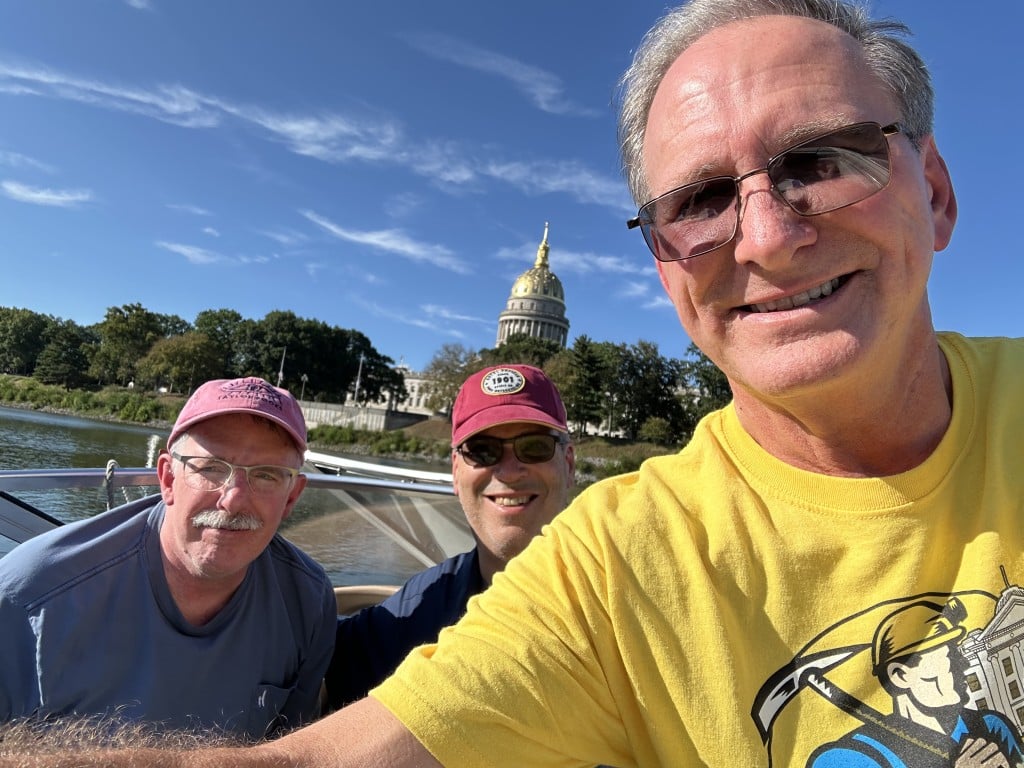
I met my old friend George Manahan for lunch. Then we headed to meet Dr. Ron Stallings — physician, former state senator, and someone who has spent his life trying to keep West Virginians alive despite the systems around them. He suggested we talk on his daycruiser, docked along the Kanawha. The late-afternoon sun lit the water in shards.
Stallings didn’t waste time easing in.
“It’s the Trumpiest state on the planet. It’s a state of contradictions. It’s so ironic. I mean, we should have more government services in West Virginia than any place, because we’re the least educated and least healthy. But we vote to have less government. We worry about cuts to Medicaid and healthcare coverage — that’s sinking in. But they phased it in. Those guys are so shrewd.”
Medicaid. Healthcare coverage. The fragile systems that hold people together — all under threat, with policy changes phased in just slowly enough that the public barely notices until it’s too late.
“You have to have a long memory to remember what they did. Whatever (Secretary of Health Robert F.) Kennedy and those guys — what they’re doing, you should do the exact opposite. 180 degrees away. We should be vaccinating more, not less. We should be investing in public health. They cut public health out the wazoo. They did away, at one point, with the Mine Safety and Health Agency – MSHA.”
He looked out over the river.
“They’re dissembling the entire health system. Oh my God. It’s scary. I knew it was going to be like this… but I had no pre-conceived notion it’d be this bad. I had no idea Congress would lay down. Totally lay down.”
When he talked about his own part of the state, coal country, the frustration deepened.
The Inflation Reduction Act could have reshaped southern West Virginia, but the local “intellectual infrastructure,” as he called it — grant writers, planners, people who can turn opportunity into action — simply wasn’t there.
“We had all the places. Hobart was ripe — which is a Post Mine Land site. You could put one of the largest solar-panel farms in the country there. And it has a huge 740-whatever-watt transmission line going through it. We thought it’d be easier to get that into the system.”
But the project died.
“‘We don’t want no solar in coal country,’” he said, imitating the Republican senator who helped kill it. “They undid it.”
In a state with almost no flat land, a rare buildable site was squandered.
Stallings worked in the mines as a young man — a “red-hat trainee,” as he said. He understands coal not as ideology but as labour, danger, and skill.
“I have all the respect in the world for those miners.” Technological efficiency, not a “war on coal,” hollowed out the workforce. A long-wall machine can do the work that once required dozens of men.
Then there was the opioid crisis.
“I was chairman, or co-chairman, of the Council of State Governments Health Policy Committee. And when I was chairman of the Health Committee, that was the time we were finally trying to get our arms around the substance-use disorder crisis… The way we did it early on just stunk.”
“I told them, I said ‘Guys, when you cut off that supply of hydrocodone and oxycodone… they’re going to go to something else.’ And they did. They went to heroin. So, the number of opioid prescriptions in West Virginia did this” — he dropped his hand — “and the number of overdose deaths did that” — he raised his hand.
“Still climbing?” I asked.
“Yeah,” he said.
On vaccinations he was unequivocal. “To me, it is absolutely clear we need to keep medical exemptions only. We have the best data on the planet. Otherwise, there’d be outbreaks and people would die. Kids would die of measles.”
“Our kids all have to be vaccinated if they’re going into public school,” George Manahan said.
“West-Virginia-like vaccination: medical exemptions only,” Stallings said. “But I’m telling you — those anti-vaxxers… they were rabid. They hated me.”
“They’re just checking a box: ‘get rid of vaccine regulations.’ And they don’t care that people will die by checking that political box.”
He told us a story about the raw-milk law. Lawmakers celebrated passing it by drinking unpasteurized milk inside the Capitol. One of them promptly got sick. “Laid out on the couch, nauseated as hell,” Stallings said.
He wasn’t laughing.
When I asked where the state goes next, he didn’t hedge.
“Somebody’s got to stand up to him. Congress or the Supreme Court. Somebody. If he keeps the House and the Senate, they’ll say it’s a mandate — a mandate to do away with vaccines and public health.”
We ended the interview drifting along the Kanawha, the city opening on both sides of the river. From the water, Charleston looks almost serene — a soft-edged capital with its dome catching the evening light.
Almost.
***
My next stop was GoMart Ballpark to meet Rod Blackstone — a man whose political journey ran straight through the heart of the old Republican establishment before he walked away from it.
I met Rod Blackstone at his office inside the ballpark, home of the Charleston Dirty Birds. I asked him about his trajectory into politics.
“Always interested in politics from the time I was young. I believe we get our partisanship from our parents. A political science professor of mine at Syracuse used to say: fundamentally, it starts with your parents. If your parents are both Republican, then you’re going to probably start off as a Republican — and vice versa for Democrat. If they are mixed or not really involved, that’s often reflected in the next generation too, until you have a significant political experience that either confirms that or changes it.”
“My dad was a lawyer, a state and small-business kind of lawyer. Mom was a professor. She was more liberal Republican and had an amazing worldview. Dad would have been voting for Eisenhower, and I’m sure he never voted for a Democrat for president. Except maybe this time.”
He spoke with nostalgia of the Republican presidents he admired: Ronald Reagan, whose 1981 inauguration he attended with his father.
Over the years, he said, he became “a liberal Republican” before finally becoming an independent. “I do not like what’s happened to the Republican Party since the crazy started taking over in 2010.”
I asked Blackstone about Trump’s relationship with the Constitution.
“He has no concept of the Constitution. None. He has zero — and he has no foundation in truth. Every once in a while, you get a confession out of him where he says, ‘Well, we rigged the election last time.’ But no, he has no foundation in truth.”
“When you look at who he’s gone after as a president: he’s gone after the cities with Black mayors, completely inappropriately to begin with. He’s — who does he decide to target at the Federal Reserve right now? A Black woman, who he has belittled throughout any encounter. It was the women — and Blacks especially. And now, of course, targeting Latino folks. I mean, the other thing is, when you cloak it in Christianity… It is — it is — I will not use the word ‘antichrist’ because that has a certain meaning. It is certainly anti-Jesus. And why do they do it? Because they can.”
Blackstone teaches Sunday school and says that it has made him more inclusive. “I am all about diversity, equity, and inclusion.”
“I am part of the dominant demographic of U.S. history: white, male, Protestant property owner. It’s time for more people in the dominant demographic to stand up and say: this is wrong. What we see is a resurgence of white supremacy, male supremacy, wrapped in the happy visage of a man who cares only about himself.”
“He has made it okay to be racist again,” Blackstone said. “He has empowered racists and white supremacists more than anything or anyone since Dr. King was assassinated. He has given them power. He has given them a voice. He has given them the ability to stand up. And he will not condemn them. And you see it manifesting across this country.”
As we wrapped up, Rod drifted toward scripture — not the performative kind, but the version that asks something of people. He described teaching the parable of the Good Samaritan and how Jesus assigns roles: the religious leader who walks by, the community leader who walks by, the despised outsider who stops and helps.
“If you retold that in Alabama in 1965,” Rod said, “the first is a Baptist preacher, the second is (then-Alabama governor) George Wallace, and the third is a Black sharecropper who had once been threatened with lynching. Jesus chose that.”
When we finished, we lingered in the doorway. I opened my phone to a flood of breaking-news alerts.
Charlie Kirk had been assassinated.
The moment landed hard — another line crossed in a country already absorbing shock as routine.
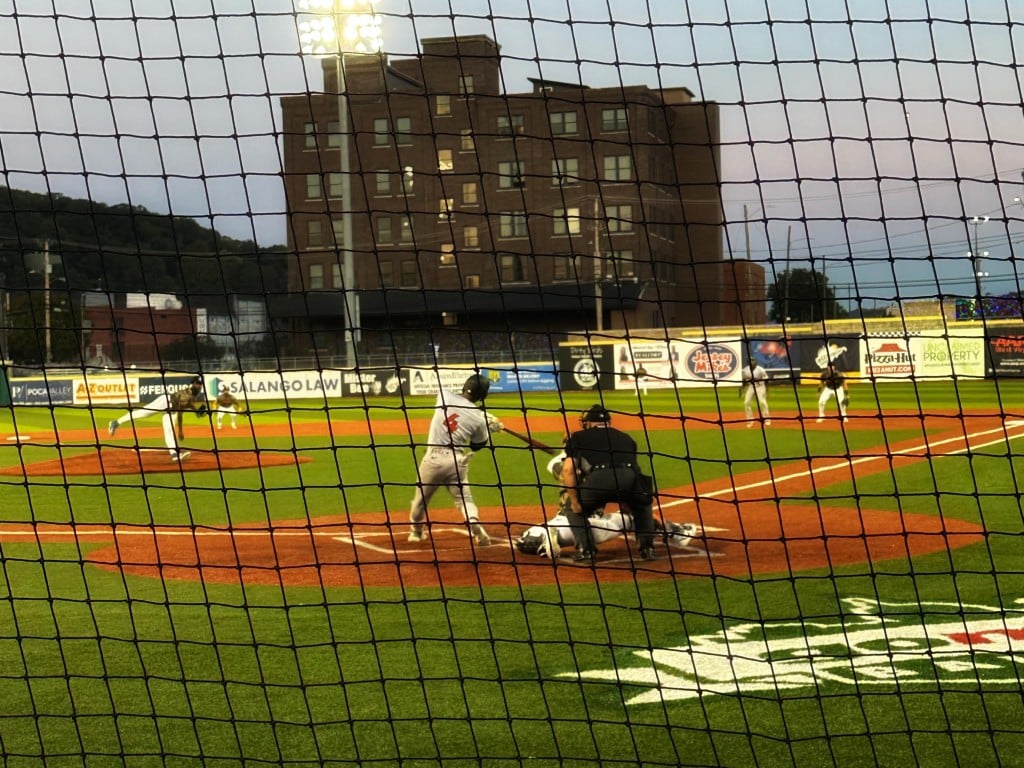
That evening, George and I went to watch the Dirty Birds play against the Gastonia Ghost Peppers. We sat down close to the field. We could hear the banter between the players and the hecklers in the stands.
Within a few innings, some of the heckling turned to comments about the players’ hairstyles.
I left Charleston the next morning and headed toward the Eastern Panhandle of West Virginia — a long drive up and through the Appalachian Mountains.
***
Berkeley Springs, Morgan County
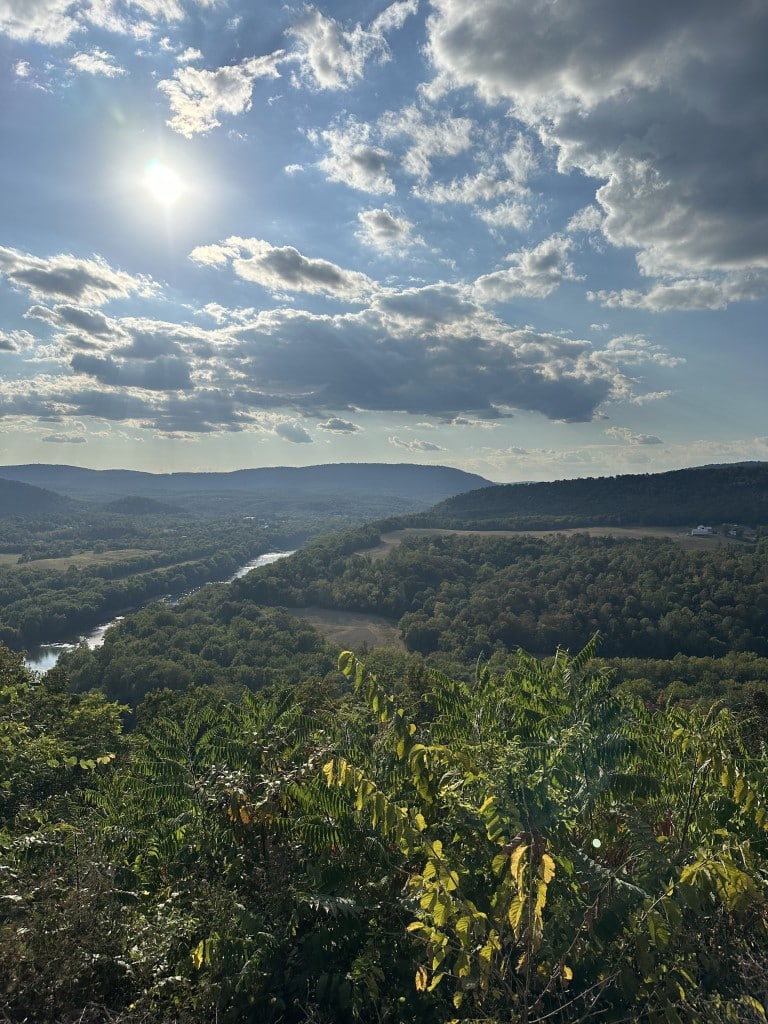
Morgan County sits in the far eastern panhandle, a rural county of 17,780 people (2024) with an older, settled population and long commutes that pull many residents toward jobs across state lines. Median household income was $63,800 in 2023.
Politically, Morgan County leans hard to the right. In the 2024 election, the county gave Donald Trump 77.1 per cent of the vote, Kamala Harris 21.4 per cent.
Berkeley Springs — originally chartered as Bath in the 18th century — has always sold itself as a place of escape. The warm mineral springs drew colonists early, and George Washington first visited in 1748 as a teenaged surveyor and returned throughout his life. That legacy lingers: a community built around spas, art studios, weekend retreats, and the promise of calm.
But this time, calm felt selective.
When I arrived, the café where I had arranged to interview the owners was closed for a “retreat.” A request to speak with the mayor went unanswered. In a town repeatedly thrust into the national spotlight because of the castle and VDARE, the reluctance to engage with yet another journalist was easy enough to understand.
I spent part of the day visiting old friends who had uprooted from the Baltimore suburbs years earlier and settled on a sweeping patch of land outside town — goats in the field, forest rolling behind the house, the kind of acreage that draws people to the Panhandle. To my surprise, they were volunteers at the castle. They helped keep it running, opening it up for community events — Halloween parties, receptions, fundraisers, the ordinary civic rituals of a small Appalachian town. And it was through them that I was introduced to Peter and Lydia Brimelow and invited up to the castle that towers over Berkeley Springs.
The building itself is unmistakable: a 19th-century stone structure perched on Warm Springs Ridge, overlooking the town below.
Ownership has shifted over the years — private residence, summer camp, museum — before being purchased by VDARE in 2020.
Before I met them, I had spent time reviewing the public record on Peter Brimelow and VDARE. Brimelow is a British-born author and former financial journalist who built his early career at mainstream publications, including Forbes, National Review, and MarketWatch. His 1995 book Alien Nation made him a prominent figure in debates over U.S. immigration policy, and in 1999 he founded the VDARE Foundation, named after Virginia Dare, the first English child born in the Americas.
Over the years, VDARE evolved into a platform publishing essays on immigration, demographics, culture, and politics. It has also drawn sustained criticism from civil-rights organizations and academic researchers for the material it chooses to publish. Brimelow disputes those characterizations and has challenged media outlets in court over terminology he considers inaccurate or defamatory.
In September 2025 (literally the week before I arrived), the organization came under renewed scrutiny when New York State Attorney General Letitia James filed a civil lawsuit against Brimelow and the VDARE Foundation. The complaint alleges that charitable assets were misused and that the organization engaged in what the filing describes as “self-dealing transactions that enriched insiders at the expense of the nonprofit’s mission.” It also cites the 2020 purchase of the Berkeley Springs Castle as an example of a transaction the Attorney General argues did not serve a legitimate charitable purpose. Brimelow and VDARE deny the allegations. The case remains active.
What unsettled me most was the contradiction.
Even under VDARE’s ownership, the castle remains stitched into the rhythm of the local community. It still hosts weddings, charity fundraisers, Halloween parties, and Christmas displays — civic events woven into Berkeley Springs’ social calendar. A 19th-century folly built by a bourbon baron, restored by private hands, now doubles as both the headquarters of a hard-right ideological project and a backdrop for seasonal celebrations.
The contrast can feel surreal. On its official website, the castle advertises events like the annual Christmas at the Castle fundraiser:
“The magic of the season returns to the Berkeley Springs Castle… featuring hundreds of feet of stunningly decorated garland, a 13′ live Christmas tree, themed rooms, and an unforgettable selfie spot with the biggest wreath you’ve ever seen. Best of all, 100 per cent of ticket sales support the Bath Christmas Project…”
Cookies, hot cocoa, Santa on the landing, and volunteers transforming the interior into a “Christmas wonderland.”
It’s an odd coexistence — history, ideology, and civic tradition colliding under one roof. And it was against this backdrop, that I found myself meeting Lydia and Peter Brimelow inside the castle.
This meeting was, I suppose, a preliminary exam. A chance for Peter to decide whether he would continue the conversation later in writing. A vetting. A test. Whatever the rubric, I passed.
He offered to give me a tour.
We walked out onto the ramparts. The town lay beneath us. From above, Berkeley Springs looked exactly as its reputation suggests: a gentle retreat with no visible edges. But standing beside one of the country’s best-known civic-nationalist figures, looking down at a town that had voted 77 per cent for Trump, the view carried a second meaning — the sense that I was no longer just observing the political drift of a region but standing inside one of its ideological nerve centres.
Once back inside, Peter led me down a narrow, hidden staircase into the bowels of the building.
There was a dungeon.
Of course there was.
The prayer at the rental garage.
Kappel’s warnings.
Swiger’s civics lesson.
Garcia’s frustration.
Stallings on public health.
Blackstone on the collapse of the Republican Party.
A castle on a hill.
A movement with deep roots.
An ideology that no longer feels abstract.
Not dystopian.
The evolution of these United States of America.
Author

Comments (4)
Leave a comment
Related Articles
OPINION: Why is McGill Fighting to be on the Wrong Side of History?
The university insists on silencing its students as they push McGill to take a stand on genocide.
Editor’s Note: When the Comments Section Gets Out of Hand
As our Instagram follower count grows, so too does the number of problematic comments. What are we supposed to do about it?
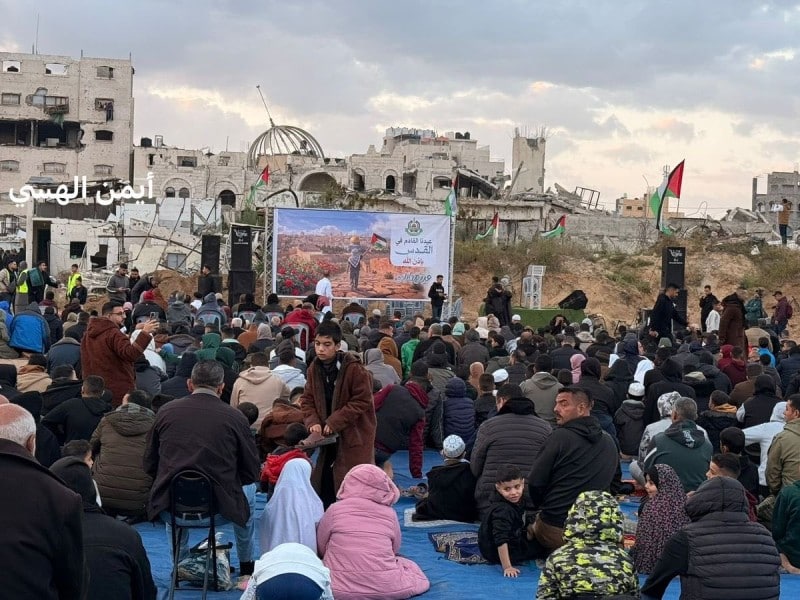
Eid in Gaza: Solidarity in the Face of Deprivation
The people of Gaza continue to help one another, sharing what little they have despite their own sorrow.
Once again, you have hauntingly captured the tumult and turmoil that is our every day existence now. We still have to live but when all the promises of “work hard, do good, and you will be well” are vanishing as those with zero reverence for the office, the responsibility, and the gravitas of holding millions of lives in their hands treat *our* lives like a reality show with no consequences. The vast majority of Americans are trapped in a horror show that has no end in sight.
Such a sad commentary on West Virginia that can also be applied to so many of our country’s poorest states-both economically and educationally. I also am in my 70s and thankful that I am on the way out. I am fearful for my children’s and grandchildren’s futures. What kind of world have we created where billionaires have so much influence over our politicians? And, where politicians might believe one thing and yet vote the opposite way to achieve what? Getting re-elected no matter what? When will this country wake up to what is really happening? Thanks, Hal, for writing this and helping to open more eyes to this conundrum we have created.
Heartbreaking and beautifully written. An excellent examination of what has occurred in both West Virginia and throughout the United States. Thank you for sharing your thought provoking insights and experiences on your travels to visit friends and seek perspective from others.
Oh, the painful moment when Swiger said “I don’t feel threatened”. Of course he doesn’t. He’s a white man in his mid-sixties. Given everything else he said, this comment came as a deep disappointment.