
Analysis: New Mayor, Same Old Challenges
With a strike paralyzing transit, another labour action looming, and Montrealers facing a crisis of homelessness and housing affordability, Soraya Martinez Ferrada has her work cut out for her.

If eight years under Projet Montréal was an experiment in turning the city over to bike-riding college professors, we’re about to see what happens when the business class takes back the reins.
Soraya Martinez Ferrada won a decisive victory Sunday on a promise to “unblock” Montreal. What this means, in real terms, is that her party will deregulate zoning bylaws to favour developers and inject public money into partnerships with these developers to (hopefully) produce more social housing. As more money gets redirected to the private sector, the city will slash 1,000 jobs under an Ensemble Montréal administration.
The mayor-elect has promised to fight a rise in violent crime by giving police access to an enormous database of private security footage and increasing the number of metro constables by 50 per cent.
In short: less government, more condos, more cops, more surveillance.
The most ambitious promise of Martinez Ferrada’s, to end homelessness within her first term, will seek to reverse a trend that’s seen the number of folks sleeping on the streets nearly double over the past decade. Under Ensemble Montréal, which holds a majority of seats on city council, there would be a total of $220 million spent to buy up buildings, convert them to shelters, hire more frontline workers and support at least 800 households struggling to make rent every month.
But can a government that promises free rein to developers also bring affordability back to a rental market that’s seen prices double under Projet?
Will handing over more money and power to a police force whose practice of racial profiling has cost the city millions in lawsuit payouts and legal fees make our streets safer for everyone? Or will it give them license to resume the practice of “random” street checks that overwhelmingly target Black, Arab and Indigenous Montrealers?
This practice, by the way, was ruled unconstitutional by both the Superior Court and the Quebec Court of Appeal.
We’ll see how it plays out, but municipal governments tend to campaign from a place of ideology and govern from a place of pragmatism. Which leaves us guessing at how the next four years will go. Without further ado, here are some things to watch for in the near, medium and distant future.
STRIKE(S)!
Perhaps the biggest shit sandwich inherited by Martinez Ferrada is a series of labour crises between the city and those who keep it running.
The day before Sunday’s election, 4,500 workers at the STM — Montreal’s transit authority — went on strike for higher pay but mostly better job conditions. One mechanic, who spoke to The Rover on condition of anonymity, spoke about how the increase in outsourcing repairs not only threatened his job but could also cost the city more than keeping things in-house.
The source spoke about a simple repair that would’ve cost the city little more than a few hours of one of its electricians’ time. Instead, they outsourced the job to a private firm for $3,000.
Outsourcing would also lead to fewer preventative repairs. That’s why, according to the source, the STM had to sideline 181 of its fleet of 220 articulated buses last week to fix a problem with overheating motors. The source said things came to a head last month when a valve carrying engine coolant burst open and sprayed riders.
Making matters worse, the city depends on massive provincial subsidies to fund public transit at a time when Quebec is slashing budgets, fighting doctors and picking on Montreal to appease its base “en région.” It’s hard to see a way out of this crisis that doesn’t hurt the transit system and the hundreds of thousands of Montrealers who use it to get to work every day.
Offering a glimmer of hope to workers, Martinez Ferrada told reporters Monday she would “put pressure” on the transit authority to resolve the strike at the negotiating table.
Not too much further on the horizon, the city’s 6,600 blue-collar workers voted 98 per cent in favour of a strike mandate during their general assembly in September. While they also want to claw back some of the losses incurred during the inflation crisis, one of the main gripes is also working conditions.
Sources in the union say essential equipment like garbage trucks, sidewalk sweepers and city vehicles routinely break down without being replaced. Now, armed with a strike mandate and an inexperienced administration, the union is in a strong bargaining position.
Housing
One of Ensemble’s first orders of business will be to do away with the Bylaw for a Diverse Metropolis — the 20/20/20 bylaw.
Projet’s signature bylaw imposed a fine on developers who didn’t build projects that included 20 per cent social housing, 20 per cent family housing and 20 per cent affordable housing. The thinking was that the threat of a fine would push developers to do the right thing and keep the city affordable for working families.
But just 11 of the 256 housing projects approved since the bylaw passed have actually built social housing. The rest paid fines, adding up to $63 million in funds that the city will use to purchase properties and convert them to off-market housing.
Devimco, which bought up the old Children’s Hospital on Tupper St., signed an agreement with the city to build 180 social housing units on the site and even include the construction of an elementary school. In the end, the developer backtracked on both promises, building no off-market units in its luxury condo tower. They even got the city to commit $21.5 million in public money to help Devimco pay its mortgage on the site.
If developers appeared to get their way under Projet, Ensemble appears to be their dream come true.
That might explain why Martinez Ferrada launched her campaign on a rooftop cocktail party at the Holt Renfrew building, where she was introduced to Montreal’s business community by the billionaire Stephen Bronfman.
A longtime Liberal fundraiser and close friend to Justin Trudeau, Bronfman also stashed $34 million of his family’s fortune in the Cayman Islands to avoid paying taxes in Canada. That’s according to a 2017 investigation by CBC and the Toronto Star.
The party featuring Martinez Ferrada was hosted by Ian Quint, a commercial real-estate developer and frequent donor to Conservative Party of Canada leader Pierre Poilievre. Quint’s company manages about $2.5 billion in assets across Quebec.
Two Quebec courts found that Quint used deceptive marketing practices after leaving his uncle’s real estate firm, Quintcap, to form his own shop, Groupe Quint. In his 2021 ruling, Superior Court Judge André Prévost found that Quint was trying to “pass off” his new company as a subsidiary of Quintcap.
If these are the kinds of people Ensemble will lean on to enact its vision, can we trust folks like Quint and Bronfman will act in the city’s best interest?
Leaning to the private sector in times of austerity certainly sounds appealing. Martinez Ferrada believes that rather than punish developers with a bylaw, the city should provide financial incentives for the creation of social housing. But looking at other major cities that gave developers free rein — Toronto and Vancouver, for instance — provides a glimpse of where that may lead.
Toronto’s condo market was so hot during the pandemic that people took to buying and flipping units at a massive profit before they were even built. That market has now crashed to its lowest point since the 1990s, meaning fewer constructions and layoffs in the construction industry.
Vancouver is also experiencing a slowdown in the condo market because, as experts note, roughly 80 per cent of citizens can’t afford to live in the new towers being erected across the city.
Support your local indie journalists
Homeless Encampments
With the city’s homeless population growing from about 3,000 to over 5,000 under Projet Montréal, encampments have become a reality of life in the city.
Over the past four years, Mayor Valérie Plante’s administration dismantled dozens of homeless encampments across the city. Some grew so big that blue-collar workers were dispatched to collect garbage and offer basic services.
But ultimately, these were ramshackle setups without electricity or running water, often hidden deep in the shadows of the city to avoid detection. That’s where people sometimes went missing or fatally overdosed without anyone attending to them.
Plante’s policy often felt inconsistent and reactive, with some encampments being tolerated while others were bulldozed.
Within the first 100 days of taking office, Martinez Ferrada’s team will draft a coherent policy on encampments after studying the phenomenon closely.
The encampments are a response to the fact that, with just over 2,000 emergency beds in Montreal’s shelter system, there’s barely enough room to house half the homeless. To this end, Ensemble has promised to build 2,000 transitional homes with psychosocial support while providing rent subsidies to at least 800 households through Maison du Père, a downtown shelter.
Bike Paths
Martinez Ferrada campaigned on the idea that she would audit and possibly reduce the number of bike lanes in Montreal within the first 100 days of taking office.
This made her the darling of conservative talk radio hosts and columnists across the city who saw bike lanes as a symbol of Projet’s elitist politics. But on the morning after her election, she backtracked, noting that the city had already commissioned an audit of the bike network under her predecessor.
Among the audit’s findings: adding bike lanes to St. Denis St. may have helped increase business occupancy from 75 per cent before their construction to nearly 90 per cent last year. The study, published this fall by McGill University, even found that to meet growing demand, the city would have to double its bike lane infrastructure.
Just 2.3 per cent of the city’s road infrastructure is dedicated to bikes, with the other 97 per cent still being used by cars. The study also found that removing bike lanes would have a negligible effect on traffic.
Even so, it took only hours for Martinez Ferrada to spend political capital taking back one of her campaign’s signature promises. And in this city, that kind of spending will get you in trouble.
Did you like this article? Share it with a friend!
Author

Comments (2)
Leave a comment
Related Articles
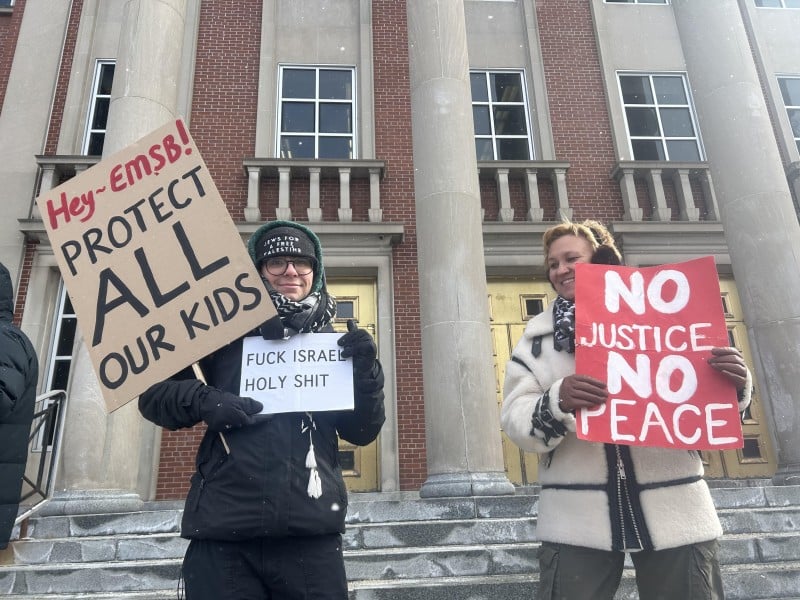
Ombudsman Rules in Favour of Student Suspended for “F*ck Israel” Post
The English Montreal School Board was ordered to retrain staff on its anti-bullying policy and students’ rights.

Will Bill 21 ‘Erase’ a Generation of Muslim Teachers from Quebec?
The legal battle over Quebec’s religious symbols ban has reached the Supreme Court in a case that will make Canadian history.

Nunavik Police Get a Pay Raise Amid Community Concerns
Inuit activists say the pay raise should match police efforts to rebuild trust with the communities.
Great summary. Thanks.
As we move back into the paradigm of public-private arrangements in real estate, intended to stimulate construction that benefits the social development of the city (affordable housing, increasing the stock of social housing, etc.) it’s worth dissecting a bit more who will be involved and at what stages will they contribute to SMF’s goals as laid out by her platform.
Who is now involved as partners now all have slightly different objectives in terms of value generation, meaning the city will have to balance incentives to goals of – REITs (growing and managing the portfolio of properties for their shareholder), REOCs (extracting rents and capital value from property for their shareholders), commercial developers who flip, lease and manage properties and property management companies who are mostly focused on rents and management on behalf of asset management funds or other non-real estate investors.
As has been shown as you point out in Toronto and Vancouver is that it is hard to balance the values and objectives of real estate’s private interests with those of the city and the public institutions whose role is to serve the needs of the public, especially during an affordability crisis caused by multiple factors, many out of the city, the province or the nation’s control.
To remedy, EM’s platform has a number of measures drawn from what can be seen as the neoliberal toolbox, hinting at rent-to-buy schemes, financial support for first-buyer deposits, tax relief for the elderly or vulnerable, a patchwork of measures intended to create more favourable situations for property owners or would-be owners. For renters though, there is not much, other than reinforcing surveillance of bad landlords, a mutual aid bank and legal tools available to renters. The one I do think will potentially make a difference is vacant property taxes, but I am doubtful it will be implemented in earnest – that is something that can legitimately increase rental housing stock, though there are many ways to get around such a system.
Some positive notes – there is an attempt by EM to study and act at different stages of real estate development so as to achieve results, such as investment in transitory housing and process efficiency that should encourage smaller developers.
Overall though, we can safely say these approaches together do not amount to much for housing in general, or the rental market as a whole. Building costs are rising, the investor class is increasingly dominating housing stock which in turn changes the objective of development. And cities continue to grow, forcing more pressure on housing stock for ordinary citizens, together with rising costs of materials and labour, prices will continue to go up.
In my opinion though, the solutions are to be found at provincial level, where policy frameworks can be created enabling publicly funded projects at scale, and non-profit partnerships with socially aligned values and objectives are needed. Public-private partnerships will not yield the desired result of downward pressure on rent cost and housing availibility.
– systemic barriers (CMHC)
https://assets.cmhc-schl.gc.ca/sf/project/archive/research_6/systemic-barriers-framework—final-pub-version.pdf
– perspectives sur le marché d’habitation (CMHC)
https://assets.cmhc-schl.gc.ca/sites/cmhc/professional/housing-markets-data-and-research/market-reports/housing-market-outlook/2025/housing-market-outlook-02-2025-fr.pdf?rev=abdfc603-de8f-415a-8986-63aef14b4d3f