
Death Threats, Boycotts and Backlash
For hundreds of Canadians, the price of speaking out on Gaza has been high.
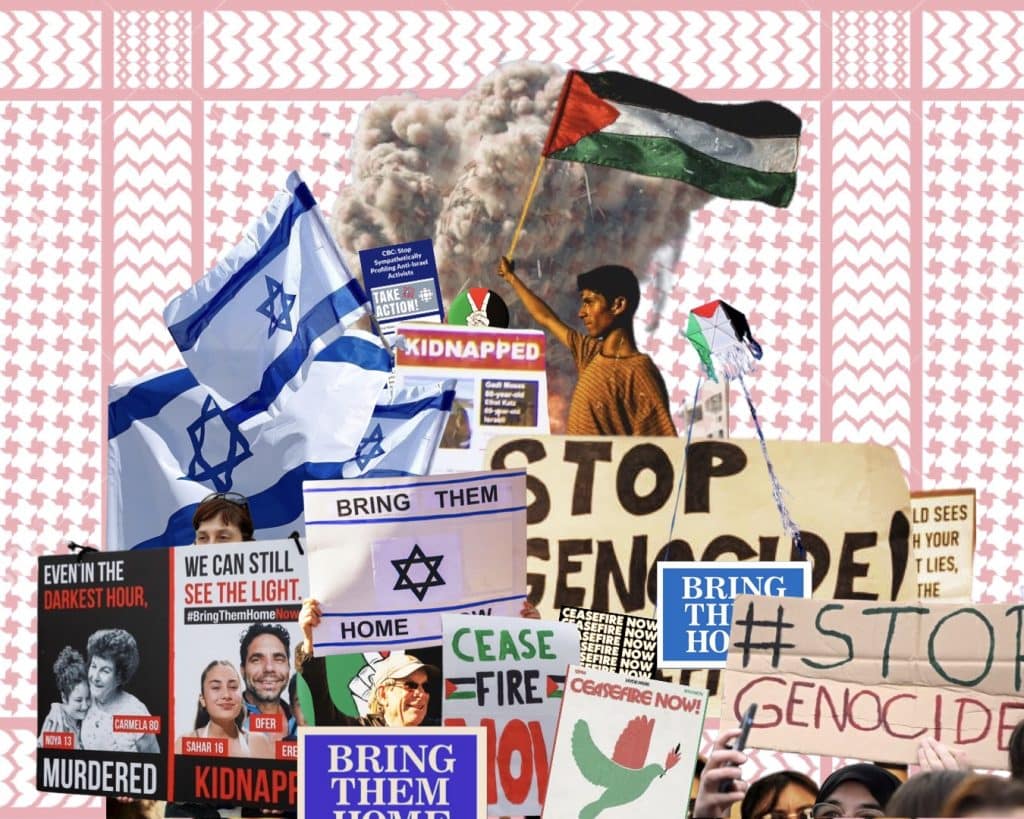
It’s been more than two months since J went viral, but the video continues to haunt them.
For weeks, people on the internet sent death threats, alluded to rapes and homophobic violence, and hunted for J’s identity and location. They called for J’s expulsion from university, imprisonment, and deportation from the country, even though J was born in Montreal. Among the slew of violent and horrific messages were photos of slaughtered pigs and clowns. Users branded J with labels including “whore,” “savage,” and “Islamist demon.”
“It’s over for you,” one user tweeted.
J’s days have since been relegated to hyperawareness. Fear accompanies them on the metro, on campus, in between classes, and anywhere that isn’t their home. Their spouse is notified whenever J moves from one site to another, and their friends and classmates are aware of every classroom they’re in. Outside of the home, they wear a medical mask.
“I never thought that if I was gonna go viral, it was gonna be for something that I didn’t say,” J said. “But it’s also terrifying, that there are large members of what would be our community sharing something that isn’t even confirmed, and you know, perpetuating a really dangerous narrative.”
SUPPORT INDEPENDENT JOURNALISM
The viral video, captured Nov. 8 on Concordia University’s campus and circulated widely on social media the same day, was accompanied with defamatory claims that J had called another student an antisemitic slur. J says this couldn’t have been possible because they’d first learned of the slur when they were shown a TVA Nouvelles article about the video a few hours later.
“I had to ask a classmate what the k-slur even was,” J said. “I can’t say a word I didn’t know.”
J has tried to correct the record on X. They told The Rover that they were on their way to class in Concordia’s Hall Building when they happened upon a large gathering on the mezzanine floor. Crowds of students had gathered, chanting slogans for opposing views of Israel’s war on Gaza.
Two tabling events, which had been scheduled on the same day, at the same time, were taking place; one from student group Solidarity for Palestinian Human Rights, which was holding a fundraiser for the humanitarian crisis in Gaza as a result of Israel’s bombing campaign and its 75-year occupation of Palestine, and the other from Israeli student group StandUp Nation, which organized a demonstration to raise awareness of the hostages taken by Hamas from Israel on Oct. 7th.
Tensions mounted over the next few hours, and clashes led to one arrest and some injuries.
J heard shouting and saw people filming each other with their phones when they arrived. They stopped to demonstrate support for Palestinians and was then met with taunts and lewd sexual gestures from a middle-aged woman. The woman was part of a group of non-students who were called onto campus through group chats and social media.
The viral version of the video shows only J’s response, but an unedited video circulating on Instagram shows the woman saying something to J before J responded, “You know what? That’s something called pinkwashing. You’re a fucking cunt.” But pro-Israel activists, politicians, media workers, and even a Concordia professor insists that they said the antisemitic slur.
J now realizes they are not only experiencing internet doxxing, but also post-traumatic stress. The woman from the video, who J suspects is another student’s parent, had asked J whether they are gay. J responded, “What does that matter?” The woman then replies that J would be “raped in the ass” if they were in Gaza, which prompted J’s reply about pinkwashing. Pinkwashing is a term which pro-Palestinian activist group Jewish Voice for Peace defines as “when a state or organization appeals to LGBTQ+ rights in order to deflect attention from its harmful practices.”
“The big reason for my reaction was this lady saying I was gonna get raped,” J said. “And I am a sexual assault survivor. I’ve been through that twice in my life. So it’s a very triggering thing to have someone say that (to me).”
J will meet with the Sexual Assault Resource Centre at Concordia to help process the verbal homophobic assault they experienced. But the video still haunts them. Concordia’s Office of Safety and Security has since notified J that the university will be putting J before a tribunal, and if J is found to have violated the university’s code of conduct, they could face disciplinary action, including expulsion.
In major cities across the country, thousands take to the streets every week, demanding an end to the bombing campaign that’s killed more than 25,000 people in Gaza, while leveling hospitals, schools, refugee camps and all major civilian infrastructure.
On Friday, the International Court of Justice ruled that it’s plausible Israel is committing genocide or failing to prevent genocide in Gaza. The court implored Israel to take all measures to prevent and punish incitement of genocide in its war on Gaza but it stopped short of demanding a ceasefire, which will almost certainly fuel more protests.
For hundreds of Canadians, merely attending a rally or expressing pro-Palestinian views has opened them up to threats, professional reprisals and accusations of supporting terrorism. People and businesses supporting Israel’s war on Gaza have also faced threats, intimidation and boycotts.
And this is besides the alarming rise in antisemitism and Islamophobia that’s traumatizing entire communities. Police in Montreal and Toronto say there have been more reports of hate crimes against Jewish and Muslim people in the past three months than all of last year.
Far from calming the waters, some of Canada’s most prominent columnists and politicians are diving headfirst into the information war. In an article published across Canada’s largest newspaper network last month, Warren Kinsella claimed that, in Montreal, “pro-Hamas protesters can get up to $50 for each protest they attend.”
“Most of the protesters … are non-residents and students from Arab countries,” Kinsella wrote in his Dec. 20 column. Kinsella’s only evidence is a rumour he heard from Beryl Wasjman, the publisher of a small newspaper in the West Island. He provides no proof to back the claim that someone is paying crowds of Arabs to support Hamas on the streets of Montreal.
Two months earlier, National Post columnist Tristin Hopper tweeted that the Palestinian flag should be declared a hate symbol.
“I’m not seeing a lot of them waved around by people who don’t support mass murder,” Hopper tweeted. He has since compared military intervention in the Middle East to culling animals.
Both columnists have been berated online with comments that range from schoolyard insults to threats. But neither has faced professional consequences for their incendiary views.
***
While Kinsella’s claims about “Arabs” and “non-residents” appear to go unchallenged at the Postmedia-Sun network, a dozen sources in newsrooms across Canada told The Rover it’s been difficult to pitch stories seen as “too pro-Palestinian.”
Stories told from a Palestinian perspective at networks like CBC, CTV and across Postmedia take much longer to edit and are vetted by senior managers whereas articles that mostly quote Canadian and Israeli officials are treated like any other news item, according to the sources — who provided screenshots of internal emails and direct messages with their superiors.
“There’s definitely a chill. People are scared. There are some columnists, not many but some, who are publicly critical of the (Israel Defense Force) expressing pro Palestinian views,” said Amber, a senior reporter in one of Canada’s biggest newsrooms. “There are many more behind the scenes, pitching stories, making suggestions about how more fairness can be inserted into the storytelling process, and those voices are being sidelined.”
Amber did not want her name published for fear of professional reprisals.
Before Oct. 7, CBC News employees were allowed to retweet and share news stories from “credible” sources, as per the national broadcaster’s social media policy. But in a Nov. 24 email to reporters covering the Middle East, editor-in-chief Brodie Fenlon said this would no longer be the case. Under the new policy, employees can only tweet news stories that have first been reported by CBC.
It’s become nearly impossible for journalists to share stories reported from inside Gaza since the national broadcaster doesn’t have much of a presence on the ground. Four sources at the CBC say they’ve been prevented from posting stories by The Guardian, The Washington Post, Al-Jazeera and other outlets reporting on starvation and possible war crimes in Gaza.
A source inside CBC said he felt his bosses are doing their best to navigate a complicated political landscape, but that “self censorship” and a “fear of backlash” is preventing reporters from doing their job.
After CBC reporter Brishti Basu wrote an article about Canadians with pro-Palestinian views facing backlash, the pro-Israel lobby group Honest Reporting organized a letter-writing campaign to have her reprimanded. It was the fourth time they reported on Basu.
Basu’s contract was terminated within the month for “budgetary reasons.” She did not wish to comment but the reporter’s colleagues describe her as a driven, thorough and fair reporter who’s been nominated for provincial and national awards throughout her short career.
In the past week alone, the lobby group has organized similar spamming campaigns against award-winning children’s author Elise Gravel, The Toronto Star’s Shree Paradkar, the student newspaper at Simon Fraser University and a professor at St-Thomas University.
Meanwhile, colleagues of a CBC journalist who works with the Fifth Estate say he’s demonstrated a clear pro-Israel bias but faced no consequences.
After Israel released Palestinian prisoners in exchange for Israeli hostages in November, one senior producer wrote an email to the CBC’s Middle East coverage team, stating the broadcaster shouldn’t show footage of Palestinian families reuniting.
“Palestinian prisoners were detained by the justice system of a country that has rule of law,” the producer wrote, in an email sent to dozens of colleagues. “Those prisoners should not have been let out as the result of an illegal hostage taking.”
In response, the journalist’s superior informs him the email was “inappropriate” but he has not been prevented from working on stories about the conflict. His statement about Palestinian prisoners is also false, according to Amnesty International and other human rights groups. Palestinians do not enjoy the same legal protections as Israelis since the creation of the state of Israel in 1948 on formerly Palestinian territory. Many of the Palestinian detainees are children and some have been held for years without a trial.
“As you know, everything we put to air or publish online must meet our journalistic standards of accuracy, impartiality, balance and fairness,” said CBC spokesperson Chuck Thompson, in a statement sent to The Rover. “We’re held accountable through an independent ombudsman.”
Instances of censorship are also affecting freelancers like Rob Rousseau, who was one of a handful of journalists purged from X two weeks ago. Rousseau, a Montrealer who broadcasts his daily show on Twitch, saw his account suspended alongside The Intercept journalist Ken Klippenstein and Texas Observer’s Steven Monacelli. Though engagement on the social media site has dropped significantly since it was acquired by Elon Musk, X is a significant driver of traffic and income for Rousseau.
“I woke up that morning, I noticed that my account had been suspended and there was no reason as to why,” Rousseau told The Rover. “Just kind of a vague message about violating the rules. They didn’t show me a tweet or anything specific, there was no actual explanation for it. I’ve been talking a lot about Israel for the last couple of months. I’ve been critical of the IDF, so I think it had to do with that.”
In public statements, Klippenstein and Moncelli have said they also believe they were suspended for their criticism of Israel and Musk, who aligned himself with the Israeli government in late November after he was taken to task for endorsing an antisemitic conspiracy theory.
Rousseau, Klippenstein and Monacelli’s accounts were reinstated after a sustained outcry on X.
Steven Zhou, a spokesperson for the National Council of Canadian Muslims, says backlash against Muslim supporters of Palestine has been “excessive and frightening.”
“There was a boy suspended from elementary school for saying the words ‘Free Palestine,’” said Zhou. “We’ve had reports of people losing their job for opposing the war and we’ve fielded hundreds of complaints since Oct. 7. The backlash is real.”
***
Every morning, when she opens her email, Katelyn comes across a picture of a dead Palestinian child.
The images are disturbing. She says they depict children missing limbs, toddlers lying dead in the street or on stretchers, covered in a pall of dust and blood.
“I’ve had 74 photos sent to me just today,” said Katelyn, who did not want her real name published for fear of more backlash. “It’s traumatizing.”
Katelyn is a staffer for a Member of Parliament who has been one of Israel’s most avid supporters throughout the war. She says she’s been shouted down in public, and called a “fat genocidal bitch” while walking into her boss’s office.
The first Friday after Oct. 7, Avishai Infeld was about to leave for Shabbat dinner in downtown Montreal when police informed him they had reason to fear for his safety. Infeld was inside the building of an organization that supports the war when police informed them they would need to be escorted to Shabbat.
Infeld says an officer told his group that a number of factors — Hamas had called on supporters to participate in a “day of rage,” which coincided with pro-Palestinian rallies across the globe — led police to take the precautionary measure.
That same day, in Illinois, a 71 year-old white American landlord killed his tenant, a 6 year-old Palestinian child named Wadea Al Fayoume, by stabbing Fayoume 26 times because “he was concerned about the national day of Jihad that was supposed to occur.” Fayoume was killed in front of his mother, who also sustained life-threatening injuries.
“It’s sad that it came to that, needing police protection,” Infeld said. “I never thought we would.”
One downtown business owner told The Rover that, during a series of pro-Palestinian rallies late last year, he felt a group of protesters were trying to intimidate him because they believed he supports Israel’s war on Gaza.
“This guy told me he’d looked me up on social media and saw that I retweeted a post condemning the Oct. 7 attacks,” the business owner said. “It wasn’t pro-war, it was literally just a message condemning the attacks. So the guy said if I didn’t delete the tweet, he would keep coming back to my business with his friends and refuse to leave. I don’t know what to call that except intimidation.”
Liberal MP Anthony Housefather told The Rover he has dealt with hundreds of hateful messages online and in his inbox while publicly being called “a Nazi” and a supporter of genocide. Last month, a group of activists postered the entrance of Housefather’s Mount Royal riding office with signs that read “Trudeau complicit in the deaths of over 20,000 Palestinians” and “Sanction Israel, End the Siege of Gaza.”
Zhou says he’s worried that well-intentioned, otherwise reasonable people are succumbing to their worst impulses on social media.
“Regardless of where you find yourself in this debate, there’s been a tendency to attack first and ask questions later,” said Zhou.
Zhou says he was shocked on Jan. 1, when Liberal MP Marco Mendicino shared a tweet by Meir Weinstein — a controversial activist who recently called on Canadians to arm themselves, “learn to fight and learn to shoot,” when asked how people should prepare for the arrival of Palestinian refugees in Canada.
Weinstein is the former president of the Jewish Defence League’s Canadian chapter. The JDL is considered a right-wing terrorist group by the Federal Bureau of Investigation. Mendicino was Canada’s Public Safety Minister before he was booted from his post in a cabinet shuffle last summer.
“We asked Mr. Mendicino to take the tweet down, we told him, ‘This is a person who’s called on violence against any potential Gazan refugees in Canada. You shouldn’t be retweeting him,’” Zhou said. “It’s not entirely clear to me why he thought it was a good idea to go down that route.”
***
The incident at Hall Building occurred during J’s first semester at Concordia, an event which completely sidelined the remaining semester for them.
“You know, I was born here and then lived in Vancouver for most of my life,” J said. “So moving back here was a really big thing for me and it’s just felt so isolating.”
J struggled to keep up with their studies. They didn’t leave the apartment for two weeks, and when they returned to campus, it was hard to focus. Finals week was impossible to keep up with on top of the stress from the doxxing campaign. All this while J was already living with Complex Post-Traumatic Stress Disorder from the two sexual assaults they lived through.
“I feel like I’ve retreated into myself a lot and kind of just been hermiting, and trying to make time go by as quickly as possible,” J said.
J returned to Concordia for the winter semester riddled with anxiety. It was hard enough, they said, walking around campus worried someone would physically or verbally attack them if they were to be recognized from the viral video. But none of it measured up to the email they received not even a week into the semester, with news that Concordia was putting them on a tribunal for allegedly making campus unsafe.
“It’s exhausting. It’s aggravating. It’s depressing,” J said. “And it feels unjust. Targeted.”
J’s tribunal is currently anticipated to take place around late summer. They’ll be requesting that Concordia settle the matter outside of the tribunal, in hopes that their academic career won’t be impacted more than it already has been. Until then, they’re taking it one day at a time.
“I have a handful of people that I feel close [to] and can confide in and feel safe around,” J said. “So as long as I have that, it makes it all a bit easier to manage.”
Authors

Comments (2)
Leave a comment
Related Articles
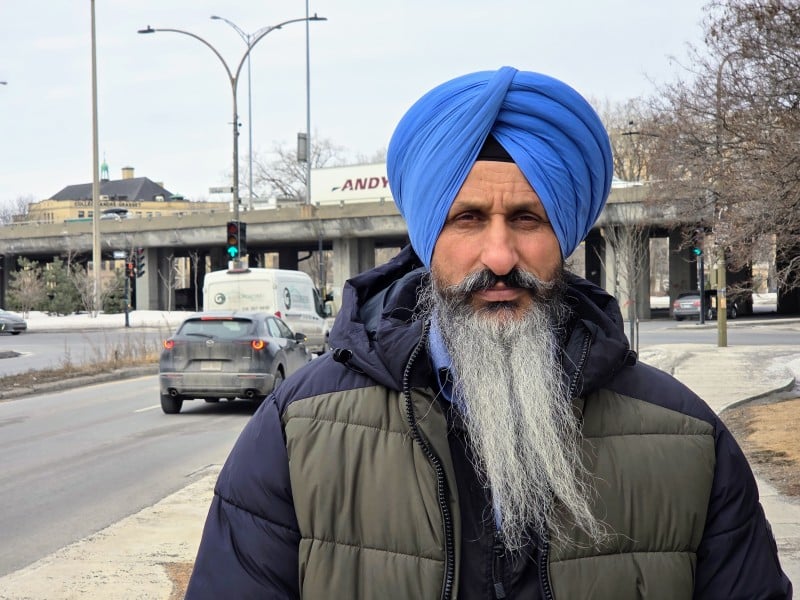
Le refus de l’asile à Ranjit Singh
Militant pour le mouvement indépendantiste sikh de l’État du Pendjab, au nord de l’Inde, Ranjit Singh fuit les persécutions policières pour trouver refuge au Canada en 2019. Il y a deux semaines, sa demande d’asile est rejetée et sa déportation prévue le vendredi 6 mars 2026.
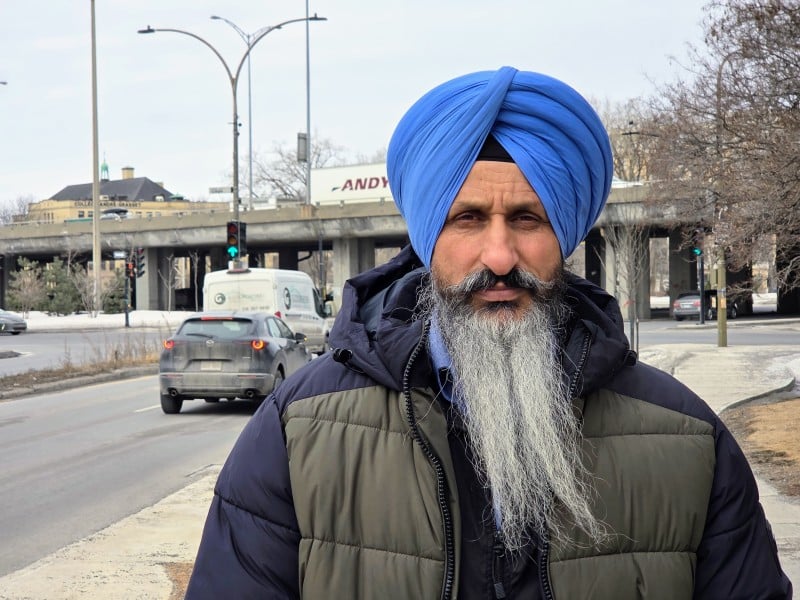
The Refusal of Asylum to Ranjit Singh
An activist for the Sikh independence movement in the state of Punjab, Ranjit Singh fled police persecution to seek refuge in Canada in 2019. Two weeks ago, his asylum application was rejected, his deportation scheduled for March 6.
Faced with a ‘Time Bomb Budget,’ the STM Turns to Real Estate for Revenue
Montreal’s transit body wants more money for crumbling infrastructure, continues negotiations with maintenance workers.
The vindictiveness and cancel culture is getting out of hand. Those who publicly empathize with the situation of Palestinians are at risk of being cancelled, having their businesses targeted and career prospects sabotaged. I have seen it first hand. It’s gross.
This “article” is an absolute crock. Stupid antisemites are stupid by choice. They shouldn’t receive death-threats, but also shouldn’t be employable as a result of their dumbarse decisions.