
“Don’t Come Here to Live”
Race, memory, and conditional belonging in Quebec.
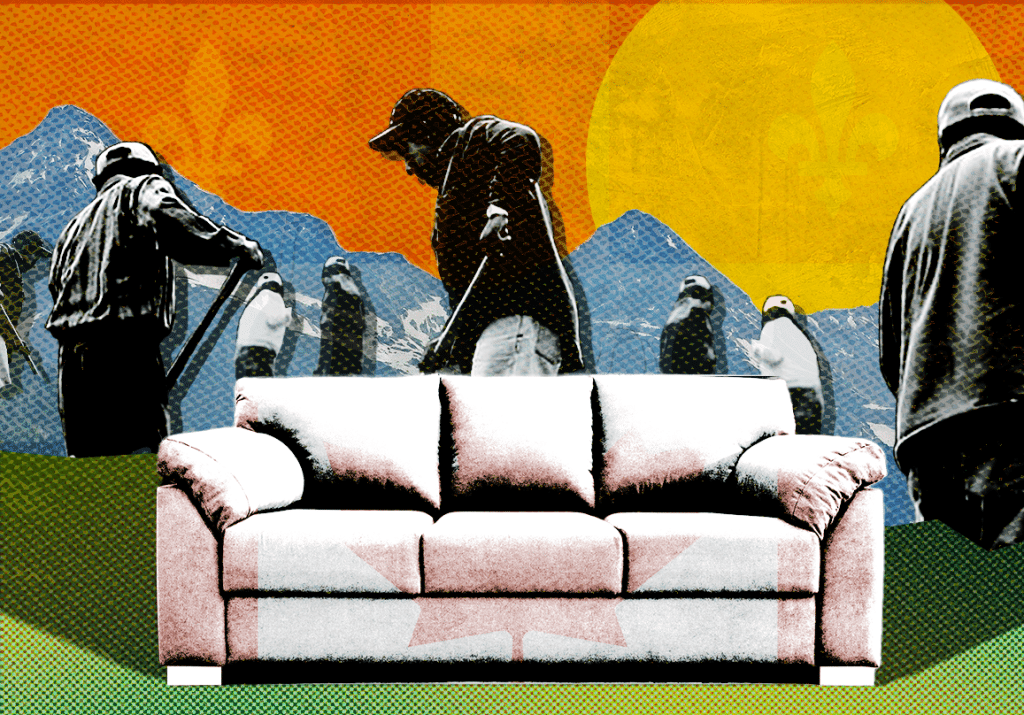
“Don’t come here to live. If you want to come, visit — but don’t come to live.”
That’s what my grandmother told me when I asked her what advice she’d give to new migrants thinking of settling in Quebec.
We were in her living room, the only one I’ve ever known, sitting on her new couch. Not the burgundy one I grew up with, the one softened by family, of Sunday dinners, of CTV News humming in the background. Curling up next to my grandfather, belly full of rice and peas and chicken. That couch made space for us. It held stories. This new cream-coloured one was quiet, like it’s waiting for someone else. The kind you sit on politely, not sprawl across.
Maybe that’s what Quebec is to me now — not the burgundy couch I grew up on, but the kind you sit on politely. The one that doesn’t invite you to stay. The one that reminds you you’re a guest, no matter how long you’ve been in the room.
Support your local indie journalists
So I asked my grandmother what seemed a simple question, though everything in me knew it wasn’t:
“Do you feel like you belong here?”
She’s been in Quebec for over 50 years, but her accent is still as Vincentian as ever. Her heart, too. When she says “home,” she means Saint Vincent. Quebec was never home and still isn’t.
That’s a truth of the immigrant experience: being asked for loyalty by a place that never offers belonging. And for me, born here, raised here, loved here, it still feels conditional.
My grandmother came to Quebec through the West Indian Domestic Scheme, a government program that sounded helpful but was rooted in exploitation. From 1955 to 1967, over 3,000 Caribbean women were brought in as live-in domestic workers. Promised a pathway to residency, they feared deportation if they left their jobs early. The working hours, long. The pay, low. Their lives, isolated.
My grandmother took mandatory night classes for newcomers to Canada at the YMCA after a full day of work. She remembers learning how to prepare for the cold and how her new job worked. The rest included teachings about Canada’s culture, social norms, and language. Or, how to shrink yourself to fit into white Canada.
Canada’s reliance on racialized labour has always been a part of its history and hasn’t ended since my grandmother’s arrival. Today’s Seasonal Agricultural and Temporary Foreign Worker Programs continue to bring in workers from the Caribbean, Mexico, and beyond. They pick Canada’s fruit and care for its elders, but remain on society’s margins. The cycle continues: different faces, same exploitation.
And yet, we’re told to “Buy Canadian.” As if buying apples grown in Quebec means supporting Quebecers. But the people who produce that food, the ones who make the “Buy Canadian” label possible, aren’t seen as Canadian at all.
This is what belonging looks like here. Whether born here or not, people of colour are expected to labour, not lead. To serve, but not make a home.
In the early 1900s, West Indian men were recruited to work as railway porters. They were chosen deliberately — not too dark, not too light, ideally with Southern accents. The goal wasn’t inclusion. It was about control and creating a facade of Canada’s diversity and inclusion. Keeping its status as a “safe haven.”
Canada still curates its diversity, deciding who gets to be seen and who doesn’t.
I used to think Quebec was diverse. Growing up, my friends came from everywhere. We shared our cultures and enjoyed learning about new ones. We talked about music, TV, and whether our homework answers were right. We didn’t necessarily belong anywhere, but somehow, we belonged to each other. That felt like enough.
I thought that was Quebec.
But as I got older, the rooms got whiter. And the silence got louder.
Quebec’s diversity had a ceiling. Eventually, the unspoken rules show up.
Rules about names. About accents. About who you can love, and what you can wear. Rules about how much of yourself you’re allowed to keep when you arrive here.
Even as a child, I was being prepped for that erasure.
My mother wanted to name me Shakiya. Her white family told her not to. They said it was too different, said kids would throw rocks at me. They suggested safer names, ones that sounded more palatable to Eurocentric norms. They knew Quebec would not take kindly to someone who already ticked too many of the “Other” boxes.
My mother gave me a more palatable first name and made Shakiya my middle name, but Shakiya is the only name she’s ever called me.
I carry it like a flag. Loud and soft and mine. And this place has always tried to fold it small.
I’ve always gone by Shakiya, but when I got older, especially in school, I started using my legal first name. Not by choice, but because it made things easier than having to explain that I go by my second name. People didn’t mispronounce my first name as much. It rolled off their tongues more comfortably. But it never felt like me. It felt like a placeholder — something to smooth over others’ discomfort, to make me more acceptable on paper, but not more understood.
That’s the thing about Quebec: it’s rarely the big moments that cut the deepest. It’s the little ones.
My mother is white, adopted into a Jewish family. My father is Black, a first-generation Canadian with roots in Saint Vincent. And I’m somewhere in the middle, visibly different from either side of my family. People squint when they look at me with either of my parents, trying to calculate how I fit in.
Who is she to you? Did you adopt her? Is that one your daughter?
At airports and border crossings, I was watched more closely. Not because of what I did, but because of how I looked, especially in contrast to who I was standing next to. It didn’t matter that I was a child. The questions still came.
Small things, maybe. But they pile up. And after a while, they start to feel like proof — proof that no matter how long you’ve been here, people still need convincing that you belong.
At some point, I realized it wasn’t just a feeling. It was systemic. It was law.
Take Bill 101, for instance. Designed to protect the French language in Quebec. In theory, I get it. But in practice, it’s always been about control, about who gets to be accepted and who must conform.
For decades, immigrants and their children, especially those who weren’t white or Catholic, were excluded from French schools. Families like mine were pushed into the English system. My grandmother didn’t speak French. Neither did my parents. I was taught minimal French in my English school, with little support. My parents couldn’t help with homework. I figured it out on my own.
Now, we’re told English is the problem. To belong here, we must assimilate into a Francophone identity we were never fully invited into.
And the silent exclusion still happens here today. Quebec has slashed funding for the very programs that help newcomers learn French. Hundreds of courses have been cancelled. Teachers have lost their jobs. Students are on waitlists for classes that may never resume. The government expects fluency, but immigrants are denied the tools to succeed. It’s a setup for exclusion. A refusal masked as a requirement.
You can’t bar people from access for generations and then blame them for not fitting in. That’s not preservation. It’s gaslighting.
During the 1995 referendum — a vote on whether Quebec should become independent from Canada — parts of my family left. Some of my Jewish relatives moved to Toronto. So did some on my Caribbean side. Not because they didn’t like living in Quebec, but because they weren’t sure Quebec wanted them to.
It wasn’t just about sovereignty. It was about fear, of what a Quebec “for Quebecers” might mean, and who that included.
This province has never been afraid to lose people. Especially not people like us. Quebec nationalism builds pride on the backs of people it refuses to embrace.
As I got older, I became more exposed to microaggressions.
I was followed in stores. I smiled often to seem safe. Performed my movements like I was onstage.
People touched my hair without asking. Is it real? Is it all yours? It’s beautiful. All said while their fingers tap my scalp like I’m a piece of material to explore and not a human whose space should be respected.
When I say I’m from Montreal, they ask again: No, but where are you really from?
The tiny cuts. Again and again. Until your body flinches before your mind does. Until you’re planning your smile before they speak.
Quebec says it doesn’t see race. But my race has always been the first thing to be commented on.
When I asked my grandmother if things had changed since she first arrived here, she didn’t mention the racism. She talked about bus drivers and how they used to be kinder, about the food being cheaper, and the streets being cleaner.
That was her way of saying “Everything.”
Her silence wasn’t an oversight. It was survival. It was intentional.
So I’ll speak of it for her. I’ve seen doctors ignore her pain. People pretend not to understand her accent, though she’s perfectly clear. I’ve seen people stay seated or give their seat to other people, while she stood on a bus. She never makes a fuss. But I noticed. And it still happens.
That’s racism, too. Just in softer tones. In tones our eyes don’t see unless we are trained to.
I may have inherited her silence, but I’ve also inherited the responsibility to speak. I refuse to keep swallowing harm just to make others feel at ease.
Quebec funds police that cracks down on the Black community but won’t fund things like Carifiesta, Montreal’s annual Caribbean carnival. No funding for the joy of those whose labour built this province.
I remember the summers we’d go downtown to watch the dancers, the steel pans, the flags in the sun. For a moment, Montreal felt like the Caribbean. Alive. Unapologetic. Uncontained. The glitter, the costumes, the music, the dancing — it was a taste of home. And it belonged here.
But year after year, they find ways to defund it. Canada has always rationed us. Whether it be our joy, our culture, or even our right to survive.
Canada once said “none is too many,” when asked how many Jewish refugees to accept during the Holocaust — a phrase attributed to Frederick Blair, then director of Immigration. Fewer than 5,000 Jewish refugees were admitted between 1933 and 1945.
In May 2024, after mounting pressure from activists, Quebec raised its intake of Palestinian refugees, who are suffering hourly under an ongoing genocide, from 1,000 to 5,000 people. Still a rationed number. Still a reluctant response. Still a country calculating lives. Refugees from Sudan, Congo, and elsewhere face the same barriers, turned away for reasons Canada claims are justifiable.
Because no matter how long we’ve been here, how fluent, how grateful, we’re still seen as “Other.” Not just different. Dispensable.
It’s hard to feel like I belong when every part of me, Black, Caribbean, Jewish, English-speaking, has been commodified, surveilled, or erased at some point in this province’s history. How can I feel like I belong in a place that only brought my family here through colonization?
And then there’s also this truth I can’t let go of:
Quebec is not a sacred identity. It’s a manufactured one, built on white supremacy, capitalism, and colonization. A name laid over stolen land. A couch we’re asked to sit on politely, but never stretch out on. Never rest. Never feel at home.
Why would I want to belong to that? Why would I want to live in a place that never wants me to get comfortable?
Because I know what came before. This land had names before Quebec. It had Indigenous caretakers, still does, whose land was taken, renamed, and occupied – by people who still refuse to fully acknowledge the harm that made their lives possible here.
And maybe because I love Montreal. For all its contradictions, for all its wounds, it has held me. It’s where my family is. It’s where my community is. I still believe in the version of this place that felt possible when I was younger, even if it was a myth.
So no, I don’t share my grandmother’s sentiment — not exactly. She said, “Don’t come here to live.” I understand why she said it. I won’t offer the invitation either. What I can say is this: a lot of us are still here. We are still trying to make this place feel like home. Not because it has always made room for us, but because we know we deserve to belong. To find one another. To build something that moves us closer to liberation. Resistance is not just survival. It is a way of refusing to be erased.
With that being said, if you come, come with care. Come knowing that a lot of us are here. Belonging, remembering, resisting. Just trying to stretch our legs a little. Curling up beside our loved ones, when we can. Maybe even trying to make this place feel just a little bit like home.
Did you like this article? Share it with a friend!
Author

Comments (2)
Leave a comment
Related Articles
Ramadan in Gaza: The Month of Mercy Amid the Rubble
Since the start of the Israeli genocide, Palestinians across the Gaza Strip have struggled to rekindle the spirit of Ramadan.
Parlons de violence étatique
En 2026, les prestations d’assistance sociale demeurent largement inférieures au minimum reconnu pour vivre au Québec.

Is Israel Preparing a Legal Framework to Execute Palestinian Prisoners?
Since October 7, 2023, prison conditions for Palestinian detainees have seriously deteriorated.
Even when you are white, you will always be an immigrant. Be it because of an accent, the way you dress, the way you carry yourself, etc.
Beautifully written
Thank you for articulating what isn’t so deeply felt in silence