
Editor’s Note: Breaking into Longform Video
The making of our first documentary, Palestine on Campus.
It was 2023 when Chris and I first started talking about creating long-form video content.
Two print journalists, members of the Moby Dick Club (we write long), we knew that our 3,000+ word articles did not have a growing interested reader base, but a declining one. “Nobody reads anymore,” I’ve decried numerous times, ignoring the fact that even I barely read anymore. Most of the news I consume nowadays is in video or podcast form, and I get it done while I’m making my breakfast or folding the laundry to save time.
Consumer trends have been pointing in the same direction for years now: while interest in traditional forms of news declines every year, the number of people using social media and video platforms to stay informed keeps rising.
We saw longform video, and by that I mean mini-docs exceeding 10 minutes in length, as a natural progression for the kind of work that we do into a format that is in higher demand, especially from the elusive Generation Z.
Fast-forward two years, and that vision came to fruition: last month we published our first documentary, a 30-minute deep dive into pro-Palestinian mobilization at Montreal’s English post-secondary schools.
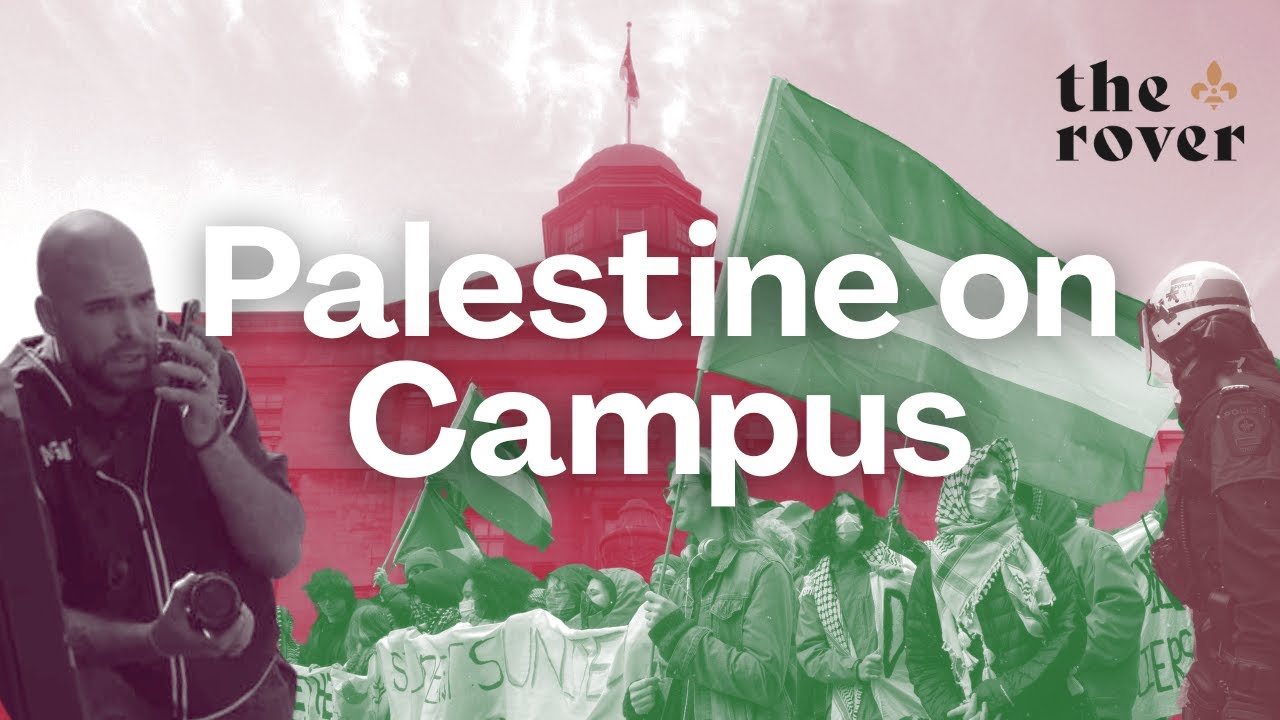
Palestine on Campus: the origin story
It all started with an emailed portfolio from one Justin Khan sent to Chris.
What won us over were the two concept pieces Justin sent. He took some of the videos from our now-defunct news podcast, The Midnight Choir (all episodes are still up on our YouTube channel for anyone curious) and re-edited them, using the colours from our website to repackage the podcast excerpts with a more professional look. He clearly understood the vibe we were going for, so we set up a meeting to talk about collaboration.
At that meeting, sometime in March 2025, the three of us exchanged ideas for potential videos, one of them being a look at the pro-Palestinian student movement’s actions during the school year. We realized that since the McGill encampment came down, student activism had barely made it into the news, but mobilization was by no means slowing down. The idea for the video was simple: what has the movement been up to?
Justin felt comfortable handling all the audiovisual elements of putting together a video, but he wasn’t keen on being the one on camera asking the questions — at least, not yet. Since Chris always has several stories on the go and I’ve been missing being out in the field, I volunteered to join Justin on the project.
We set off with the goal of creating a five- to seven-minute video recounting student mobilization efforts at McGill and Concordia. As it turns out, a lot had gone down on campus this past school year. Links could be drawn between events at different campuses, involving similar actors. Patterns emerged as we made our way through over a dozen interviews. With each one, we wanted to keep going deeper. Our original plan to limit ourselves to five to seven minutes fell by the wayside — there was just too much to get into.
Support your local indie reporters!
At some point, Chris started referring to our project as a documentary, but it was only when the first draft came in at 27 minutes in length that I began to see it that way. A documentary. It sounded so ambitious.
The draft stage was when we brought Chris in on the work we’d been doing for months. We blew past the original early-June deadline that we had set for ourselves as Chris encouraged us to make it even bigger, to better situate the viewer in space and in context. The project kept growing.
With each draft, my anxiety grew, too, worried that some major development would happen and would render all the work we’d done meaningless. Waiting till the new school year in September meant accepting that the situation could change so significantly that the entire premise of the documentary would be moot. I didn’t like the idea of publishing in the middle of the summer, but we’d put so much work into making a quality product, it wouldn’t have been right to abandon that effort and rush to release it.
It was live on July 26, on a Saturday morning — a Saturday Special, we call those here at The Rover. It did feel very special to me.
What we learned
The great thing about having put together the documentary is that now we know that it’s even possible.
We know how long everything takes (always longer than you think). We know that Justin and I work well together, that he’s way more talented and capable than he gives himself credit for. And we know there’s an interest in the medium, based on the effusive feedback we’ve received.
We were, in a very real sense, building the plane as we were flying it. Neither Justin nor I — nor Chris, for that matter — had ever taken on something of this magnitude in video format. For just about every aspect of production, from filming the interviews to selecting clips, structuring the video, and preparing all the visuals and voice-overs to accompany it, we seemed to find the best way to approach things by the time we reached the end of the task.
We almost certainly could have made this project come together more quickly, if it hadn’t been the first time ever doing this.
The big lesson for me was that choosing to cover something related to an extremely fluid, rapidly evolving crisis brought about significantly more stress than if we’d been working behind the scenes on an enterprise investigation that’s not already dominating the headlines. Granted, the original plan was not to take so long and go so goddamn in-depth, but we probably should have foreseen what a can of worms we were opening by virtue of the subject matter.
The reality of The Rover is that we will almost never be able to respond to big or breaking news as it happens. There’s no point trying to beat the big media organizations at their own game when they are considerably better funded and staffed. For those kinds of stories, our job is to show up just as the daily reporters have filed their stories, and stay there after they’ve been put on the next assignment. Stay there and make sense of the mess that’s left behind as the world moves on to another breaking news story. And only once we’ve made sense of it, report what we find.
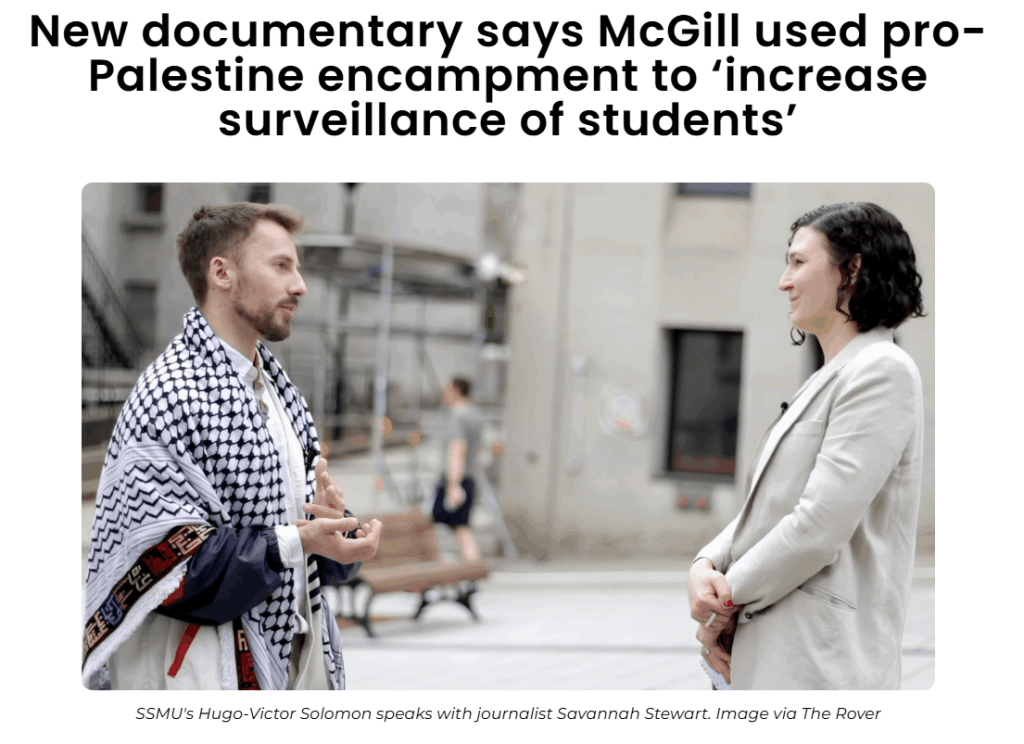
I have to wonder, if we didn’t do this deep dive into the pro-Palestinian student movement in Montreal, laying bare multiple avenues of repression from several groups and organizations, from lawfare to investigations to surveillance of students, who would have done it?
The privilege to do our job
While writing this column, the Israeli Defense Forces killed four Al-Jazeera journalists and two independent journalists with a single blast to a media tent in Gaza City. The photos of the airstrike’s damage show reporter Anas al-Sharif and his colleagues, their bodies bloodied and battered, wearing the press vests meant to protect them and mark them clearly as journalists — civilians.
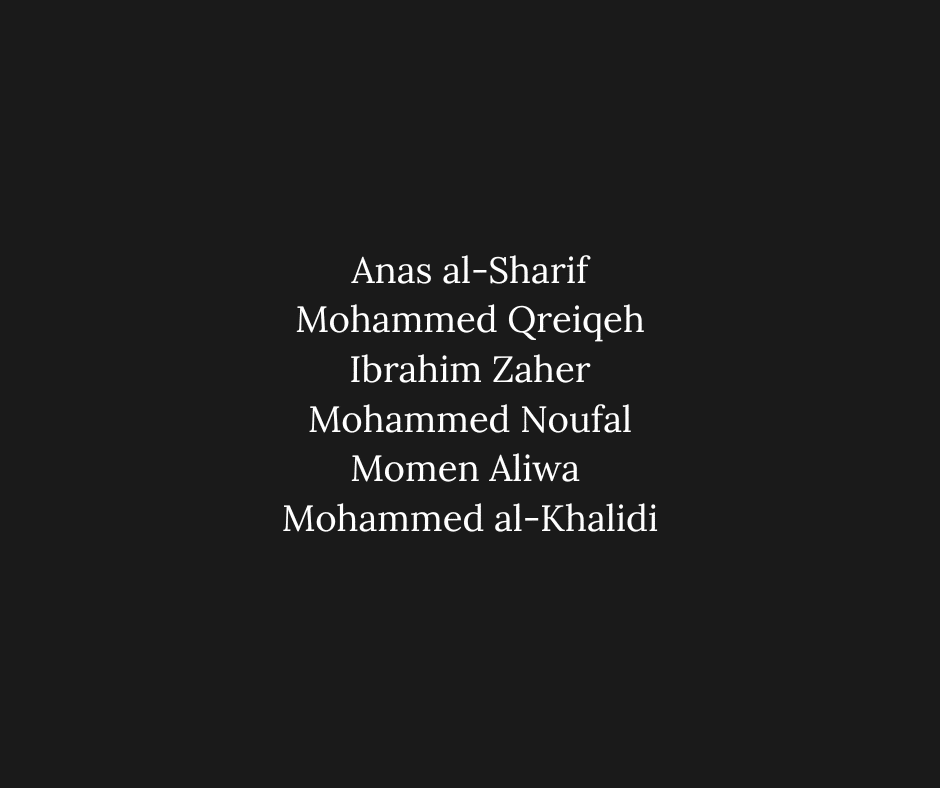
Targeting a journalist, like targeting any civilian in an armed conflict, is a war crime under the Geneva Conventions. It’s also an attack on press freedom everywhere. That’s why we frequently see Israeli officials accuse Palestinian journalists of being terrorists in the lead-up to their killings, just like it did with al-Sharif. Manufacturing consent, which outlets like the National Post gladly facilitate.
The day after their killings, my mind kept wandering back to them as I worked in the comfort of my air-conditioned home office. How privileged I am to do the job that I love free from the threat of death.
Al-Sharif was one year younger than me, 28. A whole future snuffed out in a flash. He’ll never live to be my age, because he was born on the wrong side of an imaginary line. My privilege feels boundless right now. His fate, their fates, unspeakably cruel.
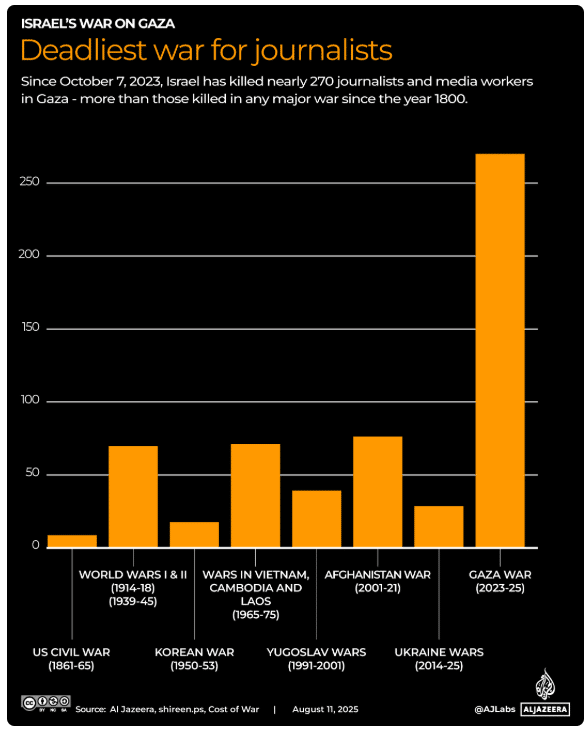
Over 240 journalists have been killed in Gaza since Oct. 7. Even an ocean away, these were my colleagues. These were parents, sons, daughters. I hurt for every civilian killed, but there’s something about the journalists murdered in their press vests that gets to me particularly hard. Murdered for bearing witness to the destruction brought down on their people, for broadcasting it out for the world to know.
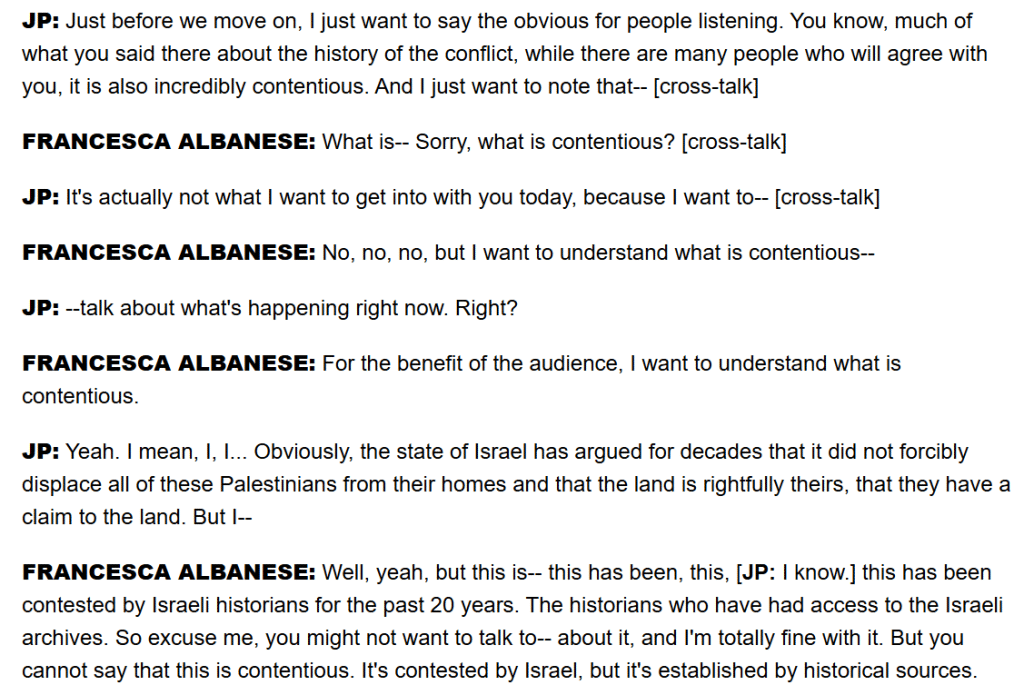
Late last year, CBC’s daily news podcast Front Burner released an interview with Francesca Albanese, UN special rapporteur on the Occupied Palestinian Territories. It was a stunning example of the journalistic failings that result from simply contrasting the talking points of the two sides for the sake of “objectivity” rather than actually assessing the context and reality on the ground.
For each of Albanese’s statements about Israel’s actions in Gaza, CBC’s Jayme Poisson countered with the Israeli government’s denial of its responsibility. I waited for the caveat that should follow this attention given to Israel’s denials, if the point of the segment is to inform people of the context and not simply to avoid the ire of organizations like HonestReporting Canada.
The caveat — that Israel contests many things that are not contested by anyone else, which should lead any serious journalist to reconsider its credibility as a source — came from Albanese, not from Poisson, the journalist in the room.
Last Thursday, the Front Burner episode was about the targeted killing of journalists in Gaza, pointing out the issues with Israel’s claims that journalists like Al-Sharif were affiliated with Hamas. The interviewee, Sharif Kouddous of The Dropsite, even decried the abject failure of many Western media institutions for failing to go beyond the talking points.
“There’s an old story about how to do journalism. If you’re sitting in a room and two people are arguing about the weather, and one person is saying it’s raining outside and the other person says it’s not, the job of the journalist is not to print those two statements. The job of the journalist is to look out the window and then expose the one that’s lying.”
I thought back to the cringeworthy Albanese interview, just a few months before, on the very same podcast. The contentment with the parroting of statements and denials, no effort made to sift out any real meaning from them.
On Israel and its campaign of war and destruction in Gaza, too many journalists have neglected their duties to accuracy and fairness. It’s easy to do that when you’re not the one under gunfire — it’s our colleagues in Gaza who pay the ultimate price for the spinelessness of these journalists.
I’ll include one more excerpt from Kouddous’ interview, because it resonates particularly strongly here at The Rover:
“A lot of journalists in these (mainstream) institutions pride themselves on being quote-unquote ‘objective,’ they look down on a lot of independent media outlets, saying that they’re ‘activist-journalists’ — I’m not sure what that means but I know they mean it as a slur, that they’re somehow biased in their coverage. But I can’t think of more bias than has swallowed the establishment orthodoxy, that they can’t see it anymore, it’s like what water is to fish.”
Did you like this column? Share it with a friend!
Author
Related Articles
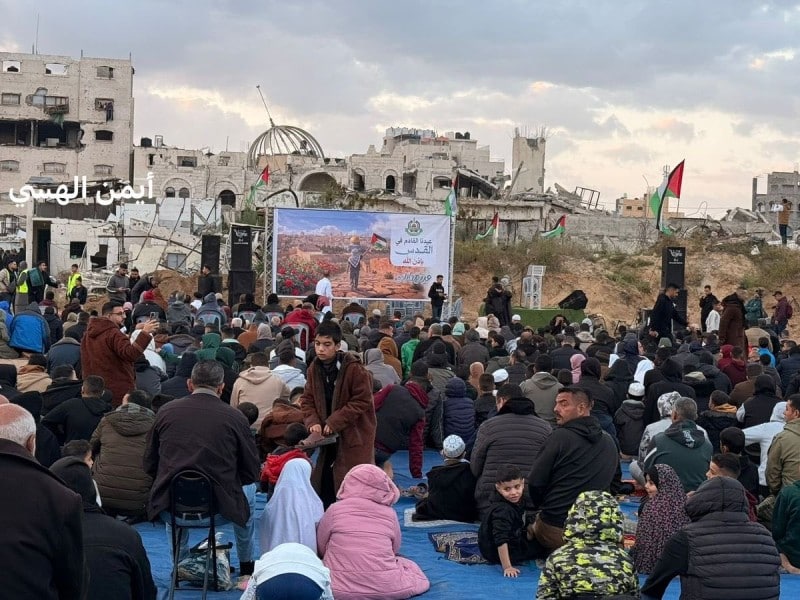
Eid in Gaza: Solidarity in the Face of Deprivation
The people of Gaza continue to help one another, sharing what little they have despite their own sorrow.
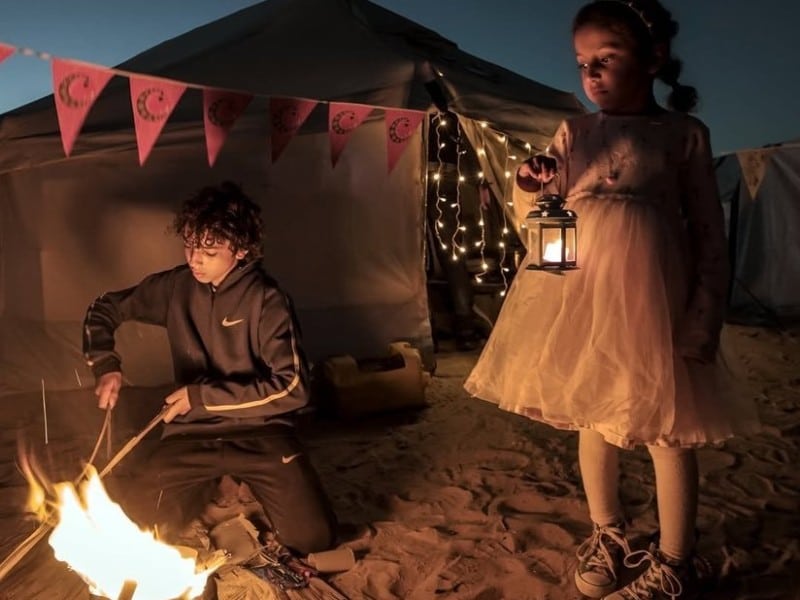
Ramadan in Gaza: The Month of Mercy Amid the Rubble
Since the start of the Israeli genocide, Palestinians across the Gaza Strip have struggled to rekindle the spirit of Ramadan.
Parlons de violence étatique
En 2026, les prestations d’assistance sociale demeurent largement inférieures au minimum reconnu pour vivre au Québec.
Comments (0)
There are no comments on this article.